
PUBLISHER: Mordor Intelligence | PRODUCT CODE: 2097173

PUBLISHER: Mordor Intelligence | PRODUCT CODE: 2097173
Italy Bottled Water - Market Share Analysis, Industry Trends & Statistics, Growth Forecasts (2026 - 2031)
According to Mordor Intelligence, the Italy bottled water market size is expected to grow from USD 8.6 billion in 2025 to USD 9.04 billion in 2026 and is forecast to reach USD 11.58 billion by 2031 at 5.08% CAGR over 2026-2031.
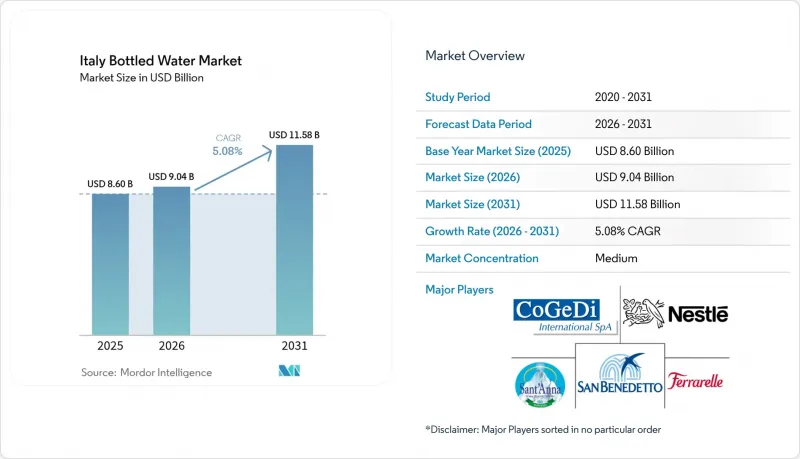
This report is Segmented by Product Type (Still Mineral Water, Carbonated/Sparkling Water, Flavoured Bottled Water, Functional Bottled Water), Distribution Channel (On-Trade, Off-Trade), Packaging Material (Plastic Bottles (PET), Glass Bottles, Cans, Others), and Geography (Italy). The Market Forecasts are Provided in Terms of Value (USD).
Italy Bottled Water Market Trends and Insights
Growth in Foodservice Expenditure & Tourism Sector
Italy's hospitality sector recovery post-COVID drives substantial demand for bottled water across restaurants, hotels, and bars, with the on-trade channel demonstrating 5.79% CAGR through 2030. Tourism's resurgence particularly benefits premium water brands positioned in high-end establishments, as international visitors expect consistent quality standards. The sector's expansion creates multiplier effects throughout the value chain, from distribution logistics to packaging requirements. MARR S.p.A., a leading foodservice distributor, reported EUR 1,610.5 million in consolidated revenues for the first nine months of 2024, though it noted challenges in the commercial catering segment due to evolving product mix dynamics. The foodservice channel's recovery trajectory suggests sustained momentum as Italy's tourism infrastructure continues to modernize and expand capacity.
Premiumization Through Fortified & Flavored Water
Consumer willingness to pay premium prices for enhanced water products drives the functional bottled water demand, outpacing traditional mineral water growth. This trend reflects broader health consciousness and the desire for products delivering specific wellness benefits beyond basic hydration. Sanpellegrino's launch of the Ciao line of flavored sparkling waters in 2025, featuring four flavors with 10 calories or fewer and no added sugars, exemplifies this premiumization strategy. The segment's growth potential remains substantial as manufacturers develop increasingly sophisticated formulations targeting specific health outcomes. Regulatory frameworks governing functional claims create barriers to entry that protect established players while rewarding innovation investments.
Plastic-Waste Backlash & Shift Toward Tap Water
Environmental consciousness drives increasing consumer resistance to single-use plastic bottles, with Milan's municipal government actively promoting tap water consumption through extensive public fountain networks and educational campaigns. Despite Italy's tap water achieving 99.1% compliance rates for safety parameters, cultural preferences for bottled water persist, though younger demographics show greater willingness to embrace alternatives. The backlash intensifies as environmental awareness campaigns highlight the contradiction between Italy's excellent tap water quality and excessive bottled water consumption. Companies respond through accelerated sustainability initiatives, including increased recycled content and alternative packaging formats, though these solutions require substantial capital investments and may not fully address consumer concerns.
Other drivers and restraints analyzed in the detailed report include:
- Rising Health Consciousness & Sugar-Reduction Initiatives
- Blockchain-Enabled Source Transparency Adoption
- Stricter EU Single-Use-Plastic Regulations
For complete list of drivers and restraints, kindly check the Table Of Contents.
Segment Analysis
Still mineral water contributed 62.30% of 2025 category revenues, underlining the cultural affinity for minimally processed spring sources anchoring the Italian bottled water market. Leading brands accentuate terroir narratives and low-sodium claims to protect positions even as growth moderates. Functional products, by contrast, are forecast to post the fastest gains at 7.27% CAGR. These fortified lines elevate perceived value by delivering vitamins, collagen, or electrolyte blends, widening price gaps and sustaining premium shelf placement. Ferrarelle's Vitasnella campaigns underscore detox benefits and sparkling variants that attract image-conscious consumers [ENGAGE.IT]. The Italy bottled water industry exploits this wellness wave by investing in scientific validation and targeted advertising across social media platforms.
Volume acceleration also reflects regulatory tailwinds because fortified waters remain exempt from the forthcoming sugar levy, encouraging retailers to allocate prime space. As formulations grow more sophisticated, makers emphasize natural extracts and clean labels to satisfy EU health-claim rules. Blockchain authentication tools further bolster credibility, ensuring that the Italy bottled water market maintains consumer confidence while charging premium margins.
Complete Report Scope:
- By Product Type
- Still Mineral Water
- Carbonated/Sparkling Water
- Flavoured Bottled water
- Functional Bottled Water
- By Distribution Channel
- On-Trade
- Off-Trade
- Supermarkets / Hypermarkets
- Convenience Stores
- Online Retail
- Others
- By packaging Material
- Plastic Bottles (PET)
- Glass Bottles
- Cans
- Others (Pouches, Cartons)
List of Companies Covered in this Report:
- Nestle S.P.A (Sanpellegrino, Levissima)
- Acqua Minerale San Benedetto S.p.A
- Ferrarelle S.p.A
- Fonti di Vinadio S.p.A
- CoGeDi S.p.A (Uliveto & Rocchetta)
- Acqua Lete S.p.A
- Lauretana S.p.A
- Refresco Group B.V (Spumador)
- Acqua Panna S.r.l
- Norda S.p.A
- Maniva S.p.A
- Dolomia S.r.l
- Fonte Essenziale S.p.A
- Vitasnella (Ferrarelle Group)
- Acqua Fiuggi S.p.A
- Sole S.p.A
- Santagata Acque Minerali
- Azzurra & In Bosco
- Acqua Eva
- Sorgesana (Acqua Lete Group)
Additional Benefits:
- The market estimate (ME) sheet in Excel format
- 3 months of analyst support
TABLE OF CONTENTS
1 Introduction
- 1.1 Study Assumptions and Market Definition
- 1.2 Scope of the Study
2 Research Methodology
3 Executive Summary
4 Market Landscape
- 4.1 Market Overview
- 4.2 Market Drivers
- 4.2.1 Growth in foodservice expenditure & tourism sector
- 4.2.2 Premiumization through fortified & flavoured water
- 4.2.3 Rising health consciousness & sugar-reduction initiatives
- 4.2.4 Blockchain-enabled source transparency adoption
- 4.2.5 Surge in refill-on-the-go retail kiosks boosting brand visibility
- 4.2.6 Roll-out of tethered caps and smart labels to comply with EU Single-Use-Plastic (SUP) Directive and create new consumer-engagement touchpoints
- 4.3 Market Restraints
- 4.3.1 Plastic-waste backlash & shift toward tap water
- 4.3.2 Stricter EU single-use-plastic regulations
- 4.3.3 Margin pressure from private-label expansion
- 4.3.4 Rapid uptake of domestic micro-filtered dispensers
- 4.4 Value / Supply-Chain Analysis
- 4.5 Regulatory Landscape
- 4.6 Technological Outlook
- 4.7 Porter's Five Forces
- 4.7.1 Threat of New Entrants
- 4.7.2 Bargaining Power of Buyers/Consumers
- 4.7.3 Bargaining Power of Suppliers
- 4.7.4 Threat of Substitute Products
- 4.7.5 Intensity of Competitive Rivalry
5 Market Size and Growth Forecasts
- 5.1 By Product Type
- 5.1.1 Still Mineral Water
- 5.1.2 Carbonated/Sparkling Water
- 5.1.3 Flavoured Bottled water
- 5.1.4 Functional Bottled Water
- 5.2 By Distribution Channel
- 5.2.1 On-Trade
- 5.2.2 Off-Trade
- 5.2.2.1 Supermarkets / Hypermarkets
- 5.2.2.2 Convenience Stores
- 5.2.2.3 Online Retail
- 5.2.2.4 Others
- 5.3 By packaging Material
- 5.3.1 Plastic Bottles (PET)
- 5.3.2 Glass Bottles
- 5.3.3 Cans
- 5.3.4 Others (Pouches, Cartons)
6 Competitive Landscape
- 6.1 Market Concentration
- 6.2 Strategic Moves
- 6.3 Market Share Analysis
- 6.4 Company Profiles (includes Global level Overview, Market level overview, Core Segments, Financials as available, Strategic Information, Market Rank/Share for key companies, Products & Services, and Recent Developments)
- 6.4.1 Nestle S.P.A (Sanpellegrino, Levissima)
- 6.4.2 Acqua Minerale San Benedetto S.p.A
- 6.4.3 Ferrarelle S.p.A
- 6.4.4 Fonti di Vinadio S.p.A
- 6.4.5 CoGeDi S.p.A (Uliveto & Rocchetta)
- 6.4.6 Acqua Lete S.p.A
- 6.4.7 Lauretana S.p.A
- 6.4.8 Refresco Group B.V (Spumador)
- 6.4.9 Acqua Panna S.r.l
- 6.4.10 Norda S.p.A
- 6.4.11 Maniva S.p.A
- 6.4.12 Dolomia S.r.l
- 6.4.13 Fonte Essenziale S.p.A
- 6.4.14 Vitasnella (Ferrarelle Group)
- 6.4.15 Acqua Fiuggi S.p.A
- 6.4.16 Sole S.p.A
- 6.4.17 Santagata Acque Minerali
- 6.4.18 Azzurra & In Bosco
- 6.4.19 Acqua Eva
- 6.4.20 Sorgesana (Acqua Lete Group)
7 Market Opportunities and Future Outlook

