PUBLISHER: Mordor Intelligence | PRODUCT CODE: 2062056

PUBLISHER: Mordor Intelligence | PRODUCT CODE: 2062056
Airport Runway Safety Systems - Market Share Analysis, Industry Trends & Statistics, Growth Forecasts (2026 - 2031)
According to Mordor Intelligence, the airport runway safety systems market size is expected to grow from USD 2.62 billion in 2025 to USD 2.81 billion in 2026 and is forecast to reach USD 4.02 billion by 2031 at a 7.42% CAGR over 2026-2031.
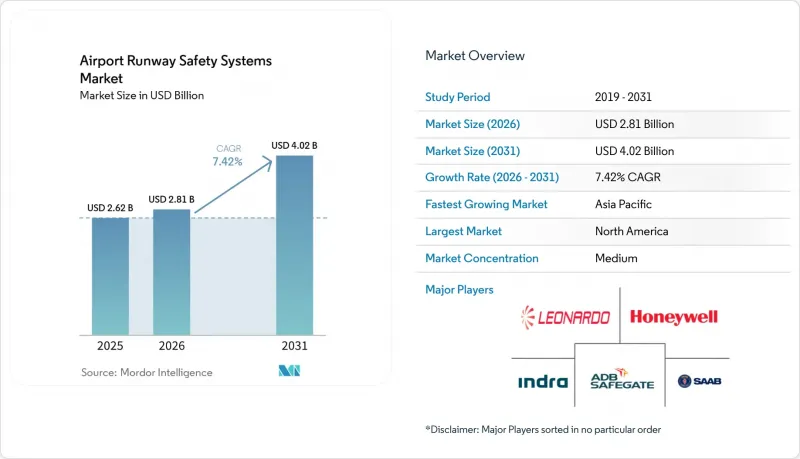
This report is Segmented by System Type (Runway Incursion Avoidance and Alerting Systems, Foreign Object Debris Detection Systems, and More), Technology (Radar, Lidar, and More), Installation (New Installation and Upgrade and Refurbishment), End User (Commercial Airports and Military Airports), and Geography (North America, Europe, and More). The Market Forecasts are Provided in Terms of Value (USD).
Global Airport Runway Safety Systems Market Trends and Insights
Rising Global Air Traffic and Runway Throughput Necessitating Safety Enhancements
Passenger volumes and operations growth sustain demand for layered surveillance, alerting, and cockpit situational awareness tools in the airport runway safety systems market. Airports Council International reported rising traffic in 2024, which is driving higher runway movement density and reinforcing the need for automated conflict detection paired with controller tools. FAA incident data underline how increased operations concentrate risk at busier surfaces, which supports investments in surface awareness and runway status logic. To maintain throughput, new runways and taxiway reconfigurations at major hubs require parallel upgrades to surface movement systems to keep separation standards intact under peak loads. The airport runway safety systems market also benefits from high-frequency training use cases, in which controllers and pilots depend on consistent alerting across varied weather and traffic conditions that exceed manual monitoring limits. This environment sustains a purchasing focus on systems that shorten detection-to-alert intervals and that integrate with tower tools and cockpit advisories without adding controller workload.
Stringent International Aviation Safety Regulations Driving System Adoption
Regulatory programs are compressing decision cycles as safety technology moves from discretionary purchases to mandated capability sets in the airport runway safety systems market. The FAA's plan to deploy runway incursion devices to 74 US airports by the end of 2026 shows how policy can set a definitive timeline for fielding surface awareness tools. ICAO has elevated runway incursion reduction in multilateral safety planning, underscoring the need to deploy surveillance and alerting capabilities that scale with traffic growth. This momentum benefits established vendors that can absorb certification overhead and align engineering artifacts with audit-ready documentation in the airport runway safety systems market. Operators also use these rule sets to justify reallocation of budget toward multi-sensor fusion platforms that deliver incident-prevention outcomes in regulated environments.
High Capital Investment Requirements and Uncertain ROI for Smaller Airports
Capital intensity and operating budget constraints make it harder for smaller airports to fund comprehensive surface movement and alerting systems. Even when hardware costs fall, program expenses still include integration, vehicle equipage, staff training, and cybersecurity, which stretch limited funds over several budget cycles. Cloud-native approaches, such as FAA-backed Surface Awareness Initiative deployments, can reduce upfront costs and installation time, helping more sites adopt surface situational awareness without large radar infrastructure. Cooperative ADS-B-based systems simplify installation and enable deployment within 90 days in towered environments, reducing scheduling complexity and service disruption risks. However, recurring fees and cyber compliance requirements pose challenges for smaller operators, who must prioritize revenue-generating initiatives over non-essential system upgrades. This dynamic encourages a modular approach where airports add capabilities in phases tied to operational profiles and seasonal peak patterns.
Other drivers and restraints analyzed in the detailed report include:
- Increased Deployment of Advanced Surface Movement and Surveillance Technologies
- Integration of AI and Data Analytics for Predictive Runway Risk Management
- Rising Cybersecurity Risks Associated with Digital Runway Safety Systems
For complete list of drivers and restraints, kindly check the Table Of Contents.
Segment Analysis
Runway incursion avoidance and alerting systems held the largest share of the airport runway safety systems market at 27.54% in 2025, supported by the FAA's push to add runway incursion devices and programs that enhance cockpit and tower situational awareness. The airport runway safety systems market continues to expand its alerting layer by using GPS and cooperative surveillance signals in cockpit and tower tools, thereby reducing reaction time during complex surface movements. Foreign object debris detection is the fastest-growing system type, with an 8.15% CAGR through 2031, reflecting operator demand for automated runway sweeps and high-confidence detection thresholds under low-visibility conditions. A growing share of deployments pairs fixed optical sensors with ML classification to pinpoint debris, dispatch crews, and log closure timelines for continuous improvement, which aligns with the airport runway safety systems market trend toward predictive field operations. Surface movement surveillance and guidance systems remain a core layer, while cloud-hosted variants shorten installation windows and simplify scaling across multi-airport networks.
Procurement choices now reflect lifecycle thinking with more airports seeking modular systems that integrate with lighting, markings, and vehicle tracking. Large hubs continue to upgrade their surveillance and safety logic, while mid-sized airports adopt ADS-B-based awareness to build toward full A-SMGCS capability over time. Standalone runway lighting and signage are being integrated into broader platforms so operators can adjust and verify configurations under automation rules that align with movement states. Arresting systems and pavement monitoring grow as runways expand and resurfacing cycles accelerate, with LiDAR and vision-based inspection adding measurable gains in inspection reliability. Across these categories, the airport runway safety systems market favors interoperable stacks that enable continuous improvement, with new data informing operating procedures and predictive maintenance after each event or sweep. This approach supports better on-time performance and incident prevention without overloading the controller or crew workflows.
Radar commanded 33.45% share of the technology mix in 2025, while LiDAR is projected to grow at 8.26% through 2031 as airports prioritize millimeter-grade surface awareness and adverse-weather reliability. The airport runway safety systems market has long relied on secondary surveillance radar for surface and approach monitoring, and next-generation units now handle high target volumes and multiple output streams to support complex traffic. LiDAR complements radar by detecting fine debris and surface anomalies at short range with high positional accuracy, which improves both FOD response and apron safety programs. Infrared and optical systems extend detection to night and low-visibility conditions, while AI models improve classification confidence for debris, wildlife, and ground equipment around the movement area. Cooperative ADS-B technologies are being fielded to expand surface situational awareness at towered airports that lack legacy radar coverage, with FAA programs demonstrating rapid deployment and controller usability. The result is an airport runway safety systems market that increasingly favors sensor fusion, where radar confirms targets at range while LiDAR and optical inputs resolve close-in hazards.
Integration priorities now include data fusion platforms that normalize feeds and apply safety logic in accordance with established operational concepts. Airports and ANSPs want technology choices that maintain performance under interference and cyber stress, while providing audit trails and maintenance diagnostics that simplify compliance. Vendors address these needs with modular components, redundant architectures, and cloud-enabled analytics that scale across multiple airports without the need for bespoke infrastructure. As AI models mature, edge processing on cameras and sensors reduces latency and network load, aligning with controller requirements for timely, trustworthy alerts. The airport runway safety systems market continues to converge sensing and analytics so operators can capture full lifecycle value from each data point, from hazard detection to post-incident review. This mix supports more effective safety assurance and shorter intervals between detection and mitigation.
Geography Analysis
North America maintained leadership with a 34.56% share in 2025, while Asia-Pacific is projected to grow at 8.21% through 2031, underscoring divergent regional maturity across the airport runway safety systems market. US programs that target runway incursion reduction and surface awareness upgrades point procurement toward rapid deployments that fill surveillance gaps at towered airports. Modernization contracts that replace older radars with solid-state units address reliability and maintenance risks at the busiest hubs. These moves pair with cockpit alerting systems that extend safety coverage and align flight crew awareness with tower advisories in the airport runway safety systems market. Together, they produce a layered protection model that scales with operational growth without increasing incident risk in proportion.
Asia-Pacific's forecast growth reflects network expansions and new runways that adopt integrated safety ecosystems during design. Program choices emphasize A-SMGCS routing and guidance, multi-sensor fusion, and data platforms that support predictive maintenance for airport runway safety systems. LiDAR and optical analytics complement radar in low-visibility conditions, which is important for all-weather operations at busy hubs. Cooperative surveillance fills deployment gaps and accelerates coverage for towered airports without legacy radar estates. Over time, these investments build a balanced stack in which automated detection and alerting help controllers maintain consistent response times during peak flows. Thus, the airport runway safety systems market expects faster growth in capabilities across Asia-Pacific's expanding networks.
Europe's trajectory is defined by stringent cyber and information security obligations that now shape solution architectures from the outset. The PART-IS regime requires risk assessments and supplier vetting, which influence integration timelines and the depth of documentation in the airport runway safety systems market. Hubs and networks maintain multi-technology approaches, pairing proven radar with ADS-B and optical sensing to achieve redundancy. Life cycle contracts with extended maintenance windows are common, reflecting a preference for measurable reliability gains and phased feature growth. Across the Middle East and other growth regions, greenfield projects often target turnkey systems with high levels of automation, which sets a high-specification baseline at opening. These approaches converge worldwide on the same objective: a unified surface picture that lowers incident probability through faster sensing and clearer alerts in the airport runway safety systems market.
- Saab AB
- Thales Group
- Leonardo S.p.A.
- Indra Sistemas S.A.
- Curtiss-Wright Corporation
- RTX Corporation
- ADB SAFEGATE
- L3Harris Technologies, Inc.
- NEC Group
- Varek, Inc (Leidos, Inc.)
- Lockheed Martin Corporation
- XSIGHT SYSTEMS LTD.
- Avlite Systems (Sealite Pty Ltd)
- Navtech Radar Limited (Halma plc)
- Frequentis AG
Additional Benefits:
- The market estimate (ME) sheet in Excel format
- 3 months of analyst support
TABLE OF CONTENTS
1 INTRODUCTION
- 1.1 Study Assumptions and Market Definition
- 1.2 Scope of the Study
2 RESEARCH METHODOLOGY
3 EXECUTIVE SUMMARY
4 MARKET LANDSCAPE
- 4.1 Market Overview
- 4.2 Market Drivers
- 4.2.1 Rising global air traffic and runway throughput necessitating safety enhancements
- 4.2.2 Stringent international aviation safety regulations driving system adoption
- 4.2.3 Acceleration of airport modernization and smart infrastructure initiatives
- 4.2.4 Increased deployment of advanced surface movement and surveillance technologies
- 4.2.5 Growing incidence of foreign object debris (FOD) events triggering demand for automated detection systems
- 4.2.6 Integration of AI and data analytics for predictive runway risk management
- 4.3 Market Restraints
- 4.3.1 High capital investment requirements and uncertain ROI for smaller airports
- 4.3.2 Integration challenges with aging airport infrastructure and legacy systems
- 4.3.3 Limited funding availability for regional and low-traffic airports
- 4.3.4 Rising cybersecurity risks associated with digital runway safety systems
- 4.4 Value Chain Analysis
- 4.5 Regulatory Landscape
- 4.6 Technological Outlook
- 4.7 Porter's Five Forces Analysis
- 4.7.1 Bargaining Power of Buyers
- 4.7.2 Bargaining Power of Suppliers
- 4.7.3 Threat of New Entrants
- 4.7.4 Threat of Substitutes
- 4.7.5 Intensity of Competitive Rivalry
5 MARKET SIZE AND GROWTH FORECASTS (VALUE)
- 5.1 By System Type
- 5.1.1 Runway Incursion Avoidance and Alerting Systems
- 5.1.2 Surface Movement Surveillance and Guidance Systems
- 5.1.3 Foreign Object Debris (FOD) Detection Systems
- 5.1.4 Runway Lighting and Signage
- 5.1.5 Pavement Monitoring and Management Systems
- 5.1.6 Runway Arrestor Bed
- 5.2 By Technology
- 5.2.1 Radar
- 5.2.2 LiDARs
- 5.2.3 Infrared/Optical
- 5.2.4 Others
- 5.3 By Installation
- 5.3.1 New Installation
- 5.3.2 Upgrade and Refubrishment
- 5.4 By End User
- 5.4.1 Commercial Airports
- 5.4.2 Military Airports
- 5.5 By Geography
- 5.5.1 North America
- 5.5.1.1 United States
- 5.5.1.2 Canada
- 5.5.1.3 Mexico
- 5.5.2 Europe
- 5.5.2.1 United Kingdom
- 5.5.2.2 Germany
- 5.5.2.3 France
- 5.5.2.4 Italy
- 5.5.2.5 Rest of Europe
- 5.5.3 Asia-Pacific
- 5.5.3.1 China
- 5.5.3.2 India
- 5.5.3.3 Japan
- 5.5.3.4 South Korea
- 5.5.3.5 Australia
- 5.5.3.6 Rest of Asia-Pacific
- 5.5.4 South America
- 5.5.4.1 Brazil
- 5.5.4.2 Rest of South America
- 5.5.5 Middle East and Africa
- 5.5.5.1 Middle East
- 5.5.5.1.1 United Arab Emirates
- 5.5.5.1.2 Saudi Arabia
- 5.5.5.1.3 Rest of Middle East
- 5.5.5.2 Africa
- 5.5.5.2.1 South Africa
- 5.5.5.2.2 Rest of Africa
- 5.5.5.1 Middle East
- 5.5.1 North America
6 COMPETITIVE LANDSCAPE
- 6.1 Market Concentration
- 6.2 Strategic Moves
- 6.3 Market Share Analysis
- 6.4 Company Profiles (includes Global level Overview, Market level overview, Core Segments, Financials as available, Strategic Information, Market Rank/Share for key companies, Products and Services, and Recent Developments)
- 6.4.1 Saab AB
- 6.4.2 Thales Group
- 6.4.3 Leonardo S.p.A.
- 6.4.4 Indra Sistemas S.A.
- 6.4.5 Curtiss-Wright Corporation
- 6.4.6 RTX Corporation
- 6.4.7 ADB SAFEGATE
- 6.4.8 L3Harris Technologies, Inc.
- 6.4.9 NEC Group
- 6.4.10 Varek, Inc (Leidos, Inc.)
- 6.4.11 Lockheed Martin Corporation
- 6.4.12 XSIGHT SYSTEMS LTD.
- 6.4.13 Avlite Systems (Sealite Pty Ltd)
- 6.4.14 Navtech Radar Limited (Halma plc)
- 6.4.15 Frequentis AG
7 MARKET OPPORTUNITIES AND FUTURE OUTLOOK
- 7.1 White-Space and Unmet-Need Assessment

