PUBLISHER: Mordor Intelligence | PRODUCT CODE: 2062069

PUBLISHER: Mordor Intelligence | PRODUCT CODE: 2062069
Electromagnetic Interference (EMI) Shielding - Market Share Analysis, Industry Trends & Statistics, Growth Forecasts (2026 - 2031)
According to Mordor Intelligence, the electromagnetic interference shielding market size was valued at USD 7.42 billion in 2025 and is estimated to grow from USD 7.85 billion in 2026 to reach USD 10.49 billion by 2031, at a CAGR of 5.97% during the forecast period (2026-2031).
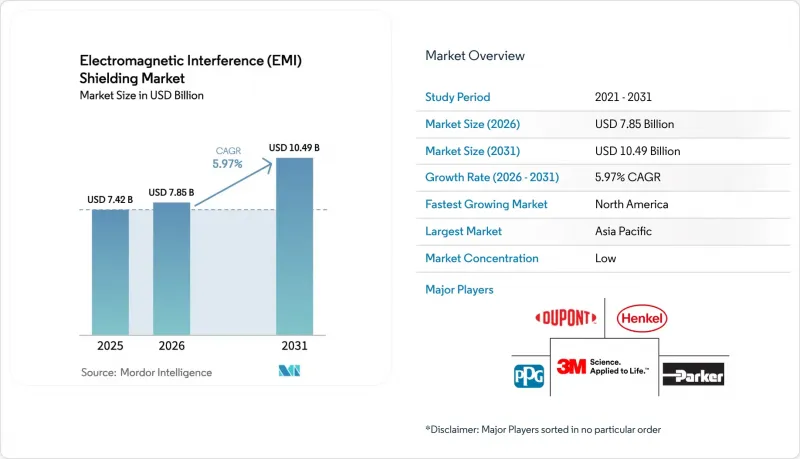
This report is Segmented by Material Type (Metal Shielding, and More), Shielding Method (Conformal Coating, Gasket Shielding, and More), Application (Consumer Electronics and Wearables, and More), Form Factor (Sheets and Foams and More), and Geography (Asia-Pacific, North America, Europe, and More). The Market Forecasts are Provided in Terms of Value (USD).
Global Electromagnetic Interference (EMI) Shielding Market Trends and Insights
Surging Adoption of Consumer Electronics and Wearables
Smartphones, smartwatches, and earbuds are shrinking, so engineers now specify shielding layers thinner than 10 μm that still deliver over 60 dB attenuation from 2.4-6 GHz. MXene-based fabrics achieve 42 dB in a single layer and 69 dB in triple stacks while enduring more than 500 bends, making them ideal for curved wearable surfaces. Foldable-phone hinges flex over 200,000 times; silver-nanowire inks keep 31,000 S/cm conductivity even under 50% strain, preventing RF leakage paths. As transparent, stretchable, and washable films mature, suppliers with roll-to-roll coating lines will outpace traditional metal-can vendors.
Rapid 5G/mm-Wave Infrastructure Rollout
Millimeter-wave base stations at 26 GHz and 39 GHz need board-level shields rated above 80 dB because low-loss polytetrafluoroethylene (PTFE) and liquid-crystal-polymer substrates amplify radiated emissions. Federal Communications Commission (FCC) Part 15 and European Telecommunications Standards Institute (ETSI) EN 301 489 tightened in 2024, so OEMs (Original Equipment Manufacturers) now buy molded assemblies that combine thermal vias and EMI gaskets, cutting production steps. North American small-cell counts are on track to top 1 million by 2028, and data-center operators near Washington D.C. already retrofit racks with 60-80 dB panels after graphics processing unit (GPU) memory-error incidents.
High Cost of Advanced Shielding Materials and Processes
Nanomaterial films can exceed USD 200 per kg, ten times the price of nickel-coated carbon fibers. Vacuum sputtering tools cost above USD 500,000 and run 30-60 minute cycles, while ultrasonic coaters have lower capital needs, at roughly USD 50,000, but add ink-formulation complexity. Certification adds 15-20% to development budgets, so small firms without in-house Electromagnetic Compatibility (EMC) labs face delayed launches.
Other drivers and restraints analyzed in the detailed report include:
- Stricter Global EMC Regulations in Auto, Medical and Aero Sectors
- Chiplet and SiP Compartment-Level Shielding in Advanced Packaging
- Copper-Price Volatility Elevating BOM Risk
For complete list of drivers and restraints, kindly check the Table Of Contents.
Segment Analysis
Conductive coatings and paints controlled 32.70% of revenue in 2025, sustained by their compatibility with spray, brush, and dip-coating processes that integrate seamlessly into existing production lines without capital-intensive tooling changes. Metal shielding still dominates high-robustness roles such as avionics bays that need more than 80 dB attenuation.
Conductive polymers and composites will grow at 6.12% CAGR to 2031, attract designers seeking corrosion immunity in marine and outdoor telecom enclosures; polyaniline/nickel-ferrite composites achieved 78.07 dB shielding effectiveness in K-band with absorption-dominant mechanisms and Green Index above 1.0, signaling environmental advantages over hexavalent-chromate surface treatments banned under EU REACH. Hybrid TPU composites now post 312 S/cm conductivity, so suppliers offering multi-material portfolios can cross-sell within shrinking vendor lists.
Gasket Shielding held 53.15% method share in 2025 and will grow at 6.23% CAGR during the forecast period (2026-2031), propelled by automotive OEMs specifying conductive-elastomer and fabric-over-foam gaskets that maintain less than 1 Ω contact resistance across 100,000 door-open cycles and withstand underhood temperatures reaching 125°C. Board-Level Shielding captures smartphone and IoT-module demand, yet this segment faces margin pressure as module vendors shift to molded shielding integrated during substrate fabrication.
Conformal Coating serves cost-sensitive consumer applications, set-top boxes, and smart speakers, where spray-applied silver or nickel paints deliver 30-50 dB attenuation sufficient for FCC Part 15 Class B compliance without tooling investment. Cable Shielding and Enclosure and Vent Shielding address infrastructure markets: data-center operators installing liquid-cooled AI racks require RF-shielded ventilation panels with honeycomb mesh that attenuates 60-80 dB at 1-6 GHz while sustaining airflow above 200 CFM to prevent thermal throttling.
Geography Analysis
Asia-Pacific commanded 41.40% of revenue in 2025, anchored by China's electronics-manufacturing base, where Shenzhen and Dongguan clusters assemble over 60% of global smartphones and wearables, and India's expanding EV cell-production capacity, which is attracting battery-management-system shielding demand. Japan logged about USD 900 million on advanced ferrite cores for 2-6 GHz modules. South Korea's 5G leadership and Samsung investments uplift chiplet shielding, while Singapore and Jakarta data centers spike vent-panel demand.
North America, forecast to grow fastest at 6.55% CAGR through 2031, benefits from hyperscale data-center expansion and 5G infrastructure investment; Northern Virginia alone accounted for over 30% of regional EMI-shielding ventilation-panel consumption in 2025 as operators co-locate GPU clusters and edge nodes within the same facilities.
Europe held a significant share in 2025, driven by Germany's automotive and industrial base and stringent EU REACH regulations that accelerate the substitution of hexavalent-chromate coatings with conductive polymers. France's aerospace and defense sectors demand lightning-strike-certified cable shields and MIL-STD-461G enclosures, while the United Kingdom's 5G rollout and smart-grid investments support telecom and industrial-automation segments. South America and Middle East and Africa remain emerging markets, with Brazil's aerospace clusters and UAE's smart-city projects providing niche opportunities, yet limited local manufacturing and reliance on imports constrain growth relative to established regions.
- 3M
- Changzhou National Radio-Products Factory
- DuPont
- ETS-Lindgren
- Henkel AG & Co. KGaA
- Holland Shielding Systems BV
- Kitagawa Industries Co., Ltd.
- Leader Tech Inc.
- MG Chemicals
- Mobix Labs
- Nolato AB
- Parker Hannifin Corp
- PPG Industries Inc.
- RTP Company
- Schaffner Holding AG
- Sekisui Chemical Co., Ltd.
- Shin-Etsu Polymer Co., Ltd.
- Sidus Space
- TDK Corporation
- Tech-Etch Inc.
- W. L. Gore & Associates Inc.
- YShield GmbH & Co. KG
Additional Benefits:
- The market estimate (ME) sheet in Excel format
- 3 months of analyst support
TABLE OF CONTENTS
1 Introduction
- 1.1 Study Assumptions and Market Definition
- 1.2 Scope of the Study
2 Research Methodology
3 Executive Summary
4 Market Landscape
- 4.1 Market Overview
- 4.2 Market Drivers
- 4.2.1 Surging adoption of consumer electronics and wearables
- 4.2.2 Rapid 5G/mm-Wave infrastructure rollout
- 4.2.3 Stricter global EMC regulations in auto, medical and aero sectors
- 4.2.4 Vertical-specific satellite constellations driving on-board shielding demand
- 4.2.5 Chiplet and SiP compartment-level shielding in advanced packaging
- 4.3 Market Restraints
- 4.3.1 High cost of advanced shielding materials and processes
- 4.3.2 Form-factor constraints in ultra-compact and foldable devices
- 4.3.3 Copper-price volatility elevating BOM risk in large-volume programs
- 4.4 Value Chain Analysis
- 4.5 Regulatory Landscape
- 4.6 Porter's Five Forces
- 4.6.1 Bargaining Power of Suppliers
- 4.6.2 Bargaining Power of Buyers
- 4.6.3 Threat of New Entrants
- 4.6.4 Threat of Substitutes
- 4.6.5 Competitive Rivalry
5 Market Size and Growth Forecasts (Value)
- 5.1 By Material Type
- 5.1.1 Conductive Coatings and Paints
- 5.1.2 Metal Shielding
- 5.1.3 Conductive Polymers and Composites
- 5.1.4 EMI/EMC Filters
- 5.1.5 Tapes and Laminates
- 5.1.6 Carbon-based Foams and Nanomaterial Films
- 5.2 By Shielding Method
- 5.2.1 Conformal Coating
- 5.2.2 Gasket Shielding
- 5.2.3 Board-Level Shielding
- 5.2.4 Cable Shielding
- 5.2.5 Enclosure and Vent Shielding
- 5.3 By Application
- 5.3.1 Consumer Electronics and Wearables
- 5.3.2 Automotive and Electric Vehicles
- 5.3.3 Telecommunications and 5G/6G Infrastructure
- 5.3.4 Aerospace, Defense and eVTOL
- 5.3.5 Healthcare and Medical Devices
- 5.3.6 Industrial Equipment and Automation
- 5.3.7 Renewable Energy and Smart Grid
- 5.3.8 Data Centers and Cloud Infrastructure
- 5.4 By Form Factor
- 5.4.1 Films and Coatings
- 5.4.2 Gaskets and O-Rings
- 5.4.3 Sheets and Foams
- 5.4.4 Fabric/Flexible Textiles
- 5.5 By Geography
- 5.5.1 Asia-Pacific
- 5.5.1.1 China
- 5.5.1.2 India
- 5.5.1.3 Japan
- 5.5.1.4 South Korea
- 5.5.1.5 Rest of Asia-Pacific
- 5.5.2 North America
- 5.5.2.1 United States
- 5.5.2.2 Canada
- 5.5.2.3 Mexico
- 5.5.3 Europe
- 5.5.3.1 Germany
- 5.5.3.2 United Kingdom
- 5.5.3.3 France
- 5.5.3.4 Russia
- 5.5.3.5 Rest of Europe
- 5.5.4 South America
- 5.5.4.1 Brazil
- 5.5.4.2 Argentina
- 5.5.4.3 Rest of South America
- 5.5.5 Asia-Pacific
- 5.5.5.1 China
- 5.5.5.2 India
- 5.5.5.3 Japan
- 5.5.5.4 South Korea
- 5.5.5.5 Rest of Asia-Pacific
- 5.5.6 Middle-East and Africa
- 5.5.6.1 South Africa
- 5.5.6.2 United Arab Emirates
- 5.5.6.3 Rest of Middle-East and Africa
- 5.5.1 Asia-Pacific
6 Competitive Landscape
- 6.1 Market Concentration
- 6.2 Strategic Moves
- 6.3 Market Share (%)/Ranking Analysis
- 6.4 Company Profiles (includes Global level Overview, Market level overview, Core Segments, Financials as available, Strategic Information, Products and Services, and Recent Developments)
- 6.4.1 3M
- 6.4.2 Changzhou National Radio-Products Factory
- 6.4.3 DuPont
- 6.4.4 ETS-Lindgren
- 6.4.5 Henkel AG & Co. KGaA
- 6.4.6 Holland Shielding Systems BV
- 6.4.7 Kitagawa Industries Co., Ltd.
- 6.4.8 Leader Tech Inc.
- 6.4.9 MG Chemicals
- 6.4.10 Mobix Labs
- 6.4.11 Nolato AB
- 6.4.12 Parker Hannifin Corp
- 6.4.13 PPG Industries Inc.
- 6.4.14 RTP Company
- 6.4.15 Schaffner Holding AG
- 6.4.16 Sekisui Chemical Co., Ltd.
- 6.4.17 Shin-Etsu Polymer Co., Ltd.
- 6.4.18 Sidus Space
- 6.4.19 TDK Corporation
- 6.4.20 Tech-Etch Inc.
- 6.4.21 W. L. Gore & Associates Inc.
- 6.4.22 YShield GmbH & Co. KG
7 Market Opportunities and Future Outlook
- 7.1 White-space and Unmet-Need Assessment

