PUBLISHER: Mordor Intelligence | PRODUCT CODE: 2062099

PUBLISHER: Mordor Intelligence | PRODUCT CODE: 2062099
Anthracite - Market Share Analysis, Industry Trends & Statistics, Growth Forecasts (2026 - 2031)
According to Mordor Intelligence, the anthracite market size was valued at USD 123.24 billion in 2025 and is estimated to grow from USD 128.55 billion in 2026 to reach USD 158.75 billion by 2031, at a CAGR of 4.31% during the forecast period (2026-2031).
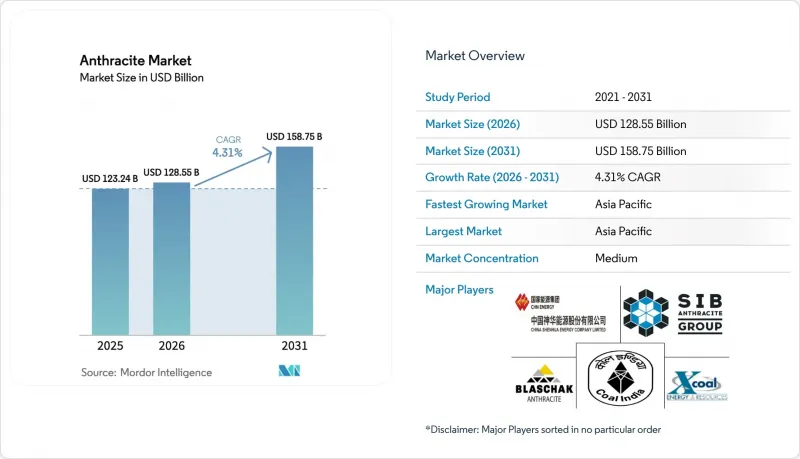
This report is Segmented by Grade (Standard Grade, Ultra-High Grade (UHG), and Calcined and Electrically-Calcined Grade), Application (Metallurgy, Water and Waste-Water Filtration, and More), End-User Industry (Steel and Metallurgy, Chemicals and Petrochemicals, Water Treatment Utilities, and More), and Geography (Asia-Pacific, North America, and More). The Market Forecasts are Provided in Terms of Value (USD).
Global Anthracite Market Trends and Insights
Mandates for Ultra-Low-Ash Carbon Additives in Green-Steel Processes
Steelmakers moving toward hydrogen DRI and electric arc furnaces need carbon additives with less than 8% ash and below 0.4% sulfur to minimize slag volumes and maintain bath chemistry. Recent acquisitions in Pennsylvania explicitly target these ultra-high-grade deposits to supply U.S. and European EAF expansions. China's plan to raise EAF share to 20% by 2030 intensifies global competition for low-volatile feedstocks, sustaining premium pricing even as mid-grade thermal anthracite faces substitution from natural-gas DRI and bio-carbon.
Municipal Shift to Dual-Media (Anthracite + Sand) Filtration Beds
North American and European utilities are retrofitting conventional sand filters with a coarse anthracite cap that extends run length up to 50% and cuts backwash costs. Sacramento's 2025 contract amendment and the Water Research Foundation's USD 500,000 PFAS project underscore the long-cycle, specification-driven nature of this demand. The operational savings shield procurement budgets from price shocks, anchoring a resilient slice of the anthracite market.
Petroleum-Coke and Bio-Carbon Price Discounting
High-sulfur U.S. Gulf Coast petcoke has traded as low as USD 60 per tonne in 2024-2026, slicing into anthracite's share of cement kilns and industrial boilers. Pilot-scale bio-carbon trials in Swedish EAFs promise net-zero emissions and could accelerate displacement if supply chains mature. Producers counter by lengthening contract tenors and highlighting anthracite's low ash and volatile-matter specs, where quality, not price, governs adoption.
Other drivers and restraints analyzed in the detailed report include:
- Growth of Electrically-Calcined Anthracite in Li-Ion Anodes
- High-Density Carbon-Brick Demand from Refractory Retrofits
- Seaborne Freight-Rate Volatility and Red-Sea Rerouting Premiums
For complete list of drivers and restraints, kindly check the Table Of Contents.
Segment Analysis
Standard grade retained 47.12% share of the anthracite market in 2025, buoyed by traditional water-treatment, residential heating, and mid-tier metallurgy demand. The sub-segment's margin, however, narrowed as petcoke undercut it in cement kilns and boilers. By contrast, calcined and electrically-calcined grades are forecast to rise at a 5.12% CAGR through 2031, capturing lithium-ion, sodium-ion, and fuel-cell anode orders that value fixed-carbon levels above 95%. Early-stage supply agreements between Chinese cell makers and Pennsylvanian and Siberian producers point to steady uptake that will lift the overall anthracite market size allocated to calcined grades during the forecast window.
Ultra-High Grade (UHG) anthracite, defined by ≥92% fixed carbon and ≤5% volatiles, sits at the apex of the value ladder and trades at premiums of 20-40% over Standard Grade. Menar's Springlake Colliery purchase in 2025 added 720,000 tons per year of export-quality UHG material to global supply. Tight spec ranges make UHG indispensable in ferroalloy reduction and EAF injection, safeguarding a niche that absorbs freight shocks and regulatory costs better than lower-grade peers.
Geography Analysis
Asia-Pacific dominated the anthracite market with 53.24% of 2025 demand and will post a 4.47% CAGR through 2031, propelled by China's coal-to-chemicals rollouts and India's 1 billion-tonne production target for FY 2028-29. China Shenhua's restructuring, adding 13 subsidiaries for USD 35 billion, secures logistics and power assets that streamline supply from mine to port while expanding reserves by 25%. ASEAN states, notably Indonesia and Vietnam, continue to sanction coal-fired power and clinker capacity where imported anthracite's high calorific value and low impurity profile confer advantages over domestic lignite.
North America's anthracite market leans on Pennsylvania's century-old basin, where Delta Dunia's 2024 purchase of Atlantic Carbon Group united four ultra-premium mines under a USD 122.4 million umbrella. Exports to Europe and Asia have expanded at double-digit rates since 2014, reflecting points of differentiation in volatile-matter content and low sulfur. Domestic thermal demand wanes as renewables and cheap gas capture utility capacity, but the filter-media and specialty-carbon niches sustain baseline throughput.
Europe witnesses contracting thermal demand yet retains a vibrant specialty segment. The EU's Carbon Border Adjustment Mechanism nudges importers toward certified-low-emission cargoes, opening space for U.S. and South African suppliers able to document mine-site efficiencies. Eastern European district heating and Nordic water-treatment plants continue spot purchases, but long-run volumes hinge on the pace of coal phase-out policies. South America, led by Brazil, oscillates with currency swings and freight costs; Australian cargoes surged to 30% share in 2025-2026 after Russian supply faced geopolitical barriers. Africa's epicenter is South Africa, where Menar's expansion gives the region an export-oriented, ultra-high-grade anchor, even as Transnet reforms open third-party rail slots that could lower FOB costs and grow volumes into the anthracite market.
- Atlantic Carbon Group
- Blaschak Anthracite
- BUMA International Group
- Carbones Holding GmbH
- CHINA SHENHUA
- Coal India Limited
- Feishang Anthracite Resources Limited
- Guess & Co
- JINERGY
- Lehigh Anthracite
- Reading Anthracite Company
- Sadovaya Group
- Sibanthracite Group
- Xcoal Energy & Resources
- Yanzhou Coal Mining Company Limited
Additional Benefits:
- The market estimate (ME) sheet in Excel format
- 3 months of analyst support
TABLE OF CONTENTS
1 Introduction
- 1.1 Study Assumptions and Market Definition
- 1.2 Scope of the Study
2 Research Methodology
3 Executive Summary
4 Market Landscape
- 4.1 Market Overview
- 4.2 Market Drivers
- 4.2.1 Mandates for ultra-low-ash carbon additives in green-steel processes
- 4.2.2 Municipal shift to dual-media (anthracite + sand) filtration beds
- 4.2.3 Growth of electrically-calcined anthracite in Li-ion anodes
- 4.2.4 High-density carbon-brick demand from refractory retrofits
- 4.2.5 Autonomous long-wall mining boosting cost-competitiveness
- 4.3 Market Restraints
- 4.3.1 Petroleum-coke and bio-carbon price discounting
- 4.3.2 Seaborne freight-rate volatility and Red-Sea rerouting premiums
- 4.3.3 Impending EU Carbon-Border Adjustment on embedded coal carbon
- 4.4 Value Chain Analysis
- 4.5 Porter's Five Forces
- 4.5.1 Threat of New Entrants
- 4.5.2 Bargaining Power of Buyers
- 4.5.3 Bargaining Power of Suppliers
- 4.5.4 Threat of Substitutes
- 4.5.5 Competitive Rivalry
5 Market Size and Growth Forecasts (Value)
- 5.1 By Grade
- 5.1.1 Standard Grade
- 5.1.2 Ultra-High Grade (UHG)
- 5.1.3 Calcined and Electrically-Calcined Grade
- 5.2 By Application
- 5.2.1 Metallurgy (Steel, Ferro-alloys, Refractories)
- 5.2.2 Water and Waste-Water Filtration
- 5.2.3 Thermal Power Generation and CHP
- 5.2.4 Chemical Feedstock and Carbon Products
- 5.2.5 Other Applications (Ceramics, Fuel Cells, etc.)
- 5.3 By End-user Industry
- 5.3.1 Steel and Metallurgy
- 5.3.2 Chemicals and Petrochemicals
- 5.3.3 Water Treatment Utilities
- 5.3.4 Energy and Power
- 5.3.5 Other End-user Industries (Construction Materials, Carbon Products, etc.)
- 5.4 By Geography
- 5.4.1 Asia-Pacific
- 5.4.1.1 China
- 5.4.1.2 Japan
- 5.4.1.3 India
- 5.4.1.4 South Korea
- 5.4.1.5 ASEAN Countries
- 5.4.1.6 Rest of Asia-Pacific
- 5.4.2 North America
- 5.4.2.1 United States
- 5.4.2.2 Canada
- 5.4.2.3 Mexico
- 5.4.3 Europe
- 5.4.3.1 Germany
- 5.4.3.2 United Kingdom
- 5.4.3.3 France
- 5.4.3.4 Italy
- 5.4.3.5 Spain
- 5.4.3.6 Russia
- 5.4.3.7 NORDIC Countries
- 5.4.3.8 Rest of Europe
- 5.4.4 South America
- 5.4.4.1 Brazil
- 5.4.4.2 Argentina
- 5.4.4.3 Rest of South America
- 5.4.5 Middle-East and Africa
- 5.4.5.1 Saudi Arabia
- 5.4.5.2 South Africa
- 5.4.5.3 Rest of Middle-East and Africa
- 5.4.1 Asia-Pacific
6 Competitive Landscape
- 6.1 Market Concentration
- 6.2 Strategic Moves
- 6.3 Market Share (%)/Ranking Analysis
- 6.4 Company Profiles (includes Global level Overview, Market level overview, Core Segments, Financials as available, Strategic Information, Products and Services, and Recent Developments)
- 6.4.1 Atlantic Carbon Group
- 6.4.2 Blaschak Anthracite
- 6.4.3 BUMA International Group
- 6.4.4 Carbones Holding GmbH
- 6.4.5 CHINA SHENHUA
- 6.4.6 Coal India Limited
- 6.4.7 Feishang Anthracite Resources Limited
- 6.4.8 Guess & Co
- 6.4.9 JINERGY
- 6.4.10 Lehigh Anthracite
- 6.4.11 Reading Anthracite Company
- 6.4.12 Sadovaya Group
- 6.4.13 Sibanthracite Group
- 6.4.14 Xcoal Energy & Resources
- 6.4.15 Yanzhou Coal Mining Company Limited
7 Market Opportunities and Future Outlook
- 7.1 White-Space and Unmet-Need Assessment
- 7.2 Surging Clean-fuel Demand across Emerging APAC Economies

