PUBLISHER: Mordor Intelligence | PRODUCT CODE: 2062120

PUBLISHER: Mordor Intelligence | PRODUCT CODE: 2062120
Rubber Vulcanization - Market Share Analysis, Industry Trends & Statistics, Growth Forecasts (2026 - 2031)
According to Mordor Intelligence, the rubber vulcanization market size was valued at USD 3.94 billion in 2025 and is expected to grow from USD 4.11 billion in 2026 to USD 5.05 billion by 2031, growing at a CAGR of 4.22% from 2026 to 2031.
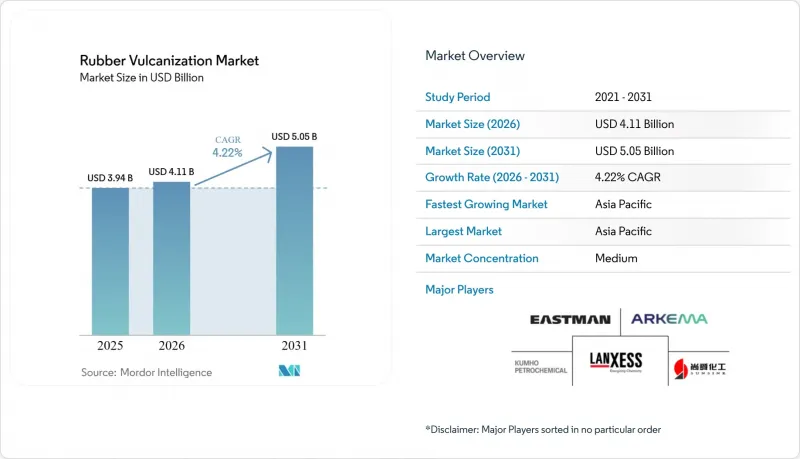
This report is Segmented by Product Type (Accelerators, Vulcanizing Agents, Activators, and Others), Application (Automotive and Transportation, Industrial, Consumer Goods, Footwear, and Others), and Geography (Asia-Pacific, North America, Europe, South America, and Middle-East and Africa). The Market Forecasts are Provided in Terms of Value (USD).
Global Rubber Vulcanization Market Trends and Insights
Shift Toward High-Performance, Low-Rolling-Resistance Rubber Compounds
Driven by global mandates on tire energy efficiency, compounders are shifting from carbon black to precipitated silica. This transition necessitates the use of thiuram and sulfenamide accelerators, which can initiate curing at lower temperatures. Continental introduced its EcoContact 7 tire in 2025, achieving a reduction in rolling resistance without compromising wet grip. This was accomplished by blending natural rubber with ultra-fast CBS accelerators. A forthcoming European Union regulation mandates a QR code indicating a product's carbon footprint. This makes low-product-carbon-footprint accelerators a key criterion for original equipment manufacturer procurement. In response, BASF launched a 2026 line of butanediol and PolyTHF with reduced product carbon footprint, enabling formulators to tout significant emission reductions. Additionally, bio-based additives like Kraton's SYLVATRAXX are enhancing these formulations, boosting traction while preserving rebound properties.
Expansion of Asia-Pacific Manufacturing and Infrastructure Spend
In 2025, China accounted for a significant share of global production, manufacturing a substantial number of passenger-car tires. Meanwhile, in 2026, India also recorded notable growth in production compared to the previous year. Both nations are strengthening their greenfield capacities, supported by considerable investments from leading domestic brands. On the upstream front, Kumho Petrochemical and Tosoh are expanding their specialty elastomer lines, which require customized curing packages. Concurrently, LANXESS has significantly increased the output of its Qingdao promoter plant to meet the region's just-in-time demand. This strategic localization highlights the growth of the rubber vulcanization chemicals market, aligning with the expansion of Asia-Pacific's export-driven tire industry.
Raw-Material Price Volatility - Butadiene, Sulfur, Zinc Oxide
In 2025, Chinese butadiene prices experienced an increase. By early 2026, North American contracts also saw a significant rise, creating a challenging price gap for non-integrated accelerator producers, making hedging difficult. During the same period, sulfur prices witnessed a substantial surge due to reduced output from Iranian mines, which resulted in a notable supply deficit. Zinc oxide prices also increased in early 2026 as smelters reduced production because of higher costs. These price dynamics have led to tighter profit margins, with NOCIL's earnings before interest, taxes, depreciation, and amortization declining in the third quarter of the fiscal year 2026. Larger multinational companies have managed to navigate these challenges by leveraging multi-regional sourcing networks, while smaller firms remain constrained by fixed contracts, putting pressure on their working capital.
Other drivers and restraints analyzed in the detailed report include:
- Industrial Demand for Conveyor, Hose and Belt Upgrades
- Microwave and Continuous-Line Vulcanization Retrofits Slash Cure Time
- 6PPD-Quinone Eco-Toxicity Scrutiny and Potential Bans
For complete list of drivers and restraints, kindly check the Table Of Contents.
Segment Analysis
Accelerators contributed 41.11% of 2025 sales, confirming their central role in every major rubber recipe. Sulfenamide grades ensure sufficient scorch safety at mixing temperatures and achieve full curing in a short time at press temperatures, solidifying their status as a staple for tires and industrial products. While more expensive, Thiuram accelerators allow for minimal sulfur loadings. This capability is crucial for low-rolling-resistance tread compounds, a feature Continental integrated into its EcoContact 7. While activators like zinc oxide have a slow maturation process, there is a rising demand for magnesium-based variants, which resist thermal hotspots, thanks to microwave retrofits. The market for vulcanizing agents in rubber vulcanization chemicals is projected to surpass that of accelerators. This shift comes as sulfur donors and peroxide systems effectively tackle challenges related to sulfur supply and durability at high temperatures, expanding at a 4.63% CAGR between 2026 and 2031. China Sunsine and NOCIL are doubling down on integrated sulfur-donor packages, aiming to lock in customers that prefer a single-source bundle.
Vulcanizing agents include elemental sulfur, sulfur donors, peroxides, and specialty insoluble sulfur. Insoluble sulfur, which commands a premium, effectively eliminates surface bloom on radial belts. Meanwhile, peroxide curing is gaining traction in ethylene propylene diene monomer hoses, especially for electric-vehicle coolant circuits that operate at higher temperatures than traditional powertrains. Chinese suppliers are now providing combined accelerator-sulfur donor masterbatches, streamlining logistics. This is a service that mid-sized western firms need to match to maintain their market share. Additionally, microwave curing is driving up demand for ultra-fast donors, capable of completing cross-linking in a significantly reduced time. This trend underscores the rubber vulcanization chemicals market's preference for innovation over commoditization.
Geography Analysis
Asia-Pacific accounted for 50.22% of 2025 revenue and is expected to advance at a 5.13% CAGR through 2026 to 2031. China leads with a significant output of passenger-car tires, followed closely by India. Substantial investments continue to flow into new radial plants. LANXESS has notably increased capacity at its Qingdao facility. Meanwhile, China Sunsine is utilizing its large-scale accelerator line to deliver integrated packages at competitive landed costs. In Japan, Tosoh is expanding its offerings with chloroprene rubber, dependent on imported vulcanization chemicals, signaling a sustained demand in developed Asian markets.
North America and Europe account for a considerable portion of the global demand. Growth remains steady but is tempered by a mature vehicle parc and regulatory challenges, notably the impending limits on certain chemical compounds. LANXESS has commenced production of specialized grades in South Carolina, providing United States tire manufacturers with a local source and reducing freight times. BASF, in a bid to meet emission-labeling standards, has adopted environmentally friendly precursors and transitioned its Verbund site in China to fully renewable energy, offering a compliance edge to European clients.
South America, the Middle-East and Africa collectively account for a smaller share of the market. Brazil has increased its truck-bus-radial output, while Mexico has maintained a notable level of tire production, with both nations heavily reliant on accelerator imports from Asia. Due to reduced sulfur availability from Iran, feedstock supplies have tightened in this region. In response, several Brazilian plants are experimenting with alternative systems that significantly reduce sulfur input. Saudi Arabia is expanding its tire production capacity to cater to regional demand, presenting new opportunities for specialty curing agents once these lines become operational.
- Arkema
- BASF
- Bolflex
- China Sunsine Chemical Holdings Ltd.
- Duslo a.s.
- Eastman Chemical Company
- Finorchem
- KUMHO PETROCHEMICAL
- LANXESS
- NOCIL Ltd
- OSAKA SODA
- OUCHI SHINKO CHEMICAL INDUSTRIAL CO., LTD
- Sumitomo Chemical Co., Ltd.
- Thomas Swan
- Tianjin Kemai Chemical
- Vanderbilt Holding Company, Inc.
- Zhejiang Baina Rubber & Plastic Equipment Co., Ltd.
Additional Benefits:
- The market estimate (ME) sheet in Excel format
- 3 months of analyst support
TABLE OF CONTENTS
1 Introduction
- 1.1 Study Assumptions and Market Definition
- 1.2 Scope of the Study
2 Research Methodology
3 Executive Summary
4 Market Landscape
- 4.1 Market Overview
- 4.2 Market Drivers
- 4.2.1 Shift toward high-performance, low-rolling-resistance rubber compounds
- 4.2.2 Expansion of Asia-Pacific manufacturing and infrastructure spend
- 4.2.3 Industrial demand for conveyor, hose and belt upgrades
- 4.2.4 Microwave and continuous-line vulcanization retrofits slash cure time
- 4.2.5 AI-driven real-time cure-profile optimization boosting plant yield
- 4.3 Market Restraints
- 4.3.1 Raw-material price volatility-butadiene, sulfur, zinc oxide
- 4.3.2 6PPD-quinone eco-toxicity scrutiny and potential bans
- 4.3.3 Sulfur-supply shocks from mining curtailments in 2026-27
- 4.4 Value Chain Analysis
- 4.5 Porter's Five Forces
- 4.5.1 Threat of New Entrants
- 4.5.2 Bargaining Power of Suppliers
- 4.5.3 Bargaining Power of Buyers
- 4.5.4 Threat of Substitutes
- 4.5.5 Competitive Rivalry
5 Market Size and Growth Forecasts (Value)
- 5.1 By Product Type
- 5.1.1 Accelerators
- 5.1.2 Vulcanizing Agents
- 5.1.3 Activators
- 5.1.4 Others
- 5.2 By Application
- 5.2.1 Automotive and Transportation
- 5.2.2 Industrial
- 5.2.3 Consumer Goods
- 5.2.4 Footwear
- 5.2.5 Others
- 5.3 By Geography
- 5.3.1 Asia-Pacific
- 5.3.1.1 China
- 5.3.1.2 India
- 5.3.1.3 Japan
- 5.3.1.4 South Korea
- 5.3.1.5 ASEAN
- 5.3.1.6 Australia and New Zealand
- 5.3.1.7 Rest of Asia-Pacific
- 5.3.2 North America
- 5.3.2.1 United States
- 5.3.2.2 Canada
- 5.3.2.3 Mexico
- 5.3.3 Europe
- 5.3.3.1 Germany
- 5.3.3.2 France
- 5.3.3.3 United Kingdom
- 5.3.3.4 Italy
- 5.3.3.5 Spain
- 5.3.3.6 Russia
- 5.3.3.7 Rest of Europe
- 5.3.4 South America
- 5.3.4.1 Brazil
- 5.3.4.2 Argentina
- 5.3.4.3 Rest of South America
- 5.3.5 Middle-East and Africa
- 5.3.5.1 Saudi Arabia
- 5.3.5.2 South Africa
- 5.3.5.3 Rest of Middle-East and Africa
- 5.3.1 Asia-Pacific
6 Competitive Landscape
- 6.1 Market Concentration
- 6.2 Strategic Moves
- 6.3 Market Share (%)/Ranking Analysis
- 6.4 Company Profiles (includes Global Overview, Market Overview, Core Segments, Financials, Strategic Information, Products and Services, and Recent Developments)
- 6.4.1 Arkema
- 6.4.2 BASF
- 6.4.3 Bolflex
- 6.4.4 China Sunsine Chemical Holdings Ltd.
- 6.4.5 Duslo a.s.
- 6.4.6 Eastman Chemical Company
- 6.4.7 Finorchem
- 6.4.8 KUMHO PETROCHEMICAL
- 6.4.9 LANXESS
- 6.4.10 NOCIL Ltd
- 6.4.11 OSAKA SODA
- 6.4.12 OUCHI SHINKO CHEMICAL INDUSTRIAL CO., LTD
- 6.4.13 Sumitomo Chemical Co., Ltd.
- 6.4.14 Thomas Swan
- 6.4.15 Tianjin Kemai Chemical
- 6.4.16 Vanderbilt Holding Company, Inc.
- 6.4.17 Zhejiang Baina Rubber & Plastic Equipment Co., Ltd.
7 Market Opportunities and Future Outlook
- 7.1 White-space and Unmet-need Assessment

