PUBLISHER: Mordor Intelligence | PRODUCT CODE: 2062131

PUBLISHER: Mordor Intelligence | PRODUCT CODE: 2062131
Foundry Coke - Market Share Analysis, Industry Trends & Statistics, Growth Forecasts (2026 - 2031)
According to Mordor Intelligence, the foundry coke market size was valued at USD 2.71 billion in 2025 and is estimated to grow from USD 2.83 billion in 2026 to reach USD 3.5 billion by 2031, at a CAGR of 4.34% during the forecast period (2026-2031).
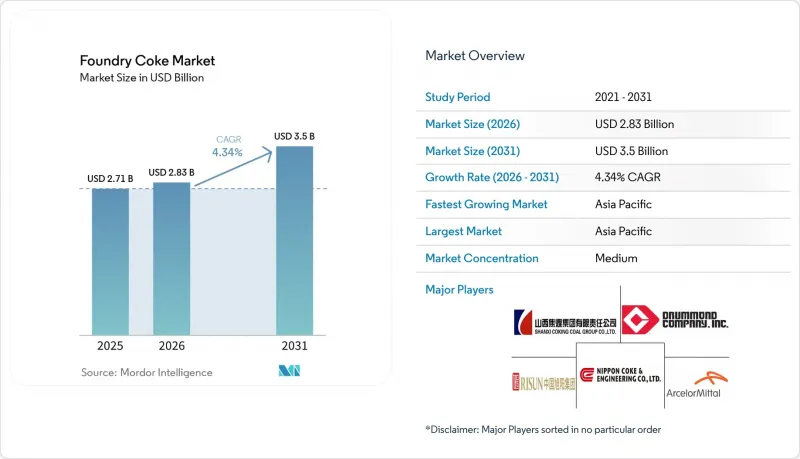
This report is Segmented by Ash Content (8%-10% Ash Content, Less Than 8% Ash Content, and More Than 10% Ash Content), Carbon Type (Metallurgical Coke, Petroleum Coke, and More), End-User Foundry Type (Automotive Foundries, Fabricated Castings, and More), and Geography (Asia-Pacific, North America, Europe, South America, and Middle-East and Africa). The Market Forecasts are Provided in Terms of Value (USD).
Global Foundry Coke Market Trends and Insights
Expansion of Southeast-Asian Foundry Clusters
Rising foreign direct investment in Indonesia, Vietnam, and Thailand is integrating nickel smelting, stainless steel, and ductile-iron cupolas inside special-economic zones that run their own coke ovens. The 3.2 million tonnes per annum (Mtpa) Morowali Industrial Park in Central Sulawesi supplies 51 customers across 17 countries, showcasing a self-sufficient model that bypasses CBAM-type carbon surcharges and achieves logistics savings that out-compete traditional merchant suppliers. Buoyant infrastructure expenditure and battery-supply-chain localization sustain multi-year demand visibility, establishing Southeast Asia as the fastest-growing pocket within the broader foundry coke market.
Investments in High-Strength Thin-Wall Castings for Lightweighting
Automotive regulations on fuel economy and emissions are pushing foundries toward 3-5 mm thin-wall ductile-iron and compacted-graphite-iron castings. These castings require premium low-ash coke (less than 8%) with high mechanical strength (M40 greater than or equal to 75%) to limit slag and maintain tight dimensional tolerances. OEM audits that extend to Scope 3 reporting now incentivize supply contracts that guarantee consistent low-ash chemistry and full batch traceability. Foundries unable to secure quality coke face higher scrap rates or must blend higher-sulfur petroleum coke and anthracite, which complicates melt chemistry control.
Volatile Premium Low-Sulfur Coking-Coal Pricing
Australian cyclone disruptions lifted Fitch's 2026 premium coal forecast to USD 190/ton, but 2025 Free On Board (FOB) prices had already fallen 21% year-on-year, undercutting producer margins. Coke makers lacking captive mines face squeezed spreads, and foundries endure quotation windows of only 6-12 months, complicating long-range order books and delaying furnace-upgrade decisions that underpin demand stability.
Other drivers and restraints analyzed in the detailed report include:
- Recovery of Construction-Equipment Output in India and Brazil
- Renewable-Energy Stimulus Driving Wind-Turbine Gearbox Castings
- Cupola-to-Electric-Melt Migration at Large U.S. Foundries
For complete list of drivers and restraints, kindly check the Table Of Contents.
Segment Analysis
Low-ash (less than 8%) grades cut slag-related defects, extend lining life, and demonstrate a 4.77% CAGR through 2031, outstripping the 8-10% mainstream segment that nonetheless held 49.98% of the 2025 foundry coke market share. AM/NS India's 1.5 Mtpa Hazira battery, commissioned in December 2025, secures captive premium supply and reduces reliance on spot imports. Western European and North American automotive foundries now mandate low-ash contracts to meet Scope 3 disclosure rules, pushing demand for documented batches with ash below 7% and sulfur under 0.8 %.
Mid-grade 8-10% coke remains the volume workhorse for construction-equipment and municipal castings. Russian GOST 3340-88 limits ash at 11-12%; upgrading to 9% ash allows Chinese and Indonesian exporters to approach EU benchmarks without full premium-grade costs. Blending premium and standard coke is an increasingly common strategy to meet OEM audits without inflating melt costs, preserving the relevance of mid-grade supply for another investment cycle.
Geography Analysis
Asia-Pacific held 57.91% of global consumption in 2025 and is projected to advance at 5.08% CAGR during the forecast period (2026-2031), the fastest regional pace, underpinned by more than 70 million tons of new blast-furnace iron capacity scheduled between 2024 and 2027. Indonesia's Morowali cluster anchors exports to India and Japan, while Vietnam's Haiphong and Thailand's Chonburi corridors add captive coke ovens for domestic cupolas that supply water-infrastructure and automotive parts. India's December 2024 import quota on low-ash coke tightened supply and prompted integrated producers to accelerate self-sufficiency projects, a policy that paradoxically stimulates domestic coking-coal washing investments.
North America is contracting in absolute tonnage as the Department of Energy (DOE)-funded furnace switches begin to bite. SunCoke's domestic offtake fell 360,000 tons in 2025 and is guided lower for 2026, though cross-border supply chains under the United States-Mexico-Canada Agreement (USMCA) still absorb mid-grade coke for gray-iron auto and agricultural castings. Broader uptake of Section 45X clean-manufacturing tax credits will decide whether cupola retirements proceed beyond the water-infrastructure niche.
Europe faces CBAM costs that elevate low-ash coke demand even as total volume shrinks. Saint-Gobain PAM's French plant documented a 95% CO2 cut after switching to induction melting, eliminating 7,800 tons/year of coal and setting a compliance benchmark for other EU foundries. Eastern European operators remain on cupolas but must document emission factors, boosting demand for dry-quenched coke with full traceability from Chinese or Indonesian suppliers able to certify sub-10% ash lots.
South America remains cyclical. Brazil benefits from mining-sector capex and a weak real that encourages local casting procurement, yet high borrowing costs limit capacity build-outs. Argentina and the Andean nations purchase coke on a spot basis for municipal and mining castings, rendering the region cost-sensitive and slow to adopt premium low-ash contracts.
Middle East and Africa shows scattered demand concentrated in Saudi Arabia's metals diversification and South Africa's mining-machinery exports. End-users import coke primarily from India and China, with logistics bottlenecks and financing constraints capping uptake of premium low-ash material. Without explicit carbon-pricing or Scope 3 mandates, coke quality decisions remain dictated by furnace yield economics rather than sustainability targets.
- ArcelorMittal
- China Risun Group Limited
- Drummond Company, Inc.
- Hebei Xinzheng Coking
- Henan Shenhuo Coke
- Jindal Coke Limited
- METALIMEX a. s.
- NIPPON COKE & ENGINEERING CO., LTD.
- POSCO
- Sesa Goa Iron Ore
- Shanxi Blue Flame Holding Co Ltd
- Shanxi Coking Co. Ltd.
- Shanxi Jianlong Coking Group
- SunCoke Energy Inc.
- Tata Steel
Additional Benefits:
- The market estimate (ME) sheet in Excel format
- 3 months of analyst support
TABLE OF CONTENTS
1 Introduction
- 1.1 Study Assumptions and Market Definition
- 1.2 Scope of the Study
2 Research Methodology
3 Executive Summary
4 Market Landscape
- 4.1 Market Overview
- 4.2 Market Drivers
- 4.2.1 Expansion of Southeast-Asian foundry clusters
- 4.2.2 Investments in high-strength thin-wall castings for lightweighting
- 4.2.3 Recovery of construction-equipment output in India and Brazil
- 4.2.4 Renewable-energy stimulus driving wind-turbine gearbox castings
- 4.2.5 OEM Scope-3 decarbonization accelerating low-ash (less than 8%) coke contracts
- 4.3 Market Restraints
- 4.3.1 Volatile premium low-sulfur coking-coal index pricing
- 4.3.2 Cupola-to-electric-melt migration at large U.S. foundries
- 4.3.3 EU CBAM carbon surcharges on coke-fired cupolas
- 4.4 Value Chain Analysis
- 4.5 Porter's Five Forces
- 4.5.1 Bargaining Power of Suppliers
- 4.5.2 Bargaining Power of Buyers
- 4.5.3 Threat of New Entrants
- 4.5.4 Threat of Substitutes
- 4.5.5 Competitive Rivalry
5 Market Size and Growth Forecasts (Value)
- 5.1 By Ash Content
- 5.1.1 8%-10% Ash Content
- 5.1.2 Less than 8% Ash Content
- 5.1.3 More than 10% Ash Content
- 5.2 By Carbon Type
- 5.2.1 Metallurgical Coke
- 5.2.2 Petroleum Coke
- 5.2.3 Pitch Coke
- 5.2.4 Anthracite Coke
- 5.2.5 Others
- 5.3 By End-user Foundry Type
- 5.3.1 Automotive Foundries
- 5.3.2 Fabricated Castings (Pumps, Valves, and Motors)
- 5.3.3 Machine and Tool Manufacturing
- 5.3.4 Aerospace and Heavy Equipment
- 5.3.5 Other Industrial Foundries
- 5.4 By Geography
- 5.4.1 Asia-Pacific
- 5.4.1.1 China
- 5.4.1.2 India
- 5.4.1.3 Japan
- 5.4.1.4 South Korea
- 5.4.1.5 Rest of Asia-Pacific
- 5.4.2 North America
- 5.4.2.1 United States
- 5.4.2.2 Canada
- 5.4.2.3 Mexico
- 5.4.3 Europe
- 5.4.3.1 Germany
- 5.4.3.2 United Kingdom
- 5.4.3.3 France
- 5.4.3.4 Italy
- 5.4.3.5 Rest of Europe
- 5.4.4 South America
- 5.4.4.1 Brazil
- 5.4.4.2 Argentina
- 5.4.4.3 Rest of South America
- 5.4.5 Middle-East and Africa
- 5.4.5.1 Saudi Arabia
- 5.4.5.2 South Africa
- 5.4.5.3 Rest of Middle-East and Africa
- 5.4.1 Asia-Pacific
6 Competitive Landscape
- 6.1 Market Concentration
- 6.2 Strategic Moves
- 6.3 Market Share (%)/Ranking Analysis
- 6.4 Company Profiles (includes Global Overview, Market Overview, Core Segments, Financials, Strategic Information, Products and Services, and Recent Developments)
- 6.4.1 ArcelorMittal
- 6.4.2 China Risun Group Limited
- 6.4.3 Drummond Company, Inc.
- 6.4.4 Hebei Xinzheng Coking
- 6.4.5 Henan Shenhuo Coke
- 6.4.6 Jindal Coke Limited
- 6.4.7 METALIMEX a. s.
- 6.4.8 NIPPON COKE & ENGINEERING CO., LTD.
- 6.4.9 POSCO
- 6.4.10 Sesa Goa Iron Ore
- 6.4.11 Shanxi Blue Flame Holding Co Ltd
- 6.4.12 Shanxi Coking Co. Ltd.
- 6.4.13 Shanxi Jianlong Coking Group
- 6.4.14 SunCoke Energy Inc.
- 6.4.15 Tata Steel
7 Market Opportunities and Future Outlook
- 7.1 White-space and Unmet-Need Assessment

