PUBLISHER: Mordor Intelligence | PRODUCT CODE: 2122930

PUBLISHER: Mordor Intelligence | PRODUCT CODE: 2122930
Metallurgical Coke - Market Share Analysis, Industry Trends & Statistics, Growth Forecasts (2026 - 2031)
According to Mordor Intelligence, the metallurgical coke market size is expected to grow from 545.78 Million tons in 2025 to 563.85 Million tons in 2026 and is forecast to reach 675.19 Million tons by 2031 at a 3.67% CAGR over 2026-2031.
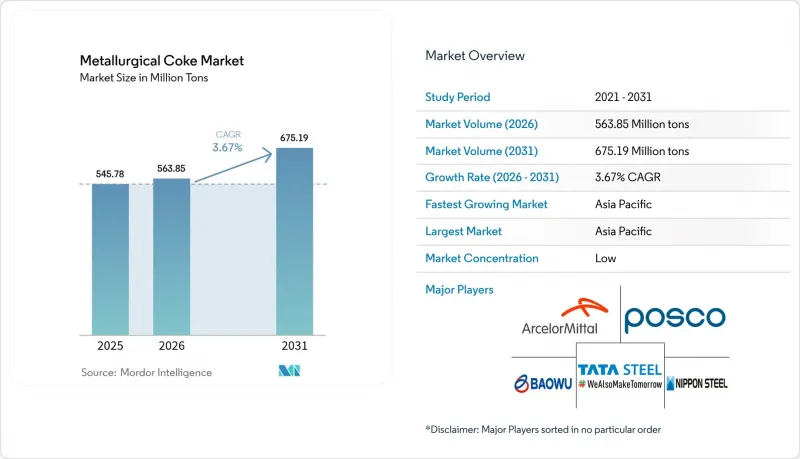
This report is Segmented by Coke Type (Blast-Furnace Coke and More), Grade (Low Ash (8 To 12% Ash) and High Ash (More Than 15% Ash)), Application (Iron and Steel Making, and More), End-User Industry (Integrated Steel Producers, Foundries, and More), and Geography (Asia-Pacific, North America, Europe, South America, and Middle-East and Africa). The Market Forecasts are Provided in Terms of Volume (tons).
Global Metallurgical Coke Market Trends and Insights
Rising Demand for Steel in Public Infrastructure
Governments in Asia-Pacific and the Middle East are allocating unprecedented budgets to highways, metro rail, and renewable-energy grids that require rebar and plate, both of which depend on blast-furnace routes using metallurgical coke. India's USD 1.4 trillion National Infrastructure Pipeline earmarks nearly one-quarter for transport projects, translating into steady coke offtake of roughly 0.8 tons per ton of crude steel. Saudi Arabia's NEOM and related megaprojects are projected to lift the kingdom's steel demand to 12 million tons by 2028, keeping regional mills on multi-year coke procurement contracts. Vietnam's North-South Expressway adds further pull, prompting Hoa Phat Group to install new blast furnaces with an extra 1.5 million tons of coke demand by 2027. Taken together, these programs underpin the positive demand trajectory of the metallurgical coke market.
Expanding Automotive Production Capacity
Light-vehicle output rebounded in China, India, and Thailand in 2025, yet steel intensity per vehicle eased as automakers adopted thinner high-strength steels and aluminum. China assembled 30.2 million vehicles in 2025, 4% above 2024, while average steel content slipped to 820 kg per car. Each incremental million vehicles in India still implies 180,000 tons of coke when blast-furnace share is considered, anchoring demand for the metallurgical coke industry despite gradual EAF inroads. Thailand's EV expansion sources more EAF steel from regional suppliers, hinting that vehicle electrification will eventually cap coke growth rates in Southeast Asia.
Metallurgical Coke Price Volatility
Spot hard-coking-coal prices swung between USD 210 and USD 340 per ton during 2024-2025 after Cyclone Jasper disrupted Queensland rail, compressing merchant-coke producer margins that average 6-8% EBITDA. India, which imported 54 million tons of coking coal in 2025, remains especially exposed, as 85% arrives from Australia. Futures hedging on the Dalian Commodity Exchange offers partial relief, yet physical-grade differentials leave basis risk.
Other drivers and restraints analyzed in the detailed report include:
- Capacity Additions in Integrated Steel Mills
- Urban Construction Boom in Emerging Economies
- Stringent Environmental Regulations on Coking Plants
For complete list of drivers and restraints, kindly check the Table Of Contents.
Segment Analysis
Blast-furnace coke accounted for 64.27% of global volume in 2025, underscoring its indispensable function as both reductant and structural support inside modern 1,500 °C furnaces. Nut coke is rising fastest at 4.25% CAGR because foundries crave 10-25 mm particles that enhance cupola permeability. Foundry coke retains its niche by supplying gray- and ductile-iron plants that demand CSR above 60% and sulfur below 0.6%. Coke breeze use is stagnating as mills shift from sinter to fluxed pellets, trimming the low-value tail of the metallurgical coke market.
Big Chinese integrated mills continue to specify high-CSR (greater than 65%) blast-furnace coke to withstand shaft pressures exceeding 15 bar in 5,000 m3 furnaces. Adoption of CDQ improves strength by 3-5 percentage points, allowing producers to fetch premiums even amid coal-price volatility. Over the forecast period, nut-coke demand will outpace blast-furnace growth, yet absolute tonnages favor the latter, cementing its status as the mainstay of the metallurgical coke market.
Low-ash (8-12%) coke captured 70.80% share in 2025 and is set to grow 4.59% annually, well ahead of high-ash alternatives. Each 1 percentage-point drop in ash trims slag by 15 kg per ton of hot metal, saving limestone and refractory costs. Consequently, mills commissioning furnaces above 4,500 m3 in India and China contract multi-year supplies of premium coal blends to secure low-ash output, locking in a quality-driven tier within the metallurgical coke market. High-ash coke, typically above 15%, retreats to legacy furnaces and non-ferrous smelters.
The price spread widened to USD 35-40 per ton in 2025 as China's crackdown on high-emission beehive ovens squeezed marginal supply. ISO 18894:2024 now measures alkali content, adding another lever that favors low-ash producers able to guarantee sodium and potassium below 0.3%. These quality screens reinforce the structural premium in the metallurgical coke market.
Complete Report Scope:
- By Coke Type
- Blast-Furnace Coke
- Foundry Coke
- Nut Coke
- Coke Breeze
- By Grade
- Low Ash (8 to 12% Ash)
- High Ash (more than 15% Ash)
- By Application
- Iron and Steel Making
- Foundry Castings
- Sugar Processing
- Glass Manufacturing
- Other Applications
- By End-User Industry
- Integrated Steel Producers
- Mini-mills / EAF Operators
- Foundries
- Non-ferrous Metallurgy
- Other End-user Industries
- By Geography
- Asia-Pacific
- China
- India
- Japan
- South Korea
- ASEAN Countries
- Rest of Asia-Pacific
- North America
- United States
- Canada
- Mexico
- Europe
- Germany
- United Kingdom
- Italy
- France
- Russia
- Rest of Europe
- South America
- Brazil
- Argentina
- Rest of South America
- Middle East and Africa
- Saudi Arabia
- United Arab Emirates
- South Africa
- Egypt
- Rest of Middle East and Africa
- Asia-Pacific
Geography Analysis
Asia-Pacific commanded 69.70% of volume in 2025 and will maintain a 4.16% CAGR to 2031, thanks to China's 480 million tons of coke production and India's rapid steel-capacity build-out. China's Ministry of Ecology and Environment shuttered 15 million tons of non-compliant capacity in 2025, shifting supply toward large, CDQ-equipped state enterprises with lower emission footprints. India expanded captive coke-oven capacity to 45 million tons, yet still relies on 54 million tons of coking-coal imports, cementing cross-border trade in the metallurgical coke market.
North America's production in 2025 was split between SunCoke merchant plants and integrated mills, but coke demand is gradually easing as US Steel idles older blast furnaces in favor of EAF routes. Canada's lone Dofasco oven faces rising carbon taxes that may accelerate electrification, potentially trimming regional metallurgical coke market demand share by 2031.
Europe's output fell in 2025 amid stricter benzene limits. With ArcelorMittal converting Krakow to an EAF and thyssenkrupp trialing hydrogen injection, European demand could drop further by 2035. South America remains stable, whereas the Middle East and Africa together may rise as Saudi and Egyptian mills add capacity, albeit with heavy dependence on imports via the metallurgical coke market.
- ArcelorMittal
- BlueScope Steel Ltd.
- China Baowu Steel Group
- China Shenhua Energy Co. Ltd.
- Drummond Company Inc.
- Gujarat NRE Coke Ltd. (GNCL)
- Hickman-Williams & Company
- Jiangsu Surung High-Carbon Co. Ltd.
- JSW Steel Ltd.
- Mahalaxmi Ennore Coke Pvt Ltd
- Mechel PAO
- Nippon Steel Corporation
- OKK Koksovny a.s.
- POSCO
- Shanxi Coking Coal Group
- SunCoke Energy Inc.
- Tata Steel Ltd.
- United States Steel Corporation
Additional Benefits:
- The market estimate (ME) sheet in Excel format
- 3 months of analyst support
TABLE OF CONTENTS
1 Introduction
- 1.1 Study Assumptions & Market Definition
- 1.2 Scope of the Study
2 Research Methodology
3 Executive Summary
4 Market Landscape
- 4.1 Market Drivers
- 4.1.1 Rising demand for steel in public infrastructure
- 4.1.2 Expanding automotive production capacity
- 4.1.3 Capacity additions in integrated steel mills
- 4.1.4 Urban construction boom in emerging economies
- 4.1.5 Adoption of dry-quenching technology enabling premium pricing
- 4.2 Market Restraints
- 4.2.1 Metallurgical coke price volatility
- 4.2.2 Stringent environmental regulations on coking plants
- 4.2.3 Supply risk from Australian met-coal logistics disruptions
- 4.3 Value Chain Analysis
- 4.4 Porter's Five Forces
- 4.4.1 Bargaining Power of Suppliers
- 4.4.2 Bargaining Power of Buyers
- 4.4.3 Threat of New Entrants
- 4.4.4 Threat of Substitutes
- 4.4.5 Degree of Competition
5 Market Size and Growth Forecasts ( Volume)
- 5.1 By Coke Type
- 5.1.1 Blast-Furnace Coke
- 5.1.2 Foundry Coke
- 5.1.3 Nut Coke
- 5.1.4 Coke Breeze
- 5.2 By Grade
- 5.2.1 Low Ash (8 to 12% Ash)
- 5.2.2 High Ash (more than 15% Ash)
- 5.3 By Application
- 5.3.1 Iron and Steel Making
- 5.3.2 Foundry Castings
- 5.3.3 Sugar Processing
- 5.3.4 Glass Manufacturing
- 5.3.5 Other Applications
- 5.4 By End-User Industry
- 5.4.1 Integrated Steel Producers
- 5.4.2 Mini-mills / EAF Operators
- 5.4.3 Foundries
- 5.4.4 Non-ferrous Metallurgy
- 5.4.5 Other End-user Industries
- 5.5 By Geography
- 5.5.1 Asia-Pacific
- 5.5.1.1 China
- 5.5.1.2 India
- 5.5.1.3 Japan
- 5.5.1.4 South Korea
- 5.5.1.5 ASEAN Countries
- 5.5.1.6 Rest of Asia-Pacific
- 5.5.2 North America
- 5.5.2.1 United States
- 5.5.2.2 Canada
- 5.5.2.3 Mexico
- 5.5.3 Europe
- 5.5.3.1 Germany
- 5.5.3.2 United Kingdom
- 5.5.3.3 Italy
- 5.5.3.4 France
- 5.5.3.5 Russia
- 5.5.3.6 Rest of Europe
- 5.5.4 South America
- 5.5.4.1 Brazil
- 5.5.4.2 Argentina
- 5.5.4.3 Rest of South America
- 5.5.5 Middle East and Africa
- 5.5.5.1 Saudi Arabia
- 5.5.5.2 United Arab Emirates
- 5.5.5.3 South Africa
- 5.5.5.4 Egypt
- 5.5.5.5 Rest of Middle East and Africa
- 5.5.1 Asia-Pacific
6 Competitive Landscape
- 6.1 Market Concentration
- 6.2 Strategic Moves
- 6.3 Market Share(%)/Ranking Analysis
- 6.4 Company Profiles (includes Global level Overview, Market level overview, Core Segments, Financials as available, Strategic Information, Products and Services, and Recent Developments)
- 6.4.1 ArcelorMittal
- 6.4.2 BlueScope Steel Ltd.
- 6.4.3 China Baowu Steel Group
- 6.4.4 China Shenhua Energy Co. Ltd.
- 6.4.5 Drummond Company Inc.
- 6.4.6 Gujarat NRE Coke Ltd. (GNCL)
- 6.4.7 Hickman-Williams & Company
- 6.4.8 Jiangsu Surung High-Carbon Co. Ltd.
- 6.4.9 JSW Steel Ltd.
- 6.4.10 Mahalaxmi Ennore Coke Pvt Ltd
- 6.4.11 Mechel PAO
- 6.4.12 Nippon Steel Corporation
- 6.4.13 OKK Koksovny a.s.
- 6.4.14 POSCO
- 6.4.15 Shanxi Coking Coal Group
- 6.4.16 SunCoke Energy Inc.
- 6.4.17 Tata Steel Ltd.
- 6.4.18 United States Steel Corporation
7 Market Opportunities and Future Outlook
- 7.1 White-space and Unmet-need Assessment

