PUBLISHER: Mordor Intelligence | PRODUCT CODE: 2062139

PUBLISHER: Mordor Intelligence | PRODUCT CODE: 2062139
Corporate Compliance Training - Market Share Analysis, Industry Trends & Statistics, Growth Forecasts (2026 - 2031)
According to Mordor Intelligence, the corporate compliance training market size is expected to grow from USD 9.68 billion in 2025 to USD 10.06 billion in 2025 and is forecast to reach USD 13.60 billion by 2030 at 6.21% CAGR over 2025-2030.
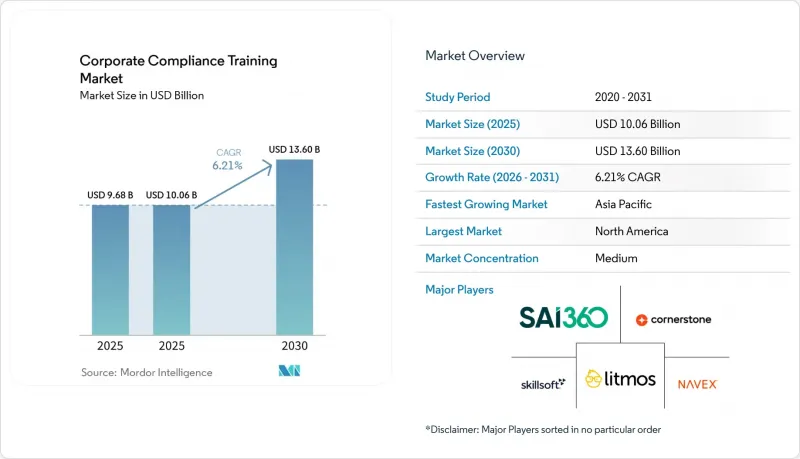
This report is Segmented by Training Type (Data Protection, Workplace Safety, Anti-Harassment, Anti-Bribery, and More), Delivery Mode (Online, Classroom, Blended), Industry Vertical (BFSI, Healthcare, Manufacturing, Energy, IT, and More), Organization Size (SMEs, Large Enterprises), and Geography (North America, South America, Europe, Asia-Pacific, MEA). Market Forecasts are in Value (USD).
Global Corporate Compliance Training Market Trends and Insights
Stricter Data Privacy Enforcement Worldwide
Supervisory action accelerated in 2025 and 2026, which redefined how the Corporate Compliance Training market prioritizes data protection programs. European data protection authorities imposed fines totaling EUR 1.15 billion (USD 1.35 billion) in 2025, and cross-border enforcement highlighted the consequences of weak transfer controls. California's privacy regulator reported rising complaint volumes and formed a multistate collaboration that coordinated enforcement expectations across jurisdictions, including a focus on Global Privacy Control signals and data broker obligations. A 2025 multistate sweep in the United States specifically examined failure to honor opt-out preference signals, elevating technical compliance as a frontline training topic for data controllers and processors. These developments reward programs that teach frontline teams how to recognize privacy design gaps and how to escalate suspected violations before they become reportable events . In France, the national authority continued to invest in practitioner education through updated GDPR training resources that help close knowledge gaps that fines alone cannot address. As oversight becomes more data-driven, the Corporate Compliance Training market is shifting toward content that blends legal interpretation with hands-on workflows for consent management, data subject requests, and vendor due diligence.
Rising Cyber Threats Targeting Employees
Cybersecurity governance has shifted from operational risk to securities disclosure risk in the United States, reshaping program design across the Corporate Compliance Training market. The SEC's four-business-day incident disclosure requirement shifted accountability to the board level, so incident playbooks now emphasize role-specific training on materiality judgments and escalation. Vendors also pivoted to integrate live threat telemetry with employee simulations, as shown by KnowBe4's acquisition of Egress to tie adaptive email defenses to awareness training. Risk management teams are folding this telemetry into targeted refresher content that reflects actual phishing patterns rather than generic templates. Japan's emphasis on whistleblowing and psychological safety is supporting early-warning systems for both cyber and ethics violations, which require recurring employee education on safe reporting and non-retaliation norms. Financial services regulators in the United States also proposed risk-based, ongoing training as a pillar of AML and CFT programs in 2026. That proposal explicitly encouraged the use of AI and machine learning, which aligns the training cadence with real-time monitoring needs. As cyber threats test human judgment first, the Corporate Compliance Training market is prioritizing behavioral reinforcement over one-time annual courses.
Training Fatigue Lowers Learner Engagement
Time pressure and cognitive load remain barriers that temper gains in the Corporate Compliance Training market. Many employees and learning leaders cite workload as a top reason for low training participation, which weakens the link between completion and behavior change when content is delivered in long blocks. In multi-jurisdictional environments, layered mandates can expand seat time and trigger disengagement when content overlaps but cannot be consolidated due to rule differences. This environment elevates microlearning and blended formats that reduce friction while preserving coverage of statutory elements. Japan's training practices emphasize psychological safety and values-based discussions, which help counter cynicism that can arise when training is perceived as performative rather than protective. Program owners are therefore aligning cadence and relevance more precisely to business rhythms to maintain engagement throughout the year.
Other drivers and restraints analyzed in the detailed report include:
- Mandated Anti-Harassment Training Expansions
- ESG Reporting & Supply Chain Due Diligence
- Fragmented Global Regulations Hinder Standardization
For complete list of drivers and restraints, kindly check the Table Of Contents.
Segment Analysis
Cybersecurity & IT Compliance captured 26.37% of the Corporate Compliance Training market share in 2025, reflecting the shift to board-level accountability for cyber incidents and heightened AML and CFT expectations for digital assets and suspicious activity response. The segment is projected to expand at a 10.56% CAGR through 2031, supported by proposals that formalize ongoing, risk-based training and encourage the careful use of AI and machine learning to improve program effectiveness. The Corporate Compliance Training market increasingly treats phishing simulation, role-specific breach escalation, and secure data handling as recurring competencies rather than annual refresh topics . Vendors are pairing adaptive threat intelligence with training that responds to active attack campaigns in real time. Data Protection & Privacy programs are growing amid state and EU enforcement, as teams need operational skills to handle opt-out signals, privacy requests, and data broker obligations. Workplace Safety programs gained urgency with national emphasis actions in manufacturing, which require documentation of both training completion and real-world competency. Anti-harassment content aligns with city and state standards, including bystander techniques and supervisor responsibilities.
ESG, Sustainability & Responsible Business is the fastest-rising non-cybersecurity area as environmental, social, and supplier due diligence disclosures become auditable and traceable to training and controls. The Corporate Compliance Training market is investing in modules for supply chain risk identification, grievance handling, and remediation planning in response to European rules that extend responsibility across complex vendor networks. Procurement, logistics, and operations teams require training on supplier onboarding, document collection, and monitoring expectations that match buyer demands. China's guidance for SMEs reinforced that compliance maturity is now part of competitive positioning, extending ESG-linked training to mid-market exporters. The Corporate Compliance Training market is also aligning ethics and anti-bribery content with sustainability themes, so that frontline actions support both legal and customer requirements. Over the forecast period, cross-functional ESG literacy will be a differentiator in regulated supply chains serving European buyers.
Online/Digital delivery commanded 72.74% of demand in 2025, anchored by the ability to produce audit-ready records and to scale instruction across distributed workforces. Blended and advanced digital learning is forecast to be the fastest-growing format, with a 9.53% CAGR through 2031, as organizations add live practice for topics where interpersonal dynamics and judgment calls drive outcomes. The Corporate Compliance Training market is converging on a combined model in which asynchronous modules establish baselines, while live sessions focus on role-play, escalation drills, and nuanced scenario analysis. Financial services expectations for ongoing AML and CFT training indicate that periodic refreshers alone cannot sustain vigilance. Microlearning is also boosting completion rates while preserving knowledge checks, which makes it easier to maintain records that stand up to enforcement review. This combination is pushing buyers to platforms that manage live and digital content within a unified learner record.
Vendors emphasize orchestration of ILT, vILT, and self-paced learning to reflect how risk owners prefer to learn and how auditors expect evidence to be structured. Core features now include SSO, automated enrollments, recertification scheduling, reporting templates, and deep integrations with HRIS and case management systems. Platforms also promote streamlined administration, helping SMEs match the cadence and documentation quality of large enterprise programs without adding headcount. In high-risk contexts such as machine safety, live demonstrations remain necessary to affirm competency, which shapes blended program design. Content roadmaps in 2025 and 2026 increased focus on jurisdiction-tailored modules, which help centralized teams deliver standardized experiences that still comply with local law. Over the forecast window, the Corporate Compliance Training market will reward vendors that make blended delivery simple, measurable, and auditable at scale.
Geography Analysis
North America held 36.88% of the Corporate Compliance Training market share in 2025. The region's position rests on several forces that continue in 2026, including enforcement escalations that add pressure on programs to demonstrate effectiveness rather than mere completion. The SEC's cyber disclosure rule made material incident training a board-relevant requirement and raised the bar for documenting readiness and escalation pathways. State privacy regulators pursued actions on opt-out signal compliance and data broker registration, which expanded training content for marketing, IT, and customer operations teams. Mandated anti-harassment training across multiple states and cities added jurisdiction-specific modules, increasing administrative tasks for national employers. Buyers in North America also show a strong preference for microlearning to maintain engagement and reduce productivity impacts. As these patterns persist, the Corporate Compliance Training market in the United States and Canada will continue to favor platforms that centralize control while enabling local tailoring.
Asia Pacific is the fastest-growing region, with a projected 9.22% CAGR through 2031. China's 15-ministry directive positioned compliance maturity as a competitive advantage for SMEs and outlined a broad scope of required systems, which drive training needs across governance, data, quality, and supply chain functions. Japan's emphasis on whistleblower systems and psychological safety has increased interest in training that supports internal reporting and respectful communications. The Corporate Compliance Training market in APAC is also benefiting from the spread of microlearning and mobile delivery, which suits frontline and distributed workforces. Suppliers connected to European buyers are expanding ESG and due diligence training as part of onboarding and ongoing verification, which pulls new users onto digital platforms. As APAC regulators publish guidance and buyers embed audit expectations, the Corporate Compliance Training market gains momentum through both top-down and customer-driven requirements.
Europe blends centralized rulemaking with member-state enforcement variation, which shapes local demand patterns. GDPR fines in 2025 demonstrated the scale of the risk for firms that mismanage cross-border data or ignore supervisory guidance, which renewed interest in multilingual, scenario-based privacy instruction. National safety, harassment, and sector regulations continue to add content variants that require jurisdictional accuracy. France invests in public education through updated GDPR training, which supports smaller firms seeking to improve compliance literacy. European sustainability and supply chain rules are expanding demand for ESG and due diligence training, especially in export-intensive markets with complex vendor networks. The Corporate Compliance Training market in Europe is therefore broadening beyond privacy and anti-bribery into sustainable operations and supplier oversight content that aligns with audit expectations.
- Skillsoft
- Cornerstone OnDemand
- NAVEX
- SAI360
- LRN
- SAP Litmos
- LinkedIn Learning
- Udemy Business
- Compliance.One
- Emtrain
- Traliant
- Ethena
- KnowBe4
- Proofpoint Security Awareness Training
- HSI (Health & Safety Institute)
- Vector Solutions
- Thomson Reuters Compliance Learning
- Skillcast
- 360Learning
- Kineo
- Learning Pool
- EVERFI/ComplyEQ
Additional Benefits:
- The market estimate (ME) sheet in Excel format
- 3 months of analyst support
TABLE OF CONTENTS
1 Introduction
- 1.1 Study Assumptions & Market Definition
- 1.2 Scope of the Study
2 Research Methodology
3 Executive Summary
4 Market Landscape
- 4.1 Market Overview
- 4.2 Market Drivers
- 4.2.1 Stricter data privacy enforcement worldwide
- 4.2.2 Rising cyber threats targeting employees
- 4.2.3 Mandated anti-harassment training expansions
- 4.2.4 ESG reporting & supply-chain due diligence
- 4.2.5 LMS-GRC integration eases audit readiness
- 4.2.6 Microlearning boosts completion, reduces risk
- 4.3 Market Restraints
- 4.3.1 Training fatigue lowers learner engagement
- 4.3.2 Fragmented global regulations hinder standardization
- 4.3.3 Budget constraints in SMEs
- 4.3.4 Poor localization undermines policy alignment
- 4.4 Value / Supply-Chain Analysis
- 4.5 Regulatory Landscape
- 4.6 Technological Outlook
- 4.7 Porter's Five Forces Analysis
- 4.7.1 Threat of New Entrants
- 4.7.2 Bargaining Power of Suppliers
- 4.7.3 Bargaining Power of Buyers
- 4.7.4 Threat of Substitutes
- 4.7.5 Industry Rivalry
- 4.8 Assessment & Credentialing Mechanics
- 4.9 Managed Services & Outsourcing Models
- 4.10 Ecosystem & Partnerships Map
5 Market Size & Growth Forecasts
- 5.1 By Training Type
- 5.1.1 Data Protection & Privacy
- 5.1.2 Workplace Safety & OSHA Compliance
- 5.1.3 Anti-Harassment, DEI & Workplace Conduct
- 5.1.4 Anti-Bribery & Corruption
- 5.1.5 Ethics & Code of Conduct
- 5.1.6 Cybersecurity & IT Compliance
- 5.1.7 ESG, Sustainability & Responsible Business
- 5.1.8 Industry-Specific Compliance
- 5.2 By Delivery Mode
- 5.2.1 Online / Digital
- 5.2.2 Classroom / On-Site
- 5.2.3 Blended Learning
- 5.3 By Industry Vertical
- 5.3.1 Banking, Financial Services & Insurance (BFSI)
- 5.3.2 Healthcare & Life Sciences
- 5.3.3 Manufacturing & Industrial
- 5.3.4 Energy & Utilities
- 5.3.5 Information Technology & Telecom
- 5.3.6 Government & Public Sector
- 5.3.7 Retail & Consumer Goods
- 5.3.8 Food & Beverage
- 5.3.9 Transportation & Logistics
- 5.3.10 Other Industry Verticals
- 5.4 By Organization Size
- 5.4.1 Small and Medium Enterprises (SMEs)
- 5.4.2 Large Enterprises
- 5.5 By Region
- 5.5.1 North America
- 5.5.1.1 United States
- 5.5.1.2 Canada
- 5.5.1.3 Mexico
- 5.5.2 South America
- 5.5.2.1 Brazil
- 5.5.2.2 Argentina
- 5.5.2.3 Chile
- 5.5.2.4 Colombia
- 5.5.2.5 Rest of South America
- 5.5.3 Europe
- 5.5.3.1 United Kingdom
- 5.5.3.2 Germany
- 5.5.3.3 France
- 5.5.3.4 Spain
- 5.5.3.5 Italy
- 5.5.3.6 Benelux (Belgium, Netherlands, and Luxembourg)
- 5.5.3.7 Nordics (Sweden, Norway, Denmark, Finland, and Iceland)
- 5.5.3.8 Rest of Europe
- 5.5.4 Asia-Pacific
- 5.5.4.1 China
- 5.5.4.2 India
- 5.5.4.3 Japan
- 5.5.4.4 South Korea
- 5.5.4.5 Australia
- 5.5.4.6 South-East Asia (Singapore, Indonesia, Malaysia, Thailand, Vietnam, and Philippines)
- 5.5.4.7 Rest of Asia-Pacific
- 5.5.5 Middle East and Africa
- 5.5.5.1 United Arab Emirates
- 5.5.5.2 Saudi Arabia
- 5.5.5.3 South Africa
- 5.5.5.4 Nigeria
- 5.5.5.5 Rest of Middle East and Africa
- 5.5.1 North America
6 Competitive Landscape
- 6.1 Market Concentration
- 6.2 Strategic Moves
- 6.3 Market Share Analysis
- 6.4 Company Profiles {(includes Global level Overview, Market level overview, Core Segments, Financials as available, Strategic Information, Market Rank/Share for key companies, Products & Services, and Recent Developments)}
- 6.4.1 Skillsoft
- 6.4.2 Cornerstone OnDemand
- 6.4.3 NAVEX
- 6.4.4 SAI360
- 6.4.5 LRN
- 6.4.6 SAP Litmos
- 6.4.7 LinkedIn Learning
- 6.4.8 Udemy Business
- 6.4.9 Compliance.One
- 6.4.10 Emtrain
- 6.4.11 Traliant
- 6.4.12 Ethena
- 6.4.13 KnowBe4
- 6.4.14 Proofpoint Security Awareness Training
- 6.4.15 HSI (Health & Safety Institute)
- 6.4.16 Vector Solutions
- 6.4.17 Thomson Reuters Compliance Learning
- 6.4.18 Skillcast
- 6.4.19 360Learning
- 6.4.20 Kineo
- 6.4.21 Learning Pool
- 6.4.22 EVERFI/ComplyEQ
7 Market Opportunities & Future Outlook
- 7.1 White-space & unmet-need assessment

