PUBLISHER: Mordor Intelligence | PRODUCT CODE: 2062232

PUBLISHER: Mordor Intelligence | PRODUCT CODE: 2062232
Rotogravure Printing Inks - Market Share Analysis, Industry Trends & Statistics, Growth Forecasts (2026 - 2031)
According to Mordor Intelligence, the rotogravure printing inks market size was valued at USD 5.78 billion in 2025 and is estimated to grow from USD 6.08 billion in 2026 to reach USD 7.86 billion by 2031, at a CAGR of 5.26% during the forecast period (2026-2031).
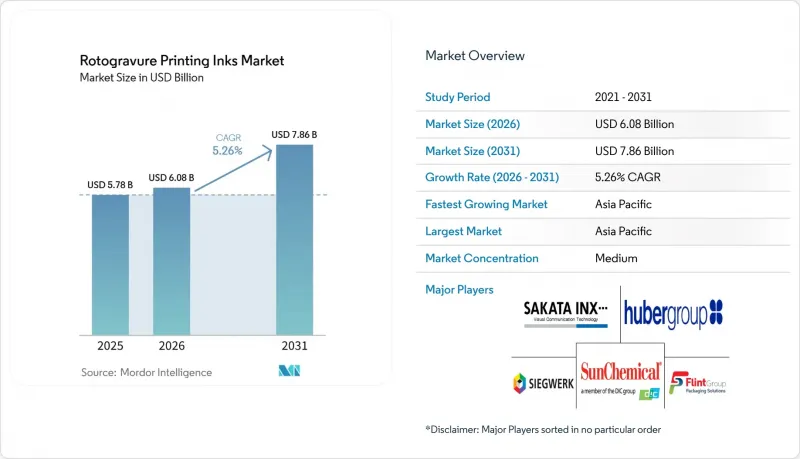
This report is Segmented by Resin Type (Nitrocellulose, Polyamide, and More), Technology (Solvent-Based, Water-Based, and EB/UV-curable), Application (Flexible Packaging, Labels and Wrappers, and More), End-User Industry (Food and Beverage, Personal Care and Cosmetics, and More), and Geography (Asia-Pacific, North America, and More). The Market Forecasts are Provided in Terms of Value (USD).
Global Rotogravure Printing Inks Market Trends and Insights
Rising Demand for High-Speed Printing in Flexible Packaging
Flexible packaging converters now operate central-impression gravure presses at sustained speeds of 400 m/min, a 25% increase compared to 2020, reducing lead times from two weeks to seventy-two hours in fast-moving consumer goods segments. The viscosity stability required for such speeds has shifted preferences toward polyurethane and acrylic-modified binders that resist solvent loss during printing. Asia-Pacific's flexible packaging expenditure reached USD 90.12 billion in 2026 and is projected to grow to USD 124.77 billion by 2035, driven by urbanizing populations in India, Indonesia, and Vietnam. Toyo Ink's November 2025 plan to expand its Gujarat liquid-ink plant by 1.5 times reflects supplier confidence in the continued importance of high-throughput gravure printing in the region.
FMCG and Food-Beverage Packaging Growth in Emerging Markets
Food and beverage applications accounted for 48.02% of global ink volume in 2025 and are expected to maintain a similar share as per-capita packaged food consumption increases in India and Southeast Asia. In India alone, supermarket chains added 12,000 outlets in 2025, each requiring tamper-evident, high-definition graphics. Gravure printing offers cost advantages over flexography for production runs exceeding 100,000 impressions. Siegwerk's INR 350 crore investment in September 2025 focuses on metallic-effect varnishes, which command a 15-20% price premium in the premium confectionery segment.
Tightening VOC and Hazardous-Solvent Regulations
The EU Industrial Emissions Directive has set a 50 mg/m3 ceiling for new gravure lines, while REACH Annex XVII restricts benzophenone levels to below 0.6 mg/kg in finished articles. Similar regulations in the United States under EPA guidelines are pushing converters toward water-based or electron-beam (EB) curable chemistries unless they invest USD 0.5-2 million in oxidizers. Flint Group's EcoVadis Gold-certified nitrocellulose-free product suite entered 2025 tenders with RecyClass pre-clearance, enabling the company to respond to brand-owner requests for proposals (RFPs) in four weeks, compared to twelve weeks for regional competitors.
Other drivers and restraints analyzed in the detailed report include:
- Brand-Owner Push for Premium Graphics on Recyclable Mono-Material Films
- Expansion of E-Commerce Requiring Long-Run Durable Prints
- Photoinitiator Toxicology Scrutiny in UV/EB Systems
For complete list of drivers and restraints, kindly check the Table Of Contents.
Segment Analysis
Nitrocellulose retained 36.13% of 2025 revenue. Polyurethane, supported by bio-based grades, is projected to grow at a CAGR of 5.89% through 2031. Polyamide continues to be preferred for high-speed publication printing, although growth in this application remains slow. Acrylic-modified systems maintain niche demand in decorative laminates due to their UV resistance, while epoxy binders are critical for antimicrobial functional layers.
Carbon pricing exceeding EUR 80 per ton is expected to eliminate the cost difference between castor-oil polyols and petrochemical alternatives by 2029. Toyo Ink's toluene-free Neemrana plant highlights supplier efforts to reduce solvent exposure while ensuring adhesion on corona-treated films.
Solvent-based gravure inks accounted for 68.92% of demand in 2025, driven by their compatibility with 400 m/min press speeds on PE and PP substrates. Water-based inks are gaining traction, supported by DIC's RePOS de-inkable line, which passed RecyClass wash tests at 60°C. EB/UV-curable gravure inks are anticipated to grow at a CAGR of 6.04% through 2031, driven by drug serialization requirements.
Hybrid workflows are becoming more common, with converters using high-solids solvent inks for opaque whites and overlaying CMYK with LED-UV inks, such as SunCure Advance ECO, which reduces photoinitiator mass by 40%. However, high capital costs remain a barrier to broader adoption of EB technology, limiting its use to high-margin applications like blister packs and cosmetics.
Geography Analysis
Asia-Pacific absorbed 46.83% of 2025 demand and is projected to grow at a CAGR of 6.37% through 2031. Siegwerk's acquisition of Hi-Tech Inks in March 2026 increased its market share in India to over 20%, combining expertise in low-migration technology with local solvent production. While China's growth moderates, it is shifting toward premium packaging for chocolate, coffee, and cosmetics using DIC's RePOS inks. Japan and South Korea show slow growth but continue adopting EB technology for blister packs. ASEAN nations are expected to add 18,000 supermarkets in 2025, driving demand for sachets and pouches.
In North America, U.S. converters face rising MEK prices due to tariff reforms, but e-commerce abrasion requirements sustain demand for solvent-based gravure inks. Canada and Mexico benefit from near-shoring trends, with cross-border just-in-time supply chains supporting automotive harness production.
In Europe, stringent IED regulations are accelerating the adoption of water-based and EB technologies. In Germany, France, and the United Kingdom, primarily in pharmaceutical blister packs and premium food wraps requires RecyClass certification. Russia's market is contracting due to supply constraints, while Poland and the Czech Republic are emerging as secondary hubs for publication printing.
South America's demand is driven by Brazilian coffee, confectionery, and personal care packaging. The Middle-East and Africa remain nascent markets, but WHO-backed serialization pilots for antimalarials are creating demand for RFID-enabled gravure sleeves produced by INVENTRA.
- Artience Co., Ltd.
- DIC Corporation
- Doneck Euroflex
- Flint Group
- hubergroup Deutschland GmbH
- Nazdar Ink Technologies
- Royal Ink & Resin
- SAKATA INX CORPORATION
- Siegwerk Druckfarben AG & Co. KGaA
- Sun Chemical
- Superior Printing Inks Co.
- Toyo Ink SC Holdings
Additional Benefits:
- The market estimate (ME) sheet in Excel format
- 3 months of analyst support
TABLE OF CONTENTS
1 Introduction
- 1.1 Study Assumptions and Market Definition
- 1.2 Scope of the Study
2 Research Methodology
3 Executive Summary
4 Market Landscape
- 4.1 Market Overview
- 4.2 Market Drivers
- 4.2.1 Rising demand for high-speed printing in flexible packaging
- 4.2.2 FMCG and food-beverage packaging growth in emerging markets
- 4.2.3 Brand-owner push for premium graphics on recyclable mono-material films
- 4.2.4 Expansion of e-commerce requiring long-run durable prints
- 4.2.5 Bio-based polyurethane dispersions enabling less than 5% VOC gravure inks
- 4.2.6 Embedded RFID/printed-electronics gravure inks for supply-chain traceability
- 4.3 Market Restraints
- 4.3.1 Tightening VOC and hazardous-solvent regulations
- 4.3.2 Feedstock-price volatility (resins, pigments, solvents)
- 4.3.3 Rapid migration to digital inkjet for short runs
- 4.3.4 Photoinitiator toxicology scrutiny in UV/EB systems
- 4.4 Value Chain Analysis
- 4.5 Porter's Five Forces
- 4.5.1 Bargaining Power of Suppliers
- 4.5.2 Bargaining Power of Buyers
- 4.5.3 Threat of New Entrants
- 4.5.4 Threat of Substitutes
- 4.5.5 Competitive Rivalry
5 Market Size and Growth Forecasts (Value)
- 5.1 By Resin Type
- 5.1.1 Nitrocellulose
- 5.1.2 Polyamide
- 5.1.3 Polyurethane
- 5.1.4 Acrylic-modified Resins
- 5.1.5 Epoxy and Other Resin Types
- 5.2 By Technology
- 5.2.1 Solvent-based Gravure Inks
- 5.2.2 Water-based Gravure Inks
- 5.2.3 EB/UV-curable Gravure Inks
- 5.3 By Application
- 5.3.1 Flexible Packaging
- 5.3.2 Labels and Wrappers
- 5.3.3 Publication Printing
- 5.3.4 Gift Wrap and Decorative Films
- 5.3.5 Decorative Laminates and Wallpapers
- 5.4 By End-user Industry
- 5.4.1 Food and Beverage
- 5.4.2 Personal Care and Cosmetics
- 5.4.3 Pharmaceuticals and Healthcare
- 5.4.4 Home and Industrial Cleaning
- 5.4.5 Consumer Electronics and Appliances
- 5.5 By Geography
- 5.5.1 Asia-Pacific
- 5.5.1.1 China
- 5.5.1.2 Japan
- 5.5.1.3 India
- 5.5.1.4 South Korea
- 5.5.1.5 ASEAN Countries
- 5.5.1.6 Rest of Asia-Pacific
- 5.5.2 North America
- 5.5.2.1 United States
- 5.5.2.2 Canada
- 5.5.2.3 Mexico
- 5.5.3 Europe
- 5.5.3.1 Germany
- 5.5.3.2 United Kingdom
- 5.5.3.3 France
- 5.5.3.4 Italy
- 5.5.3.5 Spain
- 5.5.3.6 Russia
- 5.5.3.7 Rest of Europe
- 5.5.4 South America
- 5.5.4.1 Brazil
- 5.5.4.2 Argentina
- 5.5.4.3 Rest of South America
- 5.5.5 Middle-East and Africa
- 5.5.5.1 Saudi Arabia
- 5.5.5.2 South Africa
- 5.5.5.3 Rest of Middle-East and Africa
- 5.5.1 Asia-Pacific
6 Competitive Landscape
- 6.1 Market Concentration
- 6.2 Strategic Moves
- 6.3 Market Share (%)/Ranking Analysis
- 6.4 Company Profiles (includes Global level Overview, Market level overview, Core Segments, Financials as available, Strategic Information, Products and Services, and Recent Developments)
- 6.4.1 Artience Co., Ltd.
- 6.4.2 DIC Corporation
- 6.4.3 Doneck Euroflex
- 6.4.4 Flint Group
- 6.4.5 hubergroup Deutschland GmbH
- 6.4.6 Nazdar Ink Technologies
- 6.4.7 Royal Ink & Resin
- 6.4.8 SAKATA INX CORPORATION
- 6.4.9 Siegwerk Druckfarben AG & Co. KGaA
- 6.4.10 Sun Chemical
- 6.4.11 Superior Printing Inks Co.
- 6.4.12 Toyo Ink SC Holdings
7 Market Opportunities and Future Outlook
- 7.1 Eco-friendly and low-VOC gravure ink chemistries
- 7.2 White-space and Unmet-Need Assessment

