
PUBLISHER: Mordor Intelligence | PRODUCT CODE: 2062245

PUBLISHER: Mordor Intelligence | PRODUCT CODE: 2062245
Kids Travel Bags - Market Share Analysis, Industry Trends & Statistics, Growth Forecasts (2026 - 2031)
According to Mordor Intelligence, the kids travel bags market size is expected to grow from USD 3.27 billion in 2025 and is expected to reach USD 3.5 billion in 2026, and is forecast to reach USD 5.03 billion by 2031 at 7.5% CAGR over 2026-2031.
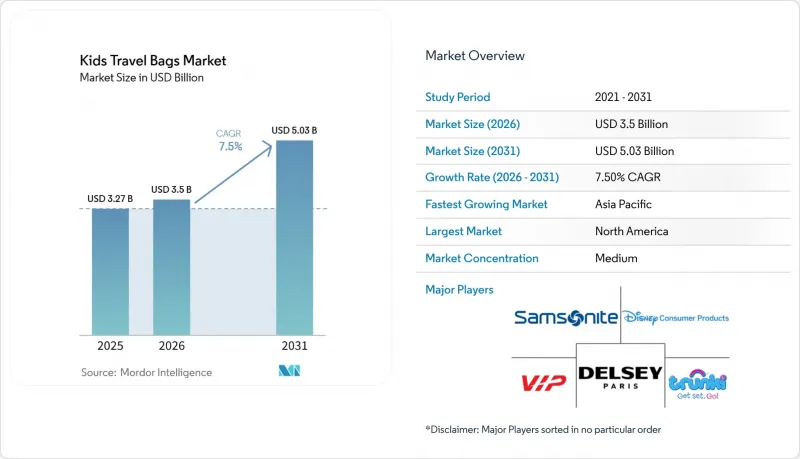
This report is Segmented by Material Types (Hard, Soft), Category (Mass, Premium), Distribution Channel (Online Retail Stores, Offline Retail Stores), and Geography (North America, Europe, Asia-Pacific, South America, Middle East and Africa). The Market Forecasts are Provided in Terms of Value (USD).
Global Kids Travel Bags Market Trends and Insights
Surge in demand for sustainable and eco-friendly materials
Manufacturers are reshaping product development cycles in response to sustainability mandates, driven by regulatory pressures and consumer demand for eco-friendly options. Samsonite, committed to science-based climate targets, aims for 100% renewable electricity in operations and a 52% reduction in Scope 3 emissions by 2030 . Moving beyond mere marketing, companies are genuinely embracing circular economy principles. For instance, Ninetygo has teamed up with Nongfu Spring to craft suitcases from post-consumer recycled polycarbonate, sourced from used water barrels. This initiative boasts an estimated 35% reduction in carbon emissions compared to conventional materials. Solo's Re: cycled Collection showcases the commercial potential of using ocean-bound plastics. Their production methods consume 50% less energy and 20% less water, with an ambitious goal of recycling 40 million bottles in the coming years. This push towards sustainability not only underscores environmental responsibility but also offers brands a chance to stand out in a competitive market, especially when integrating these values into durable designs for children's luggage.
Popularity of licensed characters and themed designs
Character licensing partnerships have transformed from mere logo placements to crafting immersive travel experiences for children. Bioworld's Disney-themed luggage collection stands as a testament to this shift. The collection boasts eye-catching designs, incorporates hidden Easter eggs, and draws color palettes from Disney's rich history. Moreover, it underscores durability, utilizing patent-pending materials for enhanced longevity. This licensing model not only diversifies revenue streams for manufacturers but also curtails marketing expenses by leveraging brand recognition. DELSEY's partnership with Jeep showcases the breadth of licensing, reaching beyond entertainment to lifestyle brands. Their luggage line captures Jeep's adventurous essence, featuring water-resistant materials and designs rooted in automotive heritage. Such collaborations empower manufacturers to set premium prices and lower customer acquisition costs, thanks to ingrained brand loyalty. However, these alliances come with challenges: a reliance on licensor relationships and the burden of ongoing royalty payments, which can strain margins in economic slumps.
Presence of counterfeit products
Counterfeit products threaten brand integrity and consumer safety. Amazon's launch of a Counterfeit Crimes Unit (CCU) underscores the enforcement challenges e-commerce platforms grapple with. The CCU has seized millions of counterfeit items and worked closely with law enforcement, highlighting the extensive resources needed to tackle sophisticated counterfeiting operations that prey on online marketplaces. Counterfeit luggage for children is especially concerning, as it may violate safety standards. Issues include the use of toxic materials, lack of structural integrity, and failure to meet flame-retardancy standards required for products meant for children. The rise of unlicensed character merchandise not only undermines legitimate licensing agreements but also confuses consumers, jeopardizing brand relationships cultivated over decades. E-commerce platforms strive to maintain an open marketplace while safeguarding brands. This delicate balance demands advanced detection algorithms and human oversight, increasing operational costs and potentially hindering product visibility for genuine sellers.
Other drivers and restraints analyzed in the detailed report include:
- Rise of luggage featuring ride-on and scooter integrations
- Increase in experiential learning trips and school excursions
- Child-contact materials face stringent safety standards
For complete list of drivers and restraints, kindly check the Table Of Contents.
Segment Analysis
In 2025, soft material type commands a dominant 72.05% market share, underscoring parental preferences for its lightweight and flexible designs. These designs not only cater to diverse packing needs but also mitigate injury risks during handling. The segment's supremacy is attributed to practical benefits: soft luggage is easier to stow in overhead compartments, boasts lower manufacturing costs for competitive pricing, and offers design flexibility. This flexibility allows for character licensing and vibrant graphics, making them particularly appealing to children. Meanwhile, hard material type, though a smaller segment, is on a rapid ascent, charting a 7.78% CAGR growth rate through 2031. This surge is fueled by hard luggage's enhanced security features and durability, which resonate with quality-conscious parents willing to pay a premium.
As families increasingly invest in electronic devices and educational materials for travel, there's a noticeable shift towards hard luggage. This shift underscores a growing consumer emphasis on product longevity and safeguarding valuable content. Tuplus's launch of carbon fiber composite suitcases, reinforced with aluminum and magnesium alloy frames, highlights the material innovations propelling hard luggage's popularity. Additionally, Covestro's Maezio thermoplastic composites offer superior impact resistance, setting a new standard against traditional materials. The premium status of hard luggage mirrors a wider trend in the premiumization of children's products, where parents increasingly prioritize safety and durability over mere cost. Furthermore, advancements in the production efficiency of thermoplastic composites are narrowing the cost disparity between hard and soft luggage. This trend could hasten the adoption of hard luggage as its price barriers continue to erode.
Geography Analysis
In 2025, North America commanded a dominant 38.87% share of the kids travel bags market. This stronghold is largely attributed to stringent oversight from the CPSC, which not only elevates entry barriers but also bolsters premium pricing. Factors such as household affluence, regular domestic flights, and travel programs from charter schools underpin a steady demand. Parents typically refresh their purchases every two to three years, either to accommodate growth spurts or to benefit from enhanced safety features. With a regulatory mandate for digital certificates by 2026, suppliers who streamline and automate their documentation processes are set to secure their market position.
Asia-Pacific is on track to achieve a 9.03% CAGR through 2031. This growth is fueled by an uptick in branded products in India. The burgeoning middle class, coupled with an expansion in organized retail, is driving up unit volumes. However, varying regulations, like Japan's unique classification for ride-on bags, necessitate swift product localization. Homegrown brands, such as Safari Industries, are extending their reach beyond metropolitan areas, further energizing the kids travel bags market. Meanwhile, Europe, though mature, remains a profitable landscape. Here, heightened environmental awareness and school exchange initiatives are propelling premium eco-friendly lines. Samsonite's strategic shift to 100% renewable energy and its experiments with circular design resonate with the sentiments of EU consumers, enhancing its brand prestige.
Efficient customs processes within the Schengen zone bolster cross-border e-commerce, enabling niche Scandinavian brands to gain traction across Europe. Demand remains steady, thanks to predictable spikes during summer and winter breaks, aiding precise inventory management. While South America, the Middle East, and Africa emerge as potential markets, challenges persist. Although airport expansions and the rise of low-cost carriers enhance accessibility, hurdles like import tariffs and income disparities limit immediate market penetration. Innovative bundles, such as pairing school backpacks with mini suitcases, could pave the way for initial market entry. As tourism infrastructure evolves, retailers who adopt flexible pricing strategies and offer micro-financing solutions are likely to dominate, expanding the kids travel bags market in these regions.
- Samsonite International S.A.
- VIP Industries Ltd.
- Delsey S.A.
- Heys International Ltd.
- Trunki (Magmatic Ltd.)
- Disney
- Totto (Nalsani S.A.)
- Osprey Packs Inc.
- Deuter Sport GmbH
- Vaude GmbH
- Adidas AG
- Nike Inc.
- Puma SE
- Herschel Supply Company Ltd.
- Skip Hop Inc.
- Modobag Inc.
- Zinc Sports Ltd.
- Stephen Joseph Inc.
- Wildkin Inc.
- Smiggle (Premier Investments Ltd.)
Additional Benefits:
- The market estimate (ME) sheet in Excel format
- 3 months of analyst support
TABLE OF CONTENTS
1 INTRODUCTION
- 1.1 Study Assumptions and Market Definition
- 1.2 Scope of the Study
2 RESEARCH METHODOLOGY
3 EXECUTIVE SUMMARY
4 MARKET LANDSCAPE
- 4.1 Market Overview
- 4.2 Market Drivers
- 4.2.1 Surge in demand for sustainable and eco-friendly materials
- 4.2.2 Popularity of licensed characters and themed designs
- 4.2.3 Rise of luggage featuring ride-on and scooter integrations
- 4.2.4 Increase in experiential learning trips and school excursions
- 4.2.5 Adoption of smart tracking chips for enhanced parental assurance
- 4.2.6 Influence of social media and travel trends encouraging family travel
- 4.3 Market Restraints
- 4.3.1 Presence of counterfeit products
- 4.3.2 High price sensitivity among parents limiting premium product adoption
- 4.3.3 Child-contact materials face stringent safety standards
- 4.3.4 Demand remains seasonal and sporadic
- 4.4 Consumer Behaviour Analysis
- 4.5 Regulatory Outlook
- 4.6 Technological Outlook
- 4.7 Porter's Five Forces
- 4.7.1 Threat of New Entrants
- 4.7.2 Bargaining Power of Buyers
- 4.7.3 Bargaining Power of Suppliers
- 4.7.4 Threat of Substitute Products
- 4.7.5 Intensity of Competitive Rivalry
5 MARKET SIZE AND GROWTH FORECASTS (VALUE)
- 5.1 By Material Types
- 5.1.1 Hard Material Type
- 5.1.2 Soft Material Type
- 5.2 By Category
- 5.2.1 Mass
- 5.2.2 Premium
- 5.3 By Distribution Channel
- 5.3.1 Online Retail Stores
- 5.3.2 Offline Retail Stores
- 5.4 By Geography
- 5.4.1 North America
- 5.4.1.1 United States
- 5.4.1.2 Canada
- 5.4.1.3 Mexico
- 5.4.1.4 Rest of North America
- 5.4.2 Europe
- 5.4.2.1 Germany
- 5.4.2.2 United Kingdom
- 5.4.2.3 Italy
- 5.4.2.4 France
- 5.4.2.5 Spain
- 5.4.2.6 Netherlands
- 5.4.2.7 Poland
- 5.4.2.8 Belgium
- 5.4.2.9 Sweden
- 5.4.2.10 Rest of Europe
- 5.4.3 Asia-Pacific
- 5.4.3.1 China
- 5.4.3.2 India
- 5.4.3.3 Japan
- 5.4.3.4 Australia
- 5.4.3.5 Indonesia
- 5.4.3.6 South Korea
- 5.4.3.7 Thailand
- 5.4.3.8 Singapore
- 5.4.3.9 Rest of Asia-Pacific
- 5.4.4 Middle East and Africa
- 5.4.4.1 South Africa
- 5.4.4.2 Saudi Arabia
- 5.4.4.3 United Arab Emirates
- 5.4.4.4 Nigeria
- 5.4.4.5 Egypt
- 5.4.4.6 Morocco
- 5.4.4.7 Turkey
- 5.4.4.8 Rest of Middle East and Africa
- 5.4.5 South America
- 5.4.5.1 Brazil
- 5.4.5.2 Argentina
- 5.4.5.3 Colombia
- 5.4.5.4 Chile
- 5.4.5.5 Peru
- 5.4.5.6 Rest of South America
- 5.4.1 North America
6 COMPETITIVE LANDSCAPE
- 6.1 Market Concentration
- 6.2 Strategic Moves
- 6.3 Market Share Analysis
- 6.4 Company Profiles (includes Global level Overview, Market level overview, Core Segments, Financials as available, Strategic Information, Market Rank/Share for key companies, Products and Services, and Recent Developments)
- 6.4.1 Samsonite International S.A.
- 6.4.2 VIP Industries Ltd.
- 6.4.3 Delsey S.A.
- 6.4.4 Heys International Ltd.
- 6.4.5 Trunki (Magmatic Ltd.)
- 6.4.6 Disney
- 6.4.7 Totto (Nalsani S.A.)
- 6.4.8 Osprey Packs Inc.
- 6.4.9 Deuter Sport GmbH
- 6.4.10 Vaude GmbH
- 6.4.11 Adidas AG
- 6.4.12 Nike Inc.
- 6.4.13 Puma SE
- 6.4.14 Herschel Supply Company Ltd.
- 6.4.15 Skip Hop Inc.
- 6.4.16 Modobag Inc.
- 6.4.17 Zinc Sports Ltd.
- 6.4.18 Stephen Joseph Inc.
- 6.4.19 Wildkin Inc.
- 6.4.20 Smiggle (Premier Investments Ltd.)
7 MARKET OPPORTUNITIES AND FUTURE OUTLOOK

