PUBLISHER: Mordor Intelligence | PRODUCT CODE: 2062249

PUBLISHER: Mordor Intelligence | PRODUCT CODE: 2062249
Medical Device Adhesive - Market Share Analysis, Industry Trends & Statistics, Growth Forecasts (2026 - 2031)
According to Mordor Intelligence, the medical device adhesive market size is expected to grow from USD 11.12 billion in 2025 to USD 11.98 billion in 2026 and is forecast to reach USD 17.40 billion by 2031 at 7.75% CAGR over 2026-2031.
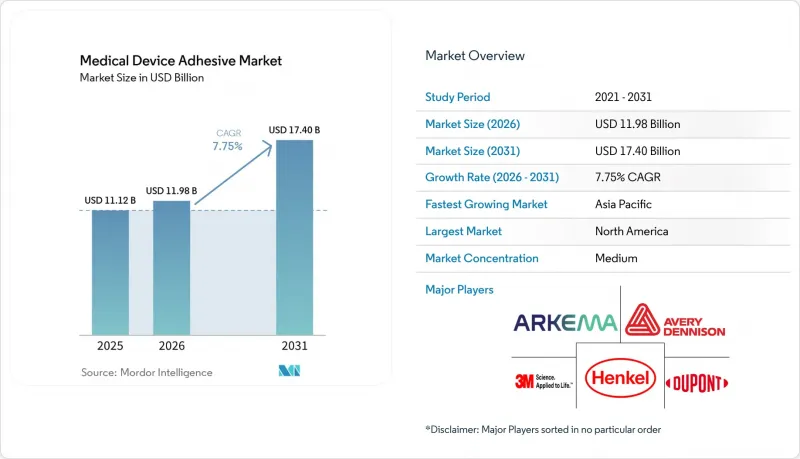
This report is Segmented by Resin (Acrylic, and More), Technology (Water-Based, and More), Adhesive Form (Pressure-Sensitive Films and Tapes, Structural/Semi-Structural Liquids, and More), Application (Medical Devices and Equipment, and More), and Geography (Asia-Pacific, North America, Europe, South America, and the Middle East and Africa). The Market Forecasts are Provided in Terms of Value (USD).
Global Medical Device Adhesive Market Trends and Insights
Surge in Remote-Monitoring and Wearable Therapeutic Devices
Wearable devices now demand skin adhesion for 7-14 days without sensitization. Medtronic showed silicone-acrylate hybrids cut erythema scores 35% versus standard acrylics in 2025 trials, thanks to silicone surface energies near 20 dynes/cm that limit protein adsorption. The FDA cleared 14 new adhesive-backed insulin-delivery systems during 2025, each passing ISO 10993-10 and -23 protocols. Co-development of tapes at the design stage has replaced retrofit approaches, optimizing peel strengths of 400-600 g/inch and moisture-vapor transmission above 800 g/m2/24 h.
Expansion of Single-Use and Minimally-Invasive Catheter Platforms
EU MDR 2017/745 tightened re-use rules in 2024, prompting rapid growth of disposable catheters. Boston Scientific reported 28% sales growth in single-use ureteroscopes aided by UV-curable balloon bonds with 5-second cure times. Stryker applies low-viscosity cyanoacrylates that wick into less than100-µm gaps on neurovascular devices, meeting ISO 10993-18 extractables thresholds under 0.1 ppm. The quick cure slashes work-in-process inventories by 40%.
Complex ISO-10993 Biocompatibility and Extractables Testing Burden
ISO 10993-1:2018 now mandates chemical characterization before biological tests, adding 18-24 months and USD 200,000-500,000 per new formulation. Contract-lab backlogs stretched to 16 weeks in 2025, delaying launches. REACH Annex XVII phthalate bans, effective June 2024, forced re-qualification of legacy tapes throughout Europe.
Other drivers and restraints analyzed in the detailed report include:
- Growth in Home-Infusion Pumps Requiring Long-Wear PSAs
- Wider Adoption of Hydrogel and Bio-Resorbable Adhesive Chemistries
- Cost Volatility of Medical-Grade Silicone and Specialty Acrylates
For complete list of drivers and restraints, kindly check the Table Of Contents.
Segment Analysis
Acrylics held 29.05% of the medical device adhesive market share in 2025 because of their USD 4.50-6.00/kg cost and 200-m/min coating speeds. Silicone resins are on track for an 8.11% CAGR between 2026 and 2031 as device makers favor adhesives that maintain greater than or equal to 400 g/in peel after 25-kGy gamma cycles. Yet ISO 10993-5 cytotoxicity scores below 1 for silicones are steering long-wear CGM and insulin-pump platforms their way. Niche cyanoacrylates, as seen in Ethicon's Dermabond Prineo 2.0, cut closure time 30% in a 450-patient trial.
Polyurethane chemistries underpin structural bonds in implantable pulse generators that require greater than or equal to 2,500 psi lap-shear, while epoxies dominate catheter-tip assembly. FDA clearance of six cyanoacrylate surgical sealants during 2025 confirms regulatory comfort when formaldehyde release stays under 2 ppm.
Water-based chemistries retained 34.82% share of the medical device adhesive market size in 2025 under tight EU VOC caps, yet their 15-30 minute dry times limit throughput. Dymax's 405-nm LED line cures to 75 Shore D in 3s, trimming energy use 85% versus mercury lamps. UV/radiation-curable adhesives will post an 8.35% CAGR through 2031, propelled by zero-VOC processing and sub-5-second cures that align with injection-molding tact times.
Solvent-based systems endure where gap filling or long open times are needed, and hot-melts are growing in surgical-drape attachment with 120-140°C melt points. Hybrid dual-cure epoxies that photopolymerize surfaces and dark-cure hidden joints over 24 h eliminate voids in complex geometries.
Geography Analysis
North America held 38.11% of global revenue in 2025, sustained by FDA 510(k) clearances that can close in 120 days and a critical mass of CGM and insulin-pump production. Abbott, Dexcom, and Medtronic shipped 8.2 million sensors in 2025, all using silicone-acrylate hybrids qualified to ISO 10993-10 for 14-day wear. Solventum's spin-off unlocked USD 180 million for new ISO-10993 labs, while Henkel added 8,000 tons of UV-curable capacity in Mexico to meet near-shoring demand.
Asia-Pacific is the fastest-growing region at an 8.46% CAGR from 2026 to 2031. China's NMPA aligned with ISO 10993 and saw a 12% device-market jump in 2025; Mindray and United Imaging integrated structural adhesives in new imaging gear. Japan okayed 18 adhesive-containing devices during 2025, and Dow opened a 3,500-ton silicone plant in Pune under India's PLI scheme. South Korea's MFDS approval of Samsung's Galaxy Watch 6 Medical Edition showcased conductive polyurethane adhesives delivering 0.8 Ω/square sheet resistance during 20% wrist flex.
In Europe, MDR enforcement tightened evidence demands. Germany's Lohmann converted 68% of its catalog to bio-based acrylates, lowering CO2 footprints 22%. The U.K. introduced a fast-track path for FDA-cleared adhesives, France prioritized diabetic wound-care reimbursement, and Urgo's hydrocolloid-silver dressing cut healing times 25%. Russia's import-substitution policy spurred domestic cyanoacrylate launches at a 30-35% price edge.
- 3M
- Arkema (Bostik)
- Avery Dennison Corporation
- Beacon Adhesives, Inc.
- CHEMENCE
- Dow
- DuPont (Liveo)
- Dymax Corporation
- EpoxySet, Inc.
- Franklin International
- H.B. Fuller Company
- Henkel AG & Co. KGaA
- Hoenle AG
- Lohmann GmbH & Co. KG
- Master Bond Inc.
- Nitto Denko Corporation
- Permabond LLC
- Scapa
- Wacker Chemie AG
Additional Benefits:
- The market estimate (ME) sheet in Excel format
- 3 months of analyst support
TABLE OF CONTENTS
1 Introduction
- 1.1 Study Assumptions and Market Definition
- 1.2 Scope of the Study
2 Research Methodology
3 Executive Summary
4 Market Landscape
- 4.1 Market Overview
- 4.2 Market Drivers
- 4.2.1 Surge in remote-monitoring and wearable therapeutic devices
- 4.2.2 Expansion of single-use and minimally-invasive catheter platforms
- 4.2.3 Growth in home-infusion pumps requiring long-wear PSAs
- 4.2.4 Wider adoption of hydrogel and bio-resorbable adhesive chemistries
- 4.2.5 Emergence of printed self-powered biosensor patches needing stretchable conductive adhesives
- 4.2.6 AI-driven inline optical-curing QA boosting assembly line throughput
- 4.3 Market Restraints
- 4.3.1 Complex ISO-10993 biocompatibility and extractables testing burden
- 4.3.2 Cost volatility of medical-grade silicone and specialty acrylates
- 4.3.3 Sterilization-induced crosslink-density drift reducing shelf-life of advanced PSAs
- 4.3.4 Supply risk of pharma-grade tackifier resins due to SE-US pine-blight
- 4.4 Value Chain Analysis
- 4.5 Porter's Five Forces
- 4.5.1 Bargaining Power of Suppliers
- 4.5.2 Bargaining Power of Buyers
- 4.5.3 Threat of New Entrants
- 4.5.4 Threat of Substitutes
- 4.5.5 Competitive Rivalry
5 Market Size and Growth Forecasts (Value)
- 5.1 By Resin
- 5.1.1 Acrylic
- 5.1.2 Cyanoacrylate
- 5.1.3 Silicone
- 5.1.4 Polyurethane
- 5.1.5 Epoxy
- 5.1.6 Other Resins
- 5.2 By Technology
- 5.2.1 Water-based
- 5.2.2 Solvent-based
- 5.2.3 Hot-melt
- 5.2.4 UV/Radiation-curable
- 5.3 By Adhesive Form
- 5.3.1 Pressure-Sensitive Films and Tapes
- 5.3.2 Structural/Semi-Structural Liquids
- 5.3.3 Gels and Hydrocolloid Patches
- 5.3.4 Sprayable/Foam Adhesives
- 5.4 By Application
- 5.4.1 Medical Devices and Equipment
- 5.4.2 External Medical Application
- 5.4.3 Dental
- 5.4.4 Internal Medical Applications
- 5.4.5 Others
- 5.5 By Geography
- 5.5.1 Asia-Pacific
- 5.5.1.1 China
- 5.5.1.2 Japan
- 5.5.1.3 India
- 5.5.1.4 South Korea
- 5.5.1.5 ASEAN Countries
- 5.5.1.6 Rest of Asia-Pacific
- 5.5.2 North America
- 5.5.2.1 United States
- 5.5.2.2 Canada
- 5.5.2.3 Mexico
- 5.5.3 Europe
- 5.5.3.1 Germany
- 5.5.3.2 United Kingdom
- 5.5.3.3 France
- 5.5.3.4 Italy
- 5.5.3.5 Spain
- 5.5.3.6 Russia
- 5.5.3.7 Rest of Europe
- 5.5.4 South America
- 5.5.4.1 Brazil
- 5.5.4.2 Argentina
- 5.5.4.3 Rest of South America
- 5.5.5 Middle East and Africa
- 5.5.5.1 Saudi Arabia
- 5.5.5.2 South Africa
- 5.5.5.3 Rest of Middle East and Africa
- 5.5.1 Asia-Pacific
6 Competitive Landscape
- 6.1 Market Concentration
- 6.2 Strategic Moves
- 6.3 Market Share (%)/Ranking Analysis
- 6.4 Company Profiles (includes Global level Overview, Market level overview, Core Segments, Financials as available, Strategic Information, Products and Services, and Recent Developments)
- 6.4.1 3M
- 6.4.2 Arkema (Bostik)
- 6.4.3 Avery Dennison Corporation
- 6.4.4 Beacon Adhesives, Inc.
- 6.4.5 CHEMENCE
- 6.4.6 Dow
- 6.4.7 DuPont (Liveo)
- 6.4.8 Dymax Corporation
- 6.4.9 EpoxySet, Inc.
- 6.4.10 Franklin International
- 6.4.11 H.B. Fuller Company
- 6.4.12 Henkel AG & Co. KGaA
- 6.4.13 Hoenle AG
- 6.4.14 Lohmann GmbH & Co. KG
- 6.4.15 Master Bond Inc.
- 6.4.16 Nitto Denko Corporation
- 6.4.17 Permabond LLC
- 6.4.18 Scapa
- 6.4.19 Wacker Chemie AG
7 Market Opportunities and Future Outlook
- 7.1 White-space and Unmet-Need Assessment

