PUBLISHER: Mordor Intelligence | PRODUCT CODE: 2062262

PUBLISHER: Mordor Intelligence | PRODUCT CODE: 2062262
Enterprise Social Software - Market Share Analysis, Industry Trends & Statistics, Growth Forecasts (2026 - 2031)
According to Mordor Intelligence, the enterprise social software market size is expected to be USD 18.8 billion in 2025, USD 22.15 billion in 2026, and reach USD 50.24 billion by 2031, growing at a CAGR of 17.8% from 2026 to 2031.
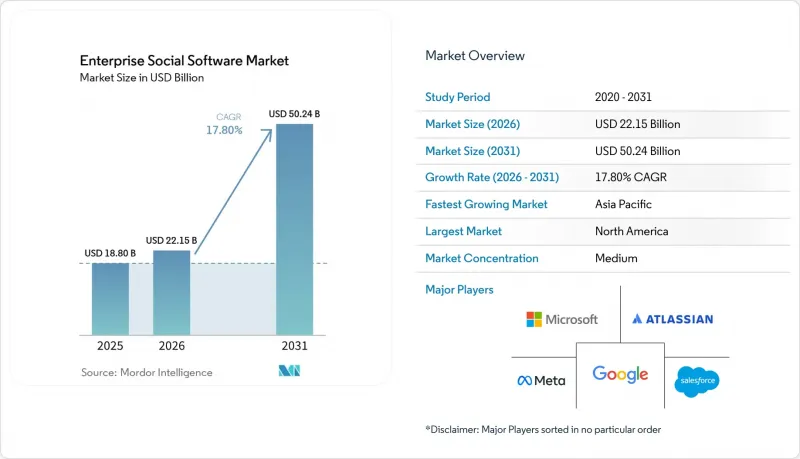
This report is Segmented by Feature Module (Internal Communications, Employee Recognition and Wellness, and More), Organization Size (SMEs, and Large Enterprises), Delivery Channel (Mobile-First, Web Browser, and More), Industry Vertical (Healthcare, IT and Telecom, Retail and ECommerce, and More), and Geography (North America, and More). The Market Forecasts are Provided in Terms of Value (USD).
Global Enterprise Social Software Market Trends and Insights
Permanent Hybrid-Work Culture
Hybrid arrangements have become the default operating model, with three out of four enterprises retaining formal split-location policies. This permanence has exposed the limits of email and meeting-centric collaboration, prompting a 91% increase in asynchronous tool budgets between 2024 and 2025. Knowledge-intensive sectors such as IT and telecom accelerated adoption because incident response and code reviews demand persistent, searchable discussion threads. Microsoft's 2026 decision to surface Viva Engage communities directly inside Teams highlights the vendor's recognition that context switching suppresses engagement. Organizations that fail to converge chat, content, and tasks into a single AI-powered hub risk locking 60% of employee time into "work about work," which is why platform consolidation is expected to intensify through 2031.
Rising SaaS Adoption for Lower TCO
Cloud migration originally promised capital-expense relief, yet premium pricing for AI add-ons is inflating operating budgets. Salesforce and Microsoft now charge USD 30-USD 60 per user each month for generative functionality, pushing finance teams to reassess lifetime subscription costs. Vendors such as Zoho are winning cost-sensitive customers by embedding AI in base tiers, delivering predictable pricing that appeals to small businesses. Asia-Pacific enterprises, many of which never owned on-premises stacks, are leapfrogging directly to SaaS and favoring mobile-first suites that mirror consumer experiences. Even so, usage-based billing tied to token consumption is introducing forecast volatility that controllers must model into 2027 and 2028 budgets.
Data-Sovereignty and Privacy Risks
GDPR and similar statutes mandate strict residency rules that complicate global roll-outs. A growing share of European enterprises invest in sovereign-cloud zones to avoid cross-border transfer triggers, which raises hosting costs and lengthens procurement cycles. Multinationals must segment user traffic by jurisdiction, adding architectural complexity that can slow adoption. Platform vendors address the issue with in-region data centres and granular encryption keys, yet some buyers still delay purchases until compliance evidence matures. These dynamics temper the growth curve of the enterprise social software market in privacy-sensitive sectors.
Other drivers and restraints analyzed in the detailed report include:
- Productivity-Suite Integrations
- ESG-Linked Employee-Engagement Needs
- Cultural Resistance to Open Sharing
For complete list of drivers and restraints, kindly check the Table Of Contents.
Segment Analysis
Generative AI in knowledge discovery is experiencing significant growth, with a compound annual growth rate (CAGR) of 21.20%. This growth rate surpasses that of the broader enterprise social software market, highlighting its increasing importance. By 2025, internal communications are projected to account for 40.70% of the enterprise social software market share. However, its dominance is expected to decline as organizations shift their budgets toward advanced modules. These modules focus on automatically surfacing expertise and summarizing extensive document repositories, addressing the growing need for efficiency in knowledge management. The shift reflects a broader trend of enterprises prioritizing tools that enhance productivity and streamline access to critical information.
Unstructured institutional memory currently leads to an average of 1.8 hours of daily search time per employee, creating inefficiencies. Enterprises are actively investing in solutions to transform this lost time into actionable insights, driving productivity. Recognition and wellness modules are gaining traction due to their alignment with environmental, social, and governance (ESG) priorities. Meanwhile, ideation hubs remain predominantly utilized in research and development (R&D)-intensive sectors. Additionally, project collaboration and file-sharing functionalities are increasingly integrated into productivity suites, compelling standalone vendors to differentiate themselves. These vendors are focusing on vertical-specific workflows or enhancing AI explainability to remain competitive in a rapidly evolving market landscape.
Large enterprises commanded 56.60% of the 2025 revenue pool, yet SMEs are advancing at an 18.60% CAGR, narrowing the usage divide. The enterprise social software market size for SME deployments is projected to accelerate as smaller firms bypass on-premises legacies and adopt cloud suites with mobile administration. This trend highlights the growing preference among SMEs for modern, flexible solutions that align with their operational agility. The shift is primarily driven by the need for cost-effective and scalable technologies that can adapt to the dynamic and evolving requirements of smaller businesses. Additionally, the increasing availability of cloud-based tools with enhanced features is further encouraging SMEs to transition away from traditional systems. This evolution is expected to significantly impact the competitive landscape of the enterprise social software market.
SMEs are increasingly drawn to predictable per-user fees and simplified onboarding processes, which reduce implementation complexities. These pricing models and streamlined processes enable smaller businesses to adopt enterprise social software without the burden of high upfront costs or technical challenges. Vendors like Zoho and MangoApps are addressing these specific needs by offering packaged industry templates tailored for SMEs, ensuring faster deployment and usability. Meanwhile, large organizations negotiate enterprise agreements that bundle AI, security, and analytics, leveraging hyperscaler ecosystems for their comprehensive offerings. This dual approach by vendors reflects the diverse needs of SMEs and large enterprises. Atlassian's modular pricing strategy exemplifies this adaptability, allowing businesses to scale from small team deployments to global rollouts seamlessly, without requiring platform migration.
Geography Analysis
North America held 37.70% of 2025 revenue and remains the reference market for AI-infused collaboration. U.S. enterprises are leading global pilots of knowledge-synthesis agents, which are designed to enhance productivity and streamline workflows. Vendor consolidation has intensified following Meta's exit from Workplace, highlighting the growing importance of integrated productivity clouds. Additionally, regulatory pressures to disclose employee-engagement metrics under ESG frameworks are driving platform renewals. The region's strong technological infrastructure and early adoption of advanced solutions further solidify its position as a critical hub for innovation and adoption in the enterprise social software market.
Asia-Pacific is the fastest-growing region, with an 18.70% CAGR, as digital workplace maturity reached 66.35% in 2025. Key markets such as India, Japan, and Australia are anchoring investments in enterprise social software, while China's localization rules are fostering separate domestic deployments, favoring Tencent and Alibaba infrastructure. SMEs across the region are rapidly adopting cloud suites, significantly contributing to user-count growth, even though the average revenue per user remains lower compared to North American benchmarks. The region's growth is further supported by increasing digital transformation initiatives, government policies promoting cloud adoption, and the rising demand for scalable and cost-effective solutions among smaller businesses.
Europe faces slower uptake due to GDPR complexities and macroeconomic uncertainties, yet it remains a strategic market for enterprise social software. Data-sovereignty capabilities proven in Europe are becoming baseline expectations in other regions, making it a testing ground for compliance-driven innovations. Germany, the United Kingdom, and France are focusing on ESG-linked engagement metrics, which are influencing platform development and adoption. Meanwhile, South America and the Middle East and Africa present mobile-led greenfield opportunities. However, these regions face challenges such as currency volatility, limited infrastructure, and slower digital transformation, which could temper growth despite their potential for market expansion.
- Microsoft Corporation
- Salesforce Inc
- Google LLC
- Atlassian Corporation
- International Business Machines Corporation
- Meta Platforms Inc
- SAP SE
- Oracle Corporation
- Zoho Corporation Pvt Ltd
- Aurea Inc Jive Software
- LumApps SAS
- MangoApps Inc
- Igloo Software Inc
- Limeade Inc incl Sitrion
- Axero Solutions LLC
- Simpplr Inc
- Happeo Oy
- Staffbase GmbH
- Firstup Inc
- Unily Ltd
Additional Benefits:
- The market estimate (ME) sheet in Excel format
- 3 months of analyst support
TABLE OF CONTENTS
1 INTRODUCTION
- 1.1 Study Assumptions and Market Definition
- 1.2 Scope of the Study
2 RESEARCH METHODOLOGY
3 EXECUTIVE SUMMARY
4 MARKET LANDSCAPE
- 4.1 Market Overview
- 4.2 Market Drivers
- 4.2.1 Permanent Hybrid-Work Culture
- 4.2.2 Rising SaaS Adoption for Lower TCO
- 4.2.3 Productivity-Suite Integrations
- 4.2.4 ESG-Linked Employee-Engagement Needs
- 4.2.5 Gen-AI Powered Knowledge Discovery
- 4.2.6 Verticalised Intranet Templates
- 4.3 Market Restraints
- 4.3.1 Data-Sovereignty and Privacy Risks
- 4.3.2 Cultural Resistance to Open Sharing
- 4.3.3 Collaboration-Tool Fatigue
- 4.3.4 LLM-Integration Lock-In Concerns
- 4.4 Industry Value / Supply-Chain Analysis
- 4.5 Impact of Macroeconomic Factors on the Market
- 4.6 Technological Outlook
- 4.7 Porter's Five Forces Analysis
- 4.7.1 Threat of New Entrants
- 4.7.2 Bargaining Power of Suppliers
- 4.7.3 Bargaining Power of Buyers
- 4.7.4 Threat of Substitutes
- 4.7.5 Competitive Rivalry
5 MARKET SIZE AND GROWTH FORECASTS VALUE
- 5.1 By Feature Module
- 5.1.1 Internal Communications
- 5.1.2 Knowledge Management
- 5.1.3 Employee Recognition and Wellness
- 5.1.4 Ideation Innovation Hubs
- 5.1.5 Others Feature Module
- 5.2 By Organization Size
- 5.2.1 Small and Medium Enterprises SMEs
- 5.2.2 Large Enterprises
- 5.3 By Delivery Channel
- 5.3.1 Mobile First
- 5.3.2 Web Browser
- 5.3.3 Desktop Client
- 5.4 By Industry Vertical
- 5.4.1 BFSI
- 5.4.2 Healthcare
- 5.4.3 IT and Telecom
- 5.4.4 Retail and eCommerce
- 5.4.5 Government and Public Sector
- 5.4.6 Manufacturing
- 5.4.7 Other Industry Verticals
- 5.5 By Geography
- 5.5.1 North America
- 5.5.1.1 United States
- 5.5.1.2 Canada
- 5.5.1.3 Mexico
- 5.5.2 Europe
- 5.5.2.1 Germany
- 5.5.2.2 United Kingdom
- 5.5.2.3 France
- 5.5.2.4 Italy
- 5.5.2.5 Spain
- 5.5.2.6 Rest of Europe
- 5.5.3 Asia Pacific
- 5.5.3.1 China
- 5.5.3.2 Japan
- 5.5.3.3 India
- 5.5.3.4 South Korea
- 5.5.3.5 Australia
- 5.5.3.6 Rest of Asia Pacific
- 5.5.4 South America
- 5.5.4.1 Brazil
- 5.5.4.2 Argentina
- 5.5.4.3 Rest of South America
- 5.5.5 Middle East and Africa
- 5.5.5.1 Middle East
- 5.5.5.1.1 Saudi Arabia
- 5.5.5.1.2 United Arab Emirates
- 5.5.5.1.3 Rest of Middle East
- 5.5.5.2 Africa
- 5.5.5.2.1 South Africa
- 5.5.5.2.2 Egypt
- 5.5.5.2.3 Rest of Africa
- 5.5.5.1 Middle East
- 5.5.1 North America
6 COMPETITIVE LANDSCAPE
- 6.1 Market Concentration
- 6.2 Strategic Moves
- 6.3 Market Share Analysis
- 6.4 Company Profiles
- 6.4.1 Microsoft Corporation
- 6.4.2 Salesforce Inc
- 6.4.3 Google LLC
- 6.4.4 Atlassian Corporation
- 6.4.5 International Business Machines Corporation
- 6.4.6 Meta Platforms Inc
- 6.4.7 SAP SE
- 6.4.8 Oracle Corporation
- 6.4.9 Zoho Corporation Pvt Ltd
- 6.4.10 Aurea Inc Jive Software
- 6.4.11 LumApps SAS
- 6.4.12 MangoApps Inc
- 6.4.13 Igloo Software Inc
- 6.4.14 Limeade Inc incl Sitrion
- 6.4.15 Axero Solutions LLC
- 6.4.16 Simpplr Inc
- 6.4.17 Happeo Oy
- 6.4.18 Staffbase GmbH
- 6.4.19 Firstup Inc
- 6.4.20 Unily Ltd
7 MARKET OPPORTUNITIES AND FUTURE OUTLOOK
- 7.1 White Space and Unmet Need Assessment

