PUBLISHER: Mordor Intelligence | PRODUCT CODE: 2062273

PUBLISHER: Mordor Intelligence | PRODUCT CODE: 2062273
Retail Logistics - Market Share Analysis, Industry Trends & Statistics, Growth Forecasts (2026 - 2031)
According to Mordor Intelligence, the retail logistics market size is projected to expand from USD 1.15 trillion in 2025 and USD 1.22 trillion in 2026 to USD 1.57 trillion by 2031, registering a 5.25% CAGR between 2026 and 2031.
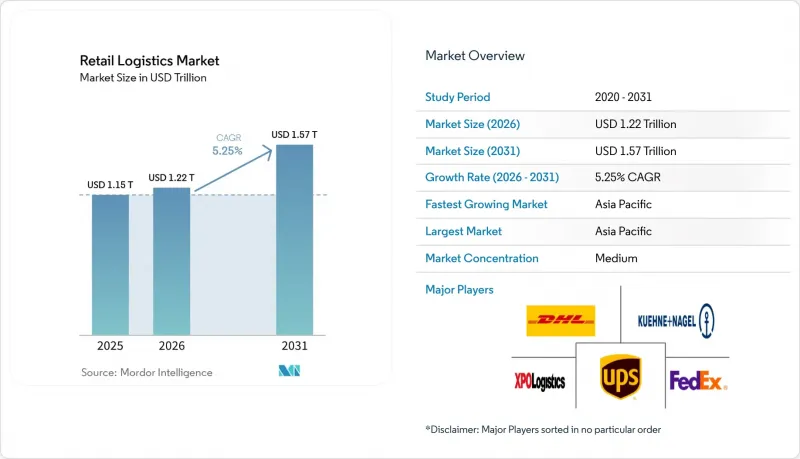
Automation roll-outs, subscription-commerce volumes, and blockchain traceability mandates are combining to reconfigure fulfillment economics, especially in last-mile and reverse-logistics settings. This report is Segmented by Service Type (Transportation, Warehousing and Distribution, and More), by Product (Foods and Beverages, Personal and Household Care, and More), by Distribution Channel (Super/Hyper/Convenience and Department Stores, Specialty Stores, and More), by Geography (North America, South America, Asia-Pacific, Europe, and More). The Market Forecasts are Provided in Terms of Value (USD).
Global Retail Logistics Market Trends and Insights
Scale Deployment of Autonomous Delivery Robots and Drones
Autonomous delivery fleets continued to solidify their commercial scale through 2025. Building on earlier milestones such as Walmart surpassing 20,000 drone deliveries across seven U.S. states in early 2024, the sector saw significant ongoing expansion. Amazon's Prime Air also expanded into the Phoenix metro area, underscoring a corporate goal of moving 500 million packages annually by aerial means before 2031. Ground-based robots from Starship Technologies now operate on over 60 university campuses and across more than 270 global locations, cutting last-mile costs by up to 60% for quick-commerce orders. Subscription programs supply the predictable order density needed to maximize battery usage and fleet turnaround times. As regulators issue sandbox permits in Asia-Pacific and Europe, cross-border technology standards are expected to converge, enabling further scale gains.
Growth of Resale / Circular Retail Spurring Reverse-Logistics Platforms
Circular retail activity is accelerating reverse-logistics investments, highlighted by DHL's 2025 purchase of Inmar Supply Chain Solutions, which added 14 returns centers and 800 specialists to its North American network. Resale marketplaces such as ThredUp and Vestiaire Collective depend on high-throughput authentication lines that traditional forward networks cannot match. Brands are internalizing take-back loops, Patagonia's Worn Wear and Lululemon's Like New programs process returned goods for verified resale, protecting brand equity. Blockchain tagging verifies provenance and condition, building consumer trust while reducing counterfeit risk. Continued regulatory support for waste-reduction targets should keep funding flowing toward dedicated returns infrastructure.
Volatile Cross-Border Tariffs Impacting Route Economics
Tariff swings on United States-China trade lanes altered landed-cost math several times in 2025, compelling retailers to dual-source from Mexico to hedge duty risks. Nearshoring demand drove UPS's buyout of Estafeta, giving it express reach across 160 Mexican cities. Yet last-minute rule changes force carriers to renegotiate fuel-surcharge clauses, adding administrative friction. Elevated uncertainty pushes warehouse lessors to shorten contract terms, raising per-square-foot rates. The outlook suggests persistent volatility until multilateral trade forums settle on longer-cycle frameworks.
Other drivers and restraints analyzed in the detailed report include:
- Cold-Chain Build-Out for Fresh Grocery E-Commerce
- Subscription-Commerce Models Stabilizing Delivery Demand
- Warehouse Real-Estate Scarcity in Tier-1 Metros Inflating 3PL Costs
For complete list of drivers and restraints, kindly check the Table Of Contents.
Segment Analysis
Transportation accounted for 62.1% of the retail logistics market share in 2025, reflecting the indispensable role of domestic road freight in last-mile fulfillment. Road carriers benefit from rich route networks that link warehouses to urban micro-hubs, while rail captures bulk upstream moves for cost efficiency. Sea lanes handle most cross-border volume, though tariff volatility is prompting lane diversification into alternate ports. Value-added services, although smaller, are registering a 6.5% CAGR and converting compliance pain points into premium revenue streams. Reverse logistics, product customization, and inspection lines enable retailers to support circular models without building proprietary infrastructure.
Automation is reshaping both ends of the service spectrum. Autonomous trucks are beginning hub-to-hub pilots on interstate corridors, while warehouse robots cut average pick times by 40% to 50%. DHL's Inmar acquisition exemplifies the stitched-together model, merging transport density with specialized return centers. Blockchain add-ons verify product authenticity at handoff, giving value-added divisions a technology moat. As ESG audits tighten, carbon-counting dashboards are likely to migrate from consultancy upgrades into standard service-level agreements.
Geography Analysis
Asia-Pacific led the Retail logistics market with a 39.8% share in 2025 and is set to grow at a 6.9% CAGR through 2031. China's government-designated autonomous-vehicle zones in Shanghai and Shenzhen carve out low-friction corridors for drone and robot testing, accelerating commercial deployments. India's National Logistics Policy unlocks funding for freight corridors and cold-chain clusters, lowering barrier costs for fresh-food e-commerce. Southeast Asian smart-city blueprints in Singapore and Kuala Lumpur integrate digital twins that feed live traffic data into routing engines, keeping delivery windows tight despite urban congestion.
North America remains a technology testbed but wrestles with land scarcity in tier-1 metros, elevating lease rates and nudging 3PLs toward multi-story hubs. Warehouse automation uptake is high, yet ESG disclosure rules emanating from corporate clients push carriers to measure diesel usage down to the parcel. Cross-border dynamics with Mexico intensify as nearshoring relocates portions of consumer-electronics assembly closer to United States buyers, shortening transit times and insulating supply chains from tariff risk.
Europe focuses on emissions compliance, with the Corporate Sustainability Reporting Directive enforcing cradle-to-gate carbon tallies that reshape procurement checklists. Vertical integration of port and rail assets in Rotterdam and Hamburg provides corridor visibility for shippers juggling green quotas. Latin America captures spillover investment through UPS's Estafeta network expansion, though infrastructure gaps and customs complexity temper growth. Middle East and Africa markets show patchy progress Gulf Cooperative Council states invest in bonded logistics parks, while many sub-Saharan countries prioritize road connectivity before high-tech upgrades can gain traction.
- DHL Supply Chain & Global Forwarding
- UPS Supply Chain Solutions
- FedEx Logistics
- XPO Logistics
- Kuehne + Nagel International
- C.H. Robinson Worldwide
- JD Logistics
- Cainiao (Alibaba Logistics)
- SF Express
- Geodis
- DSV A/S
- Rakuten Super Logistics
- GXO Logistics
- Aramex
- CEVA Logistics
- Ryder Supply Chain Solutions
- Hellmann Worldwide Logistics
- Nippon Express
- J.B. Hunt Transport Services
- Dachser
Additional Benefits:
- The market estimate (ME) sheet in Excel format
- 3 months of analyst support
TABLE OF CONTENTS
1 Introduction
- 1.1 Study Assumptions & Market Definition
- 1.2 Scope of the Study
2 Research Methodology
3 Executive Summary
4 Market Landscape
- 4.1 Market Overview
- 4.2 Market Drivers
- 4.2.1 Scale Deployment of Autonomous Delivery Robots and Drones
- 4.2.2 Growth of Resale / Circular Retail Spurring Reverse-Logistics Platforms
- 4.2.3 Subscription-Commerce Models Stabilizing Delivery Demand
- 4.2.4 Cold-Chain Build-out for Fresh Grocery E-commerce
- 4.2.5 Blockchain-based Traceability Mandates from Major Brands
- 4.2.6 Retail Media Networks Driving Data-Centric Inventory Positioning
- 4.3 Market Restraints
- 4.3.1 Volatile Cross-Border Tariffs Impacting Route Economics
- 4.3.2 Warehouse Real-Estate Scarcity in Tier-1 Metros Inflating 3Pl Costs
- 4.3.3 ESG Audit Pressures Elevating Emissions-Measurement Capex
- 4.3.4 AI-Skills Shortage Delaying Digital-Twin Roll-Outs
- 4.4 Value / Supply-Chain Analysis
- 4.5 Government Regulations and Policies
- 4.6 Technological Innovations in the Industry
- 4.7 Impact of Geopolitical Events on the Market
- 4.8 Porter's Five Forces
- 4.8.1 Competitive Rivalry
- 4.8.2 Threat of New Entrants
- 4.8.3 Bargaining Power of Suppliers
- 4.8.4 Bargaining Power of Buyers
- 4.8.5 Threat of Substitutes
5 Market Size & Growth Forecasts (Value)
- 5.1 By Service Type
- 5.1.1 Transportation
- 5.1.1.1 Road
- 5.1.1.2 Rail
- 5.1.1.3 Air
- 5.1.1.4 Sea and Inland Waterway
- 5.1.2 Warehousing & Distribution
- 5.1.3 Value-Added Services
- 5.1.1 Transportation
- 5.2 By Product
- 5.2.1 Foods and Beverages
- 5.2.2 Personal and Household Care
- 5.2.3 Fashion and Lifestyle (accessories, apparel, footwear)
- 5.2.4 Furniture
- 5.2.5 Electronics and Household Appliances
- 5.2.6 Other Products
- 5.3 By Distribution Channel
- 5.3.1 Super/Hyper/Convenience and Department Stores
- 5.3.2 Specialty Stores
- 5.3.3 Online
- 5.3.4 Other Channels
- 5.4 By Geography
- 5.4.1 North America
- 5.4.1.1 United States
- 5.4.1.2 Canada
- 5.4.1.3 Mexico
- 5.4.2 South America
- 5.4.2.1 Brazil
- 5.4.2.2 Peru
- 5.4.2.3 Chile
- 5.4.2.4 Argentina
- 5.4.2.5 Rest of South America
- 5.4.3 Asia-Pacific
- 5.4.3.1 India
- 5.4.3.2 China
- 5.4.3.3 Japan
- 5.4.3.4 Australia
- 5.4.3.5 South Korea
- 5.4.3.6 South East Asia (Singapore, Malaysia, Thailand, Indonesia, Vietnam, and Philippines)
- 5.4.3.7 Rest of Asia-Pacific
- 5.4.4 Europe
- 5.4.4.1 United Kingdom
- 5.4.4.2 Germany
- 5.4.4.3 France
- 5.4.4.4 Spain
- 5.4.4.5 Italy
- 5.4.4.6 BENELUX (Belgium, Netherlands, and Luxembourg)
- 5.4.4.7 NORDICS (Denmark, Finland, Iceland, Norway, and Sweden)
- 5.4.4.8 Rest of Europe
- 5.4.5 Middle East And Africa
- 5.4.5.1 United Arab Emirates
- 5.4.5.2 Saudi Arabia
- 5.4.5.3 South Africa
- 5.4.5.4 Nigeria
- 5.4.5.5 Rest of Middle East and Africa
- 5.4.1 North America
6 Competitive Landscape
- 6.1 Market Concentration
- 6.2 Strategic Moves
- 6.3 Market Share Analysis
- 6.4 Company Profiles (includes Global level Overview, Market level overview, Core Segments, Financials as available, Strategic Information, Market Rank/Share for key companies, Products & Services, and Recent Developments)
- 6.4.1 DHL Supply Chain & Global Forwarding
- 6.4.2 UPS Supply Chain Solutions
- 6.4.3 FedEx Logistics
- 6.4.4 XPO Logistics
- 6.4.5 Kuehne + Nagel International
- 6.4.6 C.H. Robinson Worldwide
- 6.4.7 JD Logistics
- 6.4.8 Cainiao (Alibaba Logistics)
- 6.4.9 SF Express
- 6.4.10 Geodis
- 6.4.11 DSV A/S
- 6.4.12 Rakuten Super Logistics
- 6.4.13 GXO Logistics
- 6.4.14 Aramex
- 6.4.15 CEVA Logistics
- 6.4.16 Ryder Supply Chain Solutions
- 6.4.17 Hellmann Worldwide Logistics
- 6.4.18 Nippon Express
- 6.4.19 J.B. Hunt Transport Services
- 6.4.20 Dachser
7 Market Opportunities & Future Outlook

