PUBLISHER: Mordor Intelligence | PRODUCT CODE: 2062283

PUBLISHER: Mordor Intelligence | PRODUCT CODE: 2062283
High Pressure Seals - Market Share Analysis, Industry Trends & Statistics, Growth Forecasts (2026 - 2031)
According to Mordor Intelligence, the high pressure seals market size is expected to grow from USD 5.93 million in 2025 to USD 6.31 million in 2026 and is forecast to reach USD 8.61 million by 2031 at 6.41% CAGR over 2026-2031.
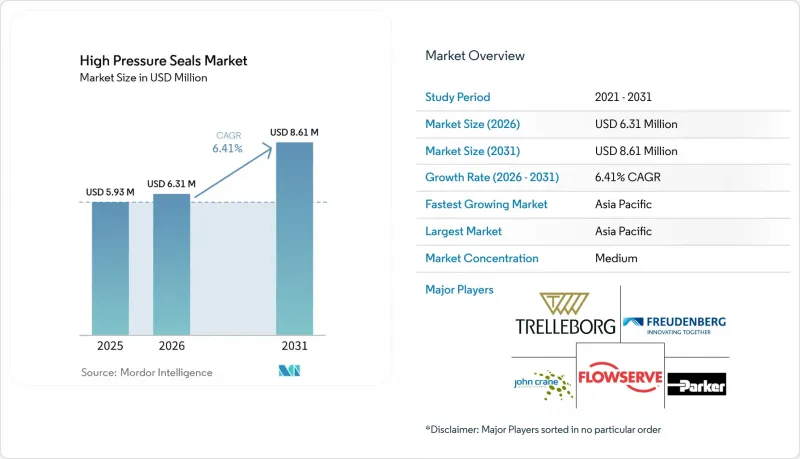
This report is Segmented by Type (Metal Seals, Thermoplastic Seals, and More), Material (Hydrogenated Nitrile Butadiene Rubber (HNBR), and More), Application (Oil and Gas, Chemicals and Petrochemicals, Power Generation, Automotive, and More), and Geography (Asia-Pacific, North America, Europe, South America, and Middle East and Africa). The Market Forecasts are Provided in Terms of Value (USD).
Global High Pressure Seals Market Trends and Insights
Capacity Additions in Chemical and Petrochemical Mega-Complexes
Integrated refinery-petrochemical sites are commissioning single-train ethylene crackers with capacities exceeding 1.5 million tons per year (tpy). These crackers are designed to seal in corrosive, high-pressure hydrocarbon and steam services. Sealmatic India secured a USD 1.8 million contract, delivering 247 API 682 mechanical seals to the Mongol Refinery. These seals, equipped with dual pressurization chambers and silicon-carbide faces, are engineered to reduce fugitive emissions. Additionally, supplier qualifications under NACE MR0175 and ISO 21049 increase switching costs, supporting premium pricing for compliant vendors.
Hydrogen Pipeline and Refueling Infrastructure Build-Out
Germany has approved a 9,040 km hydrogen core network, while North America is actively deploying stations. This development is driving orders for 700-bar dispensers and 950-bar storage seals. Compounds like Greene Tweed's Fusion 938 fluoro-elastomer and Arlon 3000XT polyetheretherketone (PEEK) are rated for rapid gas decompression at duty cycles of -40°C to +85°C. This capability helps mitigate the risk of seal failures during rapid fills.
Performance Degradation Greater Than 250°C Under Cyclic Thermal Shock
Elastomers experience accelerated compression set when subjected to thermal cycling above 250°C. While nitrile starts to degrade at 207°C, only polytetrafluoroethylene (PTFE) and graphite composites can endure exposures of up to 500°C without any mass loss. As a result, enhanced geothermal systems (EGS) and supercritical carbon dioxide (CO2) turbines utilize metallic or ceramic-filled polyether ether ketone (PEEK) seals, increasing capital expenditures and influencing volume growth in high-temperature applications.
Other drivers and restraints analyzed in the detailed report include:
- Rising Adoption of Ultra-High-Pressure Water-Jet Cutting in EV and Electronics
- Geothermal EGS Well Completions
- Proliferation of Low-Cost Regional Manufacturers
For complete list of drivers and restraints, kindly check the Table Of Contents.
Segment Analysis
Metal Seals accounted for 37.71% of 2025 revenue, driven by demand from subsea oil completions and aerospace hydraulics requiring robust, explosive-decompression-resistant designs. Hybrid/Composite products are projected to grow at the fastest 6.82% compound annual growth rate (CAGR), combining polyether ether ketone (PEEK) backup rings with fluoroelastomer (FKM) primaries to prevent extrusion in 5,000 pounds per square inch (PSI) mining hydraulics.
Designers are incorporating metal bellows, carbon fiber, and fluoroelastomers to achieve a balance between flexibility and thermal stability. Aerospace actuators on the Bell Future Long-Range Assault Aircraft (FLRAA) military tiltrotor utilize such hybrids to maintain leak rates below 1 cubic centimeter per minute (cm3/min) at 3,000 PSI across a temperature range of -54°C to +135°C.
Geography Analysis
In 2025, the Asia-Pacific region accounted for 42.22% of global revenue and is projected to grow at a compound annual growth rate (CAGR) of 7.11% through 2031. China's supply base, featuring Lepu Seal's facility producing 5,000 dry-gas seals monthly, caters to liquefied natural gas (LNG) terminals in 68 countries. In India, a EUR 270 billion (USD 312.28 billion) manufacturing expansion has driven seal demand by approximately 7% annually. To address this increase, Sealmatic's newly established 25,000 ft2 Kaman plant has increased its monthly output by 65%, focusing on nuclear and defense contracts.
North America benefits from the Permian Basin's upstream activities and is developing a hydrogen core network, which compresses gas for 700 bar dispensers. Meanwhile, a pilot project at Utah Frontier Observatory for Research in Geothermal Energy (FORGE) in the United States is increasing the demand for metallic packer elements rated at 1,000 bar.
Europe's growth is influenced by its established bases but is supported by initiatives such as Germany's hydrogen backbone, geothermal loops in Iceland, and life-extension programs for reactors in France. Contributions from South America and the Middle East & Africa include Brazilian pre-salt projects and expansions in Saudi petrochemicals, both requiring American Petroleum Institute (API)-qualified seals capable of handling 15,000 pounds per square inch (PSI) duties.
- A.W. Chesterton Company
- Advanced Sealing Technology
- American High Performance Seals
- Bal Seal Engineering
- Flowserve Corporation
- Freudenberg Sealing Technologies
- Enpro Inc.
- Greene Tweed
- Halliburton
- Hallite Seals
- James Walker Group
- John Crane
- Kalsi Engineering
- PARKER HANNIFIN
- SKF
- Technetics Group
- Tenaris
- Trelleborg Group
Additional Benefits:
- The market estimate (ME) sheet in Excel format
- 3 months of analyst support
TABLE OF CONTENTS
1 Introduction
- 1.1 Study Assumptions and Market Definition
- 1.2 Scope of the Study
2 Research Methodology
3 Executive Summary
4 Market Landscape
- 4.1 Market Overview
- 4.2 Market Drivers
- 4.2.1 Capacity additions in chemical and petrochemical mega-complexes
- 4.2.2 Hydrogen pipeline and refuelling infrastructure build-out
- 4.2.3 Rising adoption of ultra-high-pressure water-jet cutting in Electric Vehicle and electronics
- 4.2.4 Geothermal EGS well completions
- 4.2.5 Micro-fluidic and lab-on-chip miniaturised HP systems
- 4.3 Market Restraints
- 4.3.1 Performance degradation greater than 250°C under cyclic thermal shock
- 4.3.2 Proliferation of low-cost regional manufacturers
- 4.3.3 Design standardisation curbing custom HP seal demand
- 4.4 Value Chain Analysis
- 4.5 Porter's Five Forces
- 4.5.1 Threat of New Entrants
- 4.5.2 Bargaining Power of Buyers
- 4.5.3 Bargaining Power of Suppliers
- 4.5.4 Threat of Substitutes
- 4.5.5 Competitive Rivalry
5 Market Size and Growth Forecasts (Value)
- 5.1 By Type
- 5.1.1 Metal Seals
- 5.1.2 Thermoplastic Seals
- 5.1.3 Elastomeric Seals
- 5.1.4 Hybrid/Composite Seals
- 5.2 By Material
- 5.2.1 Hydrogenated Nitrile Butadiene Rubber (HNBR)
- 5.2.2 Fluoro-elastomers (FKM/FPM)
- 5.2.3 Ethylene Propylene Diene Monomer (EPDM)
- 5.2.4 Polytetrafluoroethylene (PTFE) and blends
- 5.2.5 Other Material Types (Polyether ether ketone (PEEK), etc.)
- 5.3 By Application
- 5.3.1 Oil and Gas
- 5.3.2 Chemicals and Petrochemicals
- 5.3.3 Power Generation
- 5.3.4 Aerospace and Defense Hydraulics
- 5.3.5 Automotive
- 5.3.6 Mining and Construction Equipment
- 5.3.7 Water-jet Cutting and Industrial Machinery
- 5.4 By Geography
- 5.4.1 Asia-Pacific
- 5.4.1.1 China
- 5.4.1.2 Japan
- 5.4.1.3 India
- 5.4.1.4 South Korea
- 5.4.1.5 ASEAN Countries
- 5.4.1.6 Rest of Asia-Pacific
- 5.4.2 North America
- 5.4.2.1 United States
- 5.4.2.2 Canada
- 5.4.2.3 Mexico
- 5.4.3 Europe
- 5.4.3.1 Germany
- 5.4.3.2 United Kingdom
- 5.4.3.3 France
- 5.4.3.4 Italy
- 5.4.3.5 Spain
- 5.4.3.6 Russia
- 5.4.3.7 NORDIC Countries
- 5.4.3.8 Rest of Europe
- 5.4.4 South America
- 5.4.4.1 Brazil
- 5.4.4.2 Argentina
- 5.4.4.3 Rest of South America
- 5.4.5 Middle-East and Africa
- 5.4.5.1 Saudi Arabia
- 5.4.5.2 South Africa
- 5.4.5.3 Rest of Middle-East and Africa
- 5.4.1 Asia-Pacific
6 Competitive Landscape
- 6.1 Market Concentration
- 6.2 Strategic Moves
- 6.3 Market Share(%)/Ranking Analysis
- 6.4 Company Profiles (includes Global Overview, Market Overview, Core Segments, Financials, Strategic Information, Products and Services, and Recent Developments)
- 6.4.1 A.W. Chesterton Company
- 6.4.2 Advanced Sealing Technology
- 6.4.3 American High Performance Seals
- 6.4.4 Bal Seal Engineering
- 6.4.5 Flowserve Corporation
- 6.4.6 Freudenberg Sealing Technologies
- 6.4.7 Enpro Inc.
- 6.4.8 Greene Tweed
- 6.4.9 Halliburton
- 6.4.10 Hallite Seals
- 6.4.11 James Walker Group
- 6.4.12 John Crane
- 6.4.13 Kalsi Engineering
- 6.4.14 PARKER HANNIFIN
- 6.4.15 SKF
- 6.4.16 Technetics Group
- 6.4.17 Tenaris
- 6.4.18 Trelleborg Group
7 Market Opportunities and Future Outlook
- 7.1 White-space and unmet-need assessment

