PUBLISHER: Mordor Intelligence | PRODUCT CODE: 2062297

PUBLISHER: Mordor Intelligence | PRODUCT CODE: 2062297
China Aftermarket TPMS - Market Share Analysis, Industry Trends & Statistics, Growth Forecasts (2026 - 2031)
According to Mordor Intelligence, the china aftermarket TPMS market size is projected to grow from USD 0.53 billion in 2025 to USD 0.61 billion in 2026, and is forecast to reach USD 1.20 billion by 2031, growing at a CAGR of 14.61% from 2026 to 2031.
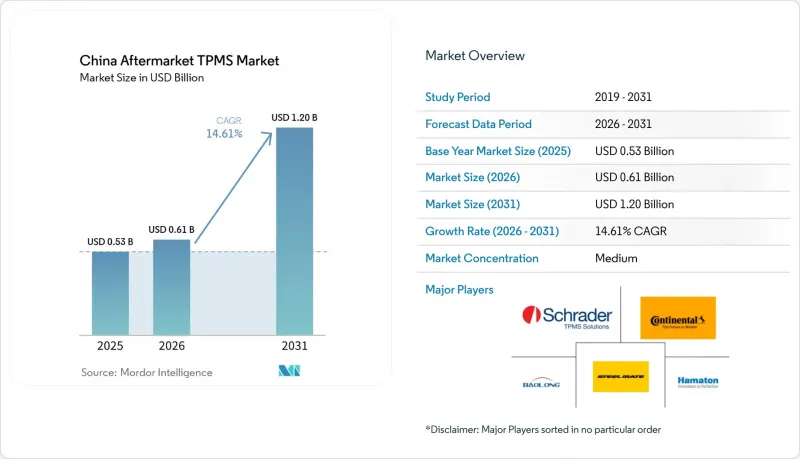
This report is Segmented by Type (Direct TPMS, Indirect TPMS), Technology Integration (Stand-Alone TPMS Units, Smart/Connected TPMS), Vehicle Type (Passenger Cars, Commercial Vehicles), and Distribution Channel (Offline, Online). The Market Forecasts are Provided in Terms of Value (USD) and Volume (Units).
China Aftermarket TPMS Market Trends and Insights
Growing Passenger-Car Parc and Sensor-Replacement Cycle
China has a significant passenger-car parc and continues to add vehicles annually. Cars sold in recent years are equipped with sealed lithium batteries, which typically last several years. This will lead to a substantial replacement wave in the future, adding millions of sensors to the annual aftermarket demand. Medium-duty trucks, with a faster turnover rate, further contribute to increased volumes in the commercial segment. Since these batteries are non-serviceable, a dead cell requires complete sensor replacement, ensuring consistent revenue for suppliers. Tier-1 cities are leading due to their established service networks, while tier-2 and tier-3 regions are gradually advancing as their DIFM infrastructure develops.
Mandatory TPMS Fitment on New Vehicles Spills Over to Retrofit Demand
The implementation of GB 26149-2017 significantly increased the adoption of TPMS in passenger cars . With factory-equipped used cars now entering the secondary market, first-time owners are benefiting from real-time alerts and are also retrofitting older vehicles. Brands like Steel Mate and Orange Electronics offer both internal and external kits that can be self-installed or professionally installed at tire shops. Even without formal truck mandates, commercial operators are proactively installing these systems to prepare for future regulations and reduce fuel losses from underinflation. The Standardization Administration's continuous scrutiny ensures that retrofit momentum remains strong, particularly in the densely populated provinces along the east coast.
Price Sensitivity and Counterfeit Sensors
Standard units fetch aftermarket prices within a certain range, while OEM-equivalent sensors are significantly more expensive. This price disparity fuels demand for low-cost substitutes, some of which turn out to be counterfeit. Stellantis and Petromin exposed a significant export ring dealing in imitation brake and steering parts, highlighting vulnerabilities in China's quality oversight. Counterfeit Tire Pressure Monitoring Systems (TPMS) often malfunction quickly, attributed to inadequate sealing and misaligned radio frequencies, eroding consumer trust. Freight operators, already feeling the pinch from electric-vehicle price wars, find little leeway for premium sensors, intensifying downward pressure on prices. While genuine brands are now prominently showcasing ISO and CE certifications online and extending warranties, enforcement of these measures is hindered by fragmented policing across numerous factories.
Other drivers and restraints analyzed in the detailed report include:
- Electrification Accelerating Tire-Wear on CV Fleets
- Expansion of E-Commerce Parts Channels
- Installation Complexity for Legacy Vehicles
For complete list of drivers and restraints, kindly check the Table Of Contents.
Segment Analysis
Direct systems captured 70.33% of the Chinese aftermarket TPMS market in 2025 because GB 26149-2017 requires precise, per-wheel pressure alarms below 75% of recommended levels. Direct sensors provide temperature data and tire-level statistics prized by ADAS platforms from automakers such as Tesla and NIO. Indirect technology, however, is projected to advance at a 15.04% CAGR because an ABS-based software update can turn any pre-2019 vehicle into a basic alert system without new hardware. Yet indirect options cannot flag over-inflation or slow leaks, identify which wheel is failing, or be calibrated after every rotation, reducing fleet appeal.
Domestic chip makers are closing the cost gap: AutoChips' single-die AC5111 has pushed average direct-sensor prices below a certain threshold, easing past price challenges. Baolong is investing significantly in R&D to enhance battery life and integrate Bluetooth connectivity, positioning itself for OTA ecosystems. Despite regulations favoring direct alerts, analysts predict direct sensors will surpass indirect units in total volume, even as indirect units penetrate price-sensitive markets.
Stand-alone TPMS devices held 71.46% of the Chinese aftermarket TPMS market in 2025 and remain staples for the used-car aftermarket, where a simple dash display suffices. Smart or connected platforms integrating BLE, NFC, and OTA updates are forecast to post a 17.11% CAGR, driven by smartphone ubiquity and telematics demand. RF-Star's BLE kit allows drivers to monitor tire pressure, temperature, and sensor battery life via an app, and to push updates without removing the wheels. Honghe Technology demonstrated that encrypted OTA packages can achieve extremely low failure rates, enhancing confidence in field firmware upgrades.
Fleet operators are adopting cloud-linked systems that transmit tire data through LoRa gateways, reducing roadside downtime, which typically incurs high costs per commercial incident. For individual drivers, NFC-programmable models eliminate the need for a diagnostic tool, enabling a DIY tire swap in a short time. While stand-alone units are expected to dominate low-ticket sales for the foreseeable future, software-defined sensors are paving the way for subscription revenue through advanced analytics and remote diagnostics.
List of Companies Covered in this Report:
- Sensata Technologies (Schrader)
- Continental AG
- Shanghai Baolong Automotive
- Steelmate Automotive
- Hamaton Automotive Technology
- Shenzhen Careud Security Equipment
- Kysonix Automotive Electronics
- Shenzhen TireMagic Electronic Tech
- AutoChips Inc.
- Hangzhou Huf Hulsbeck & Furst
- Pacific Industrial Co. Ltd.
- Denso Corporation
- ZF Friedrichshafen (WABCO)
- Orange Electronic
- Ningbo Delin Auto Parts
- ATEQ China
- Promata Sinotek
- Shenzhen EGQ Cloud Technology
Additional Benefits:
- The market estimate (ME) sheet in Excel format
- 3 months of analyst support
TABLE OF CONTENTS
1 Introduction
- 1.1 Study Assumptions & Market Definition
- 1.2 Scope of the Study
2 Research Methodology
3 Executive Summary
4 Market Landscape
- 4.1 Market Overview
- 4.2 Market Drivers
- 4.2.1 Growing Passenger-Car Parc and Sensor-Replacement Cycle
- 4.2.2 Mandatory TPMS Fitment on New Vehicles Spills Over to Retrofit Demand
- 4.2.3 Electrification Accelerating Tire-Wear on CV Fleets
- 4.2.4 Expansion of E-Commerce Parts Channels
- 4.2.5 Heightened Consumer Safety Awareness
- 4.2.6 Domestic One-Chip TPMS Silicon Slashes Kit Prices
- 4.3 Market Restraints
- 4.3.1 Price Sensitivity and Counterfeit Sensors
- 4.3.2 Installation Complexity for Legacy Vehicles
- 4.3.3 Non-Standard Frequencies and Battery-Service Costs
- 4.3.4 Data-Privacy Worries Around Connected TPMS
- 4.4 Value / Supply-Chain Analysis
- 4.5 Regulatory Landscape
- 4.6 Technological Outlook
- 4.7 Porter's Five Forces
- 4.7.1 Threat of New Entrants
- 4.7.2 Bargaining Power of Suppliers
- 4.7.3 Bargaining Power of Buyers
- 4.7.4 Threat of Substitutes
- 4.7.5 Industry Rivalry
5 Market Size and Growth Forecasts (Value (USD) and Volume (Units))
- 5.1 By Type
- 5.1.1 Direct TPMS
- 5.1.2 Indirect TPMS
- 5.2 By Technology Integration
- 5.2.1 Stand-alone TPMS Units
- 5.2.2 Smart/Connected TPMS
- 5.3 By Vehicle Type
- 5.3.1 Passenger Cars
- 5.3.1.1 Hatchbacks
- 5.3.1.2 Sedans
- 5.3.1.3 Sports Utility Vehicles (SUVs) and Multi-Utility Vehicles (MUVs)
- 5.3.2 Commercial Vehicles
- 5.3.2.1 Light Commercial Vehicles
- 5.3.2.2 Medium and Heavy Commercial Vehicles
- 5.3.2.3 Buses and Coaches
- 5.3.1 Passenger Cars
- 5.4 By Distribution Channel
- 5.4.1 Offline (Parts Stores, Specialty Shops, Service Centers)
- 5.4.2 Online (OEM Sites/Apps, E-commerce Platforms)
6 Competitive Landscape
- 6.1 Market Concentration
- 6.2 Strategic Moves
- 6.3 Market Share Analysis
- 6.4 Company Profiles (Includes Global Level Overview, Market Level Overview, Core Segments, Financials as Available, Strategic Information, Market Rank/Share for Key Companies, Products and Services, SWOT Analysis, and Recent Developments)
- 6.4.1 Sensata Technologies (Schrader)
- 6.4.2 Continental AG
- 6.4.3 Shanghai Baolong Automotive
- 6.4.4 Steelmate Automotive
- 6.4.5 Hamaton Automotive Technology
- 6.4.6 Shenzhen Careud Security Equipment
- 6.4.7 Kysonix Automotive Electronics
- 6.4.8 Shenzhen TireMagic Electronic Tech
- 6.4.9 AutoChips Inc.
- 6.4.10 Hangzhou Huf Hulsbeck & Furst
- 6.4.11 Pacific Industrial Co. Ltd.
- 6.4.12 Denso Corporation
- 6.4.13 ZF Friedrichshafen (WABCO)
- 6.4.14 Orange Electronic
- 6.4.15 Ningbo Delin Auto Parts
- 6.4.16 ATEQ China
- 6.4.17 Promata Sinotek
- 6.4.18 Shenzhen EGQ Cloud Technology
7 Market Opportunities & Future Outlook

