PUBLISHER: Mordor Intelligence | PRODUCT CODE: 2062300

PUBLISHER: Mordor Intelligence | PRODUCT CODE: 2062300
Europe Aftermarket TPMS - Market Share Analysis, Industry Trends & Statistics, Growth Forecasts (2026 - 2031)
According to Mordor Intelligence, the european aftermarket market size is projected to grow from USD 1.56 billion in 2025 to USD 1.68 billion in 2026, and is forecast to reach USD 2.46 billion by 2031, growing at a CAGR of 7.87% from 2026 to 2031.
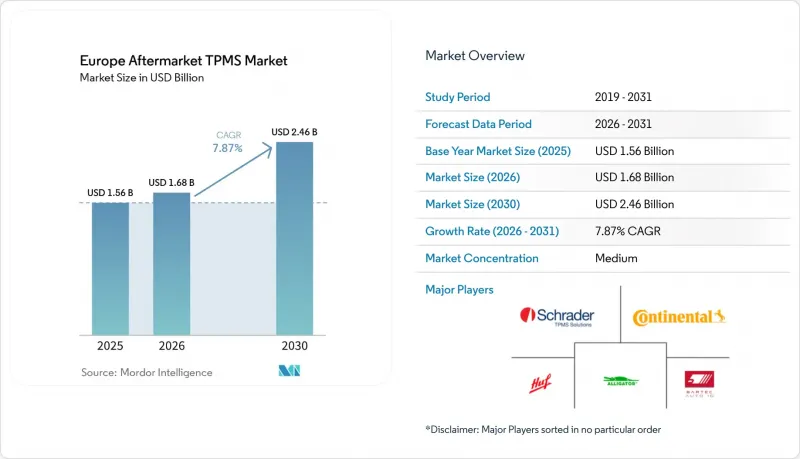
This report is Segmented by Type (Direct TPMS and Indirect TPMS), Technology Integration (Stand-Alone TPMS Units and Smart/Connected TPMS), Vehicle Type (Passenger Cars and Commercial Vehicles), Distribution Channel (Offline and Online), and Geography (Germany, United Kingdom, France, Italy, Spain, and Rest of Europe). The Market Forecasts are Provided in Terms of Value (USD).
Europe Aftermarket TPMS Market Trends and Insights
Aging Vehicle Parc Prolongs Sensor Replacement Demand
The average age of passenger cars in Europe has increased, with some regions reporting significantly older vehicles. This trend has led many first-generation direct sensors to exceed their typical battery life. To maintain affordability in repairs, workshops in cost-sensitive areas are increasingly using universal programmable sensors. This approach supports a sustained replacement trend expected to continue for the foreseeable future.
EU Regulation ECE 661/2009 Replacement-Cycle Pull
In Germany, France, and the Netherlands, periodic inspections now treat non-functional TPMS as failures, turning regulation into a reliable revenue source for service providers and manufacturers. This regulatory enforcement ensures that vehicles comply with safety standards, driving demand for TPMS maintenance and replacement. The extension of UNECE R141 to trucks and trailers signals a second compliance wave, benefiting direct TPMS that can meet the alert threshold. This development is expected to create growth opportunities in the market as fleet operators and OEMs prioritize compliance to avoid penalties and enhance operational safety.
High Sensor and Labor Cost for Relearn/Programming
In Poland, many customers delay repairs even when dashboard warnings signal issues, primarily because replacing sensors is costly, especially when labor and programming are factored in. Additionally, encryption on BMW and Tesla systems compels workshops to either purchase OEM parts or invest in advanced tools, further driving up service bills.
Other drivers and restraints analyzed in the detailed report include:
- Rising Consumer Focus on Tire Safety and Fuel Economy
- OTA-upgradeable Connected TPMS Kits
- EV-Specific High-Pressure Tires Create Compatibility Gaps
For complete list of drivers and restraints, kindly check the Table Of Contents.
Segment Analysis
Direct TPMS commanded 74.38% of the European aftermarket market share in 2025, owing to real-time, wheel-specific alerts demanded by UNECE rules. Indirect systems priced 40-50% lower are growing at an 8.14% CAGR as operators of pre-2014 vans seek low-cost compliance, particularly in Southern Europe.
Over the forecast period, the EU TPMS aftermarket market for indirect TPMS is projected to accelerate as algorithm refinements reduce false positives. Yet, gaps in absolute-pressure measurement limit uptake to cost-sensitive fleets. Semiconductor advances, such as NXP's AEC-Q100-qualified NTM88K, are cementing direct TPMS as the long-term default across heavy-duty vehicles, reinforcing the leadership position of direct solutions in the European aftermarket market.
Stand-alone valves held 57.19% of the European aftermarket TPMS market size in 2025 as installers favored simpler re-learn processes that do not require pairing with telematics gateways. Universal-fit SKUs from Schrader and Huf keep inventory overhead low, sustaining loyalty among independent workshops.
Connected TPMS revenue will advance at an 8.05% CAGR on the back of ESG-driven data reporting and predictive maintenance contracts. The European aftermarket TPMS market share for connected kits could grow significantly if subscription prices become more affordable per vehicle per month. Fleet managers, hesitant about mid-cycle sensor swaps, may find NXP's UWB architecture appealing, offering a notable improvement in battery life.
List of Companies Covered in this Report:
- Continental AG
- Sensata Technologies Inc.- Schrader
- Huf Hulsbeck & Furst GmbH
- Alligator Ventilfabrik GmbH
- ATEQ TPMS Tools
- Bartec Auto ID
- Autel Intelligent Technology
- Cub Elecparts Inc.
- Orange Electronic Co.
- Denso Corporation
- Pacific Industrial Co.
- ZF TRW Automotive
- Valeo SA
- Haltec Corporation
- Infitronic Technology
- Steelmate Automotive
- NXP Semiconductors
- Maxwell Products (TPMS Warehouse)
- Ridecell Fleet-TPMS
- Pricol Ltd.
Additional Benefits:
- The market estimate (ME) sheet in Excel format
- 3 months of analyst support
TABLE OF CONTENTS
1 Introduction
- 1.1 Study Assumptions & Market Definition
- 1.2 Scope of the Study
2 Research Methodology
3 Executive Summary
4 Market Landscape
- 4.1 Market Overview
- 4.2 Market Drivers
- 4.2.1 Aging Vehicle Parc Prolongs Sensor Replacement Demand
- 4.2.2 EU Regulation ECE 661/2009 Replacement-Cycle Pull
- 4.2.3 Rising Consumer Focus on Tire Safety and Fuel-Economy
- 4.2.4 Fleet-Wide ESG Reporting Needs Real-Time Pressure Data
- 4.2.5 OTA-Upgradeable Connected TPMS Kits as New Revenue Stream
- 4.2.6 E-Commerce Parts Channels Widen Access to Universal Kits
- 4.3 Market Restraints
- 4.3.1 High Sensor and Labor Cost for Relearn/Programming
- 4.3.2 EV-Specific High-Pressure Tires Create Compatibility Gaps
- 4.3.3 Accuracy Issues with Indirect TPMS Erode Confidence
- 4.3.4 Cyber-Risks in Connected Sensors Raise Recall Liability
- 4.4 Value / Supply-Chain Analysis
- 4.5 Regulatory Landscape
- 4.6 Technological Outlook
- 4.7 Porter's Five Forces
- 4.7.1 Bargaining Power of Suppliers
- 4.7.2 Bargaining Power of Buyers
- 4.7.3 Threat of New Entrants
- 4.7.4 Threat of Substitutes
- 4.7.5 Competitive Rivalry
5 Market Size & Growth Forecasts (Value (USD))
- 5.1 By Type
- 5.1.1 Direct TPMS
- 5.1.2 Indirect TPMS
- 5.2 By Technology Integration
- 5.2.1 Stand-alone TPMS Units
- 5.2.2 Smart/Connected TPMS
- 5.3 By Vehicle Type
- 5.3.1 Passenger Cars
- 5.3.1.1 Hatchbacks
- 5.3.1.2 Sedans
- 5.3.1.3 Sports Utility Vehicles (SUVs) & Multi-Utility Vehicles (MUVs)
- 5.3.2 Commercial Vehicles
- 5.3.2.1 Light Commercial Vehicles
- 5.3.2.2 Medium and Heavy Commercial Vehicles
- 5.3.2.3 Buses and Coaches
- 5.3.1 Passenger Cars
- 5.4 By Distribution Channel
- 5.4.1 Offline
- 5.4.2 Online
- 5.5 By Country
- 5.5.1 Germany
- 5.5.2 United Kingdom
- 5.5.3 France
- 5.5.4 Italy
- 5.5.5 Spain
- 5.5.6 Rest of Europe
6 Competitive Landscape
- 6.1 Market Concentration
- 6.2 Strategic Moves
- 6.3 Market Share Analysis
- 6.4 Company Profiles (Includes Global Level Overview, Market Level Overview, Core Segments, Financials as Available, Strategic Information, Market Rank/Share for Key Companies, Products and Services, SWOT Analysis, and Recent Developments)
- 6.4.1 Continental AG
- 6.4.2 Sensata Technologies Inc.- Schrader
- 6.4.3 Huf Hulsbeck & Furst GmbH
- 6.4.4 Alligator Ventilfabrik GmbH
- 6.4.5 ATEQ TPMS Tools
- 6.4.6 Bartec Auto ID
- 6.4.7 Autel Intelligent Technology
- 6.4.8 Cub Elecparts Inc.
- 6.4.9 Orange Electronic Co.
- 6.4.10 Denso Corporation
- 6.4.11 Pacific Industrial Co.
- 6.4.12 ZF TRW Automotive
- 6.4.13 Valeo SA
- 6.4.14 Haltec Corporation
- 6.4.15 Infitronic Technology
- 6.4.16 Steelmate Automotive
- 6.4.17 NXP Semiconductors
- 6.4.18 Maxwell Products (TPMS Warehouse)
- 6.4.19 Ridecell Fleet-TPMS
- 6.4.20 Pricol Ltd.
7 Market Opportunities & Future Outlook
- 7.1 White-space & Unmet Need Assessment

