
PUBLISHER: Mordor Intelligence | PRODUCT CODE: 2062302

PUBLISHER: Mordor Intelligence | PRODUCT CODE: 2062302
Europe E-Commerce Warehouse - Market Share Analysis, Industry Trends & Statistics, Growth Forecasts (2026 - 2031)
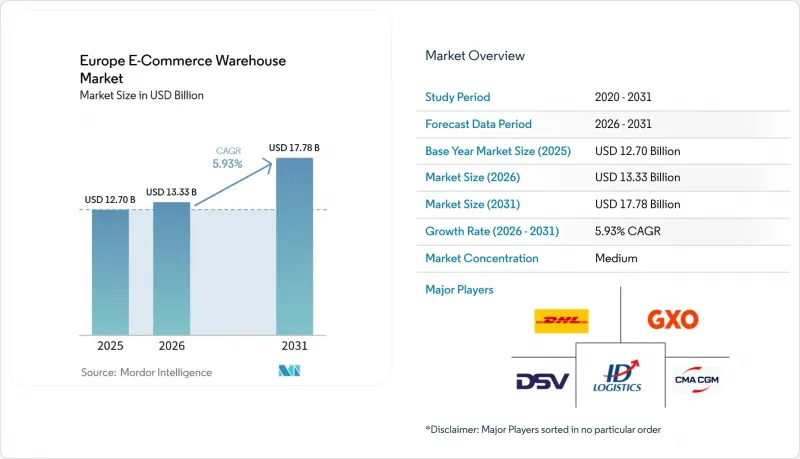
According to Mordor Intelligence, the europe e-commerce warehouse market size is projected to be USD 12.7 billion in 2025, USD 13.33 billion in 2026, and reach USD 17.78 billion by 2031, growing at a CAGR of 5.93% from 2026 to 2031.
Compliance-driven capital spending tied to the Digital Product Passport regulation is now the primary growth engine, forcing operators to embed item-level traceability rather than simply adding floor space. This report is Segmented by Warehouse Type (Fulfilment Centers, Distribution Centers, Cold-Chain Warehouses, Dark Stores/Micro-Fulfillment Centers, Others), Service Type (Storage, and More), Automation Level (Manual, Semi-Automated, Automated), End-User Industry (Apparel & Footwear, and More), and Geography (Germany, UK, France, and More). The Market Forecasts are Provided in Terms of Value (USD).
Europe E-Commerce Warehouse Market Trends and Insights
EU Digital Product Passport Spurring Serialization-Ready Fulfillment Hubs
The Digital Product Passport, effective from 2026, obliges every product sold in the bloc to carry a digital file that follows the item through its life cycle. Warehouses must now support RFID, blockchain, and API-based data exchange, shifting investment from racking to information systems. Early movers such as CEVA Logistics are already installing item-level scanners and cloud connectors that future-proof capacity. Operators unable to meet the new standard risk customer defection as brands migrate to compliant networks. Demand for dedicated reverse-logistics hubs is rising in tandem because returned items must retain their digital identity during refurbishment and resale.
Live-Commerce Boom Compressing Order Cycles, Boosting Micro-FC Roll-Outs
Influencer-led live-commerce sessions have reset consumer expectations from next-day to same-hour delivery. Operators are converting basements, parking decks, and idle retail units into micro-fulfillment centers that sit within five kilometers of dense customer clusters. Modular automation from AutoStore and Exotec allows 5,000-square-meter sites to match the throughput of legacy mega-centers. Retailers such as Jumbo have proven the model, processing live-commerce spikes without adding labor. Inventory planning now relies on AI routines that preload popular SKUs before livestream events begin, minimizing out-of-stock risk.
NIS2 Cyber-Security Compliance Inflating IT Costs for SME Operators
Compliance-driven spending on Digital Product Passports and item-level traceability is now the primary growth engine for European e-commerce warehousing, forcing a shift from simple expansion toward high-tech, urban micro-fulfillment sites capable of meeting 30-minute delivery demands. This transition is supported by EUR 250 million (USD 288.02 million) green facilities from the European Investment Bank to major players such as WDP, enabling the integration of rail-served logistics and 5G-powered automation to slash Scope-3 emissions by up to 75% compared to road transport. However, the NIS2 Directive is significantly inflating IT overhead, with compliance costs for mid-sized firms often exceeding EUR 500,000 (USD 0.57 million) and siphoning capital away from physical automation. As a result, a persistent shortage of over 274,000 cybersecurity professionals in the EU is accelerating market consolidation, as smaller family-owned 3PLs seek buy-outs from larger groups that can absorb these regulatory and technical burdens.
Other drivers and restraints analyzed in the detailed report include:
- Southern-Europe E-Grocery Surge Accelerating Refrigerated Cross-Docks
- Scope-3 Decarbonization Fueling Demand for Rail-Integrated Freight Villages
- Shortfall of Recycled Materials Delaying Level(S)-Compliant Builds
For complete list of drivers and restraints, kindly check the Table Of Contents.
Segment Analysis
Fulfillment centers commanded 42.7% of the Europe e-commerce warehouse market share in 2025. They anchor retailer networks for national coverage and bulk inventory holding. However, live-commerce and rapid-delivery models are steering capital to dark stores and micro-fulfillment centers, the fastest-growing category at 11.17% CAGR through 2031. These 2,000-5,000 square-meter facilities operate within dense city cores and rely on goods-to-person robotics that triple pick rates. Colruyt's Collect&Go project raised productivity 35% in a compact site, showing scalability for general merchandise.
The operational gamble is whether to defend hub-and-spoke economics or embrace distributed proximity. High-margin verticals such as electronics now favor micro-sites that can stage flash-sale inventory two kilometers from buyers. Bulk goods and seasonal items remain in mega-shed fulfillment centers that still benefit from space economies and rail siding access. This dual structure keeps the Europe e-commerce warehouse market balanced between scale and speed.
Storage held 50.51% of the Europe e-commerce warehouse market size in 2025, yet it is sliding toward utility status within the Europe e-commerce warehouse market. Picking and packing, projected to grow 10.64% CAGR, is where differentiation lives. Operators like Wincanton use modular robotics to raise pick rates fivefold and guarantee two-hour cut-offs for order dispatch. Growing Digital Product Passport compliance embeds serialization and kitting into standard flows, turning what was once value-added into table stakes.
Outcome-based contracts are replacing pallet storage fees. Retailers pay for order accuracy and cycle time, rewarding those 3PLs that overlay AI slotting tools and machine-vision QC stations. Low-margin storage specialists risk displacement unless they climb the service ladder.
List of Companies Covered in this Report:
- DHL Group
- GXO Logistics
- CMA CGM Group (Including CEVA Logistics)
- DSV A/S
- ID Logistics
- XPO Inc.
- Kuehne+Nagel
- Arvato Group
- SEGRO plc
- GEODIS
- La Poste / GeoPost
- FM Logistic
- Rhenus Logistics
- Logwin Logistics
- InPost Fulfilment
- PostNL Parcels and Warehousing
- Raben Group
- Dachser SE
- Hellmann Worldwide Logistics
- BLG Logistics Group*
Additional Benefits:
- The market estimate (ME) sheet in Excel format
- 3 months of analyst support
TABLE OF CONTENTS
1 Introduction
- 1.1 Study Assumptions and Market Definition
- 1.2 Scope of the Study
2 Research Methodology
3 Executive Summary
4 Market Landscape
- 4.1 Market Overview
- 4.2 Market Drivers
- 4.2.1 EU Digital Product Passport Spurring Serialization-Ready Fulfilment Hubs
- 4.2.2 Live-Commerce Boom Compressing Order Cycles, Boosting Micro-FC Roll-Outs
- 4.2.3 Southern-Europe E-Grocery Surge Accelerating Refrigerated Cross-Docks
- 4.2.4 Scope-3 Decarbonization Fueling Demand for Rail-Integrated Freight Villages
- 4.2.5 5G Private Networks Enabling AMR Retrofits of Inner-City Brownfield Sites
- 4.2.6 Subscription-Based Rental Models Driving Refurbishment and Reverse Hubs
- 4.3 Market Restraints
- 4.3.1 NIS2 Cyber-Security Compliance Inflating IT Costs for SME Operators
- 4.3.2 Shortfall of Recycled Materials Delaying Level(S)-Compliant Builds
- 4.3.3 Euro VII Truck Standards Raising First/Last-Mile Fleet Costs
- 4.3.4 Night-Time Traffic Caps Curbing Utilization of 24/7 Urban Facilities
- 4.4 Value / Supply-Chain Analysis
- 4.5 Regulatory Landscape
- 4.6 Technological Outlook
- 4.7 Porter's Five Forces
- 4.7.1 Bargaining Power of Suppliers
- 4.7.2 Bargaining Power of Buyers
- 4.7.3 Threat of New Entrants
- 4.7.4 Threat of Substitutes
- 4.7.5 Competitive Rivalry
5 Market Size and Growth Forecasts (Value)
- 5.1 By Warehouse Type
- 5.1.1 Fulfilment Centres
- 5.1.2 Distribution Centres (DCs)
- 5.1.3 Cold-Chain Warehouses
- 5.1.4 Dark Stores / Micro-Fulfillment Centers
- 5.1.5 Others (Reverse Logistics Hubs, Bonded Warehouses, Hybrid-use Spaces, etc.)
- 5.2 By Service Type
- 5.2.1 Storage
- 5.2.2 Picking & Packing
- 5.2.3 Value-Added Services and Others (Kitting, Labelling)
- 5.3 By Automation Level
- 5.3.1 Manual
- 5.3.2 Semi-Automated
- 5.3.3 Automated
- 5.4 By End-User Industry
- 5.4.1 Apparel and Footwear
- 5.4.2 Consumer Electronics
- 5.4.3 Grocery and FMCG
- 5.4.4 Pharmaceuticals, Beauty and Wellness
- 5.4.5 Home Essentials and Furnishings
- 5.4.6 Others
- 5.5 By Country
- 5.5.1 Germany
- 5.5.2 United Kingdom
- 5.5.3 France
- 5.5.4 Netherlands
- 5.5.5 Spain
- 5.5.6 Italy
- 5.5.7 Poland
- 5.5.8 Sweden
- 5.5.9 Belgium
- 5.5.10 Russia
- 5.5.11 Rest of Europe
6 Competitive Landscape
- 6.1 Market Concentration
- 6.2 Strategic Moves
- 6.3 Market Share Analysis
- 6.4 Company Profiles (includes Global level Overview, Market level overview, Core Segments, Financials as available, Strategic Information, Market Rank/Share for key companies, Products & Services, and Recent Developments)
- 6.4.1 DHL Group
- 6.4.2 GXO Logistics
- 6.4.3 CMA CGM Group (Including CEVA Logistics)
- 6.4.4 DSV A/S
- 6.4.5 ID Logistics
- 6.4.6 XPO Inc.
- 6.4.7 Kuehne+Nagel
- 6.4.8 Arvato Group
- 6.4.9 SEGRO plc
- 6.4.10 GEODIS
- 6.4.11 La Poste / GeoPost
- 6.4.12 FM Logistic
- 6.4.13 Rhenus Logistics
- 6.4.14 Logwin Logistics
- 6.4.15 InPost Fulfilment
- 6.4.16 PostNL Parcels and Warehousing
- 6.4.17 Raben Group
- 6.4.18 Dachser SE
- 6.4.19 Hellmann Worldwide Logistics
- 6.4.20 BLG Logistics Group*
7 Market Opportunities and Future Outlook

