
PUBLISHER: Mordor Intelligence | PRODUCT CODE: 2062304

PUBLISHER: Mordor Intelligence | PRODUCT CODE: 2062304
Dried Blueberries - Market Share Analysis, Industry Trends & Statistics, Growth Forecasts (2026 - 2031)
According to Mordor Intelligence, the dried blueberries market size was valued at USD 0.68 billion in 2025 and estimated to grow from USD 0.74 billion in 2026 to reach USD 1.11 billion by 2031, at a CAGR of 8.51% during the forecast period (2026-2031).
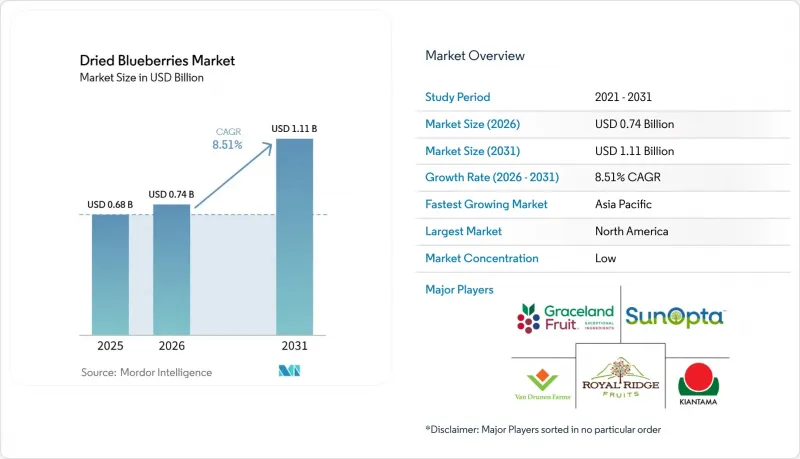
This report is Segmented by Nature (Conventional, Organic), Form (Whole Dried Fruits, Powder/Flakes, and More), Drying Technology (Air/Sun-Dried, Freeze-Dried, and More), Application (Bakery and Confectionery, Breakfast Cereals and Snack Bars, Dairy and Frozen Desserts, and More), and Geography (North America, Europe, Asia-Pacific, and More). The Market Forecasts are Provided in Terms of Value (USD).
Global Dried Blueberries Market Trends and Insights
Growth of plant-based and vegan product formulations
Plant-based food sales in the United States reached USD 8.1 billion in 2024, with fruit-based snacks and dairy alternatives capturing 22% of category growth, according to the Plant Based Foods Association. Dried blueberries serve as a clean-label ingredient in vegan protein bars, oat-milk yogurts, and nut-based cheeses, offering natural sweetness without refined sugars or synthetic colorants. European Union Regulation 1169/2011 mandates allergen labeling and ingredient transparency, which favors whole-fruit inclusions over artificial flavorings, accelerating adoption among formulators targeting health-conscious millennials and Gen Z consumers. Freeze-dried blueberries retain 95% of anthocyanin content compared to 60% for air-dried variants, making them the preferred format for premium plant-based brands emphasizing antioxidant density, according to the Journal of Food Science. Retailers such as Whole Foods and Sprouts Farmers Market expanded shelf space for vegan snacks by 18% in 2025, creating distribution momentum for ingredient suppliers. However, organic certification remains a bottleneck, as only 28% of North American blueberry acreage met USDA Organic standards in 2024, constraining supply for vegan brands that prioritize non-GMO and pesticide-free sourcing, according to the USDA National Agricultural Statistics Service.
Rising nutraceutical adoption for antioxidant claims
Blueberries contain 13.2 millimoles of antioxidants per 100 grams, ranking among the highest of commonly consumed fruits, and clinical trials published in 2024 demonstrated that daily intake of 24 grams of freeze-dried blueberry powder improved episodic memory in adults aged 65-80, according to the National Institutes of Health. Nutraceutical manufacturers are incorporating dried blueberries into capsules, tablets, and functional beverages targeting cognitive health, cardiovascular support, and glycemic control. The FDA's Generally Recognized as Safe status for blueberry extracts and whole-fruit powders streamlines regulatory approval for new supplement formulations, reducing time-to-market compared to novel botanical ingredients. Asia-Pacific markets are experiencing rapid adoption, with China's dietary-supplement sales growing and blueberry-based products gaining traction in urban centers such as Shanghai, Beijing, and Shenzhen. Powder and flake formats dominate nutraceutical applications due to superior dispersibility and standardized dosing, though supply-chain traceability requirements under ISO 22000 and FSSC 22000 are raising compliance costs for smaller processors.
Limited cultivation geography restricting raw material scalability
Blueberry cultivation is concentrated in temperate and subtropical zones with acidic soils (pH 4.5-5.5) and chilling-hour requirements of 400-800 hours below 7°C, limiting viable growing regions to North America, South America, and select European and Oceanic areas, according to the USDA Agricultural Research Service. The United States, Canada, Peru, and Chile collectively accounted for 78% of global fresh blueberry production in 2024, creating supply bottlenecks when weather events disrupt harvests. Michigan's 2024 spring frost reduced yields by 15%, while Peru's northern coastal regions faced water rationing that curtailed irrigation, tightening feedstock availability for processors, according to the Michigan State University Extension. Expansion into non-traditional origins such as Morocco, Poland, and South Africa is underway, yet these regions lack established drying infrastructure and face higher logistics costs. Genetic research into low-chill cultivars suitable for tropical climates remains in early stages, with commercial viability unlikely before 2028.
Other drivers and restraints analyzed in the detailed report include:
- Advancements in freeze-dried blueberry adoption technology
- Rising use in confectionery coatings and chocolate inclusions
- Competition from alternative dried fruits
For complete list of drivers and restraints, kindly check the Table Of Contents.
Segment Analysis
Conventional dried blueberries held 72.03% market share in 2025, anchored by established supply chains and lower retail pricing, yet organic variants are advancing at 10.32% CAGR through 2031, outpacing the overall market by nearly 2 percentage points. USDA National Organic Program certification and European Union Regulation 2018/848 mandate traceability, prohibit synthetic pesticides, and require 3-year land-transition periods, raising barriers but also commanding price premiums of 30-50% over conventional equivalents. Organic blueberry acreage in the United States expanded 9% in 2024 to reach approximately 12,000 hectares, driven by retailer demand from Whole Foods, Sprouts, and Trader Joe's, which collectively increased organic-fruit SKU counts by 14% in 2025, according to the USDA National Agricultural Statistics Service. Peru emerged as a key organic supplier, with certified acreage concentrated in Lambayeque and La Libertad provinces, though water scarcity and labor costs remain constraints.
Conventional formats benefit from economies of scale and year-round availability, serving price-sensitive applications such as private-label cereals, bulk trail mixes, and foodservice channels. Processors such as Graceland Fruit, which handles approximately 40 million pounds of dried fruit annually, maintain dual production lines to serve both conventional and organic buyers, though cross-contamination risks necessitate rigorous cleaning protocols and third-party audits. The organic segment's growth is further propelled by plant-based and vegan brands that prioritize non-GMO and pesticide-free sourcing, aligning with consumer preferences documented in Nielsen surveys showing 43% of U.S. households purchased organic products in 2025. Regulatory harmonization between USDA and EU organic standards remains incomplete, complicating export logistics and requiring dual certifications for suppliers targeting both markets.
Whole dried fruits commanded 44.83% share in 2025, preferred for visual appeal in trail mixes, breakfast cereals, and bakery inclusions, while powder and flakes are expanding at 9.63% CAGR, driven by formulators seeking dispersible ingredients for smoothie mixes, yogurt toppings, and nutraceutical capsules. Freeze-dried blueberry powder retains 92-95% of anthocyanin content and exhibits superior solubility compared to spray-dried alternatives, making it the format of choice for functional-beverage manufacturers targeting cognitive-health and antioxidant claims, according to the MDPI Foods. Slices and granulates occupy a niche position, primarily used in premium muesli blends and artisanal confections, though their irregular particle size complicates automated dosing in high-speed production lines. Equipment suppliers such as Hosokawa Micron introduced cryogenic milling systems in 2025 that produce blueberry powders with median particle sizes below 150 microns, improving flowability and reducing clumping in humid environments.
Whole dried blueberries face competition from lower-cost raisins and cranberries in value-oriented product lines, yet their clean-label positioning and antioxidant density sustain demand in premium segments. Naturipe Farms launched SnackBites in January 2026, a retail-ready whole dried-blueberry snack targeting convenience stores and airport kiosks, signaling brand investment in direct-to-consumer channels. Powder formats are gaining traction in infant nutrition, with formulators incorporating blueberry powder into organic baby-food pouches and toddler snacks, though regulatory scrutiny under FDA's Infant Formula Act and European Commission Directive 2006/125/EC mandates rigorous testing for heavy metals and microbial contaminants. The shift toward powder and flakes is also evident in pet-food applications, where dispersible formats enable uniform distribution in kibble coatings and freeze-dried treats.
Geography Analysis
North America held 40.04% market share in 2025, underpinned by the United States' production of 303,900 metric tons of fresh highbush blueberries in 2024 and Canada's 180,000 metric tons, with Michigan, Washington, Oregon, and British Columbia serving as primary growing regions, according to the USDA NASS. The region benefits from established drying infrastructure, proximity to end-use markets, and strong consumer awareness of blueberries' health benefits, yet faces labor shortages during peak harvest windows and climate volatility that disrupted yields in 2024. Asia-Pacific is advancing at a 9.47% CAGR through 2031, driven by rising disposable incomes, expanding distribution of health supplements in China, India, and Japan, and growing demand for premium snacks and functional foods.
China imported approximately 45,000 metric tons of fresh blueberries in 2024, with dried formats gaining traction in e-commerce channels and specialty retailers targeting urban millennials, according to China Customs. Europe's growth is anchored by Germany, the United Kingdom, and France, where organic certification and clean-label trends favor freeze-dried blueberries in bakery, confectionery, and dairy applications, though high processing costs and limited domestic production constrain supply. South America's market is propelled by Peru and Chile, which collectively exporting fresh blueberries, primarily to the United States, Europe, and Asia-Pacific, with a growing share diverted to domestic drying operations. Peru's northern coastal regions, Lambayeque, La Libertad, and Ancash, account for 65% of national production, leveraging year-round growing conditions and proximity to Pacific shipping lanes, though water scarcity and labor costs remain constraints.
Chile's production is concentrated in the Maule and Biobio regions, with a focus on organic certification and premium export markets. Brazil, Argentina, and Colombia are emerging origins, with acreage expanding in response to domestic demand for functional snacks and nutraceutical ingredients, though infrastructure gaps and limited access to freeze-drying technology slow commercialization. The Middle East and Africa represent nascent markets, with South Africa, Morocco, and Turkey investing in blueberry cultivation and drying capacity to serve regional demand and export to Europe, yet regulatory frameworks and cold-chain logistics remain underdeveloped.
- Royal Ridge Fruits
- Graceland Fruit, Inc.
- Kiantama Oy
- Van Drunen Farms
- SunOpta Inc.
- Shoreline Fruit
- Naturipe Farms
- Tropicland Industries
- Fruit d'Or
- Sunrise Fresh Dried Fruit
- Meduri Farms, Inc.
- Bright-Ranch
- Melissa's Produce
- Helsu International BV
- Traina Foods
- North Bay Trading Co.
- Passamaquoddy Wild Blueberry Company
- Milne MicroDried
- Oregon Berry Packing
- Decas Cranberry Products
Additional Benefits:
- The market estimate (ME) sheet in Excel format
- 3 months of analyst support
TABLE OF CONTENTS
1 INTRODUCTION
- 1.1 Study Assumptions and Market Definition
- 1.2 Scope of the Study
2 RESEARCH METHODOLOGY
3 EXECUTIVE SUMMARY
4 MARKET LANDSCAPE
- 4.1 Market Overview
- 4.2 Market Drivers
- 4.2.1 Growth of plant-based and vegan product formulations
- 4.2.2 Rising nutraceutical adoption for antioxidant claims
- 4.2.3 Advancements freeze-dried blueberry adoption technology
- 4.2.4 Increased use in sports nutrition and recovery snacks
- 4.2.5 Rising use in confectionery coatings and chocolate inclusions
- 4.2.6 Improved moisture control and texture retention technologies
- 4.3 Market Restraints
- 4.3.1 Limited cultivation geography restricting raw material scalability
- 4.3.2 Competition from alternative dried fruits
- 4.3.3 Rising product price due to supply fluctuations
- 4.3.4 Color and flavor degradation during processing and storage
- 4.4 Value Chain Analysis
- 4.5 Regulatory Outlook
- 4.6 Technological Outlook
- 4.7 Porter's Five Forces
- 4.7.1 Threat of New Entrants
- 4.7.2 Bargaining Power of Buyers
- 4.7.3 Bargaining Power of Suppliers
- 4.7.4 Threat of Substitute Products
- 4.7.5 Intensity of Competitive Rivalry
5 MARKET SIZE AND GROWTH FORECASTS (VALUE)
- 5.1 By Nature
- 5.1.1 Conventional
- 5.1.2 Organic
- 5.2 By Form
- 5.2.1 Whole Dried Fruits
- 5.2.2 Powder/Flakes
- 5.2.3 Slices and Granulates
- 5.3 By Drying Technology
- 5.3.1 Air/Sun-Dried
- 5.3.2 Freeze-Dried
- 5.3.3 Microwave-Vacuum and Refractance Window
- 5.4 By Application
- 5.4.1 Bakery and Confectionery
- 5.4.2 Breakfast Cereals and Snack Bars
- 5.4.3 Dairy and Frozen Desserts
- 5.4.4 Beverages
- 5.4.5 Nutraceuticals and Supplements
- 5.4.6 Pet Food and Others
- 5.5 By Geography
- 5.5.1 North America
- 5.5.1.1 United States
- 5.5.1.2 Canada
- 5.5.1.3 Mexico
- 5.5.1.4 Rest of North America
- 5.5.2 Europe
- 5.5.2.1 Germany
- 5.5.2.2 United Kingdom
- 5.5.2.3 Italy
- 5.5.2.4 France
- 5.5.2.5 Spain
- 5.5.2.6 Netherlands
- 5.5.2.7 Poland
- 5.5.2.8 Belgium
- 5.5.2.9 Sweden
- 5.5.2.10 Rest of Europe
- 5.5.3 Asia-Pacific
- 5.5.3.1 China
- 5.5.3.2 India
- 5.5.3.3 Japan
- 5.5.3.4 Australia
- 5.5.3.5 Indonesia
- 5.5.3.6 Thailand
- 5.5.3.7 Singapore
- 5.5.3.8 South Korea
- 5.5.3.9 Rest of Asia-Pacific
- 5.5.4 South America
- 5.5.4.1 Brazil
- 5.5.4.2 Argentina
- 5.5.4.3 Colombia
- 5.5.4.4 Chile
- 5.5.4.5 Peru
- 5.5.4.6 Rest of South America
- 5.5.5 Middle East and Africa
- 5.5.5.1 South Africa
- 5.5.5.2 Saudi Arabia
- 5.5.5.3 United Arab Emirates
- 5.5.5.4 Nigeria
- 5.5.5.5 Egypt
- 5.5.5.6 Morocco
- 5.5.5.7 Turkey
- 5.5.5.8 Rest of Middle East and Africa
- 5.5.1 North America
6 COMPETITIVE LANDSCAPE
- 6.1 Market Concentration
- 6.2 Strategic Moves
- 6.3 Market Share Analysis
- 6.4 Company Profiles (includes Global level Overview, Market level overview, Core Segments, Financials, Strategic Information, Market Rank/Share, Products and Services, Recent Developments)
- 6.4.1 Royal Ridge Fruits
- 6.4.2 Graceland Fruit, Inc.
- 6.4.3 Kiantama Oy
- 6.4.4 Van Drunen Farms
- 6.4.5 SunOpta Inc.
- 6.4.6 Shoreline Fruit
- 6.4.7 Naturipe Farms
- 6.4.8 Tropicland Industries
- 6.4.9 Fruit d'Or
- 6.4.10 Sunrise Fresh Dried Fruit
- 6.4.11 Meduri Farms, Inc.
- 6.4.12 Bright-Ranch
- 6.4.13 Melissa's Produce
- 6.4.14 Helsu International BV
- 6.4.15 Traina Foods
- 6.4.16 North Bay Trading Co.
- 6.4.17 Passamaquoddy Wild Blueberry Company
- 6.4.18 Milne MicroDried
- 6.4.19 Oregon Berry Packing
- 6.4.20 Decas Cranberry Products
7 MARKET OPPORTUNITIES AND FUTURE TRENDS

