
PUBLISHER: Mordor Intelligence | PRODUCT CODE: 2062334

PUBLISHER: Mordor Intelligence | PRODUCT CODE: 2062334
United Kingdom E-Commerce Warehouse - Market Share Analysis, Industry Trends & Statistics, Growth Forecasts (2026 - 2031)
According to Mordor Intelligence, the united kingdom e-commerce warehouse market size is expected to increase from USD 1.33 billion in 2025 to USD 1.40 billion in 2026, and reach USD 1.77 billion by 2031, growing at a CAGR of 4.87% over 2026-2031.
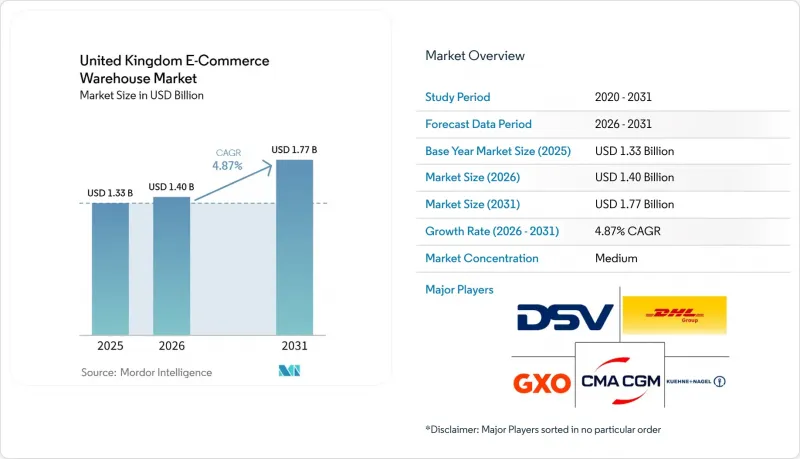
This report is Segmented by Warehouse Type (Fulfillment Centers, Distribution Centers, Cold-Chain Warehouses, Dark Stores/Micro-Fulfillment Centers, Others), by Service Type (Storage, Picking and Packing, and More), by Automation Level (Manual, and More), by End-User Industry (Apparel and Footwear, Consumer Electronics, and More). The Market Forecasts are Provided in Terms of Value (USD).
United Kingdom E-Commerce Warehouse Market Trends and Insights
Post-Brexit Customs Simplification Accelerating Cross-Border Parcel Inflows
The full Border Target Operating Model introduced in 2024 shrank EU parcel clearance from 48-72 hours to 6-12 hours, reviving volumes to 94% of 2019 levels by Q4-2025. Bonded sites inside 30 minutes of ports now obtain 15-20% rent premiums, and the United Kingdom e-commerce warehouse market increasingly concentrates near designated Border Control Posts. Freeport adjacency lets 3PLs cross-dock EU-bound shipments without incurring import duties, saving retailers 8-12% in total logistics cost. Fierce competition for land has lifted coastal industrial values 25-35% above comparable inland estates, compelling developers to accept thinner yields to secure plots. The pivot toward customs-efficient nodes amplifies port-centric capacity shortfalls within the United Kingdom e-commerce warehouse market.
Exploding Omni-Channel Returns Volumes Elevating Reverse-Logistics Space Needs
Apparel returns hit 28-32% and electronics 18-22% in 2025, forcing operators to devote 15-20% of floor space to returns triage, grading, and resale streams. Reverse flows now add 40-50% more handling touches per order, inflating labor budgets and making software-driven disposition logic a must-have. Facilities that couple refurbishment, re-labeling, and recommerce shipping capture fee uplifts of USD 2.50-6.30 per unit, supporting the 9.57% CAGR outlook for value-added services. Retailers benchmark 48-hour reintegration cycles, so latency becomes a contract-award determinant within the United Kingdom e-commerce warehouse market. Operators lacking standardized returns processes watch margins erode as penalty clauses tighten.
Interest-Rate Volatility Constraining Debt-Funded Warehouse Development
Base-rate swings between 4.5-5.25% in 2025 raised senior loan coupons to 6.5-7.5%, lifting equity requirements to 35-45% for speculative builds. Supply pipeline shrank 35-45% from 2022 peaks, tightening vacancy below 3% in core corridors. Developers now lean on forward-funded deals, locking 15-year leases with blue-chip e-tailers before breaking ground, a shift that lowers liquidity but stabilizes risk within the United Kingdom e-commerce warehouse market. Smaller regionals lacking balance-sheet heft pause projects or exit entirely, accelerating consolidation in land banks and driving a flight to quality assets.
Other drivers and restraints analyzed in the detailed report include:
- Sustainability Mandates Unlocking Retrofit Demand
- Robotics-as-a-Service Broadening Automation Access
- Limited Grid Capacity Delaying Highly Automated Facility Commissioning
For complete list of drivers and restraints, kindly check the Table Of Contents.
Segment Analysis
Fulfilment Centers captured 41.28% of the United Kingdom e-commerce warehouse market share in 2025 because they handle 10,000-50,000 SKUs for nationwide delivery. Micro-Fulfillment formats scale at 10.1% CAGR as retailers accept 40-60% higher urban rents to promise two-hour drop windows. These 15,000-25,000 sq ft nodes host 1 robot per 600 sq ft, amplifying kilowatt density. Distribution Centers sustain demand as regional hubs feeding urban spokes nightly. Cold-Chain Warehouses enjoy 25-35% rent premiums, driven by pharma compliance and chilled grocery growth, adding resilience to the United Kingdom e-commerce warehouse market.
The "Others" bracket, which holds bonded, reverse-logistics, and cross-dock hybrids, monetizes specialized functions such as duty suspension and recommerce; premium fees offset complexity. Retail asset conversions save 50-60% of capex against greenfield, yet curb lorry access and ramp hours. Developers juggle these tradeoffs, but the inexorable need to cut last-mile emissions favors inner-city dark stores, deepening their penetration of the United Kingdom e-commerce warehouse market.
Storage still anchors 52.97% of the United Kingdom e-commerce warehouse market size, but the value-added services slice rises fastest at 9.57% CAGR through 2031. Returns inspection, refurbishment, kitting, and personalization command USD 2.50-6.30 per unit, quadruple base storage revenue. Picking and packing complexity escalates as average basket lines climb, necessitating multi-zone sortation and light assembly stations.
Operators carve 15-20% of footprints into value-add cells outfitted with quality labs and branded packaging lanes. Subscription box fulfillment, which demands curated assortments and seasonal themes, reinforces this shift. Advanced WMS dashboards track service-time stamps, producing SLA evidence that underpins fee integrity across the United Kingdom e-commerce warehouse market.
List of Companies Covered in this Report:
- DHL Group
- GXO Logistics
- Kuehne+Nagel
- GEODIS
- DSV A/S
- CMA CGM Group (Including CEVA Logistics)
- La Poste Group (Including DPD Group)
- FM Logistics UK
- DACHSER
- Expeditors International of Washington
- FedEx
- Rhenus Logistics
- Solstor UK Limited
- Scan Global Logistics
- Toll Group
- NYK Line (Including Yusen Logistics)
- Noatum Logistics
- International Distribution Services PLC
- Whistl UK Ltd.
- C.H. Robinson
Additional Benefits:
- The market estimate (ME) sheet in Excel format
- 3 months of analyst support
TABLE OF CONTENTS
1 Introduction
- 1.1 Study Assumptions & Market Definition
- 1.2 Scope of the Study
2 Research Methodology
3 Executive Summary
4 Market Landscape
- 4.1 Market Overview
- 4.2 Market Drivers
- 4.2.1 Post-Brexit Customs Simplification Accelerating Cross-Border Parcel Inflows
- 4.2.2 Exploding Omni-Channel Returns Volumes Elevating Reverse-Logistics Space Needs
- 4.2.3 Sustainability Mandates (Net-Zero Warehouses, On-Site Renewables) Unlocking Retrofit Demand
- 4.2.4 Robotics-As-A-Service Adoption Boosting Throughput Expectations for New Builds
- 4.2.5 Conversion of Vacant High-Street Retail Assets into Urban Consolidation Hubs
- 4.2.6 Cross-Docking Demand for EU-Bound Parcels within the United Kingdom Freeports
- 4.3 Market Restraints
- 4.3.1 Interest-Rate Volatility Constraining Debt-Funded Warehouse Development
- 4.3.2 Limited Grid Capacity Delaying Highly Automated Facility Commissioning
- 4.3.3 Uncertain 2026 Business-Rates Revaluation Raising Occupancy-Cost Risk
- 4.3.4 Rising Cyber-Insurance Premiums Tied to Warehouse OT Cyber-Threat Exposure
- 4.4 Value / Supply-Chain Analysis
- 4.5 Regulatory Landscape
- 4.6 Technological Outlook
- 4.7 Porter's Five Forces Analysis
- 4.7.1 Threat of New Entrants
- 4.7.2 Bargaining Power of Suppliers
- 4.7.3 Bargaining Power of Buyers
- 4.7.4 Threat of Substitutes
- 4.7.5 Competitive Rivalry
5 Market Size and Growth Forecasts (Value, USD)
- 5.1 By Warehouse Type
- 5.1.1 Fulfilment Centers
- 5.1.2 Distribution Centers (DCs)
- 5.1.3 Cold-Chain Warehouses
- 5.1.4 Dark Stores / Micro-Fulfillment Centers
- 5.1.5 Others (Reverse Logistics Hubs, Bonded Warehouses, Hybrid-use Spaces, etc.)
- 5.2 By Service Type
- 5.2.1 Storage
- 5.2.2 Picking and Packing
- 5.2.3 Value-Added Services and Others (Kitting, Labelling)
- 5.3 By Automation Level
- 5.3.1 Manual
- 5.3.2 Semi-Automated
- 5.3.3 Automated
- 5.4 By End-User Industry
- 5.4.1 Apparel and Footwear
- 5.4.2 Consumer Electronics
- 5.4.3 Grocery and FMCG
- 5.4.4 Pharmaceuticals, Beauty and Wellness
- 5.4.5 Home Essentials and Furnishings
- 5.4.6 Others
- 5.5 By Region
- 5.5.1 England
- 5.5.2 Scotland
- 5.5.3 Wales
- 5.5.4 Northern Ireland
6 Competitive Landscape
- 6.1 Market Concentration
- 6.2 Strategic Moves
- 6.3 Market Share Analysis
- 6.4 Company Profiles (Includes Global Level Overview, Market Level Overview, Core Segments, Financials as Available, Strategic Information, Market Rank/Share, Products and Services, Recent Developments)
- 6.4.1 DHL Group
- 6.4.2 GXO Logistics
- 6.4.3 Kuehne+Nagel
- 6.4.4 GEODIS
- 6.4.5 DSV A/S
- 6.4.6 CMA CGM Group (Including CEVA Logistics)
- 6.4.7 La Poste Group (Including DPD Group)
- 6.4.8 FM Logistics UK
- 6.4.9 DACHSER
- 6.4.10 Expeditors International of Washington
- 6.4.11 FedEx
- 6.4.12 Rhenus Logistics
- 6.4.13 Solstor UK Limited
- 6.4.14 Scan Global Logistics
- 6.4.15 Toll Group
- 6.4.16 NYK Line (Including Yusen Logistics)
- 6.4.17 Noatum Logistics
- 6.4.18 International Distribution Services PLC
- 6.4.19 Whistl UK Ltd.
- 6.4.20 C.H. Robinson
7 Market Opportunities and Future Outlook

