PUBLISHER: Mordor Intelligence | PRODUCT CODE: 2062341

PUBLISHER: Mordor Intelligence | PRODUCT CODE: 2062341
Isoprene Rubber Latex - Market Share Analysis, Industry Trends & Statistics, Growth Forecasts (2026 - 2031)
According to Mordor Intelligence, the isoprene rubber latex market size was valued at USD 515.23 million in 2025 and is estimated to grow from USD 556.60 million in 2026 to reach USD 818.97 million by 2031, at a CAGR of 8.03% during the forecast period (2026-2031).
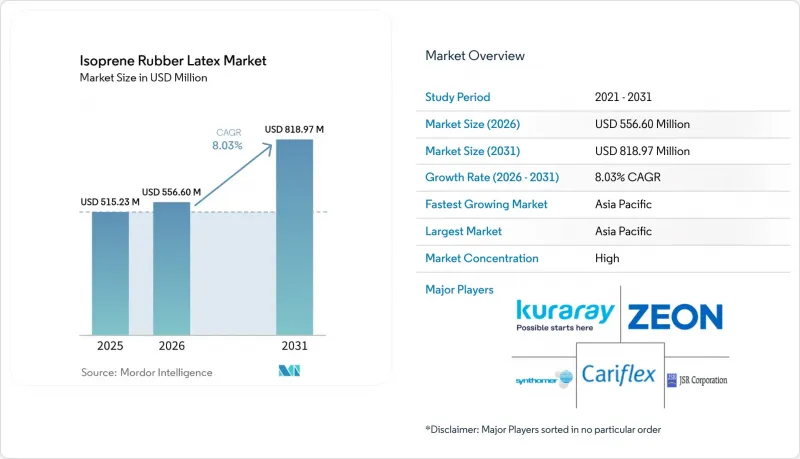
This report is Segmented by Grade (Medical, Industrial, Food, and High-Ammonia), Form (High-Solids and Low-Solids/Prevulcanized), Application (Medical Gloves, Catheters, Condoms, Adhesives, Textiles, and Others), End-User (Healthcare, Personal Care, Industrial, Consumer Goods, and Others), and Geography (Asia-Pacific, Europe, North America, and More). Market Forecasts are Provided in Terms of Value (USD).
Global Isoprene Rubber Latex Market Trends and Insights
Surging Demand for Powder-Free Medical Gloves
In 2017, the U.S. imposed a ban on powdered examination gloves, specifically targeting cornstarch carriers known to disseminate latex allergens. This regulatory shift prompted hospitals to pivot towards hypoallergenic synthetic alternatives. By the forecast period 2026-2031, Malaysia has emerged as a key exporter of surgical gloves, bolstering the demand for isoprene latex. Chinese manufacturer Intco Medical has increased its production capacity and streamlined labor costs, heightening the competitive landscape. Low-protein isoprene grades, containing less than 50 micrograms per gram, are now favored for their ability to reduce type I hypersensitivity, securing a premium position in hospital purchases. Reflecting this trend, mandates for powder-free gloves have expanded to encompass industrial and food-service sectors, amplifying the market potential for isoprene rubber latex.
Substitution of Natural Rubber Latex Amid Allergy Concerns
Natural-latex allergies affect a significant portion of healthcare workers, prompting occupational safety organizations to classify them as a workplace hazard. The European Pharmacopeia 3.2.9 has banned natural rubber latex in pharmaceutical primary packaging, shifting the focus to synthetic isoprene closures. Although guayule rubber and bio-based isoprene report fewer allergy incidents, they still await large-scale validation. Hospitals across North America and Europe have adopted nitrile or synthetic isoprene gloves, with nitrile glove revenues continuing to grow. Due to their identical cis-1,4 polyisoprene backbones, synthetic grades replicate the elasticity of natural rubber. Furthermore, being free from crop-derived proteins, they ensure consistent batches suitable for Class II/III devices.
High Production Cost Versus NRL
By the forecast period 2026-2031, synthetic isoprene latex prices outpace those of natural latex, fueled by the premium trading of polymer-grade monomers over crude C4/C5 streams. While natural rubber prices remain stable, the isoprene monomer market continues to grow steadily. Price-sensitive sectors, including household gloves and industrial dipped goods, still rely on natural latex. In contrast, medical and food-grade segments, benefiting from their hypoallergenic compliance, command premium prices.
Other drivers and restraints analyzed in the detailed report include:
- Growth in Minimally Invasive Catheter and Balloon Procedures
- DEHP-Free Device Regulation Favors IRL Catheter Balloons
- Volatile Isoprene-Monomer Feedstock Pricing
For complete list of drivers and restraints, kindly check the Table Of Contents.
Segment Analysis
In 2025, medical-grade latex, adhering to FDA 21 CFR 880 standards for gloves and USP 381 standards for closures, commanded 41.94% of the revenue. The market for food-grade isoprene rubber latex, driven by condom manufacturers targeting FDA 21 CFR 177.2600 compliant formulations, is set to expand at a CAGR of 8.52% from 2026 to 2031. Industrial-grade latex finds its application in adhesives and sealants, with liquid polyisoprene grades acting as tackifiers. While high-ammonia grades, known for enhancing shelf life, face scrutiny for EU VOC compliance, there is a noticeable industry shift towards low-ammonia stabilizers. Ultra-low-protein latex, with concentrations below 50 µg/g, is tailored for Class III surgical gloves and specialized medical devices.
Pricing for medical-grade latex remains strong, supported by ISO 13485 traceability and tightening hospital regulations on natural-latex allergens. Food-grade latex is commonly used in pacifiers, baby-bottle nipples, and hypoallergenic condoms, which drives a consistent volume increase. The industrial-grade segment is witnessing growth, especially as electric-vehicle manufacturers lean towards elastomeric bonding, moving away from traditional mechanical fasteners for weight reduction.
In 2025, high-solids latex, boasting over 50% solids content, commanded 63.91% of the revenue. This high-solids content not only reduced freight costs but also enhanced mechanical stability. Meanwhile, the market share of low-solids prevulcanized latex in the isoprene rubber sector is growing at 8.63% CAGR, from 2026 to 2031. This growth is attributed to radiation-peroxide vulcanization, which has achieved tensile strengths exceeding the ASTM D3577 standard, a benchmark for surgical gloves. Additionally, advancements in room-temperature pre-vulcanization have enabled the production of thin-wall catheter films, eliminating the need for post-cure ovens.
Although high-solids variants continue to dominate, sulfur-free prevulcanized grades are gaining traction. Their appeal lies in a reduced nitrosamine risk and faster production cycles. Glove manufacturing hubs in the Asia-Pacific (Malaysia and Thailand) region are also evolving. They have started integrating hybrid manufacturing models, combining radiation crosslinking with peroxide curing. On the logistics front, players in the supply chain, particularly those proficient in shipping stabilized low-solids latex under stringent cold-chain conditions of 2 to 8 °C, are strategically positioned to capture specialized medical orders during the forecast period of 2026-2031.
Geography Analysis
Asia-Pacific, which accounted for 53.37% of the revenue in 2025, is set to reinforce its lead with a projected 8.99% CAGR during the forecast period of 2026-2031. Malaysia has played a significant role in exporting surgical gloves. China, in addition to exporting gloves, is expanding its synthetic-rubber capacity. Both Thailand and Vietnam are increasing production in response to tariff changes affecting Chinese gloves. In February 2026, ARLANXEO launched an HNBR unit in Changzhou, while Zeon's Yonezawa facility is targeting bio-isoprene commercialization by 2034. Additionally, a rising middle class in India and Indonesia is driving increased healthcare spending, highlighting the region's growth potential.
North America and Europe are set to capture a substantial share of 2025's sales. The FDA's QMSR, introduced in 2026, along with state-level bans on phthalates, is driving reforms in catheters and stoppers, leading to increased adoption of synthetic isoprene. At the same time, European steam-cracker shutdowns are limiting local feedstock availability, pushing the region towards imports and driving up latex prices. In North America, the demand for vaccine stoppers remains strong, particularly with the expansion of mRNA fill-finish lines.
South America, the Middle-East, and Africa together make up a smaller portion of the 2025 revenue. The distribution of pre-vulcanized latex, which requires storage between 2°C and 8°C, faces challenges due to cold-chain deficiencies. ARLANXEO aims to complete its Triunfo expansion by 2027 to bolster local supply in Latin America. Meanwhile, the Middle-East's abundant petrochemical feedstock contrasts with its limited downstream latex production capacity, presenting attractive joint-venture opportunities for investors in gloves and catheters.
- ARLANXEO
- Cariflex
- Daelim Co., Ltd.
- Eni S.p.A
- Exxon Mobil Corporation
- Fushun Yikesi New Materials Co., Ltd.
- JSR Corporation
- Kent Elastomers Products, Inc.
- Kraton Corporation
- Kumho Petrochemical
- Kuraray Co., Ltd.
- LG Chem
- Lion Elastomers
- PetroChina Yanshan Petrochemical
- PJSC SIBUR Holding
- Shandong Yuhuang Chemical Co., Ltd.
- Sumitomo Rubber Industries
- Synthomer plc
- Top Glove Corporation Bhd
- Zeon Corporation
Additional Benefits:
- The market estimate (ME) sheet in Excel format
- 3 months of analyst support
TABLE OF CONTENTS
1 Introduction
- 1.1 Study Assumptions and Market Definition
- 1.2 Scope of the Study
2 Research Methodology
3 Executive Summary
4 Market Landscape
- 4.1 Market Overview
- 4.2 Market Drivers
- 4.2.1 Surging demand for powder-free medical gloves
- 4.2.2 Substitution of natural rubber latex (NRL) amid allergy concerns
- 4.2.3 Growth in minimally-invasive catheter and balloon procedures
- 4.2.4 DEHP-free device regulation favouring IRL catheter balloons
- 4.2.5 Ultra-clean IRL required for mRNA-vaccine vial stoppers
- 4.2.6 Microfluidic-chip elastomer layers needing ultra-pure IRL
- 4.3 Market Restraints
- 4.3.1 High production cost versus NRL
- 4.3.2 Volatile isoprene-monomer feedstock pricing
- 4.3.3 Steam-cracker outages limiting polymer-grade isoprene
- 4.3.4 Cold-chain logistics limitations in emerging markets
- 4.4 Value Chain Analysis
- 4.5 Regulatory Landscape
- 4.6 Technological Outlook
- 4.7 Porter's Five Forces
- 4.7.1 Bargaining Power of Suppliers
- 4.7.2 Bargaining Power of Buyers
- 4.7.3 Threat of New Entrants
- 4.7.4 Threat of Substitutes
- 4.7.5 Competitive Rivalry
5 Market Size and Growth Forecasts (Value)
- 5.1 By Grade
- 5.1.1 Medical Grade
- 5.1.2 Industrial Grade
- 5.1.3 Food Grade
- 5.1.4 High-Ammonia IRL
- 5.2 By Form
- 5.2.1 Personal Care and Hygiene
- 5.2.2 Low-Solids/Prevulcanized Latex
- 5.3 By Application
- 5.3.1 Medical Gloves
- 5.3.2 Catheters and Balloon Devices
- 5.3.3 Condoms
- 5.3.4 Adhesives and Sealants
- 5.3.5 Elastic Threads and Textiles
- 5.3.6 Other Applications (Coatings, Baby Products)
- 5.4 By End-user Industry
- 5.4.1 Healthcare and Medical
- 5.4.2 Personal Care and Hygiene
- 5.4.3 Industrial Manufacturing
- 5.4.4 Consumer Goods
- 5.4.5 Other Industries
- 5.5 By Geography
- 5.5.1 Asia-Pacific
- 5.5.1.1 China
- 5.5.1.2 India
- 5.5.1.3 Japan
- 5.5.1.4 South Korea
- 5.5.1.5 ASEAN Countries
- 5.5.1.6 Rest of Asia-Pacific
- 5.5.2 Europe
- 5.5.2.1 Germany
- 5.5.2.2 United Kingdom
- 5.5.2.3 France
- 5.5.2.4 Italy
- 5.5.2.5 Spain
- 5.5.2.6 Russia
- 5.5.2.7 Rest of Europe
- 5.5.3 North America
- 5.5.3.1 United States
- 5.5.3.2 Canada
- 5.5.3.3 Mexico
- 5.5.4 South America
- 5.5.4.1 Brazil
- 5.5.4.2 Argentina
- 5.5.4.3 Rest of South America
- 5.5.5 Middle-East and Africa
- 5.5.5.1 Saudi Arabia
- 5.5.5.2 United Arab Emirates
- 5.5.5.3 Turkey
- 5.5.5.4 South Africa
- 5.5.5.5 Rest of Middle-East and Africa
- 5.5.1 Asia-Pacific
6 Competitive Landscape
- 6.1 Market Concentration
- 6.2 Strategic Moves
- 6.3 Market Share(%)/Ranking Analysis
- 6.4 Company Profiles {(includes Global level Overview, Market level overview, Core Segments, Financials as available, Strategic Information, Products and Services, and Recent Developments)}
- 6.4.1 ARLANXEO
- 6.4.2 Cariflex
- 6.4.3 Daelim Co., Ltd.
- 6.4.4 Eni S.p.A
- 6.4.5 Exxon Mobil Corporation
- 6.4.6 Fushun Yikesi New Materials Co., Ltd.
- 6.4.7 JSR Corporation
- 6.4.8 Kent Elastomers Products, Inc.
- 6.4.9 Kraton Corporation
- 6.4.10 Kumho Petrochemical
- 6.4.11 Kuraray Co., Ltd.
- 6.4.12 LG Chem
- 6.4.13 Lion Elastomers
- 6.4.14 PetroChina Yanshan Petrochemical
- 6.4.15 PJSC SIBUR Holding
- 6.4.16 Shandong Yuhuang Chemical Co., Ltd.
- 6.4.17 Sumitomo Rubber Industries
- 6.4.18 Synthomer plc
- 6.4.19 Top Glove Corporation Bhd
- 6.4.20 Zeon Corporation
7 Market Opportunities and Future Outlook
- 7.1 White-space and Unmet-Need Assessment
- 7.2 Bio-based Isoprene Latex

