
PUBLISHER: Mordor Intelligence | PRODUCT CODE: 2062362

PUBLISHER: Mordor Intelligence | PRODUCT CODE: 2062362
France E-Commerce Warehouse - Market Share Analysis, Industry Trends & Statistics, Growth Forecasts (2026 - 2031)
According to Mordor Intelligence, the france e-Commerce warehouse market size is projected to be USD 1.29 billion in 2025, USD 1.36 billion in 2026, and reach USD 1.74 billion by 2031, growing at a CAGR of 5.06% from 2026 to 2031.
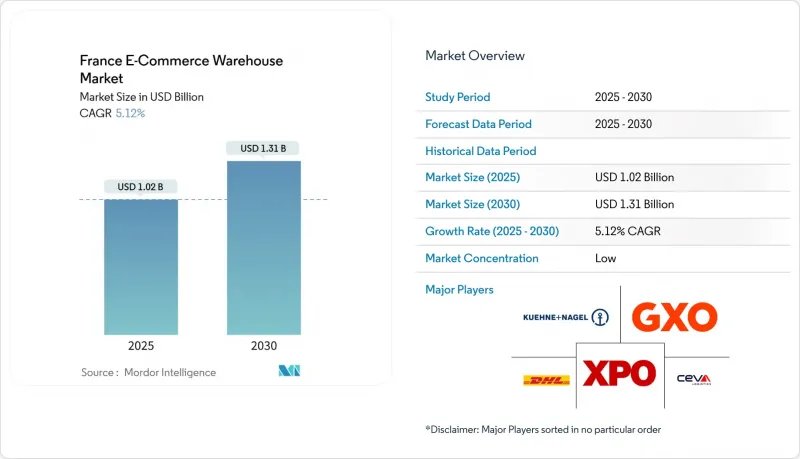
This report is Segmented by Warehouse Type (Fulfilment Centres, Distribution Centres, Cold-Chain Warehouses, Dark Stores/Micro-Fulfillment Centers, Others), by Service Type (Storage, Picking and Packing, Value-Added Services), by Automation Level (Manual, Semi-Automated, Automated), by End-User Industry (Apparel and Footwear, and More). The Market Forecasts are Provided in Terms of Value (USD).
France E-Commerce Warehouse Market Trends and Insights
Growing Demand for EU Cross-Border Consolidation Hubs
France sits at the heart of the European Union, letting operators dispatch parcels to 115 million consumers within a single-day delivery radius. Large 3PLs such as Kuehne+Nagel fold customs-clearance expertise into direct-to-consumer offerings, betting on faster growth in cross-border flows than in purely domestic traffic. Peripheral sites like Vaucluse leverage lower land prices and motorway links to Spain and Italy to attract consolidation hubs that relieve pressure on Ile-de-France. DHL's Chronopost network of 19,555 drop-off points underscores the node density required to make international e-commerce seamless. Regulatory harmonization under the EU Digital Single Market further reduces friction, steering pan-European brands toward French warehouses that balance speed, cost, and customs simplicity.
Government Subsidies for Brownfield Warehouse Conversions
Limited land in big cities drives policymakers to subsidize the reclamation of disused industrial parcels. The Schema Directeur de la Region Ile-de-France steers logistics toward already-urbanized plots, offering fiscal incentives and faster permits to developers that commit to environmental remediation. Paris-Saclay's government-backed science hub includes logistics zones where investors benefit from streamlined approvals, helping operators like Prologis meet sustainability mandates while enlarging their footprint. Upgrading brownfields cuts greenfield resistance, aligns with national net-zero goals, and keeps warehouses near end consumers to preserve delivery lead times.
Stringent Urban Noise and Traffic-Emission Zoning Compliance Costs
Municipalities now classify dark stores as warehouses, letting officials curb operating hours and impose delivery curfews, especially in Paris, where 60 quick-commerce sites risk closure for zoning breaches. Operators must invest in soundproof docks, electric vans, and real-time traffic management to retain urban footprints, inflating cost bases that already face thin e-commerce margins. Court rulings reinforce city authority, signaling that compliance spending will remain a near-term burden until vehicle electrification and micro-hub models mature.
Other drivers and restraints analyzed in the detailed report include:
- Omnichannel Click-and-Collect Surge Boosting Regional Hub Needs
- AI-Driven Inventory Analytics Improving Facility ROI
- Shortage of Robotics-Skilled Labor Delaying Automation Roll-Outs
For complete list of drivers and restraints, kindly check the Table Of Contents.
Segment Analysis
Fulfillment centers captured 51.43% of the France e-commerce warehouse market size in 2025, thanks to deep-lane storage and multi-SKU picking that serve national order peaks. Amazon's 180,000 m2 Augny site illustrates the scale of 4,000 staff and 25 km of conveyors keep lead times stable across Alsace, Lorraine, and neighboring countries. These megasites prioritize automation to offset wage inflation, embedding goods-to-person shuttles and automated sorters that push dock-to-dock cycles below 30 minutes. Operators also retrofit mezzanines into legacy shells, focusing on cubic optimization to avoid greenfield barriers near Paris.
Dark stores and micro-fulfillment centers, though only 4% of floor space today, are the fastest-growing sub-category at 10.26% CAGR through 2031. Quick-commerce players exploit 1,000-3,000 m2 facilities inside ring roads to promise 15-minute grocery drops. Land-use pushback is steering the next wave toward converted parking garages and rail depots, with Prologis piloting urban-hub concepts in Orleans that mix parcel lockers, EV charging, and bicycle docks. Cold-chain variants emerge as on-demand meal solutions expand, opening a premium pocket inside the France e-commerce warehouse market for temperature-specific micro sites.
Storage services accounted for 45.16% of France e-commerce warehouse market share in 2025, reflecting the enduring need to hold safety stock amid supply-chain volatility. Large retailers secure long-term leases on multi-client campuses, tying up racked capacity ahead of holiday peaks. Value-added storage, such as tri-temperature chambers at STEF, commands premium rents by complying with food-safety protocols and energy-efficiency targets.
Picking and packing, expanding at 9.54% CAGR, gains traction as robotics slashes order-cycle times to under one hour. DISPEO's Evreux site reaches 180 picks per person per hour with goods-to-person robots, extracting labor savings that more than offset capital outlays. Subscription boxes and influencer "drops" require kitting, labeling, and gift-wrap steps all bundled into integrated service contracts that lift warehouse yields. As same-day delivery proliferates, shippers favor operators that fuse storage, picking, personalization, and return handling under one roof, reinforcing convergence in the France e-commerce warehouse market.
List of Companies Covered in this Report:
- DHL Group
- ID Logistics
- GEODIS
- GXO Logistics
- La Poste Group (including Colissimo/Chronopost)
- STEF
- FM Logistic
- Kuehne+Nagel
- Centrimex
- XPO Logistics
- DSV
- DACHSER
- CMA CGM Group (including CEVA Logistics)
- Bansard International
- Seko Logistics
- Schneider Logistics
- SupplyWeb
- Amazon Logistics
- Rhenus Logistics
- Loxxess
Additional Benefits:
- The market estimate (ME) sheet in Excel format
- 3 months of analyst support
TABLE OF CONTENTS
1 Introduction
2 Research Methodology
3 Executive Summary
4 Market Landscape
- 4.1 Market Overview
- 4.2 Market Drivers
- 4.2.1 Growing Demand for EU Cross-Border Consolidation Hubs
- 4.2.2 Government Subsidies for Brownfield Warehouse Conversions
- 4.2.3 Omnichannel Click-and-Collect Surge Boosting Regional Hub Needs
- 4.2.4 AI-Driven Inventory Analytics Improving Facility ROI
- 4.2.5 Rapid Rise of Subscription Delivery Models Requiring Temperature-Controlled Space
- 4.2.6 Expansion of EV Last-Mile Fleets Needing Charging-Ready Warehouses
- 4.3 Market Restraints
- 4.3.1 Stringent Urban Noise and Traffic-Emission Zoning Compliance Costs
- 4.3.2 Shortage of Robotics-Skilled Labor Delaying Automation Roll-Outs
- 4.3.3 Volatile Electricity Tariffs Inflating Operating Expenses
- 4.3.4 EU Cyber-Security Mandates Raising WMS Upgrade Outlays
- 4.4 Value / Supply-Chain Analysis
- 4.5 Regulatory Landscape
- 4.6 Technological Outlook
- 4.7 Porter's Five Forces
- 4.7.1 Bargaining Power of Suppliers
- 4.7.2 Bargaining Power of Buyers
- 4.7.3 Threat of New Entrants
- 4.7.4 Threat of Substitutes
- 4.7.5 Competitive Rivalry
5 Market Size and Growth Forecasts
- 5.1 By Warehouse Type
- 5.1.1 Fulfilment Centres
- 5.1.2 Distribution Centres (DCs)
- 5.1.3 Cold-Chain Warehouses
- 5.1.4 Dark Stores / Micro-Fulfillment Centers
- 5.1.5 Others (Reverse Logistics Hubs, Bonded Warehouses, Hybrid-use Spaces, Etc.)
- 5.2 By Service Type
- 5.2.1 Storage
- 5.2.2 Picking and Packing
- 5.2.3 Value-Added Services and Others (Kitting, Labelling)
- 5.3 By Automation Level
- 5.3.1 Manual
- 5.3.2 Semi-Automated
- 5.3.3 Automated
- 5.4 By End-User Industry
- 5.4.1 Apparel and Footwear
- 5.4.2 Consumer Electronics
- 5.4.3 Grocery and FMCG
- 5.4.4 Pharmaceuticals, Beauty and Wellness
- 5.4.5 Home Essentials and Furnishings
- 5.4.6 Others
- 5.5 By French Region (Value)
- 5.5.1 Ile-de-France
- 5.5.2 Auvergne-Rhone-Alpes
- 5.5.3 Hauts-de-France
- 5.5.4 Provence-Alpes-Cote d'Azur
- 5.5.5 Grand Est
- 5.5.6 Nouvelle-Aquitaine
- 5.5.7 Occitanie
- 5.5.8 Others
6 Competitive Landscape
- 6.1 Market Concentration
- 6.2 Strategic Moves
- 6.3 Market Share Analysis
- 6.4 Company Profiles {(includes Global Level Overview, Market Level Overview, Core Segments, Financials as Available, Strategic Information, Market Rank/Share for Key Companies, Products and Services, and Recent Developments)}
- 6.4.1 DHL Group
- 6.4.2 ID Logistics
- 6.4.3 GEODIS
- 6.4.4 GXO Logistics
- 6.4.5 La Poste Group (including Colissimo/Chronopost)
- 6.4.6 STEF
- 6.4.7 FM Logistic
- 6.4.8 Kuehne+Nagel
- 6.4.9 Centrimex
- 6.4.10 XPO Logistics
- 6.4.11 DSV
- 6.4.12 DACHSER
- 6.4.13 CMA CGM Group (including CEVA Logistics)
- 6.4.14 Bansard International
- 6.4.15 Seko Logistics
- 6.4.16 Schneider Logistics
- 6.4.17 SupplyWeb
- 6.4.18 Amazon Logistics
- 6.4.19 Rhenus Logistics
- 6.4.20 Loxxess
7 Market Opportunities and Future Outlook

