
PUBLISHER: Mordor Intelligence | PRODUCT CODE: 2062371

PUBLISHER: Mordor Intelligence | PRODUCT CODE: 2062371
Specialty Tea - Market Share Analysis, Industry Trends & Statistics, Growth Forecasts (2026 - 2031)
According to Mordor Intelligence, the specialty tea market size was valued at USD 36.07 billion in 2025 and estimated to grow from USD 38.42 billion in 2026 to reach USD 52.66 billion by 2031, at a CAGR of 6.51% during the forecast period (2026-2031).
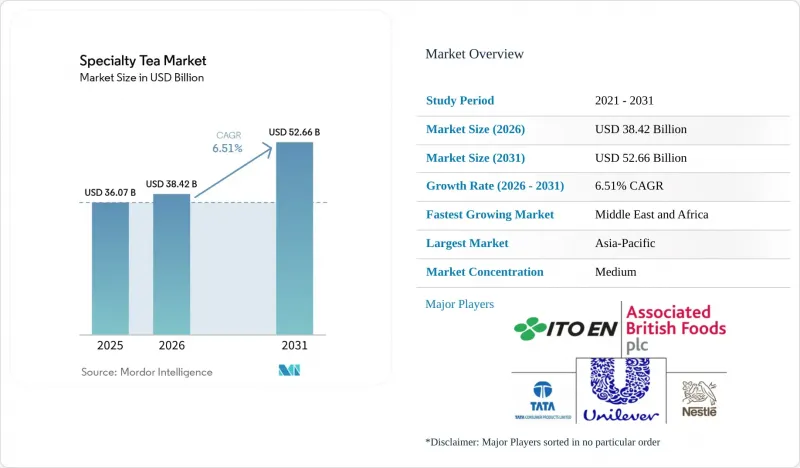
This report is Segmented by Product Type (Black Tea, Green Tea, Oolong Tea, Others), Category (Organic, Conventional), Packaging (Box, Pouches, Bags, Others), Distribution Channel (On-Trade, Off-Trade), and Geography (North America, Europe, Asia-Pacific, South America, Middle East and Africa). The Market Forecasts are Provided in Terms of Value (USD) and Volume (Liters).
Global Specialty Tea Market Trends and Insights
Growing focus on health and wellness
With a growing emphasis on physical and mental well-being, consumers are increasingly turning to specialty teas. According to the 2024 IFIC Food and Health Survey, 74% of consumers are choosing foods and beverages for their specific health benefits, particularly for stress relief, improved sleep, and boosted immunity. Studies published in 2025 validate that a daily intake of 300-500 mg of EGCG can bolster cardiovascular and cognitive functions. This finding has heightened interest in matcha, known for its superior EGCG concentrations. In response to this trend, Japan exported 8,798 tons of matcha in 2024, fetching JPY 36.4 billion, marking a significant 25% increase. Product developers are now blending Green Tea with ashwagandha and reishi, capitalizing on the calming effects of theanine (200 mg per cup) to offer stress relief without sedation. This innovation is evident in The Republic of Tea's SuperShroom collection, launched in March 2026. While social media buzz (#matcha boasts over 500 million views) is driving adoption, the market's sustained growth will rely more on consistent health outcomes and clear labeling than on influencer endorsements.
Expanding cafe culture and specialty tea outlets
Specialty cafes are now anchoring their margins on tea, with cup prices soaring to three to four times that of comparable Off-Trade servings. This shift highlights the growing consumer demand for premium tea experiences, which offer higher profitability for cafes. By Q3 FY2026, Tata Starbucks surpassed the milestone of 500 stores in India, introducing cold-brewed oolong and nitro green tea lines that align with local preferences, showcasing their strategy to cater to evolving consumer tastes. In 2024, Dubai's DMCC Tea Centre processed over 24,400 metric tons of tea, representing more than half of the global tea re-exports. This significant volume has played a pivotal role in energizing premium tea lounges throughout the Gulf, further solidifying the region's position as a global tea hub. Suppliers are bolstering this trend by offering barista training and tailored HoReCa bulk packs, empowering independent cafes to focus on curation rather than sheer scale, thereby enabling them to compete effectively in the premium tea market.
Competition from coffee and RTD beverages
In 2022, the volume of RTD tea hit 40 billion liters, reflecting the growing consumer preference for convenient and ready-to-drink beverages. In November 2024, PepsiCo and Unilever, as reported by Unilever, expanded Lipton RTD's reach to 11 new territories, aiming to strengthen their global footprint in the RTD tea market and cater to increasing demand. Lipton Hard Iced Tea, witnessing a remarkable 130% surge, raked in sales of approximately USD 150 million, effectively capturing consumption occasions typically overlooked by loose-leaf teas, such as casual social gatherings, outdoor events, and on-the-go scenarios. Meanwhile, coffee chains are ramping up the competition by introducing matcha lattes and cold brews, leveraging years of investment in barista culture, premium product offerings, and advanced equipment to attract a broader consumer base and diversify their beverage portfolios.
Other drivers and restraints analyzed in the detailed report include:
- Clean-label and organic preference surge
- Premiumization of artisanal blends
- High retail price of premium teas
For complete list of drivers and restraints, kindly check the Table Of Contents.
Segment Analysis
In 2025, Black Tea is set to dominate the specialty tea market, holding a 39.62% share. In 2024, it bolstered its status as the volume leader by exporting 198,410 tons to Europe. Yet, its growth lags behind other segments, attributed to its limited functional differentiation. To stay competitive, brands like Twinings are spotlighting traceability and eco-friendly packaging, such as using recycled materials and ensuring transparency in sourcing practices. These efforts highlight the growing importance of sustainability and ethical considerations in consumer purchasing decisions, underscoring that mere scale isn't sufficient in today's market.
Green Tea is on a rapid ascent, boasting a projected CAGR of 8.91% through 2031, outpacing the overall specialty tea market. This surge is largely fueled by a burgeoning demand for matcha, with exports soaring 25% year-on-year, reaching JPY 36.4 billion in 2024. In light of this, ITO EN launched a dedicated Matcha Business Department in May 2025, with ambitions to triple its powdered output by FY2029. This move aims to alleviate grinding bottlenecks and tackle challenges posed by an aging grower demographic, which has been a growing concern for the industry. By addressing these operational and supply chain issues, Green Tea is carving out a significant niche in the premium and functional segments of the market, further solidifying its role in driving innovation and growth within the specialty tea category.
In 2025, conventional teas commanded a dominant 87.71% share of the total market output. Their stronghold is bolstered by well-established supply chains and economies of scale, which effectively keep production costs in check. Industry giants, such as Bigelow, bolster consumer confidence by rigorously testing each lot for up to 450 pesticides, emphasizing their commitment to safety and consistency. Yet, an oversupply in Kenya's commodity channel is exerting downward pressure on export prices, curbing potential value growth. While conventional tea leads in global volume, its future expansion hinges on navigating tighter safety and sustainability standards without compromising efficiency.
Organic teas are emerging as the market's fastest-growing segment, with projections pointing to a robust 9.56% CAGR through 2031, buoyed by the USDA's NOPID traceability mandate. The surging demand for products with verified origins and minimal residues is driving prices higher. Notably, Kyoto's organic tencha auctions witnessed a staggering 170% spike, a testament to supply constraints. However, producers grapple with challenges in scaling production, primarily due to steep compliance costs and diminished yields. For organic teas to truly flourish, a delicate balance between traceability and cost-effectiveness is paramount. With transparency becoming a pivotal advantage, organic teas are poised to allure an even larger segment of premium buyers on the global stage.
Geography Analysis
In 2025, Asia-Pacific accounted for 37.51% of global tea revenue, driven largely by China's export of 419,000 tonnes, with a notable 88.1% being Green Tea. The region's dominance is further supported by its strong production capabilities and growing consumer demand for premium tea varieties. In 2024, Japan's matcha exports surged by 25% to reach JPY 36.4 billion, and in April 2025, shipments to the U.S. skyrocketed by 176.5%, totaling JPY 2.05 billion. This growth highlights Japan's increasing focus on expanding its footprint in international markets, particularly in the United States. Meanwhile, India showcased its dual prowess as both an exporter and innovator, unveiling 15 new Tetley SKUs in Q3 FY2026. The introduction of these SKUs reflects India's strategy to cater to evolving consumer preferences and strengthen its position in the global tea market.
Leading the charge, the Middle East and Africa region is projected to grow at a robust 9.81% CAGR through 2031. This growth is largely attributed to Dubai's DMCC Tea Centre, which processed 24,400 metric tons in 2024 and commands over half of the global tea re-exports. The region's strategic location and infrastructure have made it a critical hub for the tea trade and re-exports. In 2024, Kenya, solidifying its emerging role in the premium tea segment, garnered KES 215.21 billion from tea and exported 28.90 million kg of value-added specialty teas. Kenya's focus on value addition and specialty products is helping it tap into higher-margin markets and diversify its export portfolio.
North America and Europe play pivotal roles in realizing premium tea prices. In FY2025, ITO EN's beverage volume in North America surged by 53%, with its Oi Ocha brand now reaching 47 countries. The brand's expansion underscores the growing demand for authentic and high-quality tea products in the region. Europe, witnessing a steady annual growth of approximately 12%, has organic tea constituting 15% of its market volume. This trend reflects increasing consumer awareness and preference for sustainable and health-focused products. While South America remains largely dominated by yerba mate, urban centers in Brazil are showing a budding interest in wellness teas, signaling potential growth in the future. The rising health consciousness among urban consumers is expected to drive demand for innovative tea products in the region.
- Unilever PLC
- Tata Consumer Products Ltd.
- Associated British Foods PLC
- ITO EN Ltd.
- The Hain Celestial Group Inc.
- Nestle S.A.
- Starbucks Corporation
- Bigelow Tea Company
- Harney and Sons Fine Teas
- Yogi Tea (Golden Temple Inc.)
- The Republic of Tea Inc.
- Dilmah Ceylon Tea Company
- Mariage Freres SA
- Rishi Tea and Botanicals
- Numi Organic Tea Inc.
- Mighty Leaf Tea Company
- Teapigs Ltd.
- Lupicia Co. Ltd.
- Ten Ren Tea Co.
- Vahdam India
Additional Benefits:
- The market estimate (ME) sheet in Excel format
- 3 months of analyst support
TABLE OF CONTENTS
1 INTRODUCTION
- 1.1 Study Assumptions and Market Definition
- 1.2 Scope of the Study
2 RESEARCH METHODOLOGY
3 EXECUTIVE SUMMARY
4 MARKET LANDSCAPE
- 4.1 Market Overview
- 4.2 Market Drivers
- 4.2.1 Growing focus on health and wellness
- 4.2.2 Expanding cafe culture and specialty tea outlets
- 4.2.3 Clean-label and organic preference surge
- 4.2.4 Premiumization of artisanal blends
- 4.2.5 Functional botanicals and adaptogens integration
- 4.2.6 Blockchain-enabled provenance verification
- 4.3 Market Restraints
- 4.3.1 Competition from coffee and RTD beverages
- 4.3.2 High retail price of premium teas
- 4.3.3 Fragmented micro-lot supply chains complexity
- 4.3.4 Limited consumer sensory knowledge
- 4.4 Consumer Behavior Analysis
- 4.5 Regulatory Outlook
- 4.6 Technological Outlook
- 4.7 Porter's Five Forces Analysis
- 4.7.1 Threat of New Entrants
- 4.7.2 Bargaining Power of Buyers
- 4.7.3 Bargaining Power of Suppliers
- 4.7.4 Threat of Substitutes
- 4.7.5 Competitive Rivalry
5 MARKET SIZE AND GROWTH FORECASTS (VALUE AND VOLUME)
- 5.1 By Product Type
- 5.1.1 Black Tea
- 5.1.2 Green Tea
- 5.1.3 Oolong Tea
- 5.1.4 Others
- 5.2 By Category
- 5.2.1 Organic
- 5.2.2 Conventional
- 5.3 By Packaging
- 5.3.1 Box
- 5.3.2 Pouches
- 5.3.3 Bags
- 5.3.4 Others
- 5.4 By Distribution Channel
- 5.4.1 On-Trade
- 5.4.2 Off-Trade
- 5.4.2.1 Supermarket/Hypermarket
- 5.4.2.2 Convineience/Grocery Stores
- 5.4.2.3 Online Retail Stores
- 5.4.2.4 Others
- 5.5 By Geography
- 5.5.1 North America
- 5.5.1.1 United States
- 5.5.1.2 Canada
- 5.5.1.3 Mexico
- 5.5.1.4 Rest of North America
- 5.5.2 Europe
- 5.5.2.1 Germany
- 5.5.2.2 United Kingdom
- 5.5.2.3 Italy
- 5.5.2.4 France
- 5.5.2.5 Spain
- 5.5.2.6 Netherlands
- 5.5.2.7 Rest of Europe
- 5.5.3 Asia-Pacific
- 5.5.3.1 China
- 5.5.3.2 India
- 5.5.3.3 Japan
- 5.5.3.4 Australia
- 5.5.3.5 Rest of Asia-Pacific
- 5.5.4 South America
- 5.5.4.1 Brazil
- 5.5.4.2 Argentina
- 5.5.4.3 Rest of South America
- 5.5.5 Middle East and Africa
- 5.5.5.1 South Africa
- 5.5.5.2 Saudi Arabia
- 5.5.5.3 United Arab Emirates
- 5.5.5.4 Rest of Middle East and Africa
- 5.5.1 North America
6 COMPETITIVE LANDSCAPE
- 6.1 Market Concentration
- 6.2 Strategic Moves
- 6.3 Market Share Analysis
- 6.4 Company Profiles {(includes Global level Overview, Market level overview, Core Segments, Financials as available, Strategic Information, Market Rank/Share for key companies, Products and Services, and Recent Developments)}
- 6.4.1 Unilever PLC
- 6.4.2 Tata Consumer Products Ltd.
- 6.4.3 Associated British Foods PLC
- 6.4.4 ITO EN Ltd.
- 6.4.5 The Hain Celestial Group Inc.
- 6.4.6 Nestle S.A.
- 6.4.7 Starbucks Corporation
- 6.4.8 Bigelow Tea Company
- 6.4.9 Harney and Sons Fine Teas
- 6.4.10 Yogi Tea (Golden Temple Inc.)
- 6.4.11 The Republic of Tea Inc.
- 6.4.12 Dilmah Ceylon Tea Company
- 6.4.13 Mariage Freres SA
- 6.4.14 Rishi Tea and Botanicals
- 6.4.15 Numi Organic Tea Inc.
- 6.4.16 Mighty Leaf Tea Company
- 6.4.17 Teapigs Ltd.
- 6.4.18 Lupicia Co. Ltd.
- 6.4.19 Ten Ren Tea Co.
- 6.4.20 Vahdam India
7 MARKET OPPORTUNITIES AND FUTURE OUTLOOK

