PUBLISHER: Mordor Intelligence | PRODUCT CODE: 2062378

PUBLISHER: Mordor Intelligence | PRODUCT CODE: 2062378
Car Detailing Services - Market Share Analysis, Industry Trends & Statistics, Growth Forecasts (2026 - 2031)
According to Mordor Intelligence, the car detailing services market size is projected to be USD 42.75 billion in 2025, USD 45.21 billion in 2026, and reach USD 59.63 billion by 2031, growing at a CAGR of 5.69% from 2026 to 2031.
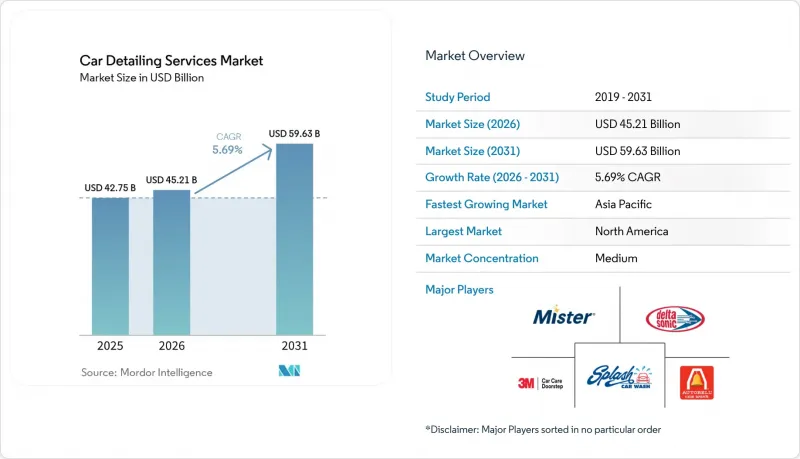
This report is Segmented by Service Type (Exterior Wash, Exterior Wax/Sealant, and More), Provider Model (Conventional Service Station, Mobile/On-Demand, and More), Car Body Style (Hatchback, Sedan, and More), and Booking Channel (Online/App-Based, Walk-in/Offline), and Geography (North America, South America, and More). Market Forecasts are Provided in Terms of Value (USD).
Global Car Detailing Services Market Trends and Insights
Luxury and EV Penetration Demanding Specialty Detailing
As battery-electric vehicle prices rise, owners are turning to multi-year coatings to safeguard their resale values. In recent years, Glossgenic reported EV ticket prices soaring above standard packages. Astonishing Detail, based in the Pacific Northwest, highlighted that Tesla and Rivian owners are increasingly investing in two-step correction-plus-coating services. Meanwhile, NVN Motorworks, boasting what it claims to be the world's largest luxury detailing facility, operates in both Dubai and Riyadh, emphasizing the segment's global footprint. This dynamic landscape compels operators to strike a balance between high-volume express tunnels and boutique studios that command premium margins.
Soaring Subscription-Based Express-Wash Memberships
Unlimited-wash memberships now anchor revenue for leading chains, shielding operators from seasonal swings. Mister Car Wash grew its Unlimited Wash Club to nearly 2.3 million members in 2025, with membership contributing 79% of wash revenue . In India, ROXO Hub offers similar service bundles, while ALPHASHINE in the Gulf combines interior and tire services. This strategy boosts their average revenue per user. The consistent cash inflows not only shorten working-capital cycles but also bolster leverage for expanding networks. Established brand chains can afford to underprice smaller independents, leading to a swift shift in market share. As a result, private-equity sponsors are keen on platforms that can leverage memberships across their widespread locations.
Labor-Cost Inflation and Technician Shortage
In 2025, median hourly wages for detailers in U.S. metros experienced significant growth. Concurrently, many shops grappled with hiring challenges. The industry faces high turnover rates, inflating training costs and limiting expansion into secondary cities. While automation offers a potential relief, the upfront costs of robotic polishers and AI inspection lines remain a hurdle for many independent operators. In contrast, chains boasting robust balance sheets leverage their position, providing career pathways and benefits, thus amplifying the existing capability gap.
Other drivers and restraints analyzed in the detailed report include:
- AI-Powered Visual-Inspection Upselling Platforms
- OEM "Paint-Protection-As-A-Service" Partnerships
- PFAS / VOC Chemical Bans
For complete list of drivers and restraints, kindly check the Table Of Contents.
Segment Analysis
Exterior wash services generated 36.15% of revenue in 2025, confirming their role as the volume backbone of the car detailing services market. Paint correction and ceramic coating are forecast to grow at 12.39% a year to 2031 as EV owners invest in multi-year surface protection. Ticket prices for this specialty cluster soar significantly above those of express washes, boosting gross margins for studios adept at multi-layer applications. As regulatory limits tighten on VOCs, suppliers are pivoting to low-solvent formulations. This shift not only nudges prices upward but also strengthens the value proposition centered on environmental compliance. Operators who can't invest in new chemistry lines face the risk of losing premium clients to studios that offer certified low-VOC products.
By 2025, the market for ceramic-coating packages in car detailing services had already gained significant traction, with further growth projected by 2031. Partnerships like Ceramic Pro with Lucid underscore the growing legitimacy of coatings as near-standard features. While express tunnels dominate by processing a high volume of vehicles daily, subscription discounts are squeezing per-car revenue. Consequently, high-margin specialty suites are sprouting within larger operations, enabling operators to harness both scale and premium spending.
Conventional service stations retained 73.01% share in 2025 on the strength of embedded tunnel infrastructure. However, mobile and on-demand operators are projected to compound at 16.45% through 2031. Clean Mobile Detailing in California charges significant premiums over fixed-site prices yet still enjoys repeat bookings from urban professionals who value convenience. Fleet managers view on-site service as a way to avoid routing vehicles off-shift, supporting enterprise packages that guarantee recurring volume.
Subscription clubs bridge both models. Mister Car Wash reported that membership sales contributed 79% of wash turnover in 2025. The car detailing services market share of mobile providers is expected to climb by 2031 as app-based platforms extend geographic reach without real estate drag. Conventional stations continue to dominate rural areas where land is cheap, and tunnel throughput outweighs travel cost, but the urban pendulum has swung toward mobile.
Geography Analysis
North America generated 39.12% of global revenue in 2025, underpinned by mature subscription penetration and dense express-tunnel networks. In February 2026, Mister Car Wash crossed USD 1 billion in revenue across 548 sites, and Quick Quack exceeded 300 locations following KKR funding. PFAS and VOC legislation in California and Washington is forcing chemistry shifts that reward operators with R&D depth. Canada contributes incremental growth, helped by high vehicle ownership, while Mexico lags owing to lower disposable income, but offers white space for value-priced chains.
Asia-Pacific is the fastest riser, poised for an 8.15% CAGR through 2031. In India, urban detailing studios like The Car Laundry and The Detailing Gang are catering to middle-income professionals, offering a wide range of packages. With China's substantial EV penetration in 2025, there's a growing demand for specialty coatings, particularly those addressing battery-specific thermal constraints. Meanwhile, water scarcity issues in Australia and Malaysia are driving a swift adoption of waterless chemicals, a trend that's also gaining momentum in the Gulf.
Europe, South America, the Middle East, and Africa contribute to the remaining turnover. Brazil's detailing sector has experienced remarkable growth over the past few years, fueled by an expanding vehicle parc. The Middle East stands out with the highest per-visit spending; for instance, NVN Motorworks in Dubai offers premium packages. In Europe, the push for PFAS substitution, driven by REACH regulations, presents challenges. However, smaller shops are navigating this by marketing low-impact chemistries to environmentally conscious owners. While these regions offer opportunities for portfolio diversification, they also necessitate tailored service menus to align with local climatic and regulatory landscapes.
- Mister Car Wash Holdings, Inc.
- Splash Car Wash
- Autobell Car Wash, Inc.
- Delta Sonic Carwash Systems Inc.
- Quick Quack Car Wash
- AutoKorrect
- Elite Detailing and Protection
- M-PIRE Auto Detailing
- Oasis Detail LLC
- 3M Company (3M Car Care)
- DetailXPerts Franchise System, LLC
- Action Car Detailing Inc.
- Turtle Wax Inc.
- Whistle Express Car Wash
- ZIPS Car Wash
Additional Benefits:
- The market estimate (ME) sheet in Excel format
- 3 months of analyst support
TABLE OF CONTENTS
1 Introduction
- 1.1 Study Assumptions and Market Definition
- 1.2 Scope of the Study
2 Research Methodology
3 Executive Summary
4 Market Landscape
- 4.1 Market Overview
- 4.2 Market Drivers
- 4.2.1 Luxury and EV Penetration Demanding Specialty Detailing
- 4.2.2 Soaring Subscription-Based Express-Wash Memberships
- 4.2.3 AI-Powered Visual-Inspection Upselling Platforms
- 4.2.4 OEM "Paint-Protection-As-A-Service" Partnerships
- 4.2.5 Private-Equity Roll-Ups Creating Branded Super-Chains
- 4.2.6 Water-Scarcity Rules Accelerating Water-Less Chemicals
- 4.3 Market Restraints
- 4.3.1 Labor-Cost Inflation and Technician Shortage
- 4.3.2 PFAS / VOC Chemical Bans
- 4.3.3 Do-It-Yourself Kits Eroding Repeat Visits
- 4.3.4 Self-Clean Nanocoatings on AV Fleets
- 4.4 Value / Supply-Chain Analysis
- 4.5 Regulatory Landscape
- 4.6 Technological Outlook
- 4.7 Porter's Five Forces
- 4.7.1 Threat of New Entrants
- 4.7.2 Bargaining Power of Suppliers
- 4.7.3 Bargaining Power of Buyers
- 4.7.4 Threat of Substitutes
- 4.7.5 Competitive Rivalry
5 Market Size and Growth Forecasts (Value, USD)
- 5.1 By Service Type
- 5.1.1 Exterior Wash
- 5.1.2 Exterior Wax / Sealant
- 5.1.3 Interior Vacuuming
- 5.1.4 Interior Surface Cleaning
- 5.1.5 Glass and Windshield Cleaning
- 5.1.6 Tire and Wheel Dressing
- 5.1.7 Paint Correction / Ceramic Coating
- 5.1.8 Others (Odor Removal, Engine Bay, Headlight Restoration)
- 5.2 By Provider Model
- 5.2.1 Conventional Service Station
- 5.2.2 Mobile / On-Demand
- 5.2.3 Subscription Club / Membership
- 5.3 By Car Body Style
- 5.3.1 Hatchback
- 5.3.2 Sedan
- 5.3.3 Sport Utility Vehicles and Multi-Purpose Vehicles
- 5.4 By Booking Channel
- 5.4.1 Online / App-Based
- 5.4.2 Walk-in / Offline
- 5.5 By Geography
- 5.5.1 North America
- 5.5.1.1 United States
- 5.5.1.2 Canada
- 5.5.1.3 Rest of North America
- 5.5.2 South America
- 5.5.2.1 Brazil
- 5.5.2.2 Argentina
- 5.5.2.3 Rest of South America
- 5.5.3 Europe
- 5.5.3.1 Germany
- 5.5.3.2 United Kingdom
- 5.5.3.3 France
- 5.5.3.4 Italy
- 5.5.3.5 Spain
- 5.5.3.6 Rest of Europe
- 5.5.4 Asia-Pacific
- 5.5.4.1 China
- 5.5.4.2 Japan
- 5.5.4.3 India
- 5.5.4.4 South Korea
- 5.5.4.5 Rest of Asia-Pacific
- 5.5.5 Middle East and Africa
- 5.5.5.1 Saudi Arabia
- 5.5.5.2 United Arab Emirates
- 5.5.5.3 Egypt
- 5.5.5.4 South Africa
- 5.5.5.5 Rest of Middle East and Africa
- 5.5.1 North America
6 Competitive Landscape
- 6.1 Market Concentration
- 6.2 Strategic Moves
- 6.3 Market Share Analysis
- 6.4 Company Profiles (Includes Global Level Overview, Market Level Overview, Core Segments, Financials as Available, Strategic Information, Market Rank/Share for Key Companies, Products and Services, SWOT Analysis, and Recent Developments)
- 6.4.1 Mister Car Wash Holdings, Inc.
- 6.4.2 Splash Car Wash
- 6.4.3 Autobell Car Wash, Inc.
- 6.4.4 Delta Sonic Carwash Systems Inc.
- 6.4.5 Quick Quack Car Wash
- 6.4.6 AutoKorrect
- 6.4.7 Elite Detailing and Protection
- 6.4.8 M-PIRE Auto Detailing
- 6.4.9 Oasis Detail LLC
- 6.4.10 3M Company (3M Car Care)
- 6.4.11 DetailXPerts Franchise System, LLC
- 6.4.12 Action Car Detailing Inc.
- 6.4.13 Turtle Wax Inc.
- 6.4.14 Whistle Express Car Wash
- 6.4.15 ZIPS Car Wash
7 Market Opportunities and Future Outlook
- 7.1 White-space and Unmet-Need Assessment

