PUBLISHER: Mordor Intelligence | PRODUCT CODE: 2062390

PUBLISHER: Mordor Intelligence | PRODUCT CODE: 2062390
Recycled Lead - Market Share Analysis, Industry Trends & Statistics, Growth Forecasts (2026 - 2031)
According to Mordor Intelligence, the recycled lead market size is projected to be USD 19.08 billion in 2025, USD 19.68 billion in 2026, and reach USD 22.98 billion by 2031, growing at a CAGR of 3.15% from 2026 to 2031.
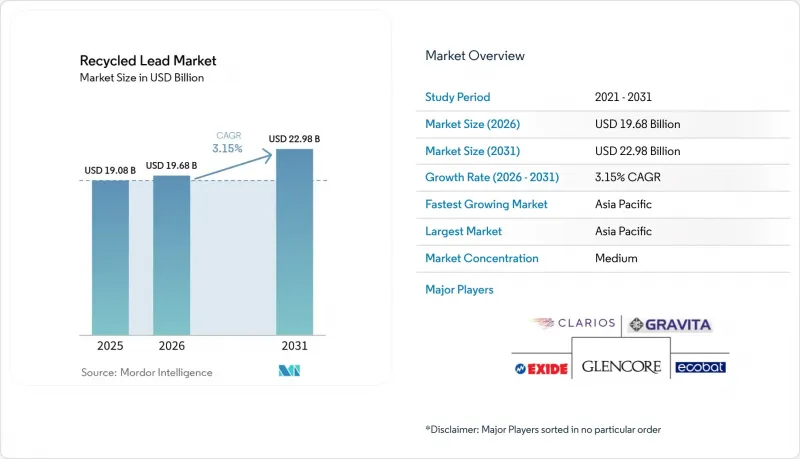
This report is Segmented by Source Type (Used Lead-Acid Batteries, Lead Scrap, and More), Recycling Method (Pyrometallurgical, Hydrometallurgical, and More), Form (Recycled Lead Ingots, Recycled Lead Alloys, and More), End-User Industry (Automotive - SLI, Energy Storage Systems, and More), and Geography (Asia-Pacific, North America, and More). The Market Forecasts are Provided in Terms of Value (USD).
Global Recycled Lead Market Trends and Insights
Growing Demand for Sustainable and Circular-Economy Practices
Circular-economy regulations are transforming procurement strategies among automakers and industrial battery buyers. The European Union mandates manufacturers to achieve 75% collection efficiency by 2025 and 90% lead recovery by 2027, encouraging original equipment manufacturers to establish long-term supply agreements with certified recyclers. In the United States, NESHAP limits for secondary smelters increase compliance costs but improve air quality near urban facilities. Large integrated firms are adopting advanced technologies like scrubbers and electrostatic precipitators, which smaller operators cannot afford, driving consolidation in the recycled lead market. Battery manufacturers view recycled lead as a safeguard against disruptions in primary-mine supply, particularly after Indonesia and Australia restricted lead-ore exports in 2024. As a result, the recycled lead market is gaining strategic importance within the broader battery value chain.
Rising Use of Lead-Acid Batteries in Automotive and Stationary Storage
Global vehicle production surpassed 85 million units in 2024, with each internal-combustion vehicle requiring an SLI battery, maintaining baseline demand for the recycled lead market. Even battery-electric vehicles use 12-volt auxiliary packs for safety systems, ensuring the continued relevance of recycled lead. Telecom towers in India and Africa now exceed 600,000 units and rely on VRLA batteries to address unreliable grid conditions, expanding the scrap stream. Data-center operators reported a 15% increase in reserve-power battery shipments in 2025, highlighting the growth of stationary storage. Recyclers benefit from VRLA scrap, which provides high-purity lead oxide with a 5%-8% price premium, boosting margins within the recycled lead market.
Environmental and Health Risks in Informal Recycling Clusters
Workers in unregulated recycling facilities in countries like India and Nigeria often record blood-lead levels exceeding 40 µg/dL, far above the World Health Organization guideline of 5 µg/dL. Effluent from these facilities contaminates irrigation channels, raising community concerns and occasionally leading to plant closures. While the Basel Convention prescribes enclosed furnaces and slag stabilization, enforcement gaps persist, enabling price undercutting that reduces margins for compliant operators. Battery manufacturers are increasingly auditing supply chains to avoid reputational risks. Upgrading informal facilities to ISO 14001 standards would cost USD 0.5-1 million per site, a financial burden many operators cannot bear, temporarily reducing scrap flows into the formal recycled lead market.
Other drivers and restraints analyzed in the detailed report include:
- Stringent EHS Regulations That Mandate Lead Recovery
- Cost Advantage of Secondary versus Primary Lead
- Lead-Price Volatility Squeezing Smelter Margins
For complete list of drivers and restraints, kindly check the Table Of Contents.
Segment Analysis
Used lead-acid batteries (ULABs) contributed 73.89% of the recycled lead market share in 2025, highlighting the critical role of end-of-life SLI and VRLA units in ensuring feedstock availability. Industrial waste and sludge is the fastest-growing source type, with a CAGR of 3.58% projected through 2031, driven by stricter regulations on the disposal of electronics and metal-forming residues. Expanding into sludge and factory scrap helps processors stabilize revenues against fluctuations in ULAB inflows, a strategy already being utilized by larger firms.
Industrial waste requires processes like sulfate neutralization and carbonate removal, but its high-purity oxide content is appealing to battery paste manufacturers prioritizing consistency. Aqua Metals' AquaRefining system, which operates at room temperature, is designed for ULABs and eliminates the need for blast furnaces, reducing capital costs by approximately 30% for greenfield plants. Processors adopting blended feedstock strategies gain flexibility, supporting the long-term stability of the recycled lead market.
The pyrometallurgical method accounted for 63.02% of recycled lead output in 2025, as blast furnaces with capacities ranging from 50,000 to 100,000 tons per year achieve significant economies of scale. The hydrometallurgical method is expected to grow at a CAGR of 3.64% through 2031, benefiting from 40%-50% lower energy consumption and the elimination of sulfur-dioxide emissions.
The European Union's Carbon Border Adjustment Mechanism, effective from 2026, will impose import fees on carbon-intensive metals, encouraging companies to retrofit furnaces with scrubbers or invest in low-temperature reactors. ACE Green Recycling's modular electrochemical units, priced under USD 1 million, are designed for small operators in regions like Africa and India, potentially accelerating technology adoption. A bifurcation in technology is anticipated: high-volume plants will continue refining pyrometallurgical emissions, while new entrants are likely to adopt hydrometallurgical methods that align with ESG financing criteria, enhancing competitive diversity in the recycled lead market.
Geography Analysis
Asia-Pacific led the recycled lead market with 45.33% share in 2025 and is anticipated to grow at a 3.97% CAGR to 2031. China tightened emission controls in 2024, pushing informal smelters toward consolidation and favoring licensed operators capable of funding scrubbers and real-time monitoring. India's e-rickshaw ecosystem supplies predictable VRLA scrap to recyclers such as Gravita India, while ASEAN economies offer fiscal perks for new hydrometallurgical capacity. Japan and South Korea target carbon neutrality by 2050, stimulating pilot plants that test low-carbon reactors and supporting regional technology diffusion across the recycled lead market.
In North America, collection efficiency already exceeds 99%, capping incremental volume growth. The U.S. Lead and Copper Rule revisions in 2024 forced facility retrofits that raise fixed costs but improve community air quality. Canada and Mexico integrate cross-border scrap flows to buff smelter utilization, and several U.S. players are shifting into premium oxide for stationary storage that meets data-center ESG procurement rules. The recycled lead market thus balances mature collection infrastructure with evolving product-mix opportunities.
Europe's demand is shaped by the EU Battery Regulation that embeds recycled-content thresholds into product approval pathways. Germany, France, and Italy host vertically integrated clusters where ECOBAT and Campine co-locate collection and smelting, securing economies of density. Russia's export restrictions shift demand to domestic and North African recyclers, diversifying supply.
South America, and Middle-East and Africa combined for a lower share in 2025. Brazil's 40 million-vehicle fleet supplies significant ULAB volumes, yet informal yards persist outside major metros. Data-center expansion in the United Arab Emirates and Saudi Arabia stimulates VRLA imports that will transition into scrap later this decade, adding a regional growth vector to the recycled lead market.
- ACE Green Recycling, Inc.
- Aqua Metals, Inc.
- Battery Solutions Inc.
- Campine nv
- Clarios
- East Penn Manufacturing Company
- ECOBAT
- ENERSYS
- EXIDE INDUSTRIES LTD.
- Fenix Battery Recycling
- Glencore
- Gravita India Ltd.
- JAIN RESOURCE RECYCLING LTD.
- KC Recycling
- METALICO
- Pilot Industries Limited
- Pondy Oxides and Chemicals Limited
- Recylex SA
- Terrapure BR Ltd.
- The Doe Run Company
- Wirtz Manufacturing
Additional Benefits:
- The market estimate (ME) sheet in Excel format
- 3 months of analyst support
TABLE OF CONTENTS
1 Introduction
- 1.1 Study Assumptions and Market Definition
- 1.2 Scope of the Study
2 Research Methodology
3 Executive Summary
4 Market Landscape
- 4.1 Market Overview
- 4.2 Market Drivers
- 4.2.1 Growing demand for sustainable and circular-economy practices
- 4.2.2 Rising use of lead-acid batteries in automotive and stationary storage
- 4.2.3 Stringent EHS regulations mandating lead recovery
- 4.2.4 Cost advantage of secondary vs. primary lead
- 4.2.5 Ramp-up of VRLA battery demand in emerging micro-mobility markets
- 4.3 Market Restraints
- 4.3.1 Environmental and health risks in informal recycling clusters
- 4.3.2 Lead-price volatility squeezing smelter margins
- 4.3.3 Shrinking scrap availability due to longer battery life
- 4.4 Value Chain Analysis
- 4.5 Porter's Five Forces
- 4.5.1 Threat of New Entrants
- 4.5.2 Bargaining Power of Buyers
- 4.5.3 Bargaining Power of Suppliers
- 4.5.4 Threat of Substitutes
- 4.5.5 Competitive Rivalry
5 Market Size and Growth Forecasts (Value)
- 5.1 By Source Type
- 5.1.1 Used Lead-Acid Batteries (ULABs)
- 5.1.2 Lead Scrap (cables, roofing, alloys)
- 5.1.3 Industrial Waste and Sludge
- 5.1.4 Other Source Types
- 5.2 By Recycling Method
- 5.2.1 Pyrometallurgical
- 5.2.2 Hydrometallurgical
- 5.2.3 Electrochemical
- 5.2.4 Other Recycling Methods
- 5.3 By Form
- 5.3.1 Recycled Lead Ingots
- 5.3.2 Recycled Lead Alloys
- 5.3.3 Secondary Lead Oxide
- 5.3.4 Other Forms
- 5.4 By End-user Industry
- 5.4.1 Automotive - SLI (Starting, Lighting, and Ignition)
- 5.4.2 Energy Storage Systems
- 5.4.3 Telecom and Data Centers
- 5.4.4 Industrial Equipment
- 5.4.5 Construction and Infrastructure
- 5.4.6 Consumer Electronics
- 5.4.7 Defense and Marine
- 5.5 By Geography
- 5.5.1 Asia-Pacific
- 5.5.1.1 China
- 5.5.1.2 India
- 5.5.1.3 Japan
- 5.5.1.4 South Korea
- 5.5.1.5 ASEAN Countries
- 5.5.1.6 Rest of Asia-Pacific
- 5.5.2 North America
- 5.5.2.1 United States
- 5.5.2.2 Canada
- 5.5.2.3 Mexico
- 5.5.3 Europe
- 5.5.3.1 Germany
- 5.5.3.2 United Kingdom
- 5.5.3.3 France
- 5.5.3.4 Italy
- 5.5.3.5 Spain
- 5.5.3.6 Russia
- 5.5.3.7 NORDIC Countries
- 5.5.3.8 Rest of Europe
- 5.5.4 South America
- 5.5.4.1 Brazil
- 5.5.4.2 Argentina
- 5.5.4.3 Rest of South America
- 5.5.5 Middle-East and Africa
- 5.5.5.1 Saudi Arabia
- 5.5.5.2 South Africa
- 5.5.5.3 Rest of Middle-East and Africa
- 5.5.1 Asia-Pacific
6 Competitive Landscape
- 6.1 Market Concentration
- 6.2 Strategic Moves
- 6.3 Market Share (%)/Ranking Analysis
- 6.4 Company Profiles (includes Global level Overview, Market level overview, Core Segments, Financials as available, Strategic Information, Products and Services, and Recent Developments)
- 6.4.1 ACE Green Recycling, Inc.
- 6.4.2 Aqua Metals, Inc.
- 6.4.3 Battery Solutions Inc.
- 6.4.4 Campine nv
- 6.4.5 Clarios
- 6.4.6 East Penn Manufacturing Company
- 6.4.7 ECOBAT
- 6.4.8 ENERSYS
- 6.4.9 EXIDE INDUSTRIES LTD.
- 6.4.10 Fenix Battery Recycling
- 6.4.11 Glencore
- 6.4.12 Gravita India Ltd.
- 6.4.13 JAIN RESOURCE RECYCLING LTD.
- 6.4.14 KC Recycling
- 6.4.15 METALICO
- 6.4.16 Pilot Industries Limited
- 6.4.17 Pondy Oxides and Chemicals Limited
- 6.4.18 Recylex SA
- 6.4.19 Terrapure BR Ltd.
- 6.4.20 The Doe Run Company
- 6.4.21 Wirtz Manufacturing
7 Market Opportunities and Future Outlook
- 7.1 White-space and Unmet-need Assessment

