PUBLISHER: Mordor Intelligence | PRODUCT CODE: 2062393

PUBLISHER: Mordor Intelligence | PRODUCT CODE: 2062393
Cool Roof - Market Share Analysis, Industry Trends & Statistics, Growth Forecasts (2026 - 2031)
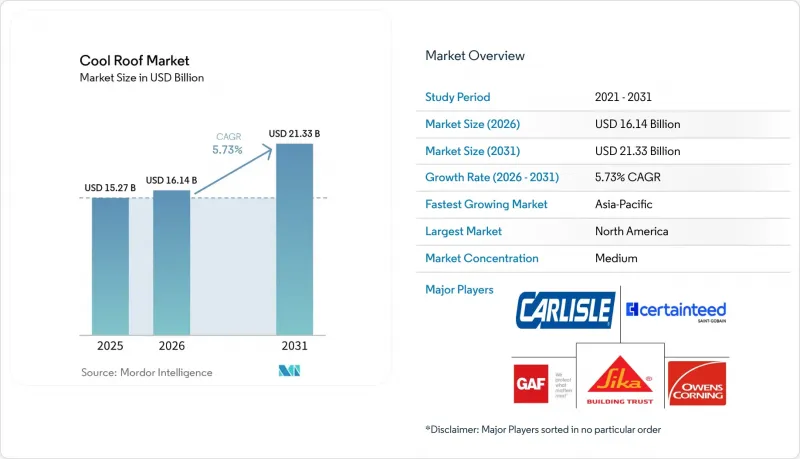
According to Mordor Intelligence, the cool roof market size was valued at USD 15.27 billion in 2025 and is estimated to grow from USD 16.14 billion in 2026 to reach USD 21.33 billion by 2031, at a CAGR of 5.73% during the forecast period (2026-2031).
This report is Segmented by Roof Type (Low-Slope Roofs, Steep-Slope Roofs, and Flat Roofs), Material Type (Cool Roof Coatings, Single-Ply Membranes, and More), Coating Chemistry (Acrylic, Elastomeric, Silicone, and More), Application (Commercial Buildings, Residential Buildings, and More), and Geography (Asia-Pacific, North America, Europe, and More). The Market Forecasts are Provided in Terms of Value (USD).
Global Cool Roof Market Trends and Insights
Energy-Efficiency Regulations and Zero-Carbon Mandates
Jurisdictions are incorporating minimum SRI thresholds directly into building codes, removing trade-off options that previously allowed developers to use additional insulation instead of reflective roofs. Europe's directive for zero-emission new buildings by 2030 requires architects to integrate cool roofs early in the design process, while China's GB 55015-2021 performance standards effectively mandate high-albedo roofing to achieve its approximately 30% energy-reduction target. India's Eco-Niwas Samhita 2024 introduces numeric caps on roof U-values and requires an initial reflectance of 0.6 for shallow slopes, signaling a strong regulatory push for the cool roof market. In the United States, LEED v5 increases SRI requirements to 82 (initial) and 64 (aged) for low-slope assemblies, driving manufacturers to reformulate coatings to withstand pollution-related degradation. These regulatory changes are expediting specification decisions, reducing payback periods, and fostering material innovation and supply chain scaling.
Urban Heat-Island Mitigation Programs
Cities are increasingly funding cool roofs as public infrastructure to reduce peak energy demand and lower ambient summer temperatures. For example, Atlanta's 2025 ordinance applies to commercial buildings over 10,000 ft2 and projects USD 310 million in cumulative energy savings by 2035. Hyderabad's program aims to cover 300 million m2 by 2028, achieving indoor temperature reductions of up to 4.5 °C and significant cooling energy savings. Other cities, such as Boston, Montreal, and various locations in California, offer grants to subsidize cool roof adoption for low-income buildings. These initiatives shift demand from private retrofits to public procurement, stabilizing supplier volumes and expanding the market footprint for cool roofs.
Higher Upfront Cost vs Conventional Asphalt Roofs
Reflective coatings cost between USD 0.75-2.50/ft2, and TPO membranes range from USD 3.50-6.50/ft2, compared to USD 1.00-3.00/ft2 for basic asphalt shingles. This 50-150% premium deters cost-sensitive builders. In temperate regions with lower cooling demands, payback periods can exceed five years, limiting cool roofs to discretionary upgrades. Tear-off disposal adds an additional USD 1-2/ft2, although retrofit coatings that avoid removal can reduce payback to under five years. While PACE financing spreads costs through property taxes, adoption remains concentrated in California and a few other states. Until incentives bridge this cost gap, price remains a significant barrier to wider market penetration.
Other drivers and restraints analyzed in the detailed report include:
- Rising Electricity Tariffs in Hot Climates
- Green-Building Certification Incentives
- Reflectivity Loss from Airborne Soot and Pollution
For complete list of drivers and restraints, kindly check the Table Of Contents.
Segment Analysis
Low-slope roofs accounted for 44.87% of 2025 revenue, emphasizing their importance in the cool roof market share for warehouses, malls, and institutional buildings. These roofs utilize large contiguous areas to enhance cooling efficiency and support ballasted solar arrays without membrane penetrations. CRRC's stricter three-climate aged-rating protocol, adopted in 2025, now prioritizes membranes with longer-lasting reflectance, increasing demand for premium PVC and TPO options that sustain cool roof market size gains. Steep-slope installations have slower growth as reflective asphalt shingles carry a 30-50% cost premium, and homeowners often prioritize aesthetics over energy savings. However, GAF's solar shingle launch suggests a bundled value proposition that could increase residential adoption if costs decrease further.
Secondary growth is driven by logistics operators retrofitting built-up roofs with TPO membranes, contributing to a 6.28% CAGR for flat roofs through 2031. Integrated 30-year warranties and ENERGY STAR certifications enhance financial appeal, enabling asset managers to qualify for green bonds. Roofers also utilize closed-loop take-back programs to reduce landfill fees and promote environmental credentials, further differentiating cool roofs from conventional membranes.
Cool roof coatings retained 30.02% revenue in 2025 due to their ability to overlay existing substrates, avoiding tear-off costs and expanding the cool roof market size across cost-sensitive retrofits. Single-ply membranes, however, are the fastest-growing segment, with a 6.42% CAGR through 2031, as builders of new logistics and data hubs prefer their 20-year warranties and weld-sealed seams. Acrylic elastomers remain cost-effective but are prone to dirt accumulation, while silicones and polyurethane-acrylic hybrids are increasingly specified for their superior aged reflectance. Asphalt shingles show modest growth, while metal roofs gain traction in hurricane-prone regions for their uplift resilience. Emerging nano-ceramic top-coats offer anti-soiling benefits but remain niche until standardized testing validates their long-term performance.
Geography Analysis
North America led 2025 demand with 35.50% share, driven by California's stringent building codes, Atlanta's city mandates, and widespread LEED adoption. Federal tax incentives and state grants offset upfront costs, sustaining the leading cool roof market size momentum. Canada and Mexico exhibit slower growth due to fewer cooling-degree days, though urban heat-island studies in Toronto and Monterrey are encouraging municipal pilot programs.
Asia-Pacific exhibits the fastest 6.88% CAGR through 2031. India's regional acceleration is supported by Telangana's policy targeting 300 km2 of installations by 2028 and Eco-Niwas caps on roof U-values, steering both public and private tenders toward reflective options. China's GB 55015-2021 energy code establishes cool roofs as the standard compliance path for new dwellings, while Japan's CASBEE assessments promote adoption in high-occupancy commercial towers.
Europe grows steadily on the back of the recast Energy Performance of Buildings Directive. Germany and France have translated EU mandates into national codes that incorporate SRI minimums, while Nordic countries remain cautious due to winter heat-loss concerns. Southern Europe is seeing increased adoption to mitigate extreme summer temperatures, though high pollution levels in cities like Milan and Madrid drive demand for dirt-resistant silicone coatings.
Middle-East and Africa expands from a smaller base. Saudi Arabia's post-subsidy tariff reforms create strong economic incentives, while the UAE's Estidama certification mandates reflective roofing for major projects in Abu Dhabi and Dubai. South Africa's growth is modest, limited by lower cooling needs outside Gauteng, but supported by green-building initiatives in Johannesburg and Cape Town. Brazil anchors South America's uptake following the 2024 publication of NBR 17162, which aligns testing standards with ASTM and boosts local production capacity.
- Akzo Nobel N.V.
- Asian Paints Ltd.
- Carlisle Companies Inc.
- CertainTeed, LLC
- Dow
- Elevate
- GACO
- GAF Materials LLC
- Huntsman International LLC
- IKO Industries Ltd.
- Johns Manville
- NanoTech Materials
- Nippon Paint Holdings Co., Ltd.
- Owens Corning
- PPG Industries, Inc.
- Saint-Gobain
- Sika AG
- SOPREMA Group
- TAMKO Building Products LLC
- Valspar
Additional Benefits:
- The market estimate (ME) sheet in Excel format
- 3 months of analyst support
TABLE OF CONTENTS
1 Introduction
- 1.1 Study Assumptions and Market Definition
- 1.2 Scope of the Study
2 Research Methodology
3 Executive Summary
4 Market Landscape
- 4.1 Market Overview
- 4.2 Market Drivers
- 4.2.1 Energy-efficiency Regulations and Zero-carbon Mandates
- 4.2.2 Urban Heat-Island Mitigation Programs
- 4.2.3 Rising Electricity Tariffs in Hot Climates
- 4.2.4 Green-Building Certification Incentives
- 4.2.5 Data-Centre Cooling Retrofits for Heat Reduction
- 4.3 Market Restraints
- 4.3.1 Higher Upfront Cost vs Conventional Asphalt Roofs
- 4.3.2 Reflectivity Loss from Airborne Soot and Pollution
- 4.3.3 Performance Degradation in Humid/Cloudy Zones
- 4.4 Value Chain Analysis
- 4.5 Porter's Five Forces
- 4.5.1 Threat of New Entrants
- 4.5.2 Bargaining Power of Buyers
- 4.5.3 Bargaining Power of Suppliers
- 4.5.4 Threat of Substitutes
- 4.5.5 Competitive Rivalry
5 Market Size and Growth Forecasts (Value)
- 5.1 By Roof Type
- 5.1.1 Low-Slope Roofs
- 5.1.2 Steep-Slope Roofs
- 5.1.3 Flat Roofs
- 5.2 By Material Type
- 5.2.1 Cool Roof Coatings
- 5.2.2 Single-Ply Membranes (TPO, PVC, EPDM)
- 5.2.3 Asphalt Shingles
- 5.2.4 Metal Roofs
- 5.2.5 Tiles and Slates
- 5.2.6 Built-Up Roofs (BUR)
- 5.2.7 Modified Bitumen
- 5.2.8 Other Material Types (Green Roofs, Wood Shingles)
- 5.3 By Coating Chemistry
- 5.3.1 Acrylic
- 5.3.2 Elastomeric
- 5.3.3 Silicone
- 5.3.4 Polyurethane
- 5.3.5 Other Coating Chemistries (Aluminum, Ceramic, Nano)
- 5.4 By Build Phase
- 5.4.1 New Construction
- 5.4.2 Retrofit/Reroofing
- 5.5 By Application
- 5.5.1 Commercial Buildings
- 5.5.2 Residential Buildings
- 5.5.3 Industrial Facilities
- 5.5.4 Government and Public Infrastructure
- 5.5.5 Healthcare and Educational Campuses
- 5.5.6 Other Applications
- 5.6 By Geography
- 5.6.1 Asia-Pacific
- 5.6.1.1 China
- 5.6.1.2 India
- 5.6.1.3 Japan
- 5.6.1.4 South Korea
- 5.6.1.5 ASEAN Countries
- 5.6.1.6 Rest of Asia-Pacific
- 5.6.2 North America
- 5.6.2.1 United States
- 5.6.2.2 Canada
- 5.6.2.3 Mexico
- 5.6.3 Europe
- 5.6.3.1 Germany
- 5.6.3.2 United Kingdom
- 5.6.3.3 France
- 5.6.3.4 Italy
- 5.6.3.5 Spain
- 5.6.3.6 Russia
- 5.6.3.7 NORDIC Countries
- 5.6.3.8 Rest of Europe
- 5.6.4 South America
- 5.6.4.1 Brazil
- 5.6.4.2 Argentina
- 5.6.4.3 Rest of South America
- 5.6.5 Middle-East and Africa
- 5.6.5.1 Saudi Arabia
- 5.6.5.2 South Africa
- 5.6.5.3 Rest of Middle-East and Africa
- 5.6.1 Asia-Pacific
6 Competitive Landscape
- 6.1 Market Concentration
- 6.2 Strategic Moves
- 6.3 Market Share (%)/Ranking Analysis
- 6.4 Company Profiles (includes Global level Overview, Market level overview, Core Segments, Financials as available, Strategic Information, Products and Services, and Recent Developments)
- 6.4.1 Akzo Nobel N.V.
- 6.4.2 Asian Paints Ltd.
- 6.4.3 Carlisle Companies Inc.
- 6.4.4 CertainTeed, LLC
- 6.4.5 Dow
- 6.4.6 Elevate
- 6.4.7 GACO
- 6.4.8 GAF Materials LLC
- 6.4.9 Huntsman International LLC
- 6.4.10 IKO Industries Ltd.
- 6.4.11 Johns Manville
- 6.4.12 NanoTech Materials
- 6.4.13 Nippon Paint Holdings Co., Ltd.
- 6.4.14 Owens Corning
- 6.4.15 PPG Industries, Inc.
- 6.4.16 Saint-Gobain
- 6.4.17 Sika AG
- 6.4.18 SOPREMA Group
- 6.4.19 TAMKO Building Products LLC
- 6.4.20 Valspar
7 Market Opportunities and Future Outlook
- 7.1 White-space and Unmet-Need Assessment

