PUBLISHER: Mordor Intelligence | PRODUCT CODE: 2062454

PUBLISHER: Mordor Intelligence | PRODUCT CODE: 2062454
Playout Automation And Channel-In-A-Box - Market Share Analysis, Industry Trends & Statistics, Growth Forecasts (2026 - 2031)
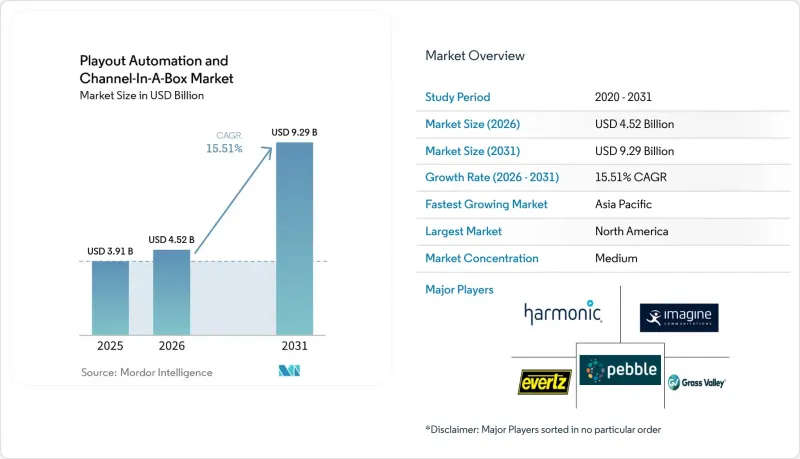
According to Mordor Intelligence, the playout automation and channel-in-a-box market size is projected to expand from USD 3.91 billion in 2025 and USD 4.52 billion in 2026 to USD 9.29 billion by 2031, registering a 15.51% CAGR between 2026 and 2031.
This report is Segmented by Component (Hardware, Software, and Services), Deployment Model (On-Premise, Cloud, and Hybrid), End-User Industry (Terrestrial and Satellite Broadcasters, Cable Network Operators, OTT/Streaming Platforms, and More), Channel Type (Single-Channel Automation, and Multi-Channel Automation), and Geography. The Market Forecasts are Provided in Terms of Value (USD).
Global Playout Automation And Channel-In-A-Box Market Trends and Insights
Shift Toward IP-Based Playout Infrastructure
Broadcasters are retiring SDI master-control rooms in favor of SMPTE ST 2110 IP workflows that enable remote production, flexible routing, and cloud-burst capacity for major events. PBS replaced satellite links with Ateme TITAN Edge across its MPLS backbone connecting more than 170 stations, reducing distribution cost by 50% and paving the way for ATSC 3.0 regional rollout. BBC World Service completed an IP migration using Encompass Altitude Connect with Zixi transport, proving reliability for global radio and TV partners. While IP routing trims cabling and hardware, packet loss management and frame-accurate sync remain critical for live sports, and skill shortages in Asia-Pacific delay full adoption.
Proliferation of OTT and FAST Channels
OTT and FAST operators expand quickest as advertisers pivot to programmatic inventory and viewers favor ad-supported streaming. Amagi processed 21% more video hours year over year on its CLOUDPORT platform, with most new channels classed as FAST. AIS PLAY doubled Thai League football feeds after adding six PlayBox Neo channel-in-a-box units, underscoring regional demand for low-cost rapid launch. Cloud playout eliminates USD 500 000 hardware spends and allows seasonal pop-up channels, though fragmented advertising-disclosure rules create compliance complexity across jurisdictions.
High Upfront Capital Expenditure for Hardware Refresh
Smaller broadcasters struggle to finance USD 500 000 master-control overhauls, delaying IP adoption and subtracting 2.1 percentage points from growth. Although cloud models offer pay-as-you-go pricing, migration still incurs network upgrades and dual-run periods. Sky Deutschland's shift of Vodafone cable feeds to IP required costly set-top box swaps to Sky Q hardware, demonstrating downstream capital impacts.
Other drivers and restraints analyzed in the detailed report include:
- Need for Cost-Effective Multi-Channel Operations
- Regulatory Push Toward HD and UHD Broadcasting
- Complex Integration with Legacy Automation Systems
For complete list of drivers and restraints, kindly check the Table Of Contents.
Segment Analysis
Services recorded the fastest 16.11% CAGR while hardware held the largest 45.89% share of the playout automation and channel-in-a-box market in 2025. Managed playout providers bundle origination, encoding, monitoring, and distribution so content owners avoid staffing 24-hour control rooms. Comcast Technology Solutions consolidated multiple client feeds into a single IP Broadcast Operations Center, illustrating how centralized oversight trims personnel and facility expense. Hardware remains critical in markets enforcing data-sovereignty, where on-premise appliances satisfy local storage mandates. Subscription-based software maintenance converts one-time capital sales into recurring revenue, letting vendors smooth cash flow and continuously push feature updates. Over the forecast period, the playout automation and channel-in-a-box market size for services is widening as broadcasters reallocate capex toward content acquisition rather than infrastructure upkeep.
Demand for integrated support contracts also lifts service revenue, with PlayBox Neo's 24-hour ASM and TS programs guaranteeing software upgrades and remote troubleshooting. North America and Europe drive adoption because mature ecosystems value predictable opex. Asia-Pacific and the Middle East lean toward hardware while wide-area bandwidth and latency remain concerns for live sports. Hybrid engagements that place ingest hardware on site but route schedules to cloud orchestration are emerging as a transitional bridge, anchoring vendor relationships and locking in multiyear SLA revenue streams.
Cloud captured 41.36% revenue in 2025, growing 16.17% annually as broadcasters prioritize time-to-market and elastic scaling. Amagi CLOUDPORT provisions multi-region redundancy with AES-128 encryption and role-based permissions, allowing clients to stand up global FAST networks in days. The playout automation and channel-in-a-box market share for cloud rises when operators spin seasonal pop-up feeds or add language variants without new on-premise hardware. Hybrid models remain popular where baseline playout stays local but surges burst to AWS or Azure during major tournaments, balancing latency and scalability.
On-premise systems stay relevant for national networks bound by sovereignty laws or reliant on SDI contribution. Arqiva offers deployment choices from single-region cloud to customer-owned tenancy, giving engineers precise control over geographic failover. Cybersecurity risk tempers cloud enthusiasm, but vendors respond with ISO 27001 compliance and real-time threat monitoring. As internet backbone capacity improves, cloud's unit economics strengthen, positioning it to eclipse on-premise share before 2031.
Geography Analysis
North America retained 32.84% market share in 2025, supported by early SMPTE ST 2110 adoption and robust managed-service ecosystems. PBS's conversion to IP terrestrial distribution cut satellite spend by 50%, proving commercial viability for public broadcasters. Comcast's Dry Creek hub centralizes playout for broadcast and streaming brands, highlighting scale economics. Canadian and Mexican uptake is slower due to rural bandwidth gaps, yet both leverage cross-border service bureaus housed in the United States. FCC rules mandating parallel ATSC 1.0 and 3.0 outputs elevate demand for channel-in-a-box appliances capable of multi-standard playout.
Asia-Pacific records the fastest 16.51% CAGR. India, Japan, and Southeast Asia replace SDI with IP to support regional language feeds, while OTT operators chase mobile-first consumers. Sky New Zealand's AMPP deployment underscores hybrid cloud momentum. Thailand's AIS PLAY doubled sports channels via PlayBox Neo appliances, reflecting how local rights deals drive incremental capacity. Japan's stringent ARIB UHD specifications quicken hardware refresh cycles, whereas China and India lean on on-premise gear for sovereignty reasons. South Korea and Australia run baseline playout locally then burst to cloud during live events, balancing cost and performance.
Europe demonstrates steady growth as public-service mandates require universal access yet budgets push engineers toward IP to curtail satellite and cable costs. BBC World Service completed a full IP handoff across the continent, and Sky Deutschland shifted Vodafone cable customers to IPTV, reducing head-end fees while adding interactive features. Sweden's BoxerTV exit from DTT catalyzes debate over terrestrial spectrum value, nudging policymakers toward OTT support. South America, the Middle East, and Africa trail due to connectivity gaps and import tariffs, but managed-service vendors entice broadcasters with opex models that convert capex into subscription fees, stimulating gradual adoption.
- Grass Valley Canada Holdings Limited
- Imagine Communications Corp.
- Harmonic Inc.
- Evertz Microsystems Ltd.
- Pebble Beach Systems Group plc
- Dalet S.A.
- PlayBox Neo Ltd.
- BroadStream Solutions Inc.
- Florical Systems, Inc.
- Aveco s.r.o.
- Cinegy GmbH
- Rohde and Schwarz GmbH and Co KG
- Ross Video Ltd.
- Amagi Corporation
- Hexaglobe SAS (SGT)
- Pixel Power Ltd.
- ENCO Systems Inc.
- Switch Media Pty Ltd.
- Logitek Electronic Systems Inc.
- Crispin Corporation
Additional Benefits:
- The market estimate (ME) sheet in Excel format
- 3 months of analyst support
TABLE OF CONTENTS
1 INTRODUCTION
- 1.1 Study Assumptions and Market Definition
- 1.2 Scope of the Study
2 RESEARCH METHODOLOGY
3 EXECUTIVE SUMMARY
4 MARKET LANDSCAPE
- 4.1 Market Overview
- 4.2 Market Drivers
- 4.2.1 Shift Toward IP-Based Playout Infrastructure
- 4.2.2 Proliferation of OTT and FAST Channels
- 4.2.3 Need for Cost-Effective Multi-Channel Operations
- 4.2.4 Regulatory Push Toward HD and UHD Broadcasting
- 4.2.5 Adoption of ML-Driven Automated QC in Playout Chains
- 4.2.6 Rising Demand for Disaster-Recovery Pop-Up Channels
- 4.3 Market Restraints
- 4.3.1 High Upfront Capital Expenditure for Hardware Refresh
- 4.3.2 Complex Integration with Legacy Automation Systems
- 4.3.3 Skill Shortage in SMPTE ST 2110 Workflows
- 4.3.4 Cybersecurity Concerns for Cloud-Based Playout
- 4.4 Impact of Macroeconomic Factors on the Market
- 4.5 Industry Value Chain Analysis
- 4.6 Regulatory Landscape
- 4.7 Technological Outlook
- 4.8 Porter's Five Forces Analysis
- 4.8.1 Bargaining Power of Suppliers
- 4.8.2 Bargaining Power of Buyers
- 4.8.3 Threat of New Entrants
- 4.8.4 Threat of Substitutes
- 4.8.5 Intensity of Competitive Rivalry
5 MARKET SIZE AND GROWTH FORECASTS (VALUE)
- 5.1 By Component
- 5.1.1 Hardware
- 5.1.2 Software
- 5.1.3 Services
- 5.2 By Deployment Model
- 5.2.1 On-Premise
- 5.2.2 Cloud
- 5.2.3 Hybrid
- 5.3 By End-user Industry
- 5.3.1 Terrestrial and Satellite Broadcasters
- 5.3.2 Cable Network Operators
- 5.3.3 OTT / Streaming Platforms
- 5.3.4 Other End-User Inudustries
- 5.4 By Channel Type
- 5.4.1 Single-Channel Automation
- 5.4.2 Multi-Channel Automation
- 5.5 By Geography
- 5.5.1 North America
- 5.5.1.1 United States
- 5.5.1.2 Canada
- 5.5.1.3 Mexico
- 5.5.2 South America
- 5.5.2.1 Brazil
- 5.5.2.2 Argentina
- 5.5.2.3 Rest of South America
- 5.5.3 Europe
- 5.5.3.1 United Kingdom
- 5.5.3.2 Germany
- 5.5.3.3 France
- 5.5.3.4 Italy
- 5.5.3.5 Spain
- 5.5.3.6 Rest of Europe
- 5.5.4 Asia-Pacific
- 5.5.4.1 China
- 5.5.4.2 Japan
- 5.5.4.3 India
- 5.5.4.4 South Korea
- 5.5.4.5 Rest of Asia-Pacific
- 5.5.5 Middle East and Africa
- 5.5.5.1 Middle East
- 5.5.5.1.1 United Arab Emirates
- 5.5.5.1.2 Saudi Arabia
- 5.5.5.1.3 Rest of Middle East
- 5.5.5.2 Africa
- 5.5.5.2.1 South Africa
- 5.5.5.2.2 Egypt
- 5.5.5.2.3 Rest of Africa
- 5.5.5.1 Middle East
- 5.5.1 North America
6 COMPETITIVE LANDSCAPE
- 6.1 Market Concentration
- 6.2 Strategic Moves
- 6.3 Market Share Analysis
- 6.4 Company Profiles (includes Global Level Overview, Market Level Overview, Core Segments, Financials as available, Strategic Information, Market Rank/Share, Products and Services, Recent Developments)
- 6.4.1 Grass Valley Canada Holdings Limited
- 6.4.2 Imagine Communications Corp.
- 6.4.3 Harmonic Inc.
- 6.4.4 Evertz Microsystems Ltd.
- 6.4.5 Pebble Beach Systems Group plc
- 6.4.6 Dalet S.A.
- 6.4.7 PlayBox Neo Ltd.
- 6.4.8 BroadStream Solutions Inc.
- 6.4.9 Florical Systems, Inc.
- 6.4.10 Aveco s.r.o.
- 6.4.11 Cinegy GmbH
- 6.4.12 Rohde and Schwarz GmbH and Co KG
- 6.4.13 Ross Video Ltd.
- 6.4.14 Amagi Corporation
- 6.4.15 Hexaglobe SAS (SGT)
- 6.4.16 Pixel Power Ltd.
- 6.4.17 ENCO Systems Inc.
- 6.4.18 Switch Media Pty Ltd.
- 6.4.19 Logitek Electronic Systems Inc.
- 6.4.20 Crispin Corporation
7 MARKET OPPORTUNITIES AND FUTURE OUTLOOK
- 7.1 White-Space and Unmet-Need Assessment

