PUBLISHER: Mordor Intelligence | PRODUCT CODE: 2062464

PUBLISHER: Mordor Intelligence | PRODUCT CODE: 2062464
Biomass Briquette - Market Share Analysis, Industry Trends & Statistics, Growth Forecasts (2026 - 2031)
According to Mordor Intelligence, the biomass briquette market size is projected to expand from USD 0.96 billion in 2025 and USD 1.04 billion in 2026 to USD 1.53 billion by 2031, registering a CAGR of 7.99% between 2026 and 2031.
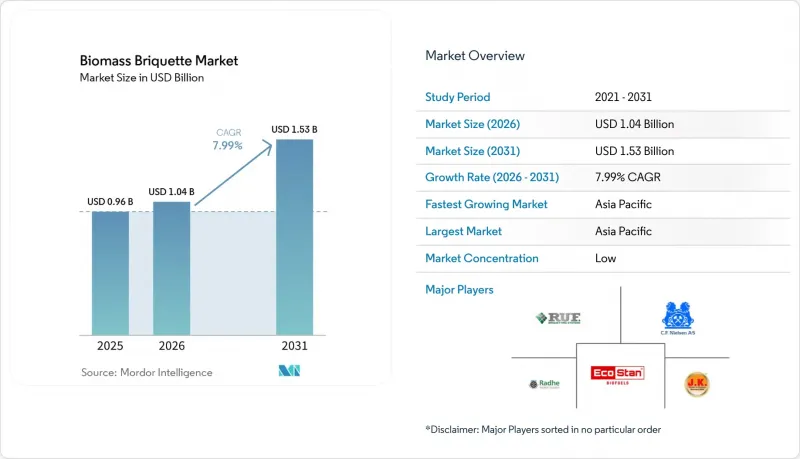
This report is Segmented by Type (Agro Briquettes, Wood Briquettes, and More), Raw Material (Sawdust, Rice Husk, Bagasse, and More), Application (Power Generation, Industrial Process Heating, Commercial and Institutional Heating, and More), and Geography (North America, Europe, Asia-Pacific, South America, and Middle East and Africa). The Market Forecasts are Provided in Terms of Value (USD).
Global Biomass Briquette Market Trends and Insights
Government Co-firing Mandates in Coal Plants
India, Indonesia, and Poland now stipulate biomass blends of 5%-10% by energy content at coal stations, creating predictable offtake volumes for briquette suppliers. India alone co-fired 164,976 metric tons by March 2025, while Indonesia's PLN targets 3.2 million metric tons annually by 2028. Poland tops up each percentage point above 5% with a EUR 15 per MWh subsidy. ISO 17225-8 testing is emerging as the de facto quality gate.
Surge in Boiler Retrofits for Solid Biofuels
Industrial and district-heating operators in the United Kingdom, Denmark, and Canada are converting legacy coal and oil boilers, spurred by carbon-pricing schemes and subsidy pools totaling GBP 120 million in the UK alone. Orsted's GBP 400 million Avedore retrofit eliminated 1.2 million metric tons of coal a year. Canada's Clean Fuel Regulations now extend credits to industrial heat users that shift to certified briquettes.
Low-priced LNG Glut in Southeast Asia
Spot LNG below USD 10 per MMBtu kept Thai and Philippine industries on gas through early 2026, delaying briquette boiler conversions. An Asian Development Bank survey showed 62% of Vietnamese plants mothballed retrofits when gas slipped under USD 9 per MMBtu.
Other drivers and restraints analyzed in the detailed report include:
- Rural Electrification Programs in Sub-Saharan Africa
- EU Carbon Border Adjustment Mechanism Spill-over
- High Intra-continental Logistics Cost for Low-density Briquettes
For complete list of drivers and restraints, kindly check the Table Of Contents.
Segment Analysis
Torrefied Briquettes are on course to expand at a 10.3% CAGR, far above the biomass briquette market average, reflecting utilities' need for hydrophobic, high-energy products that slipstream into existing coal conveyors. The biomass briquette market size for torrefied variants is projected to reach USD 450 million by 2031, commanded by high-heating-value shipments to Europe and Northeast Asia. Agro Briquettes remain cost-advantaged at USD 100-130 per metric ton and held 42.3% of the biomass briquette market share in 2025.
Wood Briquettes continue to serve premium residential heat markets thanks to 0.5%-2.0% ash and predictable combustion profiles. Charcoal-Blend Briquettes, with 10%-20% charcoal fines, are popular among African households for fast ignition and reduced smoke. Emerging categories such as algae-based briquettes remain pilot-scale until waste-collection and regulatory hurdles are cleared.
Geography Analysis
Asia-Pacific accounted for 48.9% of 2025 revenue and will expand at 8.8% annually, anchored by India's 5%-7% co-firing rule and China's small-coal-unit retirements. Indonesia targets 3.2 million t/y rice-husk blends by 2028, and Japan imports torrefied briquettes to earn feed-in-tariff credits despite USD 35-50 per metric ton ocean freight.
Europe ranks second, propelled by GBP 120 million in UK boiler-retrofit grants and Denmark's Avedore conversion. CBAM's embedded-carbon reporting favors high-energy torrefied products, while Nordic countries channel forestry residues into district heating for >80% GHG savings.
North America advances on the back of southeastern U.S. sawdust briquette exports to Japan and South Korea and Canada's Clean Fuel Regulations, which credit industrial heat users who switch from natural gas. South America's growth is led by Brazil's bagasse surplus and Colombia's coffee-husk initiatives. The Middle East and Africa remain dominated by clean-cooking programs using rice-husk and groundnut-shell briquettes.
- Radhe Industrial Corporation
- C.F. Nielsen A/S
- RUF Briquetting Systems
- Biomass Briquettes UK Ltd
- ECOSTAN
- Jay Khodiyar Machine Tools
- Weima Maschinenbau
- Advance Hydrau-Tech
- Maxton Industrial Co.
- Lehra Fuel Tech
- Shreenithi Engineering Works
- Ronak Engineering
- Biomass Secure Power Inc.
- Verdo Energy
- Energis Oy
- SC Rika Ecofuel SRL
- Vyncke NV
- Zhengzhou Fusmar Machinery
- Jiangsu Yongli Machinery
- FEECO International
Additional Benefits:
- The market estimate (ME) sheet in Excel format
- 3 months of analyst support
TABLE OF CONTENTS
1 Introduction
- 1.1 Study Assumptions & Market Definition
- 1.2 Scope of the Study
2 Research Methodology
3 Executive Summary
4 Market Landscape
- 4.1 Market Overview
- 4.2 Market Drivers
- 4.2.1 Government co-firing mandates in coal plants
- 4.2.2 Surge in boiler retrofits for solid biofuels
- 4.2.3 Rural electrification programs in Sub-Saharan Africa
- 4.2.4 EU Carbon Border Adjustment Mechanism (CBAM) spill-over
- 4.2.5 Commercial-scale torrefaction breakthroughs
- 4.2.6 Maritime sector's switch to low-sulfur solid fuels
- 4.3 Market Restraints
- 4.3.1 Low-priced LNG glut in Southeast Asia
- 4.3.2 High intra-continental logistics cost for low-density briquettes
- 4.3.3 Stricter particulate-matter norms on small household stoves
- 4.3.4 Competing demand from pellet export industry
- 4.4 Supply-Chain Analysis
- 4.5 Regulatory Landscape
- 4.6 Technological Outlook
- 4.7 Porter's Five Forces
- 4.7.1 Threat of New Entrants
- 4.7.2 Bargaining Power of Suppliers
- 4.7.3 Bargaining Power of Buyers
- 4.7.4 Threat of Substitutes
- 4.7.5 Competitive Rivalry
5 Market Size & Growth Forecasts
- 5.1 By Type
- 5.1.1 Agro Briquettes
- 5.1.2 Wood Briquettes
- 5.1.3 Torrefied Briquettes
- 5.1.4 Charcoal-Blend Briquettes
- 5.1.5 Others
- 5.2 By Raw Material
- 5.2.1 Sawdust
- 5.2.2 Rice Husk
- 5.2.3 Bagasse
- 5.2.4 Groundnut (Peanut) Shells
- 5.2.5 Coconut Husk and Shell
- 5.2.6 Corn Stover and Straw
- 5.2.7 Forestry Residues
- 5.2.8 Mixed Agricultural Waste
- 5.3 By Application
- 5.3.1 Power Generation
- 5.3.2 Industrial Process Heating
- 5.3.3 Commercial and Institutional Heating
- 5.3.4 Residential Space and Water Heating
- 5.3.5 Cooking Fuel
- 5.3.6 Others
- 5.4 By Geography
- 5.4.1 North America
- 5.4.1.1 United States
- 5.4.1.2 Canada
- 5.4.1.3 Mexico
- 5.4.2 Europe
- 5.4.2.1 United Kingdom
- 5.4.2.2 Germany
- 5.4.2.3 France
- 5.4.2.4 Spain
- 5.4.2.5 Nordic Countries
- 5.4.2.6 Russia
- 5.4.2.7 Rest of Europe
- 5.4.3 Asia-Pacific
- 5.4.3.1 China
- 5.4.3.2 India
- 5.4.3.3 Japan
- 5.4.3.4 South Korea
- 5.4.3.5 ASEAN Countries
- 5.4.3.6 Rest of Asia-Pacific
- 5.4.4 South America
- 5.4.4.1 Brazil
- 5.4.4.2 Argentina
- 5.4.4.3 Colombia
- 5.4.4.4 Rest of South America
- 5.4.5 Middle East and Africa
- 5.4.5.1 United Arab Emirates
- 5.4.5.2 Saudi Arabia
- 5.4.5.3 South Africa
- 5.4.5.4 Egypt
- 5.4.5.5 Rest of Middle East and Africa
- 5.4.1 North America
6 Competitive Landscape
- 6.1 Market Concentration
- 6.2 Strategic Moves (M&A, Partnerships, PPAs)
- 6.3 Market Share Analysis (Market Rank/Share for key companies)
- 6.4 Company Profiles (includes Global level Overview, Market level overview, Core Segments, Financials as available, Strategic Information, Products & Services, and Recent Developments)
- 6.4.1 Radhe Industrial Corporation
- 6.4.2 C.F. Nielsen A/S
- 6.4.3 RUF Briquetting Systems
- 6.4.4 Biomass Briquettes UK Ltd
- 6.4.5 ECOSTAN
- 6.4.6 Jay Khodiyar Machine Tools
- 6.4.7 Weima Maschinenbau
- 6.4.8 Advance Hydrau-Tech
- 6.4.9 Maxton Industrial Co.
- 6.4.10 Lehra Fuel Tech
- 6.4.11 Shreenithi Engineering Works
- 6.4.12 Ronak Engineering
- 6.4.13 Biomass Secure Power Inc.
- 6.4.14 Verdo Energy
- 6.4.15 Energis Oy
- 6.4.16 SC Rika Ecofuel SRL
- 6.4.17 Vyncke NV
- 6.4.18 Zhengzhou Fusmar Machinery
- 6.4.19 Jiangsu Yongli Machinery
- 6.4.20 FEECO International
7 Market Opportunities & Future Outlook
- 7.1 White-space & Unmet-Need Assessment

