PUBLISHER: Mordor Intelligence | PRODUCT CODE: 2062475

PUBLISHER: Mordor Intelligence | PRODUCT CODE: 2062475
Energy Retrofit - Market Share Analysis, Industry Trends & Statistics, Growth Forecasts (2026 - 2031)
According to Mordor Intelligence, the energy retrofit market size is expected to increase from USD 202.61 billion in 2025 to USD 216.69 billion in 2026 and reach USD 295.49 billion by 2031, growing at a CAGR of 6.40% over 2026-2031.
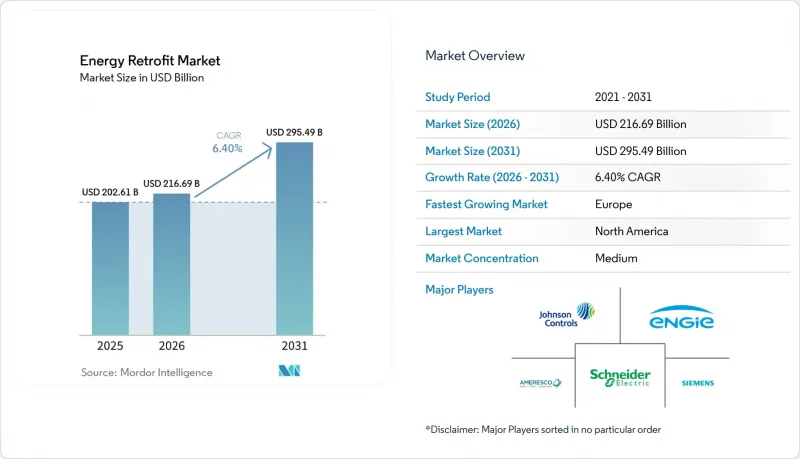
This report is Segmented by Retrofit Depth (Deep Energy Retrofits, Shallow/Light Energy Retrofits), Technology (HVAC Systems, Lighting Systems, Building Envelope, and More), Application (Residential Buildings, Commercial Buildings, and More), and Geography Geography (North America, Europe, Asia-Pacific, South America and Middle East and Africa). The Market Forecasts are Provided in Terms of Value (USD).
Global Energy Retrofit Market Trends and Insights
Government Energy-Efficiency Mandates & Incentives
The European Union's recast Energy Performance of Buildings Directive, transposed by member states in 2024, sets statutory renovation requirements that convert optional upgrades into legal obligations. Germany disbursed EUR 13.5 billion for efficiency upgrades under its BEG program during 2024, and France's MaPrimeRenov' added EUR 2.6 billion to subsidize heat-pump installations. In the United States, Section 179D of the Inflation Reduction Act now offers a USD 5 per-square-foot deduction for projects achieving 50% energy cuts, while the Bipartisan Infrastructure Law funneled USD 3.5 billion through Energy Efficiency and Conservation Block Grants. Japan's revised Building Energy Conservation Law, effective April 2025, imposed mandatory savings standards on all new non-residential properties, prompting a wave of pre-emptive retrofits. South Korea's Zero Energy Building mandate was extended to all public buildings above 500 square meters in June 2025, complemented by a Seoul subsidy that covers up to 50% of retrofit costs.
Corporate Net-Zero/ESG Commitments Accelerating Retrofit Demand
Large enterprises are writing retrofit spending directly into science-based emission-reduction roadmaps. IKEA aims to upgrade every owned store to net-zero energy by 2030, installing 1.7 GW of rooftop solar across 400 sites by end-2024. Levi Strauss has committed to retrofit 90% of its facilities by 2027 to slash energy intensity 40%. The Federal Reserve Bank of San Francisco's 2024 study showed that firms with public science-based targets devote 23% more capital to efficiency projects compared with peers. Financing tools are evolving in tandem: HSBC arranged a USD 500 million sustainability-linked loan for a European REIT in 2024, reducing borrowing costs as verified portfolio energy intensity falls.
High Upfront CAPEX Despite Falling Tech Costs
Comprehensive retrofits often group envelope upgrades, HVAC replacements, and controls integration into one project, pushing typical spends into six- or seven-figure territory. A 2024 British Columbia meta-analysis found median deep-retrofit costs of CAD 150-250 per square foot (USD 110-185), with simple payback exceeding 15 years even after subsidies, far longer than many investors' hold periods. The European Commission pegs the annual funding gap for its 2030 renovation target at EUR 95 billion. Similar gaps loom in India, where 68% of surveyed owners cited upfront cost as the primary deterrent to action. Emerging tools such as green banks and on-bill financing are promising but remain limited to select U.S. states and a handful of EU nations.
Other drivers and restraints analyzed in the detailed report include:
- Ageing Building Stock in OECD Economies Requiring Upgrades
- Volatile Electricity & Gas Prices Prompting Payback-Driven Retrofits
- Landlord-Tenant Split-Incentive Dilemma
For complete list of drivers and restraints, kindly check the Table Of Contents.
Segment Analysis
Shallow retrofits captured 64.4% of the 2025 Energy Retrofit Market size, reflecting owners' preference for quick-payback measures such as LED relamping, smart thermostats, and low-cost insulation top-ups that deliver 15%-25% savings with minimal disruption. Deep retrofits, though capital-intensive, are expanding at an 8.6% CAGR as net-zero mandates push portfolios toward more than 50% cuts in energy intensity. Median savings of 38% in U.S. Better Buildings Initiative projects underscore the upside, justifying long amortization schedules under efficiency-linked financing.
Industry value chains are bifurcating. Electrical contractors dominate high-volume shallow works, while deep projects attract specialist engineering firms that can integrate envelope redesign, mechanical upgrades, and renewable installations under outcome-based contracts. Passive House certification is emerging as a credibility marker, with 1,840 certified retrofit projects worldwide in 2024, up 64% from 2022. The European Investment Bank's EUR 200 million facility for multifamily deep retrofits in Poland and Romania demonstrates growing investor appetite for savings-backed debt structures.
Geography Analysis
North America captured 38.9% of the 2025 Energy Retrofit Market revenue, buoyed by generous U.S. federal tax incentives and state-level green-bank financing programs. The region's regulatory push will intensify as California's 2026 solar-plus-storage mandate for new commercial buildings spills over into retrofit scopes.
Europe, forecast to grow at 9.0% CAGR, benefits from the EPBD's hard compliance deadlines and multi-billion-euro subsidy pools such as Germany's BEG and the U.K.'s Public Sector Decarbonisation grants. Yet the European Commission warns of a EUR 95 billion annual financing gap, spurring creative instruments like renovation mortgage portfolios and EU-backed guarantee schemes.
Asia-Pacific trends are heterogeneous. China's 14th Five-Year Plan targets 350 million m2 of retrofits by 2025, but enforcement differs widely by province. Japan's April 2025 building-energy code stiffening is triggering a wave of upgrades in the commercial core, while South Korea's aggressive zero-energy mandate is catalyzing half-subsidized retrofits in public stock. Latin America and the Middle East-Africa, though flagship programs, Brazil's PROCEL and the UAE's Estidama, are laying regulatory foundations for future scale.
- Johnson Controls
- Ameresco
- Siemens AG
- Schneider Electric
- ENGIE
- Honeywell International
- ABB
- Daikin Industries
- Trane Technologies
- Carrier Global
- Bouygues Energies & Services
- Veolia Energy
- Enel X
- Rockwool Group
- Kingspan Group
- NORESCO
- Cenergistic
- Eaton Corporation
- Comfort Systems USA
- EMCOR Group
Additional Benefits:
- The market estimate (ME) sheet in Excel format
- 3 months of analyst support
TABLE OF CONTENTS
1 Introduction
- 1.1 Study Assumptions & Market Definition
- 1.2 Scope of the Study
2 Research Methodology
3 Executive Summary
4 Market Landscape
- 4.1 Market Overview
- 4.2 Market Drivers
- 4.2.1 Government energy-efficiency mandates & incentives
- 4.2.2 Corporate net-zero/ESG commitments accelerating retrofit demand
- 4.2.3 Ageing building stock in OECD economies requiring upgrades
- 4.2.4 Volatile electricity & gas prices prompting payback-driven retrofits
- 4.2.5 AI-enabled building-twin analytics uncovering hidden savings
- 4.2.6 Growing adoption of outcome-based financing & ESG-linked loans
- 4.3 Market Restraints
- 4.3.1 High upfront CAPEX despite falling tech costs
- 4.3.2 Landlord-tenant split-incentive dilemma
- 4.3.3 Shortage of deep-retrofit skilled labor & project managers
- 4.3.4 Performance-risk perception & measurement uncertainty
- 4.4 Supply-Chain Analysis
- 4.5 Regulatory Landscape
- 4.6 Technological Outlook
- 4.7 Porter's Five Forces Analysis
- 4.7.1 Threat of New Entrants
- 4.7.2 Bargaining Power of Suppliers
- 4.7.3 Bargaining Power of Buyers
- 4.7.4 Threat of Substitutes
- 4.7.5 Competitive Rivalry
- 4.8 Investment & Funding Trends
5 Market Size & Growth Forecasts
- 5.1 By Retrofit Depth
- 5.1.1 Deep Energy Retrofits
- 5.1.2 Shallow/Light Energy Retrofits
- 5.2 By Technology
- 5.2.1 HVAC Systems
- 5.2.2 Lighting Systems
- 5.2.3 Building Envelope (Insulation and Glazing)
- 5.2.4 Renewable Integration (Solar PV, Solar Thermal)
- 5.2.5 Smart Building Controls and IoT
- 5.2.6 Water Heating and Plumbing
- 5.3 By Application
- 5.3.1 Residential Buildings
- 5.3.2 Commercial Buildings
- 5.3.3 Industrial Facilities
- 5.3.4 Public and Institutional Buildings
- 5.4 By Geography
- 5.4.1 North America
- 5.4.1.1 United States
- 5.4.1.2 Canada
- 5.4.1.3 Mexico
- 5.4.2 Europe
- 5.4.2.1 United Kingdom
- 5.4.2.2 Germany
- 5.4.2.3 France
- 5.4.2.4 Spain
- 5.4.2.5 Nordic Countries
- 5.4.2.6 Russia
- 5.4.2.7 Rest of Europe
- 5.4.3 Asia-Pacific
- 5.4.3.1 China
- 5.4.3.2 India
- 5.4.3.3 Japan
- 5.4.3.4 South Korea
- 5.4.3.5 ASEAN Countries
- 5.4.3.6 Australia and New Zealand
- 5.4.3.7 Rest of Asia-Pacific
- 5.4.4 South America
- 5.4.4.1 Brazil
- 5.4.4.2 Argentina
- 5.4.4.3 Colombia
- 5.4.4.4 Rest of South America
- 5.4.5 Middle East and Africa
- 5.4.5.1 United Arab Emirates
- 5.4.5.2 Saudi Arabia
- 5.4.5.3 South Africa
- 5.4.5.4 Egypt
- 5.4.5.5 Rest of Middle East and Africa
- 5.4.1 North America
6 Competitive Landscape
- 6.1 Market Concentration
- 6.2 Strategic Moves (M&A, Partnerships, PPAs)
- 6.3 Market Share Analysis (Market Rank/Share for key companies)
- 6.4 Company Profiles (includes Global level Overview, Market level overview, Core Segments, Financials as available, Strategic Information, Products & Services, and Recent Developments)
- 6.4.1 Johnson Controls
- 6.4.2 Ameresco
- 6.4.3 Siemens AG
- 6.4.4 Schneider Electric
- 6.4.5 ENGIE
- 6.4.6 Honeywell International
- 6.4.7 ABB
- 6.4.8 Daikin Industries
- 6.4.9 Trane Technologies
- 6.4.10 Carrier Global
- 6.4.11 Bouygues Energies & Services
- 6.4.12 Veolia Energy
- 6.4.13 Enel X
- 6.4.14 Rockwool Group
- 6.4.15 Kingspan Group
- 6.4.16 NORESCO
- 6.4.17 Cenergistic
- 6.4.18 Eaton Corporation
- 6.4.19 Comfort Systems USA
- 6.4.20 EMCOR Group
7 Market Opportunities & Future Outlook
- 7.1 White-space & Unmet-Need Assessment

