PUBLISHER: Mordor Intelligence | PRODUCT CODE: 2062478

PUBLISHER: Mordor Intelligence | PRODUCT CODE: 2062478
Vehicle-to-Grid (V2G) - Market Share Analysis, Industry Trends & Statistics, Growth Forecasts (2026 - 2031)
According to Mordor Intelligence, the vehicle-to-Grid market size was valued at USD 5.75 billion in 2025 and is estimated to grow from USD 7.42 billion in 2026 to reach USD 20.24 billion by 2031, at a CAGR of 22.22% during the forecast period (2026-2031).
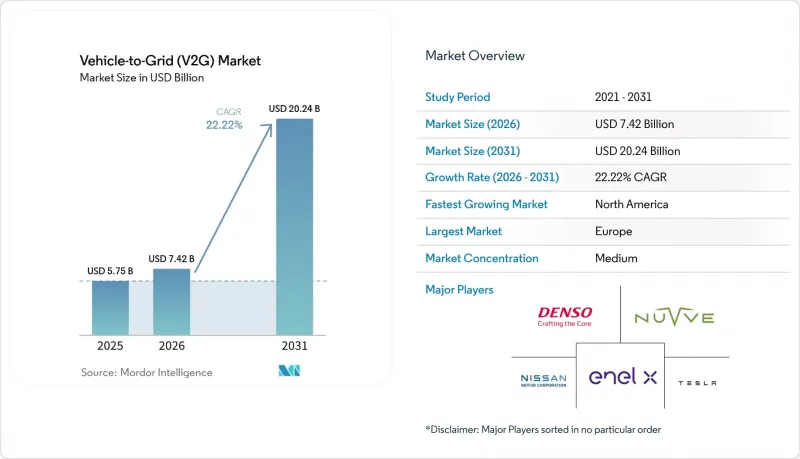
This report is Segmented by Component (Electric Vehicles, V2G Charging Stations, and More), Charging Infrastructure (AC Charging, DC Charging, Hybrid), Vehicle Type (BEVs, Phevs, Fcevs), Application (Commercial, Individual), and Geography (North America, Europe, Asia-Pacific, South America, Middle East and Africa). The Market Forecasts are Provided in Terms of Value (USD).
Global Vehicle-to-Grid (V2G) Market Trends and Insights
Rapid EV Parc Expansion & Supportive Incentives
Fleet electrification compresses payback periods because operators can layer time-of-use arbitrage, demand-charge reduction, and frequency-regulation income that residential owners cannot easily capture. Japan's Ministry of Economy, Trade, and Industry paid JPY 750,000 (≈ USD 5,000) per V2H installation in 2025, spurring over 10,000 Nissan Leaf connections, a design that ties subsidies to measured grid services rather than hardware purchases . California's Public Utilities Commission ordered 150 MW of enrolled V2G capacity by 2027 and a 7 GW load-shift goal by 2030, eliminating policy ambiguity that suppressed projects before 2024 . China's National Energy Administration started a 100-vehicle pilot in Suzhou in 2024, signaling future nationwide integration, though provincial interconnection rules remain uneven. Markets that impose binding enrollment or cost-recovery mechanisms attract disproportionate investment, while voluntary jurisdictions continue to lag.
Accelerating Renewables Share Driving Grid-Flexibility Need
Variable renewable penetration above 40% in several European grids during 2025 increases intraday volatility that EV batteries can arbitrage at minimal incremental cost. Germany's Bundesnetzagentur opened frequency-containment reserves to aggregated EV fleets at 1 MW minimum bids in 2025, enabling mid-size depots to participate . Denmark's eMabler users earned USD 38-76 per month from frequency-regulation contracts, rising to USD 152 for commercial fleets with optimized dispatch. Australia's ARENA-funded REVS trial proved 150 vehicles could respond within 200 ms, outperforming spinning reserves. As curtailment events multiply, utilities prefer V2G over new peaker plants because distributed batteries avoid transmission upgrades and deliver sub-second ramp rates.
Battery Degradation & Warranty Concerns
Daily V2G cycles impose 9-14% state-of-health loss over 10 years, translating to roughly USD 140/MWh in make-whole payments by 2030. Most OEM warranties exclude grid discharge; Nissan's Leaf warranty voids coverage if telemetry detects excessive export events. Tesla's Cybertruck limits owners to 365 discharge cycles annually, effectively blocking daily V2G without voiding the 8-year battery warranty. Without tiered warranties that price grid duty, V2G remains a commercial-fleet proposition.
Other drivers and restraints analyzed in the detailed report include:
- Aggregator-Based Business Models Gaining Regulatory Clarity
- Declining Bidirectional Charger CAPEX
- Interoperability & Protocol Fragmentation
For complete list of drivers and restraints, kindly check the Table Of Contents.
Segment Analysis
Electric Vehicles supplied 48.3% revenue in 2025, yet V2G Charging Stations are forecast to climb at 25.8% CAGR because infrastructure players now package energy-management software that earns monthly fees rather than one-time hardware profits. Energy-management platforms charge fleets USD 15-30 per vehicle monthly and earn 60-70% gross margins, dwarfing the 20-30% typical for chargers.
Software's emergence is reshaping the Vehicle-to-Grid (V2G) market; component suppliers that once thrived on metal-and-plastic margins must now master telemetry, ISO 15118-20 compliance, and real-time dispatch. The Vehicle-to-Grid (V2G) market size attributable to software is consequently expanding faster than aggregate growth, while commoditized smart meters and communication devices are bundled into utility upgrades with limited standalone revenue potential.
AC equipment captured 57.6% of 2025 revenue because overnight dwell times allow 7-11 kW charging at low cost. Still, hybrid AC-plus-DC solutions are projected to deliver the highest 29.2% CAGR, blending cheap AC overnight charging with 50-150 kW DC discharge for ancillary-service contracts.
Hybrid platforms thus strike a pragmatic balance: installed at ≈ USD 12,000, they undercut standalone DC hardware by one-third and shorten payback for school-bus depots to four years on frequency-regulation income. This versatility underpins the Vehicle-to-Grid (V2G) market's shift toward infrastructure that supports both commuting energy and grid-service monetization without duplicating assets.
Geography Analysis
Europe retained 40.2% share in 2025, propelled by Germany's 1 MW bid threshold and the EU-wide ISO 15118-20 mandate. The United Kingdom's dynamic export tariffs triple peak-hour prices, halving residential payback times, and French automaker Renault Group's 500-vehicle Utrecht trial proved passenger cars can satisfy RTE's balancing requirements.
North America is the fastest-growing region, expanding at 25.1% CAGR through 2031, with California's 150 MW enrollment target and ChargeScape's 6 million-vehicle platform providing scale. Canadian pilots in Ontario and Quebec demonstrate technical readiness, yet the absence of export tariffs delays commercial rollouts. Mexico remains nascent, though cross-border utility contracts hint at future uptake.
Asia-Pacific growth hinges on China's State Grid pilots in Suzhou and Shanghai, Japan's USD 4716 V2H subsidy, and South Korea's 500-vehicle frequency-regulation test. Protocol fragmentation between CHAdeMO and CCS still inflates costs, and ASEAN markets await higher EV penetration before committing to large deployments. Australia's ARENA-funded REVS project confirms technical viability but must navigate fragmented National Electricity Market rules.
- Nissan Motor Corporation
- Mitsubishi Motors Corporation
- Tesla Inc.
- Denso Corporation
- Enel X (Enel Group)
- Nuvve Holding Corp.
- The Mobility House
- Fermata Energy
- ABB Ltd.
- Hitachi Energy
- Renault Group
- Honda Motor Co., Ltd.
- Hyundai Motor Co.
- BYD Company Ltd.
- Siemens AG
- Wallbox Chargers, S.L.
- ENGIE SA
- EV Connect, Inc.
- NextEra Energy, Inc.
- ChargePoint Holdings, Inc.
Additional Benefits:
- The market estimate (ME) sheet in Excel format
- 3 months of analyst support
TABLE OF CONTENTS
1 Introduction
- 1.1 Study Assumptions & Market Definition
- 1.2 Scope of the Study
2 Research Methodology
3 Executive Summary
4 Market Landscape
- 4.1 Market Overview
- 4.2 Market Drivers
- 4.2.1 Rapid EV parc expansion & supportive incentives
- 4.2.2 Accelerating renewables share driving grid-flexibility need
- 4.2.3 Aggregator-based business models gaining regulatory clarity
- 4.2.4 Declining bidirectional charger CAPEX
- 4.2.5 Blockchain-enabled micro-settlements for V2G transactions
- 4.2.6 Second-life battery integration with V2G networks
- 4.3 Market Restraints
- 4.3.1 Battery degradation & warranty concerns
- 4.3.2 Interoperability & protocol fragmentation
- 4.3.3 EV-SE cyber-security vulnerabilities
- 4.3.4 Distribution transformer stress from reverse power flows
- 4.4 Supply-Chain Analysis
- 4.5 Regulatory Landscape
- 4.6 Technological Outlook
- 4.7 Porter's Five Forces
- 4.7.1 Threat of New Entrants
- 4.7.2 Bargaining Power of Buyers
- 4.7.3 Bargaining Power of Suppliers
- 4.7.4 Threat of Substitutes
- 4.7.5 Competitive Rivalry
5 Market Size & Growth Forecasts
- 5.1 By Component
- 5.1.1 Electric Vehicles (EVs)
- 5.1.2 V2G Charging Stations
- 5.1.3 Smart Meters and Communication Devices
- 5.1.4 Energy Management Systems (EMS)
- 5.1.5 Software and Platforms
- 5.2 By Charging Infrastructure
- 5.2.1 AC Charging
- 5.2.2 DC Charging
- 5.2.3 Hybrid
- 5.3 By Vehicle Type
- 5.3.1 Battery Electric Vehicles (BEVs)
- 5.3.2 Plug-in Hybrid Electric Vehicles (PHEVs)
- 5.3.3 Fuel Cell Electric Vehicles (FCEVs)
- 5.4 By Application
- 5.4.1 Commercial
- 5.4.2 Individual
- 5.5 By Geography
- 5.5.1 North America
- 5.5.1.1 United States
- 5.5.1.2 Canada
- 5.5.1.3 Mexico
- 5.5.2 Europe
- 5.5.2.1 Germany
- 5.5.2.2 United Kingdom
- 5.5.2.3 France
- 5.5.2.4 Italy
- 5.5.2.5 NORDIC Countries
- 5.5.2.6 Russia
- 5.5.2.7 Rest of Europe
- 5.5.3 Asia-Pacific
- 5.5.3.1 China
- 5.5.3.2 India
- 5.5.3.3 Japan
- 5.5.3.4 South Korea
- 5.5.3.5 ASEAN Countries
- 5.5.3.6 Rest of Asia-Pacific
- 5.5.4 South America
- 5.5.4.1 Brazil
- 5.5.4.2 Argentina
- 5.5.4.3 Rest of South America
- 5.5.5 Middle East and Africa
- 5.5.5.1 Saudi Arabia
- 5.5.5.2 United Arab Emirates
- 5.5.5.3 South Africa
- 5.5.5.4 Egypt
- 5.5.5.5 Rest of Middle East and Africa
- 5.5.1 North America
6 Competitive Landscape
- 6.1 Market Concentration
- 6.2 Strategic Moves (M&A, Partnerships, PPAs)
- 6.3 Market Share Analysis (Market Rank/Share for key companies)
- 6.4 Company Profiles (includes Global level Overview, Market level overview, Core Segments, Financials as available, Strategic Information, Products & Services, and Recent Developments)
- 6.4.1 Nissan Motor Corporation
- 6.4.2 Mitsubishi Motors Corporation
- 6.4.3 Tesla Inc.
- 6.4.4 Denso Corporation
- 6.4.5 Enel X (Enel Group)
- 6.4.6 Nuvve Holding Corp.
- 6.4.7 The Mobility House
- 6.4.8 Fermata Energy
- 6.4.9 ABB Ltd.
- 6.4.10 Hitachi Energy
- 6.4.11 Renault Group
- 6.4.12 Honda Motor Co., Ltd.
- 6.4.13 Hyundai Motor Co.
- 6.4.14 BYD Company Ltd.
- 6.4.15 Siemens AG
- 6.4.16 Wallbox Chargers, S.L.
- 6.4.17 ENGIE SA
- 6.4.18 EV Connect, Inc.
- 6.4.19 NextEra Energy, Inc.
- 6.4.20 ChargePoint Holdings, Inc.
7 Market Opportunities & Future Outlook
- 7.1 White-space & Unmet-need Assessment

