PUBLISHER: Mordor Intelligence | PRODUCT CODE: 2063243

PUBLISHER: Mordor Intelligence | PRODUCT CODE: 2063243
Residential Generators - Market Share Analysis, Industry Trends & Statistics, Growth Forecasts (2026 - 2031)
According to Mordor Intelligence, the residential generators market size was valued at USD 5.38 billion in 2025 and is estimated to grow from USD 5.77 billion in 2026 to reach USD 8.09 billion by 2031, at a CAGR of 6.99% during the forecast period (2026-2031).
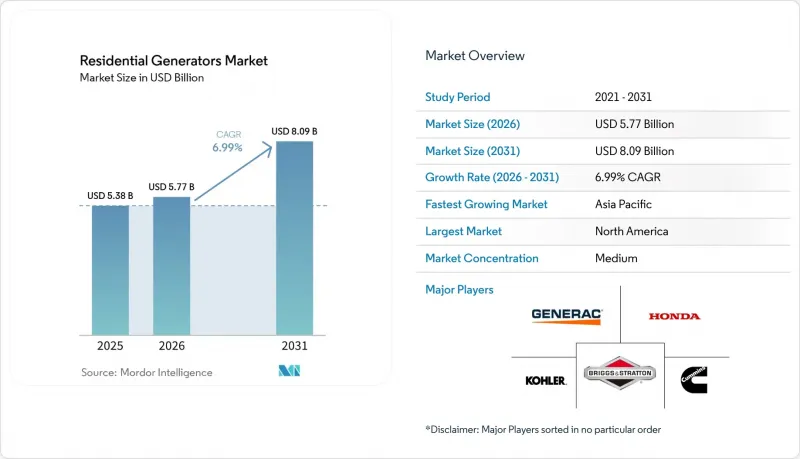
This report is Segmented by Fuel Type (Diesel, and More), Power Rating (Below 3 KW, and More), Phase (Single-Phase, Three-Phase), Type (Portable, Standby, Inverter), Technology (Conventional, Inverter, Hybrid), Application (Emergency Backup, and More), and Geography (North America, Europe, Asia-Pacific, South America, Middle East and Africa). Market Forecasts are Provided in Value (USD).
Global Residential Generators Market Trends and Insights
Growing frequency of extreme-weather-related outages
Severe storms generated 80.1% of U.S. power interruptions between 2000 and 2023, and the average major event lasted 229 minutes in 2022, double the restoration windows common a decade earlier . Similar patterns emerged worldwide in 2025 when Chile's nationwide outage and Iraq's heat-wave blackout underscored how compound climate stressors topple grids already operating near capacity. County-level studies confirm that days above 32.2 °C combined with wind or precipitation sharply elevate outage counts, pushing households in California, Texas, and the Southeast toward automatic-start solutions that can cover multi-day disruptions. As refrigerators, HVAC systems, and connectivity equipment all become mission-critical, buyers increasingly select standby or hybrid units featuring long runtime and remote monitoring. The outcome is a sustained uplift in the Residential generators market as backup power becomes a core element of household resilience planning.
Aging transmission & distribution infrastructure
Roughly 70% of U.S. transmission lines and large transformers now exceed 25 years of service, a lifespan bracket correlated with higher failure rates during extreme temperatures . Planned grid-hardening investments of USD 480 billion in 2025 and USD 5.8 trillion through 2035 will ease the strain eventually, but permitting delays and labor shortages stretch completion timelines, leaving homeowners exposed for the next decade. North American reliability assessments already flag 13 of 23 regions at elevated risk, so demand for backup generation persists even as utilities invest. Similar replacement lags characterize Western Europe, where legacy infrastructure meets rising electrification loads. Consequently, the Residential generators market benefits from a long, visible demand horizon that encourages manufacturers to expand dealer networks, financing options, and hybrid product lines.
Tightening small-engine emission limits
EPA Tier 2, California's small off-road engine rules, and EU Stage V standards demand particulate filters, catalytic reduction, and advanced injection systems that add 15-20% to the bill of materials for sub-20 kW sets . Vendors such as Kohler hedge with hydrogen-compatible and HVO-ready products to preserve market access as thresholds tighten. Compliance costs hit portable and entry-level standby models hardest, compressing margins and nudging buyers toward quieter inverter or battery solutions that sidestep combustion limits. The regulatory drag is moderate yet persistent, shaving 0.8 percentage points off forecast CAGR in the Residential generators market.
Other drivers and restraints analyzed in the detailed report include:
- Hybrid Solar-Storage-Generator Resilience Packages
- Work-from-Anywhere Surge in Home Critical Electronics
- Falling Lithium-Ion Home-Battery Costs
For complete list of drivers and restraints, kindly check the Table Of Contents.
Segment Analysis
Natural-gas units accounted for 34.8% Residential generators market share in 2025 on the back of pipeline availability, automatic-start ease, and lower fuel cost per kWh. Ongoing grid expansions in Ontario and the U.S. Sun Belt widen the addressable base, supporting steady volume. The Residential generators market size for natural-gas sets is projected to reach USD 3.2 billion by 2031 as installations migrate from manual transfer switches to fully automated whole-home coverage. Meanwhile, solar-battery hybrids log an 11.0% CAGR, luring urban, noise-sensitive buyers with rebate-driven economics and silent operation. Diesel remains relevant for rural, off-grid properties requiring multi-day autonomy, but emission compliance raises system cost. Gasoline portables cling to entry-level niches yet lose share to dual-fuel LPG models that store safer and run cleaner. Manufacturers hedging across dual- and tri-fuel capabilities best capture mixed-infrastructure markets flagged by reliability agencies where winter pipeline pressure can drop.
Renewables adoption steers future preferences. Regions crossing 20% rooftop solar penetration lean heavily toward hybrids that self-charge daily and ride through evening peaks on batteries. In contrast, suburban tracts with mature natural-gas grids prefer fuel-based standby sets sized for HVAC and EV-charger loads. Strategic positioning, therefore, revolves around offering both zero-emission and dual-fuel pathways inside branded ecosystems so customers can add or swap modules as policy or price signals evolve.
With 42.1% share, 3-10 kW generators represent the mainstream choice for refrigerators, HVAC blowers, lighting, and home-office electronics. Their installed cost per kW and footprint suit single-family dwellings, keeping shipment volume high even as hybrids gain ground. The Residential generators market size tied to this band is forecast to climb to USD 3.5 billion by 2031, though share inches down as larger homes and EV charging drive upgrades. The 10-20 kW bracket grows fastest at 7.7% CAGR, reflecting Level 2 charger prevalence and rising adoption of electric heat pumps. Portable power stations under 3 kW eat into small gasoline generator demand thanks to silent, indoor-safe batteries that meet camping and tailgating needs. Units above 20 kW remain niche-luxury estates, farms, and small businesses-but could scale if vehicle-to-grid rules allow export revenues that offset higher capex.
Capacity planning increasingly accounts for peak-start loads of heat pumps and EV chargers rather than average draw, nudging households to size up. Manufacturers emphasize load-management modules that orchestrate appliances dynamically, letting a 10 kW generator run a 15 kW connected load sequentially, stretching the sweet spot while containing costs.
Geography Analysis
North America anchored 37.0% of 2025 revenue, a leadership position sustained by mature natural-gas grids, streamlined permitting for standby installations, and insurance discounts tied to certified backup systems. Chronic hurricane, wildfire, and ice-storm activity keeps consumer awareness high. Canada's Enbridge expansions in Ontario broaden pipeline coverage and enlarge the Residential generators market as gas standbys become feasible for another 2,200 rural homes by 2027. Mexico shows faster unit growth than revenue growth because portable sets dominate in lower-income regions. Outage-risk assessments through 2035 flag resource adequacy shortfalls in MISO, PJM, ERCOT, and WECC, pointing to a long demand runway.
Asia-Pacific, the quickest riser at an 8.5% CAGR, features highly varied national profiles. India's tier-2 cities endure frequent blackouts, boosting portable uptake; Honda's 2026 UPS leasing rollout captures this affordability-focused niche. Japan's typhoon seasons and aging grid elevate standby demand, while Australia's cyclone belt fuels dual-fuel portable sales. Mainland China's rural electrification gaps still prompt weekly outages, sustaining low-price gasoline generator volume. Permitting hurdles and fuel-logistics issues slow standby penetration in Indonesia and the Philippines, but inverter portables gain share where noise limits apply in dense urban areas.
Europe blends strict emission policies with growing outage risk as renewable intermittency rises. EU Stage V compliance costs push buyers toward inverter and hybrid sets, and municipal sound ordinances drive less than 60 dBA equipment preference. Storm Eowyn's 2025 damage to Ireland's network showed that even advanced grids remain vulnerable. Germany, Italy, and Spain use generous feed-in tariffs to promote solar-battery hybrids, eating into short-duration generator demand. South America clusters demand in Brazil and Argentina, though economic volatility caps high-end sales. The Middle East relies on diesel prime power where grids falter, evidenced by Lebanon's 80% diesel share, yet income levels support sizeable unit shipments. Sub-Saharan Africa's 2.5 million annual portable sales reflect urbanization outpacing grid build-out, with South Africa recording 200 load-shedding days in 2023.
- Generac Holdings Inc.
- Kohler Co.
- Briggs & Stratton Corp.
- Cummins Inc.
- Honda Motor Co., Ltd.
- Atlas Copco AB
- Caterpillar Inc.
- Yamaha Motor Co., Ltd.
- Champion Power Equipment Inc.
- Wacker Neuson SE
- Honeywell (Home Standby Licensing)
- Westinghouse Electric Corp.
- Hyundai Power Products
- FG Wilson (Caterpillar)
- DEUTZ AG
- Wartsila Corp.
- Rolls-Royce plc (MTU Power Systems)
- Siemens Energy AG
- PRAMAC Group
- Ingersoll Rand Inc.
Additional Benefits:
- The market estimate (ME) sheet in Excel format
- 3 months of analyst support
TABLE OF CONTENTS
1 Introduction
- 1.1 Study Assumptions & Market Definition
- 1.2 Scope of the Study
2 Research Methodology
3 Executive Summary
4 Market Landscape
- 4.1 Market Overview
- 4.2 Market Drivers
- 4.2.1 Growing frequency of extreme-weather-related outages
- 4.2.2 Aging transmission & distribution infrastructure
- 4.2.3 Expansion of residential natural-gas grids
- 4.2.4 "Work-from-anywhere" surge in home load-critical electronics
- 4.2.5 Hybrid solar-storage-generator resilience packages
- 4.2.6 Grid-cybersecurity breach concerns among homeowners
- 4.3 Market Restraints
- 4.3.1 Tightening small-engine emission limits (EU Stage V, CARB)
- 4.3.2 Municipal noise / zoning restrictions
- 4.3.3 Falling Li-ion home-battery costs
- 4.3.4 Insurance rebates favouring zero-emission backup
- 4.4 Supply-Chain Analysis
- 4.5 Regulatory Landscape
- 4.6 Technological Outlook
- 4.7 Porter's Five Forces
- 4.7.1 Threat of New Entrants
- 4.7.2 Bargaining Power of Buyers
- 4.7.3 Bargaining Power of Suppliers
- 4.7.4 Threat of Substitutes
- 4.7.5 Competitive Rivalry
5 Market Size & Growth Forecasts
- 5.1 By Fuel Type
- 5.1.1 Diesel
- 5.1.2 Natural Gas
- 5.1.3 Gasoline
- 5.1.4 Solar-Battery Hybrid
- 5.1.5 Others
- 5.2 By Power Rating
- 5.2.1 Below 3 kW
- 5.2.2 3 to 10 kW
- 5.2.3 10 to 20 kW
- 5.2.4 Above 20 kW
- 5.3 By Phase
- 5.3.1 Single-Phase
- 5.3.2 Three-Phase
- 5.4 By Type
- 5.4.1 Portable Generators
- 5.4.2 Standby Generators
- 5.4.3 Inverter Generators
- 5.5 By Technology
- 5.5.1 Conventional
- 5.5.2 Inverter
- 5.5.3 Hybrid
- 5.6 By Application
- 5.6.1 Emergency Backup
- 5.6.2 Prime/Continuous
- 5.6.3 Recreational / Outdoor
- 5.7 By Geography
- 5.7.1 North America
- 5.7.1.1 United States
- 5.7.1.2 Canada
- 5.7.1.3 Mexico
- 5.7.2 Europe
- 5.7.2.1 Germany
- 5.7.2.2 United Kingdom
- 5.7.2.3 France
- 5.7.2.4 Italy
- 5.7.2.5 NORDIC Countries
- 5.7.2.6 Russia
- 5.7.2.7 Rest of Europe
- 5.7.3 Asia-Pacific
- 5.7.3.1 China
- 5.7.3.2 India
- 5.7.3.3 Japan
- 5.7.3.4 South Korea
- 5.7.3.5 ASEAN Countries
- 5.7.3.6 Rest of Asia-Pacific
- 5.7.4 South America
- 5.7.4.1 Brazil
- 5.7.4.2 Argentina
- 5.7.4.3 Rest of South America
- 5.7.5 Middle East and Africa
- 5.7.5.1 Saudi Arabia
- 5.7.5.2 United Arab Emirates
- 5.7.5.3 South Africa
- 5.7.5.4 Egypt
- 5.7.5.5 Rest of Middle East and Africa
- 5.7.1 North America
6 Competitive Landscape
- 6.1 Market Concentration
- 6.2 Strategic Moves (M&A, Partnerships, PPAs)
- 6.3 Market Share Analysis (Market Rank/Share for key companies)
- 6.4 Company Profiles (includes Global level Overview, Market level overview, Core Segments, Financials as available, Strategic Information, Products & Services, and Recent Developments)
- 6.4.1 Generac Holdings Inc.
- 6.4.2 Kohler Co.
- 6.4.3 Briggs & Stratton Corp.
- 6.4.4 Cummins Inc.
- 6.4.5 Honda Motor Co., Ltd.
- 6.4.6 Atlas Copco AB
- 6.4.7 Caterpillar Inc.
- 6.4.8 Yamaha Motor Co., Ltd.
- 6.4.9 Champion Power Equipment Inc.
- 6.4.10 Wacker Neuson SE
- 6.4.11 Honeywell (Home Standby Licensing)
- 6.4.12 Westinghouse Electric Corp.
- 6.4.13 Hyundai Power Products
- 6.4.14 FG Wilson (Caterpillar)
- 6.4.15 DEUTZ AG
- 6.4.16 Wartsila Corp.
- 6.4.17 Rolls-Royce plc (MTU Power Systems)
- 6.4.18 Siemens Energy AG
- 6.4.19 PRAMAC Group
- 6.4.20 Ingersoll Rand Inc.
7 Market Opportunities & Future Outlook
- 7.1 White-space & Unmet-Need Assessment

