PUBLISHER: Mordor Intelligence | PRODUCT CODE: 2063249

PUBLISHER: Mordor Intelligence | PRODUCT CODE: 2063249
China Swine Feed - Market Share Analysis, Industry Trends & Statistics, Growth Forecasts (2026 - 2031)
According to Mordor Intelligence, the china swine feed market size is projected to grow from USD 26.7 billion in 2025 to USD 28.1 billion in 2026, and further to USD 36.9 billion by 2031, with a CAGR of 5.4% from 2026 to 2031.
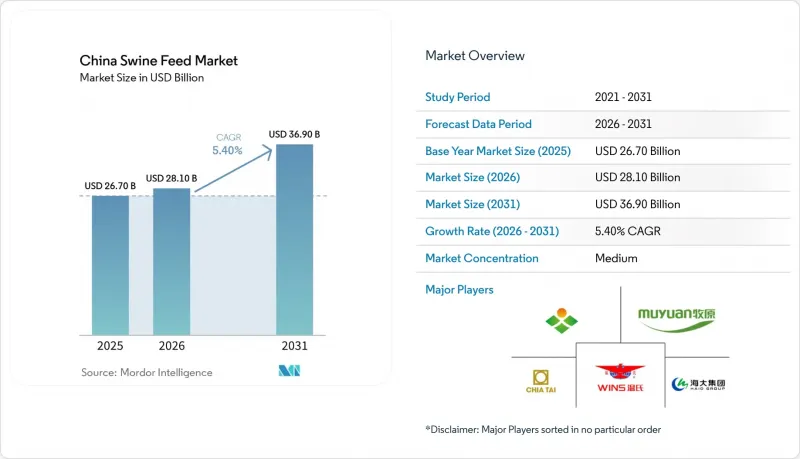
This report is Segmented by Product Type (Starter Feed, Grower Feed, Finisher Feed, Breeder Feed), by Form (Pellet, Mash, Crumbles), and by Ingredient Type (Corn, Soybean Meal, Amino-Acid Additives, Vitamins and Minerals, Enzymes, Other Cereals and Fats). The Market Forecasts are Provided in Terms of Value (USD).
China Swine Feed Market Trends and Insights
Rapid Consolidation of Large-Scale Pig Farms
The rapid consolidation of large-scale pig farms is shifting procurement power toward vertically integrated companies that negotiate directly with grain suppliers and require stage-specific feed rations. Muyuan Foods reported a fully allocated breeding cost of CNY 12 per kilogram (USD 1.65 per kilogram) in March 2025 . The scale of operations enables integrators to operate on-site feed mills, implement stringent biosecurity measures, and reinvest cost savings into nutrition research, further widening the gap between large integrators and smallholders.
African Swine Fever (ASF)-Triggered Surge in Biosecure Commercial Feed
In response to the African Swine Fever (ASF) outbreak, swine producers are tightening biosecurity measures and pivoting towards safer feed sourcing. The Food and Agriculture Organization reported a jump in ASF cases in Vietnam, rising from over 1,600 in 2024 to about 2,495 in 2025, leading to the culling of roughly 1.27 million pigs . This uptick underscores heightened contamination risks in conventional systems. Given that ASF can be transmitted via feed and farm inputs, producers are turning to heat-treated, certified commercial feed sourced from biosecure mills. This shift is propelling the demand for traceable, HACCP-compliant compound feed products.
Domestic Corn-Price Volatility
In February 2026, domestic corn was traded at 2.320 RMB per kilogram (USD 0.32 per kilogram), marking a significant decline from 3.000 RMB per kilogram in late 2022 . This sharp price drop highlights the volatility in the corn market, which poses challenges for producers and traders alike. Such fluctuations create uncertainty in forward contracting, making it difficult for producers to secure stable pricing and plan their operations effectively. Additionally, this price instability may prompt producers to reduce their inventory levels as a precautionary measure, potentially leading to a decline in feed demand and further impacting market dynamics.
Other drivers and restraints analyzed in the detailed report include:
- Swill-Feeding Ban Spurs Commercial Feed Uptake
- Roll-Out of Precision-Feeding IoT Platforms
- Slow Herd-Rebuilding Pace post ASF
For complete list of drivers and restraints, kindly check the Table Of Contents.
Segment Analysis
Grower feed accounted for the largest 38% of the China swine feed market share in 2025, driven by the high feed consumption during the 30 to 70 kilogram growth phase, which requires the largest ration volume per animal. The starter feed market size is projected to register the fastest CAGR of 5.9% from 2026 to 2031. This growth reflects the industry's increasing focus on early-life gut-health programs designed to reduce mortality rates and shorten finishing periods, addressing key challenges in swine production. Finisher Feed remains focused on cost efficiency to optimize production expenses, while Breeder Feed volumes are closely tied to sow inventory trends.
Producers are focusing on nutritional precision during the weaning phase to minimize stress, improve gut health, and enhance growth performance. This has resulted in increased use of functional ingredients, including easily digestible proteins, organic acids, and feed additives that promote immunity and nutrient absorption. Regulatory restrictions on the use of antibiotics and zinc oxide are further driving the development of advanced, compliant starter feed solutions. Additionally, the expansion of large-scale farms and contract rearing systems is boosting the demand for high-quality starter feed, supported by integrated production models aimed at improving feed efficiency and reducing mortality rates.
List of Companies Covered in this Report:
- New Hope Liuhe Co., Ltd.
- Chia Tai Investment Co., Ltd. (Charoen Pokphand Group)
- Wens Foodstuff Group Co., Ltd.
- Guangdong Haid Group Co., Ltd.
- Muyuan Foods Co., Ltd.
- Beijing Dabeinong Technology Group Co., Ltd. (DBN Group)
- Tongwei Co., Ltd.
- Liaoning Wellhope Agri-Tech Co., Ltd.
- Cargill, Incorporated
- Archer-Daniels-Midland Company
- DSM-Firmenich AG
- Evonik Industries AG
Additional Benefits:
- The market estimate (ME) sheet in Excel format
- 3 months of analyst support
TABLE OF CONTENTS
1 Introduction
- 1.1 Study Assumptions and Market Definition
- 1.2 Scope of the Study
2 Research Methodology
3 Executive Summary
4 Market Landscape
- 4.1 Market Overview
- 4.2 Market Drivers
- 4.2.1 Rapid consolidation of large-scale pig farms
- 4.2.2 African Swine Fever (ASF)-triggered surge in biosecure commercial feed
- 4.2.3 Government soybean-meal reduction mandate
- 4.2.4 Roll-out of precision-feeding IoT platforms
- 4.2.5 Adoption of recombinant thermostable phytase
- 4.2.6 Retailers carbon-neutral pork procurement targets
- 4.3 Market Restraints
- 4.3.1 Domestic corn-price volatility
- 4.3.2 Slow herd-rebuilding pace post-ASF
- 4.3.3 Stricter antibiotic-use regulations
- 4.3.4 Rising share of insect/fermented proteins in rations
- 4.4 Regulatory Landscape
- 4.5 Technological Outlook
- 4.6 Porter's Five Forces Analysis
- 4.6.1 Threat of New Entrants
- 4.6.2 Bargaining Power of Suppliers
- 4.6.3 Bargaining Power of Buyers
- 4.6.4 Threat of Substitutes
- 4.6.5 Competitive Rivalry
5 Market Size and Growth Forecast (Value)
- 5.1 By Product Type
- 5.1.1 Starter Feed
- 5.1.2 Grower Feed
- 5.1.3 Finisher Feed
- 5.1.4 Breeder Feed
- 5.2 By Form
- 5.2.1 Pellet
- 5.2.2 Mash
- 5.2.3 Crumbles
- 5.3 By Ingredient Type
- 5.3.1 Corn
- 5.3.2 Soybean Meal
- 5.3.3 Amino-Acid Additives
- 5.3.4 Vitamins and Minerals
- 5.3.5 Enzymes (e.g., Phytase)
- 5.3.6 Other Cereals and Fats
6 Competitive Landscape
- 6.1 Market Concentration
- 6.2 Strategic Moves
- 6.3 Market Share Analysis
- 6.4 Company Profiles
- 6.4.1 New Hope Liuhe Co., Ltd.
- 6.4.2 Chia Tai Investment Co., Ltd. (Charoen Pokphand Group)
- 6.4.3 Wens Foodstuff Group Co., Ltd.
- 6.4.4 Guangdong Haid Group Co., Ltd.
- 6.4.5 Muyuan Foods Co., Ltd.
- 6.4.6 Beijing Dabeinong Technology Group Co., Ltd. (DBN Group)
- 6.4.7 Tongwei Co., Ltd.
- 6.4.8 Liaoning Wellhope Agri-Tech Co., Ltd.
- 6.4.9 Cargill, Incorporated
- 6.4.10 Archer-Daniels-Midland Company
- 6.4.11 DSM-Firmenich AG
- 6.4.12 Evonik Industries AG
7 Market Opportunity and Future Outlook

