
PUBLISHER: Mordor Intelligence | PRODUCT CODE: 2063254

PUBLISHER: Mordor Intelligence | PRODUCT CODE: 2063254
Virtual Pipeline Systems - Market Share Analysis, Industry Trends & Statistics, Growth Forecasts (2026 - 2031)
According to Mordor Intelligence, the virtual pipeline systems market size was valued at USD 1.67 billion in 2025 and is estimated to grow from USD 1.79 billion in 2026 to reach USD 2.48 billion by 2031, at a CAGR of 6.71% during the forecast period (2026-2031).
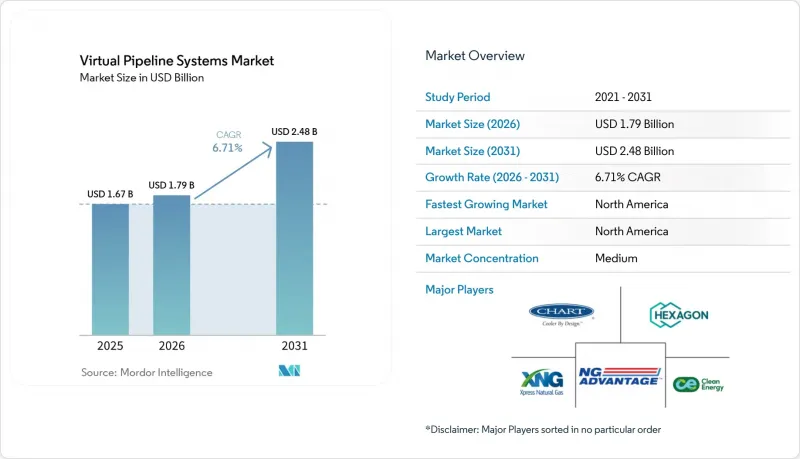
This report is Segmented by Gas (CNG, LNG, Others), Type (Standard Trailer, Towable Trailer), Pressure Rating (Less Than 3, 000 Psi, 3, 001 To 5, 000 Psi, More Than 5, 000 Psi), Application (Industrial, Transportation, Commercial and Residential), and Geography (North America, Europe, Asia-Pacific, South America, Middle East and Africa). Market Forecasts are Provided in Terms of Value (USD).
Global Virtual Pipeline Systems Market Trends and Insights
Soaring Off-Grid Natural-Gas Demand in Mining & Remote Power
Remote mines, data centers, and military installations are bypassing lengthy pipeline build-outs in favor of virtual pipeline systems that can be deployed within weeks. Altaaqa Global erected a 40 MW mobile gas-turbine plant for a Kazakh data center in just 27 days, highlighting the speed advantage over fixed infrastructure . Australian mining sites using hybrid solar-battery systems still rely on mobile CNG or LNG for baseload power, cutting diesel consumption by 77.9%. In Texas, MPLX supplies Delaware Basin gas to a 400 MW crypto-mining campus that plans to scale to 1.5 GW under a long-term virtual-pipeline contract. The U.S. Air Force validated the model with a 250 kW multi-fuel generator at Travis Air Force Base, proving suitability for defense resilience. Growing power-intensive workloads and energy-security concerns keep this demand trend firmly positive over the medium term.
Modular Trailer Innovations Slashing Last-Mile Delivery Costs
Advances in carbon-fiber cylinders and better cryogenic insulation are reducing tare weight by about 40%, boosting payloads and lowering unit-delivery costs. Hexagon Agility's TITAN 53 CNG module carries 492,000 scf, 40% more than legacy steel designs, which cuts trip frequency for high-volume clients . CIMC ENRIC doubled LNG-cylinder production capacity after a 1,000-unit order that enables 3,500 km driving ranges for heavy trucks. Cryoshelter's second-generation LNG tanks add 30% fuel capacity within the same footprint, widening commercial take-up. Digital-twin routing from Intangles trims unscheduled downtime by 20%, further shrinking the total cost of ownership. Collectively, these innovations place continual downward pressure on delivered-gas pricing.
High Upfront CAPEX for Cryogenic ISO & Type IV Modules
Cryogenic ISO tanks and Type-IV hydrogen trailers cost 50-100% more than conventional steel CNG units, deterring small operators from fleet upgrades. A single Type-IV container carrying 1.1 t of hydrogen sells for more than USD 500,000, whereas steel CNG trailers average USD 200-300 thousand. Chart Industries' jumbo 1,700 m3 cryogenic tanks need specialized Louisiana fabrication, keeping global prices elevated. Emerging-market buyers often rely on used equipment lacking advanced safety features, widening a technology gap. Limited leasing facilities and high local interest rates extend payback cycles. This financial barrier slows technology diffusion even where fuel demand is robust.
Other drivers and restraints analyzed in the detailed report include:
- Carbon-Credit Premiums for Renewable CNG & LNG Blends
- Industrial Decarbonization Mandates Across EU & North America
- Patchwork of Hazmat Transport Regulations Across Regions
For complete list of drivers and restraints, kindly check the Table Of Contents.
Segment Analysis
CNG delivered 58.5% of the virtual pipeline systems market revenue in 2025, owing to its entrenched role in industrial heating and heavy transport. The Others category (biogas, RNG, and hydrogen) is forecast to grow at 15.5% CAGR through 2031, propelled by premium carbon credits and new hydrogen hubs. North American RNG output reached 225 TBtu in 2025, validating feedstock scalability. Hexagon Purus shipped Europe's first Type-IV hydrogen units in March 2026, opening new decarbonization pathways.
RNG uptake is rising in dairy-intensive regions, with Clean Energy Fuels' USD 85 million South Fork facility generating 2.6 million gallons annually under long-term transit contracts. Indonesia's 40 t/d Cryobox micro-LNG plant shows how small-scale LNG can displace diesel on islands lacking pipelines. Hydrogen demand remains nascent yet is scaling in Germany, Japan, and South Korea as green-steel pilots advance.
Standard trailers occupied 75.8% of the virtual pipeline systems market in 2025 because of high-volume payloads and predictable delivery cycles. Towable platforms, however, are projected to expand at 9.1% CAGR as mining camps and disaster-relief agencies favor rapid deployment. Altaaqa Global repositioned towable LNG modules to power a 40 MW Kazakh site within 27 days.
Standard units still dominate large industrial contracts; Hexagon Agility's TITAN 53 cuts delivery trips by 30% thanks to 492,000 scf capacity. In urban settings, decoupled towable tanks relieve congestion by allowing tractors to swap loads without on-site idling, enhancing fleet productivity.
Geography Analysis
North America held 40.6% virtual pipeline systems market share in 2025 and is forecast to achieve a 7.2% CAGR to 2031, supported by the Inflation Reduction Act tax credits and DOE hydrogen-cost targets of USD 4 per kg by 2031. Operator NG Advantage has already delivered more than 25 Bcf of CNG to off-pipeline industrial clients, a record volume for the region. Canada's net-zero grid policy pushes remote miners toward mobile LNG for on-site generation. Mexico's 7.8 Mtpa Amigo LNG export project will supply northern industrial corridors via virtual pipelines starting in 2028.
Europe is expanding at a steady clip due to methane-leak rules and hydrogen pilots. Hexagon Purus secured a EUR 6.2 million (~ USD 7.21 million) order for hydrogen distribution units in March 2026, marking Europe's first commercial deployment of Type-IV containers. Southern Europe is embracing small-scale LNG for island power; INOXCVA commissioned terminals in the Bahamas and Scotland that can reload ISO tanks for onward truck delivery.
The Asia-Pacific region shows the largest absolute volume growth. China's LNG truck boom and India's city-gas build-out anchor demand, though hazmat-rule fragmentation restrains fleet utilization. Indonesia's Cryobox micro-LNG rollout proves small-island viability. Japan and South Korea are channeling subsidies into hydrogen logistics, fueling composite-cylinder imports.
South America and the Middle East constitute emerging pockets. Brazil is weighing micro-LNG to serve pre-salt platforms, whereas Argentina's Vaca Muerta shale produces surplus gas suited for trucking to coastal demand centers. Gulf producers are adding LNG trailers to diversify revenue beyond crude, while South African mines in the Northern Cape deploy CNG trailers to offset diesel volatility.
- Xpress Natural Gas (XNG)
- REV LNG
- Hexagon Composites ASA
- Chart Industries Inc.
- NG Advantage LLC
- Compass Natural Gas
- Clean Energy Fuels Corp.
- Galileo Technologies
- Worthington Industries
- Quantum Fuel Systems
- Luxfer-GTM Technologies
- Verdek LLC
- Broadwind Energy Inc.
- ANGI Energy Systems
- CRYO Gas Tech
- GE Vernova (Oil & Gas)
- CIMC ENRIC
- CIMARRON Trailers
- Eagle LNG Partners
- Energia Primus
Additional Benefits:
- The market estimate (ME) sheet in Excel format
- 3 months of analyst support
TABLE OF CONTENTS
1 Introduction
- 1.1 Study Assumptions & Market Definition
- 1.2 Scope of the Study
2 Research Methodology
3 Executive Summary
4 Market Landscape
- 4.1 Market Overview
- 4.2 Market Drivers
- 4.2.1 Soaring off-grid natural-gas demand in mining & remote power
- 4.2.2 Modular trailer innovations slashing last-mile delivery costs
- 4.2.3 Carbon-credit premiums for renewable CNG & LNG blends
- 4.2.4 Industrial decarbonization mandates across EU & North America
- 4.2.5 Hydrogen-ready composite cylinders expanding addressable market
- 4.2.6 Defense & disaster-relief agencies adopting mobile gas hubs
- 4.3 Market Restraints
- 4.3.1 High upfront CAPEX for cryogenic ISO & Type-IV modules
- 4.3.2 Patchwork of hazmat transport regulations across regions
- 4.3.3 Scarcity of skilled drivers & technicians for LNG handling
- 4.3.4 Volatile spot LNG/CNG pricing impacting project IRRs
- 4.4 Supply-Chain Analysis
- 4.5 Regulatory Landscape
- 4.6 Technological Outlook
- 4.7 Porter's Five Forces
- 4.7.1 Threat of New Entrants
- 4.7.2 Bargaining Power of Buyers
- 4.7.3 Bargaining Power of Suppliers
- 4.7.4 Threat of Substitutes
- 4.7.5 Competitive Rivalry
5 Market Size & Growth Forecasts
- 5.1 By Gas
- 5.1.1 Compressed Natural Gas (CNG)
- 5.1.2 Liquefied Natural Gas (LNG)
- 5.1.3 Others (Biogas, Hydrogen, etc.)
- 5.2 By Type
- 5.2.1 Standard Trailer
- 5.2.2 Towable Trailer
- 5.3 By Pressure Rating
- 5.3.1 Less than 3,000 Psi
- 5.3.2 3,001 to 5,000 Psi
- 5.3.3 More than 5,000 Psi
- 5.4 By Application
- 5.4.1 Industrial
- 5.4.2 Transportation
- 5.4.3 Commercial and Residential
- 5.5 By Geography
- 5.5.1 North America
- 5.5.1.1 United States
- 5.5.1.2 Canada
- 5.5.1.3 Mexico
- 5.5.2 Europe
- 5.5.2.1 Germany
- 5.5.2.2 United Kingdom
- 5.5.2.3 France
- 5.5.2.4 Italy
- 5.5.2.5 NORDIC Countries
- 5.5.2.6 Russia
- 5.5.2.7 Rest of Europe
- 5.5.3 Asia-Pacific
- 5.5.3.1 China
- 5.5.3.2 India
- 5.5.3.3 Japan
- 5.5.3.4 South Korea
- 5.5.3.5 ASEAN Countries
- 5.5.3.6 Rest of Asia-Pacific
- 5.5.4 South America
- 5.5.4.1 Brazil
- 5.5.4.2 Argentina
- 5.5.4.3 Rest of South America
- 5.5.5 Middle East and Africa
- 5.5.5.1 Saudi Arabia
- 5.5.5.2 United Arab Emirates
- 5.5.5.3 South Africa
- 5.5.5.4 Egypt
- 5.5.5.5 Rest of Middle East and Africa
- 5.5.1 North America
6 Competitive Landscape
- 6.1 Market Concentration
- 6.2 Strategic Moves (M&A, Partnerships, PPAs)
- 6.3 Market Share Analysis (Market Rank/Share for key companies)
- 6.4 Company Profiles (includes Global level Overview, Market level overview, Core Segments, Financials as available, Strategic Information, Products & Services, and Recent Developments)
- 6.4.1 Xpress Natural Gas (XNG)
- 6.4.2 REV LNG
- 6.4.3 Hexagon Composites ASA
- 6.4.4 Chart Industries Inc.
- 6.4.5 NG Advantage LLC
- 6.4.6 Compass Natural Gas
- 6.4.7 Clean Energy Fuels Corp.
- 6.4.8 Galileo Technologies
- 6.4.9 Worthington Industries
- 6.4.10 Quantum Fuel Systems
- 6.4.11 Luxfer-GTM Technologies
- 6.4.12 Verdek LLC
- 6.4.13 Broadwind Energy Inc.
- 6.4.14 ANGI Energy Systems
- 6.4.15 CRYO Gas Tech
- 6.4.16 GE Vernova (Oil & Gas)
- 6.4.17 CIMC ENRIC
- 6.4.18 CIMARRON Trailers
- 6.4.19 Eagle LNG Partners
- 6.4.20 Energia Primus
7 Market Opportunities & Future Outlook
- 7.1 White-space & Unmet-Need Assessment
- 7.2 Growth in Small-Scale LNG & Microgrid Systems
- 7.3 Integration with Renewable & Hydrogen Infrastructure
- 7.4 Rise in Off-grid & Remote-area Demand
- 7.5 Digitalization & Fleet Optimization in Virtual Pipelines

