PUBLISHER: Mordor Intelligence | PRODUCT CODE: 2063262

PUBLISHER: Mordor Intelligence | PRODUCT CODE: 2063262
Wave Energy - Market Share Analysis, Industry Trends & Statistics, Growth Forecasts (2026 - 2031)
According to Mordor Intelligence, the wave energy market size in terms of installed base is projected to be 4 megawatt in 2025, 10 megawatt in 2026, and reach 125 megawatt by 2031, growing at a CAGR of 65.72% from 2026 to 2031.
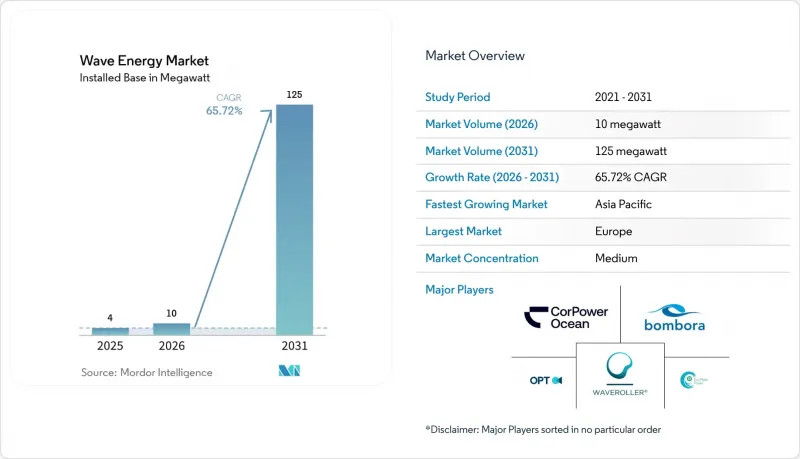
This report is Segmented by Type (Oscillating Water Column, Others), Deployment Location (Onshore, Near-Shore, Offshore Shallow Shelf, Offshore Deep Water), Application (Power Generation, Desalination, Environmental Protection, Others), and Geography (North America, Europe, Asia-Pacific, South America, Middle East and Africa). The Market Forecasts are Provided in Terms of Volume (MW).
Global Wave Energy Market Trends and Insights
Feed-in-tariff & Contract-for-difference Schemes Expand in EU & APAC
Member-state targets under the European Renewable Energy Directive III require that 5% of new renewable capacity between 2025 and 2030 come from innovative sources, explicitly naming wave technologies. Ireland's Marine Energy Programme, Horizon Europe grants, and Taiwan's first contract-for-difference agreement for wave power create predictable revenue streams that derisk early projects. These incentives shorten payback periods, attract venture backing, and move the wave energy market from prototype trials to pre-commercial clusters. Developers in India and Portugal are already securing long-term tariffs at premiums that mirror early offshore-wind support schemes. The success of these frameworks is prompting other Asia-Pacific governments to draft similar support mechanisms, enlarging the investable project pipeline.
Demand for Ocean-Sourced Baseload Renewables to Balance Wind and Solar
Wave devices deliver capacity factors of 25-35% today and up to 40-48% in optimized forecasts, smoothing supply during solar and wind lulls. Island grids in Hawaii, the Canary Islands, and King Island deploy wave arrays to displace diesel generation without relying on large battery systems. U.S. federal programs such as the Waves to Water Prize fund off-grid desalination buoys that use direct mechanical pressure rather than grid electricity. Commercial operators of remote mining and aquaculture sites adopt wave energy to cut fuel logistics and lower emissions penalties. Collectively, these baseload applications widen the customer base and accelerate scale economies for the wave energy market.
High CAPEX & LCOE Gap Versus Mature Renewables
Wave energy's 2025 levelized cost of USD 388-618 MWh is three to six times that of utility-scale solar, deterring merchant investments. Learning-curve studies by NREL show costs may drop to USD 0.07-0.13 kWh by 2050, conditional on multi-gigawatt roll-outs. Early adopters, therefore, depend on tariffs exceeding USD 351 MWh or direct capital subsidies. In emerging markets, willingness to pay is below USD 0.10 kWh, widening the financing gap. Without continued policy support, the wave energy market risks stalling before economies of scale can unlock parity.
Other drivers and restraints analyzed in the detailed report include:
- Cost Decline from Composite Structures & Modular PTOs
- Rising Venture & Infrastructure Fund Investments in Demonstrator Arrays
- Grid Interconnection & Multi-Agency Permitting Hurdles
For complete list of drivers and restraints, kindly check the Table Of Contents.
Segment Analysis
Oscillating body converters, mainly point absorbers, captured 59.7% of installed capacity in 2025. The wave energy market size for this segment is on course to grow at a 93.5% CAGR, supported by serial production of standardized modules. Phase-control algorithms in devices such as HiWave-5 have lifted energy-capture ratios, helping investors view the technology as near-commercial. The segment's rising reliability underpins a broader shift from survivability testing to revenue-focused deployments.
Demand for point absorbers is reinforced by their flexible mooring options, making them suitable for both breakwater retrofits and shallow-shelf foundations. Composite cladding extends service lives in corrosive marine environments, limiting downtime to scheduled annual inspections. These improvements lower the cost of insurance and financing, securing a durable lead for oscillating body converters within the wave energy market.
Geography Analysis
Europe anchors the wave energy market with 75.1% of installed capacity in 2025. Robust policy support under Renewable Energy Directive III, plus Horizon Europe's USD 273.78 million marine-energy budget, ensures a steady queue of 1-10 MW arrays, feeding a regional supply chain that now exports components to Asia-Pacific. The United Kingdom, Ireland, and Portugal each combine feed-in premiums with test-site infrastructure, accelerating learning rates.
Asia-Pacific shows the fastest growth, charting an 84.4% CAGR through 2031, powered by India's 40 GW theoretical potential, Taiwan's 20 MW medium-term target, and Japan's NEDO-backed demonstrations. Local oil and gas majors in Indonesia and Malaysia are trialing co-location concepts, providing anchor customers for early arrays. China's Beibu Gulf cavity revetment system reports levelized costs near grid parity, proving feasibility in low-labor-cost markets.
North America, South America, and the Middle East are emerging frontiers. California's Senate Bill 605 flags 37 GW of state coastal resources, yet only PacWave South is fully permitted. Brazil's USD 1 billion Santa Catarina initiative exemplifies sovereign-wealth backing aimed at import substitution. Saudi Arabia's NEOM evaluates Red Sea prototypes within its 120 GW 2032 renewable commitment, potentially opening a new high-insolation yet wave-rich geography to hybrid solutions.
- Ocean Power Technologies, Inc.
- Eco Wave Power Ltd.
- Carnegie Clean Energy Ltd.
- CorPower Ocean AB
- AW-Energy Oy
- SINN Power GmbH
- Mocean Energy Ltd.
- Wello Oy
- Wave Swell Energy Ltd.
- Seabased AB
- Resolute Marine Energy, Inc.
- Oscilla Power, Inc.
- Bombora Wave Power Pty Ltd.
- Infinite Power Ltd.
- Havkraft AS
- Floating Power Plant A/S
- Seatricity Ltd.
- AWS Ocean Energy Ltd.
- Wave Dragon ApS
- INGINE Inc.
Additional Benefits:
- The market estimate (ME) sheet in Excel format
- 3 months of analyst support
TABLE OF CONTENTS
1 Introduction
- 1.1 Study Assumptions & Market Definition
- 1.2 Scope of the Study
2 Research Methodology
3 Executive Summary
4 Market Landscape
- 4.1 Market Overview
- 4.2 Market Drivers
- 4.2.1 Feed-in-tariff & contract-for-difference schemes expand in EU & APAC
- 4.2.2 Demand for ocean-sourced baseload renewables to balance wind/solar
- 4.2.3 Cost decline from composite structures & modular PTOs
- 4.2.4 Rising venture & infrastructure fund investments in demonstrator arrays
- 4.2.5 Power-to-X hubs (green hydrogen/ammonia) integrating wave devices
- 4.2.6 Decarbonisation mandates for offshore O&G platforms driving co-location
- 4.3 Market Restraints
- 4.3.1 High CAPEX & LCOE gap versus mature renewables
- 4.3.2 Grid interconnection & multi-agency permitting hurdles
- 4.3.3 Marine-spatial conflict with future deep-sea mining zones
- 4.3.4 Shortage of specialised far-shore maintenance vessels & crew
- 4.4 Supply-Chain Analysis
- 4.5 Regulatory Landscape
- 4.6 Technological Outlook
- 4.7 Porter's Five Forces
- 4.7.1 Threat of New Entrants
- 4.7.2 Bargaining Power of Buyers
- 4.7.3 Bargaining Power of Suppliers
- 4.7.4 Threat of Substitutes
- 4.7.5 Competitive Rivalry
5 Market Size & Growth Forecasts
- 5.1 By Type
- 5.1.1 Oscillating Water Column
- 5.1.2 Oscillating Body Converters
- 5.1.3 Overtopping Converters
- 5.2 By Deployment Location
- 5.2.1 Onshore (fixed breakwater)
- 5.2.2 Near-shore (Up to 2 km, Over 25 m depth)
- 5.2.3 Offshore - Shallow Shelf (2 to 20 km, 25 to 60 m)
- 5.2.4 Offshore - Deep Water (More than 20 km, More than 60 m)
- 5.3 By Application
- 5.3.1 Power Generation
- 5.3.2 Desalination
- 5.3.3 Environmental Protection (breakwaters, reef restoration)
- 5.3.4 Others
- 5.4 By Geography
- 5.4.1 North America
- 5.4.1.1 United States
- 5.4.1.2 Canada
- 5.4.1.3 Mexico
- 5.4.2 Europe
- 5.4.2.1 United Kingdom
- 5.4.2.2 France
- 5.4.2.3 Spain
- 5.4.2.4 Netherland
- 5.4.2.5 Denmark
- 5.4.2.6 Russia
- 5.4.2.7 Rest of Europe
- 5.4.3 Asia-Pacific
- 5.4.3.1 China
- 5.4.3.2 India
- 5.4.3.3 Japan
- 5.4.3.4 South Korea
- 5.4.3.5 ASEAN Countries
- 5.4.3.6 Australia and New Zealand
- 5.4.3.7 Rest of Asia-Pacific
- 5.4.4 South America
- 5.4.4.1 Brazil
- 5.4.4.2 Argentina
- 5.4.4.3 Colombia
- 5.4.4.4 Rest of South America
- 5.4.5 Middle East and Africa
- 5.4.5.1 United Arab Emirates
- 5.4.5.2 Saudi Arabia
- 5.4.5.3 South Africa
- 5.4.5.4 Egypt
- 5.4.5.5 Rest of Middle East and Africa
- 5.4.1 North America
6 Competitive Landscape
- 6.1 Market Concentration
- 6.2 Strategic Moves (M&A, Partnerships, PPAs)
- 6.3 Market Share Analysis (Market Rank/Share for key companies)
- 6.4 Company Profiles (includes Global level Overview, Market level overview, Core Segments, Financials as available, Strategic Information, Products & Services, and Recent Developments)
- 6.4.1 Ocean Power Technologies, Inc.
- 6.4.2 Eco Wave Power Ltd.
- 6.4.3 Carnegie Clean Energy Ltd.
- 6.4.4 CorPower Ocean AB
- 6.4.5 AW-Energy Oy
- 6.4.6 SINN Power GmbH
- 6.4.7 Mocean Energy Ltd.
- 6.4.8 Wello Oy
- 6.4.9 Wave Swell Energy Ltd.
- 6.4.10 Seabased AB
- 6.4.11 Resolute Marine Energy, Inc.
- 6.4.12 Oscilla Power, Inc.
- 6.4.13 Bombora Wave Power Pty Ltd.
- 6.4.14 Infinite Power Ltd.
- 6.4.15 Havkraft AS
- 6.4.16 Floating Power Plant A/S
- 6.4.17 Seatricity Ltd.
- 6.4.18 AWS Ocean Energy Ltd.
- 6.4.19 Wave Dragon ApS
- 6.4.20 INGINE Inc.
7 Market Opportunities & Future Outlook
- 7.1 White-space & Unmet-need Assessment

