PUBLISHER: Mordor Intelligence | PRODUCT CODE: 2063276

PUBLISHER: Mordor Intelligence | PRODUCT CODE: 2063276
Train Lighting - Market Share Analysis, Industry Trends & Statistics, Growth Forecasts (2026 - 2031)
According to Mordor Intelligence, the train lighting market size is expected to increase from USD 0.58 billion in 2025 to USD 0.64 billion in 2026 and reach USD 0.92 billion by 2031, growing at a CAGR of 7.65% over 2026-2031.
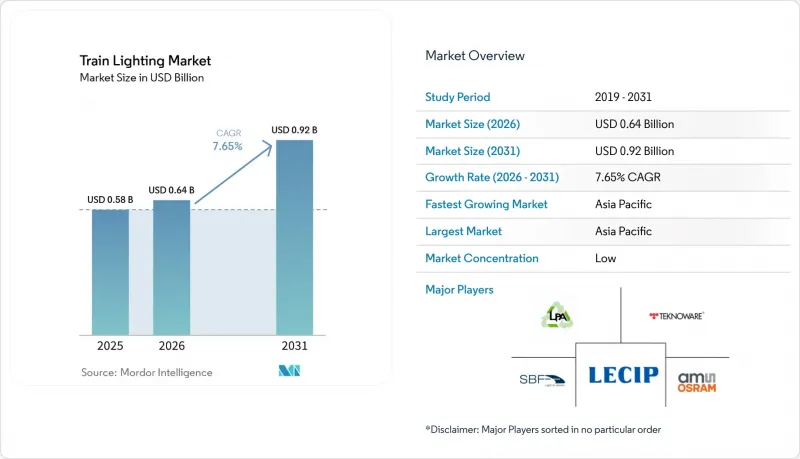
This report is Segmented by Light Type (LED, Halogen, and More), Position (Interior Lighting, Exterior Lighting), Train Type (Diesel Locomotives, Electric Locomotives, and More), Technology (Conventional Lighting, Smart Lighting), End User (Public Rail Operators, Private Rail Operators), and Geography. The Market Forecasts are Provided in Terms of Value (USD).
Global Train Lighting Market Trends and Insights
Energy-Efficient LED Retrofits Lowering Total Lifecycle Cost
Operators gravitate to LEDs because service life regularly exceeds 60,000 hours, stretching replacement intervals and trimming inventory burdens. Payback periods of 2 to 3 years remain common where rolling stock accumulates high daily mileage. The business case strengthens further as turnkey retrofit kits eliminate the need for rewiring, dramatically reducing installation labor. Historic budget hesitation among freight fleets is waning as supply of fluorescent tubes diminishes. As standard-gauge networks harmonize headlight intensity rules, LEDs emerge as a low-risk compliance route that future-proofs fleets against looming efficiency mandates.
Compliance with EN 45545, APTA and Other Safety Lighting Standards
Fire-smoke criteria under EN 45545 and photometric thresholds in APTA rules drive material selection and photometric testing. Suppliers invest in flame-retardant polymers and accredited labs to maintain approval status. Certified product lines simplify cross-border tendering, giving incumbents first-mover advantage. At the operator level, documented compliance streamlines fleet certification for cross-regional service. The incremental cost, while notable, is viewed as a necessary hedge against retrofit rework.
High Upfront Retrofit CAPEX Versus Legacy Fluorescent Fixtures
Purchase prices for rail-grade LED assemblies still outstrip fluorescent units, challenging operators with tight capital envelopes. Financing instruments from multilateral lenders ease the hurdle, but approval timelines slow rollouts. Some fleets adopt phased conversion, focusing first on high-failure or safety-critical areas. As legislation targets mercury disposal, fluorescent options will continue to fade, pointing to LED inevitability. Suppliers counter cost objections with service-life warranties that rebalance the total-cost calculus.
Other drivers and restraints analyzed in the detailed report include:
- Rapid Metro and Light-Rail Expansion in Asia-Pacific Driving New Lighting Installations
- IoT-Enabled Smart Lighting Improving Fleet-Wide Asset Monitoring
- LED Chip Supply-Chain Volatility Amid Geo-Political Trade Tensions
For complete list of drivers and restraints, kindly check the Table Of Contents.
Segment Analysis
LED retains clear leadership with 63.15% of the train lighting market share in 2025, while its nearest rivals ceded ground as maintenance economics shifted decisively in favor of solid-state sources. Operators favor LEDs for their durability and regulatory headroom, qualities underscored in prominent locomotive retrofit programs. Standardization of footprints and optics smooths fleet conversions, and suppliers increasingly market drop-in modules to minimize downtime. The declining availability of legacy halogen or fluorescent spares hastens switchover timelines. With color-tuning and smart-bus compatibility now standard on premium models, LED incumbency looks secure.
Growth momentum aligns with an 8.95% CAGR, the fastest among light types. New-build rolling stock now specifies LED as the default, eliminating the need for debate over specifications. Refurbishment tenders routinely bundle lighting into broader energy-efficiency packages, thereby amplifying the addressable volumes. Freight locomotives, once a holdout, are moving to LED headlights for better lumen maintenance and lower amperage draw. Niche xenon fixtures disappear from catalogs as equivalent LED packages hit mandated candela thresholds. Over the forecast horizon, halogen and fluorescent lamps transition almost entirely to aftermarket niches.
Interior luminaires accounted for 53.18% of the train lighting market share in 2025, owing to abundant fixture points within coaches and multiple ambiance layers. Passenger comfort, color consistency, and vandal-resistant frame are the most common procurement checklists. Modular ceiling panels facilitate factory installation and simplify progressive refits in existing cars. Reading lights, corridor strips, and restroom fixtures converge on a single set of integrated drivers to save space. Enhancements in lens design spread illumination evenly without glare.
Exterior units advance at the segment-leading 8.63% CAGR as safety regulations tighten luminous-intensity thresholds. Headlights, marker lights, and tail lamps rank high for immediate payback because reduced current draw translates into smaller alternator load and lower fuel use. All-in-one exterior modules with quick-swap fronts address harsh operating conditions and enable line-side replacement at high speed. Enhanced ingress-protection ratings sustain performance during washdowns and ballast strikes. Thermal architecture optimized for wide ambient swings improves perceived reliability among operators operating in extreme climates.
Geography Analysis
Asia-Pacific anchors demand, accounting for 38.55% of the train lighting market share in 2025 and an 8.23% CAGR outlook. Rapid urbanization drives elevated coach orders, and local standards mandating higher tunnel luminance accelerate LED penetration. Suppliers collaborate with domestic car builders to navigate certification and localization rules. The growing emphasis on automated operations is driving investment in connected lighting as a cornerstone of intelligent trains. Cross-border export ambitions of regional vendors intensify competition in the global train lighting market.
Europe's mature network shows steady renewal activity under green-mobility funding programs. Operators tap EU grants to refurbish aging fleets, and strict fire-smoke and recyclability laws sustain premium product uptake. Incumbent suppliers leverage deep compliance portfolios to secure repeat orders. Smart-bus architectures gain traction in long-distance services as part of digital-train demonstrators. Sustainability reporting requirements propel disclosure of luminaire recyclability and embodied carbon.
The Americas combine retrofit momentum in legacy diesel fleets with select new-build metro schemes. North American safety standards enforce high candela values for exterior fixtures, guiding niche specialization among domestic suppliers. South American metros are increasingly specifying LED from day one to curtail operational costs. Cross-border supply logistics, particularly lead-time sensitivity, influence sourcing decisions. Growing scrutiny of cybersecurity in public procurement is driving the inclusion of secure-boot and encrypted-communication clauses in lighting packages.
- LPA Group plc
- Teknoware Oy
- SBF Spezialleuchten GmbH
- LECIP Holdings Corporation
- ams-OSRAM AG
- LEDtronics, Inc.
- Seisenbacher GmbH
- MBM Industry & Rail Tech
- INPS Group
- Drew Lear Technology
- LMXLED Ltd.
- EUTRAC Stromschienen GmbH
- Guangdong Mason Technologies Co., Ltd.
Additional Benefits:
- The market estimate (ME) sheet in Excel format
- 3 months of analyst support
TABLE OF CONTENTS
1 Introduction
- 1.1 Study Assumptions & Market Definition
- 1.2 Scope of the Study
2 Research Methodology
3 Executive Summary
4 Market Landscape
- 4.1 Market Overview
- 4.2 Market Drivers
- 4.2.1 Energy-Efficient LED Retrofits Lowering Total Lifecycle Cost
- 4.2.2 Compliance with EN 45545, APTA and Other Safety Lighting Standards
- 4.2.3 Rapid Metro and Light-Rail Expansion in Asia-Pacific Driving New Lighting Installations
- 4.2.4 IoT-Enabled Smart Lighting Improving Fleet-Wide Asset Monitoring
- 4.2.5 European Rolling-Stock Refurbishment Programs Demanding Plug-&-Play LED Kits
- 4.2.6 Adaptive Tunnel Lighting Mitigating Urban Light-Pollution Restrictions
- 4.3 Market Restraints
- 4.3.1 High Upfront Retrofit CAPEX Versus Legacy Fluorescent Fixtures
- 4.3.2 LED Chip Supply-Chain Volatility Amid Geo-Political Trade Tensions
- 4.3.3 Limited RoI for Freight Operators with Long Duty Cycles
- 4.3.4 Cyber-Security Risk in Connected Lighting Control Networks
- 4.4 Value / Supply-Chain Analysis
- 4.5 Regulatory Landscape
- 4.6 Technological Outlook
- 4.7 Porter's Five Forces
- 4.7.1 Threat of New Entrants
- 4.7.2 Bargaining Power of Suppliers
- 4.7.3 Bargaining Power of Buyers
- 4.7.4 Threat of Substitutes
- 4.7.5 Competitive Rivalry
5 Market Size & Growth Forecasts (Value, USD)
- 5.1 By Light Type
- 5.1.1 LED
- 5.1.2 Halogen
- 5.1.3 Fluorescent
- 5.1.4 Xenon
- 5.2 By Position
- 5.2.1 Interior Lighting
- 5.2.1.1 Cabin
- 5.2.1.2 Corridor
- 5.2.1.3 Restroom
- 5.2.1.4 Reading Lights
- 5.2.2 Exterior Lighting
- 5.2.2.1 Headlights
- 5.2.2.2 Tail Lights
- 5.2.2.3 Marker Lights
- 5.2.1 Interior Lighting
- 5.3 By Train Type / Rolling Stock
- 5.3.1 Diesel Locomotives
- 5.3.2 Electric Locomotives
- 5.3.3 DMUs
- 5.3.4 EMUs
- 5.3.5 Metros
- 5.3.6 Light Rail
- 5.3.7 Passenger Coaches
- 5.3.8 Freight Wagons
- 5.4 By Technology
- 5.4.1 Conventional Lighting
- 5.4.2 Smart Lighting
- 5.4.2.1 IoT-enabled
- 5.4.2.2 Adaptive Systems
- 5.5 By End User
- 5.5.1 Public Rail Operators
- 5.5.2 Private Rail Operators
- 5.6 By Geography
- 5.6.1 North America
- 5.6.1.1 United States
- 5.6.1.2 Canada
- 5.6.1.3 Rest of North America
- 5.6.2 South America
- 5.6.2.1 Brazil
- 5.6.2.2 Argentina
- 5.6.2.3 Rest of South America
- 5.6.3 Europe
- 5.6.3.1 United Kingdom
- 5.6.3.2 Germany
- 5.6.3.3 Spain
- 5.6.3.4 Italy
- 5.6.3.5 France
- 5.6.3.6 Russia
- 5.6.3.7 Rest of Europe
- 5.6.4 Asia-Pacific
- 5.6.4.1 India
- 5.6.4.2 China
- 5.6.4.3 Japan
- 5.6.4.4 South Korea
- 5.6.4.5 Rest of Asia-Pacific
- 5.6.5 Middle East and Africa
- 5.6.5.1 United Arab Emirates
- 5.6.5.2 Saudi Arabia
- 5.6.5.3 Turkey
- 5.6.5.4 Egypt
- 5.6.5.5 South Africa
- 5.6.5.6 Rest of Middle East and Africa
- 5.6.1 North America
6 Competitive Landscape
- 6.1 Market Concentration
- 6.2 Strategic Moves
- 6.3 Market Share Analysis
- 6.4 Company Profiles (Includes Global Level Overview, Market Level Overview, Core Segments, Financials as Available, Strategic Information, Market Rank/Share for Key Companies, Products and Services, SWOT Analysis, and Recent Developments)
- 6.4.1 LPA Group plc
- 6.4.2 Teknoware Oy
- 6.4.3 SBF Spezialleuchten GmbH
- 6.4.4 LECIP Holdings Corporation
- 6.4.5 ams-OSRAM AG
- 6.4.6 LEDtronics, Inc.
- 6.4.7 Seisenbacher GmbH
- 6.4.8 MBM Industry & Rail Tech
- 6.4.9 INPS Group
- 6.4.10 Drew Lear Technology
- 6.4.11 LMXLED Ltd.
- 6.4.12 EUTRAC Stromschienen GmbH
- 6.4.13 Guangdong Mason Technologies Co., Ltd.
7 Market Opportunities & Future Outlook
- 7.1 White-space & Unmet-Need Assessment

