
PUBLISHER: Mordor Intelligence | PRODUCT CODE: 2063280

PUBLISHER: Mordor Intelligence | PRODUCT CODE: 2063280
United Kingdom Automotive Infotainment - Market Share Analysis, Industry Trends & Statistics, Growth Forecasts (2026 - 2031)
According to Mordor Intelligence, the united kingdom automotive infotainment market size was valued at USD 0.46 billion in 2025 and is expected to increase from USD 0.49 billion in 2026 to reach USD 0.71 billion by 2031, growing at a 7.59% CAGR over 2026-2031.
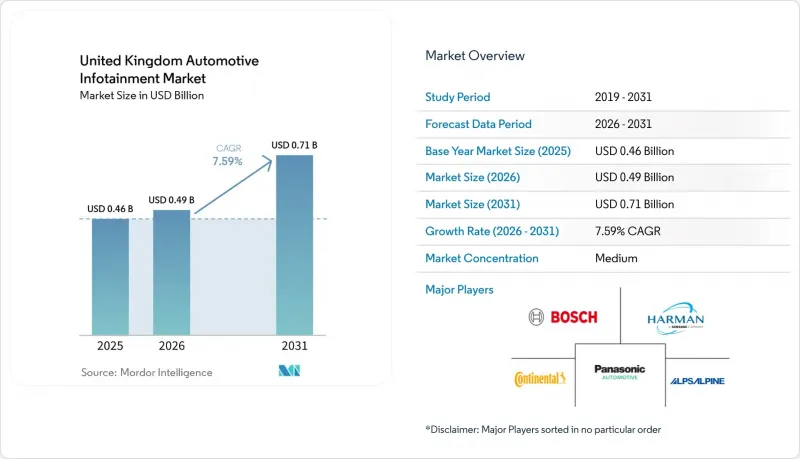
This report is Segmented by Installation Type (In-Dash Infotainment and Rear-Seat Infotainment), Vehicle Type (Passenger Cars, Light Commercial Vehicles, and More), Component (Display/Touch-screen Module, Head Unit/Domain Controller, and More), Propulsion Type, Connectivity Generation, Operating System, and Sales Channel. The Market Forecasts are Provided in Terms of Value (USD).
United Kingdom Automotive Infotainment Market Trends and Insights
Accelerated EV Adoption Requiring Richer HMI Experiences
BEV registrations reached 473,348 units in 2025, equal to 23.4% of new-car sales, and early-2026 figures show continued momentum despite tapering incentives. Buyers of emission-free models expect wider OLED panels, augmented-reality navigation, and voice assistants that schedule charging, so OEMs invest in display innovation and software ecosystems. Centralized electrical architectures free cabin space for pillar-to-pillar screens, while over-the-air updates create durable revenue streams. Government funding accelerates charging-network integration, giving suppliers a clear commercial path. The positive feedback loop between BEV uptake and cockpit content sustains double-digit growth for this sub-segment.
Rising Demand for Connected-Car and Smartphone-Integrated Features
Consumers want seamless handoffs between phones and dashboards, driving the adoption of automaker-curated app stores. Regulators, however, link screen interaction to distracted-driving incidents, so suppliers integrate driver-monitoring cameras that dim displays when attention strays. Balancing convenience and compliance shapes the user interface roadmap and keeps connected-service adoption on a steady climb.
High BOM Cost for Advanced Displays and Processors
Sharp increases in memory and OLED panel pricing squeeze supplier margins just when OEMs seek cost offsets for batteries. Larger incumbents mitigate pressure through vertical integration and long-term supply contracts, yet smaller tier-twos risk program delays. Price volatility may temper near-term display-area expansion, slightly dampening growth expectations.
Other drivers and restraints analyzed in the detailed report include:
- Nationwide 5G Roll-Out Enabling High-Bandwidth In-Car Services
- Centralized Domain Controllers in Software-Defined Vehicles
- Driver-Distraction Regulations Limiting Visual UX
For complete list of drivers and restraints, kindly check the Table Of Contents.
Segment Analysis
In-dash systems held 85.15% of the United Kingdom automotive infotainment market share in 2025. Their dominance stems from being the primary human-machine interface, combining navigation, media, and driver-assistance cues in a single focal point. Carmakers refine these front-row displays with richer graphics, adaptive widgets, and voice-first controls to satisfy safety regulators and tech-savvy drivers. Suppliers collaborate with chipmakers and UI studios to reduce latency and deliver context-aware content that shifts seamlessly between the cluster and the center screen. Continuous over-the-air updates keep the interface up to date without requiring hardware swaps.
Rear-seat systems are expanding at an 8.54% CAGR through 2031, the fastest rate within the installation segment. Luxury brands and ride-hailing fleets view individual passenger screens as a differentiator that justifies premium fares. Electric-vehicle floor layouts free space for larger seat-back panels, while 5G connectivity lets each rider stream personalized content without buffering. Integrators are adding wireless-casting, multi-zone audio, and parental-control modes to broaden appeal beyond executive shuttles. The result is a virtuous circle in which rising service revenues encourage still more cabin-entertainment innovation.
Passenger cars accounted for 67.13% of the United Kingdom automotive infotainment market share in 2025. Their large addressable base lets manufacturers amortize software-development costs across high volumes, encouraging feature-rich dashboards even in entry trims. Competitive pressure from new entrants pushes incumbents to shorten release cycles and integrate smartphone-style ecosystems. Consumers now expect intuitive voice assistants, seamless phone pairing, and cloud-synced preferences as standard equipment. These expectations elevate infotainment from a nice-to-have to a central purchase criterion.
The segment posts the fastest growth, advancing at a 10.47% CAGR through 2031. Silent powertrains spotlight cabin acoustics and screen clarity, so OEMs fit pillar-to-pillar OLED bars and augmented-reality navigation to heighten the sensory experience. Centralized electronic architectures simplify adding new apps that manage energy use or locate high-speed chargers. Regulators rewarding zero-emission fleets add momentum by aligning incentives with connected services rollouts. Together, these factors make BEV infotainment a bellwether for future design language.
Display modules accounted for 45.25% of the United Kingdom automotive infotainment market share in 2025, making them the largest single hardware component. Panel makers invest in thinner stacks and improved brightness to maintain leadership amid rising competition. Automotive stylists use these advances to create curved surfaces that blend clusters and center screens into unified glass cockpits. Adhesive and lamination suppliers, meanwhile, refine optical bonding techniques that reduce glare and enhance touch response. These collaborative gains reinforce the panel's position at the heart of cockpit value creation.
Operating-system software and apps are climbing at an 8.15% CAGR, the fastest within the component mix. As business models tilt toward recurring revenue, OTA-delivered features become more lucrative than hardware margins. Carmakers curate branded app stores, bundling navigation, streaming, and diagnostics under subscription umbrellas. Developers target these storefronts because the installed base ensures predictable monetization. This symbiosis between platform owners and content providers shifts bargaining power toward software firms that can keep vehicles fresh over time.
List of Companies Covered in this Report:
- Robert Bosch GmbH
- Harman International
- Continental AG
- Panasonic Automotive Systems Co., Ltd.
- Alps Alpine
- Pioneer Corporation
- DENSO Corporation
- Visteon Corporation
- Aptiv PLC
- Magna International
- Valeo SA
- Hyundai Mobis Co., Ltd.
- Forvia SE
- JVC Kenwood
- BlackBerry Limited (QNX)
- Google LLC
- Qualcomm Technologies, Inc.
- NXP Semiconductors N.V.
Additional Benefits:
- The market estimate (ME) sheet in Excel format
- 3 months of analyst support
TABLE OF CONTENTS
1 Introduction
- 1.1 Study Assumptions & Market Definition
- 1.2 Scope of the Study
2 Research Methodology
3 Executive Summary
4 Market Landscape
- 4.1 Market Overview
- 4.2 Market Drivers
- 4.2.1 Accelerated EV Adoption Requiring Richer HMI Experiences
- 4.2.2 Rising Demand for Connected-Car and Smartphone-Integrated Features
- 4.2.3 Nationwide 5G Roll-Out Enabling High-Bandwidth In-Car Services
- 4.2.4 Centralized Domain Controllers in Software-Defined Vehicles
- 4.2.5 Usage-Based-Insurance Data Monetization via Infotainment
- 4.2.6 Mobility-as-a-Service and Ride-Hailing Comfort Differentiation
- 4.3 Market Restraints
- 4.3.1 High BOM Cost for Advanced Displays and Processors
- 4.3.2 Driver-Distraction Regulations Limiting Visual UX
- 4.3.3 Legacy Fleet Retrofit Complexity and CAN-Bus Variance
- 4.3.4 Escalating Cyber-Insurance Premiums for Connected Vehicles
- 4.4 Value / Supply-Chain Analysis
- 4.5 Regulatory Landscape
- 4.6 Technological Outlook
- 4.7 Porter's Five Forces
- 4.7.1 Threat of New Entrants
- 4.7.2 Bargaining Power of Suppliers
- 4.7.3 Bargaining Power of Buyers
- 4.7.4 Threat of Substitutes
- 4.7.5 Competitive Rivalry
5 Market Size & Growth Forecasts (Value, USD)
- 5.1 By Installation Type
- 5.1.1 In-dash Infotainment
- 5.1.2 Rear-seat Infotainment
- 5.2 By Vehicle Type
- 5.2.1 Passenger Cars
- 5.2.2 Light Commercial Vehicles
- 5.2.3 Medium and Heavy Commercial Vehicles
- 5.3 By Component
- 5.3.1 Display / Touch-screen Module
- 5.3.2 Head Unit / Domain Controller
- 5.3.3 Operating-System Software and Apps
- 5.3.4 Connectivity ICs and Antenna Modules
- 5.4 By Propulsion Type
- 5.4.1 Internal-Combustion Engine Vehicles
- 5.4.2 Hybrid Electric Vehicles
- 5.4.3 Battery Electric Vehicles
- 5.5 By Connectivity Generation
- 5.5.1 4G LTE
- 5.5.2 5G
- 5.5.3 Legacy 2G/3G
- 5.6 By Operating System
- 5.6.1 Linux-Based (AAOS, AGL, etc.)
- 5.6.2 QNX
- 5.6.3 Android Automotive OS
- 5.6.4 Others (Proprietary, RTOS)
- 5.7 By Sales Channel
- 5.7.1 OEM-Installed
- 5.7.2 Aftermarket
6 Competitive Landscape
- 6.1 Market Concentration
- 6.2 Strategic Moves
- 6.3 Market Share Analysis
- 6.4 Company Profiles (Includes Global Level Overview, Market Level Overview, Core Segments, Financials as Available, Strategic Information, Market Rank/Share for Key Companies, Products and Services, SWOT Analysis, and Recent Developments)
- 6.4.1 Robert Bosch GmbH
- 6.4.2 Harman International
- 6.4.3 Continental AG
- 6.4.4 Panasonic Automotive Systems Co., Ltd.
- 6.4.5 Alps Alpine
- 6.4.6 Pioneer Corporation
- 6.4.7 DENSO Corporation
- 6.4.8 Visteon Corporation
- 6.4.9 Aptiv PLC
- 6.4.10 Magna International
- 6.4.11 Valeo SA
- 6.4.12 Hyundai Mobis Co., Ltd.
- 6.4.13 Forvia SE
- 6.4.14 JVC Kenwood
- 6.4.15 BlackBerry Limited (QNX)
- 6.4.16 Google LLC
- 6.4.17 Qualcomm Technologies, Inc.
- 6.4.18 NXP Semiconductors N.V.
7 Market Opportunities & Future Outlook
- 7.1 White-space & Unmet-Need Assessment

