PUBLISHER: Mordor Intelligence | PRODUCT CODE: 2063288

PUBLISHER: Mordor Intelligence | PRODUCT CODE: 2063288
Product Prototyping - Market Share Analysis, Industry Trends & Statistics, Growth Forecasts (2026 - 2031)
According to Mordor Intelligence, the product prototyping market size is projected to expand from USD 23.11 billion in 2025 and USD 25.75 billion in 2026 to USD 44.19 billion by 2031, registering a CAGR of 11.41% between 2026 to 2031.
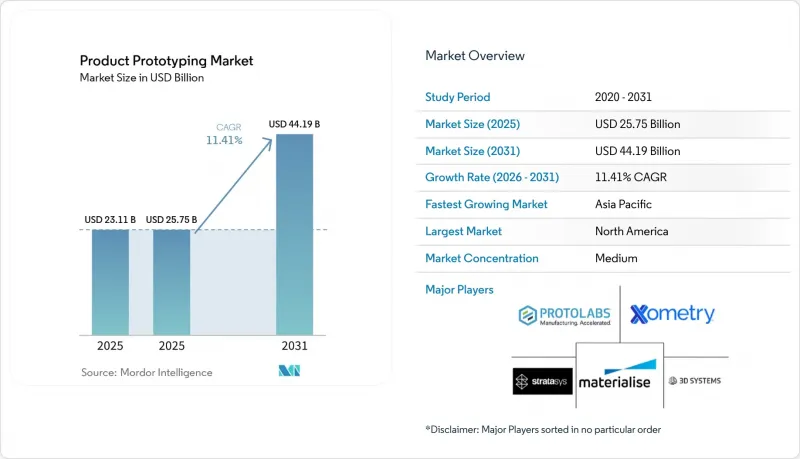
This report is Segmented by Product Type (3D Printing, CNC Machining, and More), Material Type (Plastics, Metals, Composites, and More), Service Type (Design and Engineering, Prototype Manufacturing, and More), End-Use Industry (Automotive, Aerospace and Defense, Consumer Electronics, Medical Devices, Industrial Machinery, and More), and Geography. The Market Forecasts are Provided in Terms of Value (USD).
Global Product Prototyping Market Trends and Insights
Rising Demand for On-Demand Manufacturing and Hyper-Personalized Products
Brands in electronics, medical devices, and automotive interiors increasingly rely on pull-based fabrication, ordering single pieces or micro-batches that arrive within days. Patient-specific orthopedic guides exemplify how geometry variability makes traditional tooling uneconomical. Footwear firms test lattice midsoles tuned to individual gait patterns, while eyewear designers iterate frames from facial scans. ISO 13485 and ISO 9001 frameworks ensure that distributed workflows meet production-grade traceability, easing adoption. As AI automates manufacturability checks, non-engineers gain entry, broadening the product prototyping market.
Accelerating Cost Decline per Part in Additive Manufacturing
Polymer and metal additive part costs have fallen 30-40% in five years as multi-laser systems lift throughput and powder-recovery loops curb waste. Binder-jetting platforms now re-use powder across cycles, further reducing unit economics. Aerospace programs prototype titanium parts earlier to validate designs before forging, leveraging these savings. Material vendors are pricing engineering polymers 20-30% below 2020 levels, stimulating broader uptake. Combined with advanced build-optimization software, these shifts pull the product prototyping market toward applications once reserved for CNC machining.
High Post-Processing and Finishing Costs for Functional Prototypes
Support removal, sand-blasting, and heat treatment can triple the base build cost of metal parts, eroding the business case for functional prototypes in cost-sensitive sectors. Although AM Flow and PostProcess Technologies offer automated finishing cells, entry tickets above USD 400,000 deter many shop floors. Labor-driven steps also introduce variability that undermines tight tolerance requirements in aerospace and orthopedic implants. Clients unwilling to absorb these expenses revert to traditional machining despite longer lead times, constraining revenue realization for the product prototyping market until automation spreads and capital costs decline.
Other drivers and restraints analyzed in the detailed report include:
- Automotive OEM Shift Toward Agile Hardware Sprints
- High Post-Processing and Finishing Costs for Functional Prototypes
- IP-Theft Concerns in Distributed Manufacturing Ecosystems
For complete list of drivers and restraints, kindly check the Table Of Contents.
Segment Analysis
3D printing generated 36.57% of 2025 revenue, securing the largest product prototyping market share, and is projected to expand at an 11.64% CAGR. Complex lattices and conformal cooling channels make additive manufacturing the default for aerospace brackets and medical implants. CNC machining keeps relevance where sub-10 micron tolerances and mirror finishes are mandatory, although longer setups limit its growth. Injection molding endures for production-intent validation when cosmetic surfaces and production plastics are essential, but up-front mold costs gatekeep low-volume programs.
Hybrid workflows integrate sheet-metal laser cutting and CNC bending for thin-wall enclosures with cycle times that rival additive for flat-pattern parts. Multi-material additive platforms that deposit rigid and elastomeric polymers in one build further erode the boundaries between methods, consolidating assemblies and shrinking lead times. As these technologies converge, the product prototyping market continues shifting toward flexible, digital-driven production engines.
Plastics provided 44.88% of revenues in 2025, underlining their cost and processing versatility. However, composites are expected to post an 11.67% CAGR through 2031, the fastest of any material segment. Continuous-fiber printing now validates load paths for automotive and aerospace structures before committing to autoclave tooling. Metals remain indispensable where heat dissipation or biocompatibility matter, with titanium and aluminum dominating additive builds for medical and aerospace prototypes.
Elastomeric prototypes support sealing and haptic feedback use cases, aided by photopolymers that replicate multiple shore hardness levels. Ceramic and bio-based polymer demand, while niche, grows on sustainability regulations in Europe. The narrowing gap between prototype and production materials reduces redesign cycles and pushes further growth in the product prototyping market.
Geography Analysis
North America controlled 30.18% of 2025 revenue, supported by clustered automotive and aerospace design centers and contract-manufacturing density. Government incentives for reshoring critical supply chains continue to reinforce local prototype demand. However, Asia-Pacific is projected to post a 12.11% CAGR as China recorded a 54% year-on-year jump in 3D-printing equipment output during Q1 2026. India's friendshoring initiatives further amplify regional capacity additions.
Europe's growth is built on Germany's automotive-tooling corridors and the United Kingdom's aerospace-certification expertise. GE Aerospace's EUR 110 million (USD 124 million) regional investment underscores lasting confidence. Middle East and Africa markets are emerging, exemplified by Saudi Arabia's USD 26 million tungsten-core framework that pairs local innovation with global OEM partnerships.
South America remains small but shows momentum as Brazilian firms trial rapid tooling and Argentine aerospace projects test metal additive for satellite parts. Across geographies, vendor selection now weighs cost and lead time against IP protection and certification infrastructure, a calculus that shapes flows in the product prototyping market.
- Proto Labs, Inc.
- Materialise NV
- 3D Systems Corporation
- Stratasys Ltd.
- Xometry, Inc.
- Fathom Digital Manufacturing Corporation
- Quickparts.com, Inc.
- Star Rapid Manufacturing Co., Ltd.
- Hubs B.V.
- GE Additive (General Electric Company)
- Renishaw plc
- Sculpteo S.A.
- Vaupell Holdings, Inc.
- HLH Prototypes Co., Ltd.
- Weerg S.r.l.
- Shapeways Holdings, Inc.
- RapidDirect (Hangzhou Bright Technology Co., Ltd.)
- ProtoCAM Additive Manufacturing, LLC
- Forecast 3D, Inc.
- Rapid Manufacturing Group Co., Ltd.
Additional Benefits:
- The market estimate (ME) sheet in Excel format
- 3 months of analyst support
TABLE OF CONTENTS
1 INTRODUCTION
- 1.1 Study Assumptions and Market Definition
- 1.2 Scope of the Study
2 RESEARCH METHODOLOGY
3 EXECUTIVE SUMMARY
4 MARKET LANDSCAPE
- 4.1 Market Overview
- 4.2 Market Drivers
- 4.2.1 Surge in on-demand manufacturing for hyper-personalized products
- 4.2.2 Rapid decline in additive-manufacturing cost per part
- 4.2.3 Shorter product life-cycles in consumer electronics
- 4.2.4 Automotive OEM pivot towards agile hardware sprints
- 4.2.5 Venture-capital inflows into cloud-connected prototyping platforms
- 4.2.6 Government R&D subsidies for localized manufacturing resilience
- 4.3 Market Restraints
- 4.3.1 High post-processing and finishing costs for functional prototypes
- 4.3.2 Persistent skills gap in hybrid (CNC + AM) workflow integration
- 4.3.3 Volatile raw-material (engineering-grade polymer) prices
- 4.3.4 IP-theft concerns in distributed manufacturing networks
- 4.4 Industry Value / Supply-Chain Analysis
- 4.5 Regulatory Landscape
- 4.6 Technological Outlook
- 4.7 Porter's Five Forces Analysis
- 4.7.1 Threat of New Entrants
- 4.7.2 Bargaining Power of Suppliers
- 4.7.3 Bargaining Power of Buyers
- 4.7.4 Threat of Substitutes
- 4.7.5 Competitive Rivalry
- 4.8 Pricing Analysis
5 MARKET SIZE AND GROWTH FORECASTS (VALUE)
- 5.1 By Product Type
- 5.1.1 3D Printing
- 5.1.2 CNC Machining
- 5.1.3 Injection Molding
- 5.1.4 Sheet-Metal Prototyping
- 5.1.5 Other Product Type
- 5.2 By Material Type
- 5.2.1 Plastics
- 5.2.2 Metals
- 5.2.3 Composites
- 5.2.4 Rubber
- 5.2.5 Other Material Type
- 5.3 By Service Type
- 5.3.1 Design and Engineering
- 5.3.2 Prototype Manufacturing
- 5.3.3 Functional Testing
- 5.3.4 3D Scanning and Reverse Engineering
- 5.3.5 Other Service Type
- 5.4 By End-Use Industry
- 5.4.1 Automotive
- 5.4.2 Aerospace and Defense
- 5.4.3 Consumer Electronics
- 5.4.4 Medical Devices
- 5.4.5 Industrial Machinery
- 5.4.6 Other End-Use Industry
- 5.5 By Geography
- 5.5.1 North America
- 5.5.1.1 United States
- 5.5.1.2 Canada
- 5.5.1.3 Mexico
- 5.5.2 Europe
- 5.5.2.1 Germany
- 5.5.2.2 United Kingdom
- 5.5.2.3 France
- 5.5.2.4 Russia
- 5.5.2.5 Rest of Europe
- 5.5.3 Asia-Pacific
- 5.5.3.1 China
- 5.5.3.2 Japan
- 5.5.3.3 India
- 5.5.3.4 South Korea
- 5.5.3.5 Australia
- 5.5.3.6 Rest of Asia-Pacific
- 5.5.4 Middle East and Africa
- 5.5.4.1 Middle East
- 5.5.4.1.1 Saudi Arabia
- 5.5.4.1.2 United Arab Emirates
- 5.5.4.1.3 Rest of Middle East
- 5.5.4.2 Africa
- 5.5.4.2.1 South Africa
- 5.5.4.2.2 Egypt
- 5.5.4.2.3 Rest of Africa
- 5.5.4.1 Middle East
- 5.5.5 South America
- 5.5.5.1 Brazil
- 5.5.5.2 Argentina
- 5.5.5.3 Rest of South America
- 5.5.1 North America
6 COMPETITIVE LANDSCAPE
- 6.1 Market Concentration
- 6.2 Strategic Moves
- 6.3 Market Share Analysis
- 6.4 Company Profiles (includes Global level Overview, Market level overview, Core Segments, Financials as available, Strategic Information, Market Rank/Share for key companies, Products and Services, and Recent Developments)
- 6.4.1 Proto Labs, Inc.
- 6.4.2 Materialise NV
- 6.4.3 3D Systems Corporation
- 6.4.4 Stratasys Ltd.
- 6.4.5 Xometry, Inc.
- 6.4.6 Fathom Digital Manufacturing Corporation
- 6.4.7 Quickparts.com, Inc.
- 6.4.8 Star Rapid Manufacturing Co., Ltd.
- 6.4.9 Hubs B.V.
- 6.4.10 GE Additive (General Electric Company)
- 6.4.11 Renishaw plc
- 6.4.12 Sculpteo S.A.
- 6.4.13 Vaupell Holdings, Inc.
- 6.4.14 HLH Prototypes Co., Ltd.
- 6.4.15 Weerg S.r.l.
- 6.4.16 Shapeways Holdings, Inc.
- 6.4.17 RapidDirect (Hangzhou Bright Technology Co., Ltd.)
- 6.4.18 ProtoCAM Additive Manufacturing, LLC
- 6.4.19 Forecast 3D, Inc.
- 6.4.20 Rapid Manufacturing Group Co., Ltd.
7 MARKET OPPORTUNITIES AND FUTURE OUTLOOK
- 7.1 White-space and unmet-need assessment

