PUBLISHER: Mordor Intelligence | PRODUCT CODE: 2063290

PUBLISHER: Mordor Intelligence | PRODUCT CODE: 2063290
India Testing, Inspection, And Certification (TIC) - Market Share Analysis, Industry Trends & Statistics, Growth Forecasts (2026 - 2031)
According to Mordor Intelligence, the india testing, inspection, and certification (TIC) market size is expected to increase from USD 12.8 billion in 2025 to USD 13.63 billion in 2026 and reach USD 18.68 billion by 2031, growing at a CAGR of 6.51% over 2026-2031.
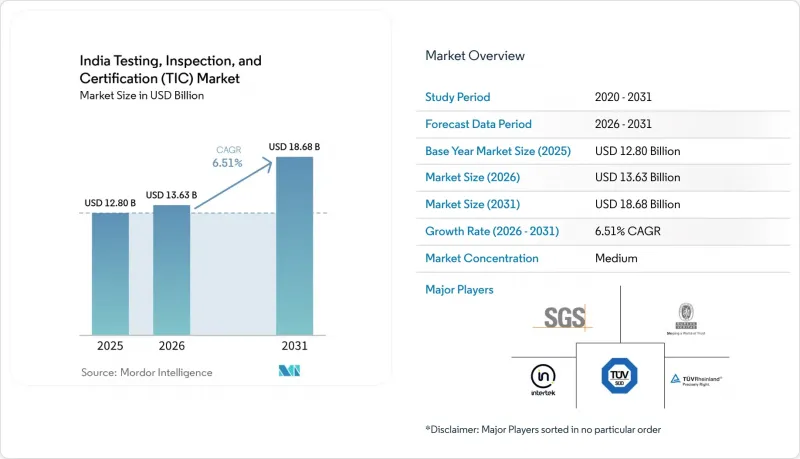
This report is Segmented by Service Type (Testing, Inspection, Certification), Sourcing Type (In-House, Outsourced), Industry Vertical (Consumer Goods and Retail, ICT and Telecom, Automotive and Transportation, and More), and Mode of Service Delivery (On-Site, Off-Site Laboratory, Remote Digital). The Market Forecasts are Provided in Terms of Value (USD).
India Testing, Inspection, And Certification (TIC) Market Trends and Insights
Increasing Regulatory Enforcement Across Indian Industries
BIS inspections uncovered 142 non-compliant items on major e-commerce sites, putting platforms on notice and widening demand for third-party verification. The March 2025 Quality Control Orders added 769 products to mandatory certification, instantly pulling manufacturers of hand tools, aluminum goods, and household appliances into the compliance net. Revised 2025 solar-module guidelines toughened performance tests just as domestic capacity scaled, requiring fresh rounds of conformity assessments before modules could ship. Parallel scrutiny from export markets forces firms to layer foreign standards atop domestic ones, multiplying the volume of test reports they must secure. This synchronized enforcement at home and abroad ensures a durable pipeline for accredited laboratories able to cover BIS, IEC, and destination-market norms.
Growing Outsourcing of TIC by Exporters and OEMs
Government reimbursement of certification fees turns outsourced assurance into a subsidized service, making it financially irrational for most MSMEs to maintain internal labs. Automotive OEMs exemplify the shift, funneling battery-safety and homologation work to ARAI, which logged a 19% revenue jump as a result. Global TIC majors keep pace: a EUR 15 million (USD 16 million) Bengaluru complex by TUV SUD centralizes EMC and medical-device testing, while Intertek's purchase of a solar PV lab in Ahmedabad offers one-stop BIS and IECEE approvals. Manufacturers increasingly view external labs as an elastic cost that flexes with output, grants faster time-to-market, and instantly opens access to coveted international accreditations.
Shortage of Qualified Inspectors and Lab Analysts
Revised accreditation rules heightened the skill bar just as demand spiked, leaving the country short by around 10,000 qualified professionals. Large expansions, such as TUV SUD's 70,000-square-foot site, required nine-month hiring cycles to fill specialized EMC roles. New regional labs like CPRI Nashik had to borrow engineers from other sites, illustrating internal cannibalization. Scarcity is acute in non-destructive testing, where Level III technicians cluster in metros and command premium wages, swelling certification queues during seasonal peaks. The mismatch between talent supply and industry need stretches turnaround times and occasionally forces clients toward unaccredited alternatives despite the risks.
Other drivers and restraints analyzed in the detailed report include:
- Rapid Growth of Life Sciences and Healthcare Sector
- Expansion of Consumer Goods and Retail Requiring Compliance
- Fragmented Lab Infrastructure and Inconsistent Quality
For complete list of drivers and restraints, kindly check the Table Of Contents.
Segment Analysis
Certification captured growing relevance as export markets insisted on third-party attestations tied to ESG and product-safety norms. While testing still represented 57.31% of the India TIC market in 2025, certification revenue is rising faster because surveillance audits and management-system renewals generate steady annuities. Subsidies under the TRACE scheme reposition certification from discretionary spend to strategic advantage, especially for MSMEs chasing European and North American orders. Inspection remains critical in construction, energy, and machinery, yet rising drone and AI use trims labor hours and lifts margins.
Certification momentum draws strength from lender-mandated ESG audits and programs such as GRIHA's Decarbonizing Habitat tiers. Intertek's CarbonClear and CarbonZero offerings cater to exporters needing verified low-carbon labels to pass buyer scorecards. Testing keeps its primacy through ever-widening QCO coverage that mandates laboratory analysis before goods hit shelves, but certification now delivers the sharper growth slope, anchoring long-term order books for providers with deep multi-standard portfolios.
Outsourced contracts owned 65.21% share in 2025 and are forecast to rise at 7.11% CAGR, underscoring how firms favor variable costs and instant access to accreditations. Automotive, renewable energy, and consumer-goods exporters outsource whole compliance cycles to avoid multimillion-dollar outlays on EMC chambers, vibration rigs, or bioanalytical suites. The India TIC market size attached to outsourced work keeps expanding as policies like the TRACE subsidy tilt the economics decisively away from in-house builds.
Large manufacturers still keep pilot-phase labs for R&D, yet final conformity is usually entrusted to external bodies whose certificates regulators and overseas buyers recognize. Network effects accrue to global majors running 25-plus sites nationwide, enabling one-stop assurance and uniform quality. Revised NABL rules further hobble smaller corporate labs, steering even conservative firms toward accredited outsourcers that can clear products for multiple jurisdictions in a single engagement.
List of Companies Covered in this Report:
- SGS India Pvt. Ltd.
- Bureau Veritas (India) Pvt. Ltd.
- Intertek India Pvt. Ltd.
- TUV SUD South Asia Pvt. Ltd.
- TUV Rheinland India Pvt. Ltd.
- UL India Pvt. Ltd.
- DNV Business Assurance India Pvt. Ltd.
- DEKRA Certification India Pvt. Ltd.
- Lloyd's Register Quality Assurance India Pvt. Ltd.
- IRClass Systems and Solutions Pvt. Ltd.
- Applus+ India Inspection Services Pvt. Ltd.
- Eurofins Analytical Services India Pvt. Ltd.
- ALS Testing Services India Pvt. Ltd.
- Mistras Group (India) Pvt. Ltd.
- Element Materials Technology India Pvt. Ltd.
- Kiwa Certification India Pvt. Ltd.
- QIMA Technical Services India Pvt. Ltd.
- TCR Engineering Services Pvt. Ltd.
- RINA India Pvt. Ltd.
- PONY Testing International Group India Pvt. Ltd.
- Velosi Certification Services India Pvt. Ltd.
- Vexil BPS Pvt. Ltd.
- ITS Testing Services (India) Pvt. Ltd.
Additional Benefits:
- The market estimate (ME) sheet in Excel format
- 3 months of analyst support
TABLE OF CONTENTS
1 INTRODUCTION
- 1.1 Study Assumptions and Market Definition
- 1.2 Scope of the Study
2 RESEARCH METHODOLOGY
3 EXECUTIVE SUMMARY
4 MARKET LANDSCAPE
- 4.1 Market Overview
- 4.2 Market Drivers
- 4.2.1 Increasing Regulatory Enforcement Across Indian Industries
- 4.2.2 Growing Outsourcing of TIC by Exporters and OEMs
- 4.2.3 Expansion of Consumer Goods and Retail Requiring Compliance
- 4.2.4 Rapid Growth of Life Sciences and Healthcare Sector
- 4.2.5 Digital Bharat Push Enabling Remote/AI-Driven Inspections
- 4.2.6 Surge in ESG-Linked Audits from Lenders and PE Investors
- 4.3 Market Restraints
- 4.3.1 Fragmented Lab Infrastructure and Inconsistent Quality
- 4.3.2 Shortage of Qualified Inspectors and Lab Analysts
- 4.3.3 Slow NABL/BIS Accreditation Turnaround Times
- 4.3.4 Price-Cutting by Unaccredited Local Labs Eroding Margins
- 4.4 Industry Value Chain Analysis
- 4.5 Regulatory Landscape
- 4.6 Technological Outlook
- 4.7 Porter's Five Forces Analysis
- 4.7.1 Bargaining Power of Suppliers
- 4.7.2 Bargaining Power of Buyers
- 4.7.3 Threat of New Entrants
- 4.7.4 Threat of Substitutes
- 4.7.5 Intensity of Competitive Rivalry
- 4.8 Assessment of Macroeconomic Trends on the Market
5 MARKET SIZE AND GROWTH FORECASTS (VALUE)
- 5.1 By Service Type
- 5.1.1 Testing
- 5.1.2 Inspection
- 5.1.3 Certification
- 5.2 By Sourcing Type
- 5.2.1 In-house
- 5.2.2 Outsourced
- 5.3 By Industry Vertical
- 5.3.1 Consumer Goods and Retail
- 5.3.2 ICT and Telecom
- 5.3.3 Automotive and Transportation
- 5.3.4 Aerospace and Defense
- 5.3.5 Oil, Gas and Petrochemicals
- 5.3.6 Energy and Utilities
- 5.3.7 Industrial Manufacturing and Machinery
- 5.3.8 Chemicals and Materials
- 5.3.9 Construction and Infrastructure
- 5.3.10 Life Sciences and Healthcare
- 5.3.11 Food, Agriculture and Beverage
- 5.3.12 Others Industry Verticals
- 5.4 By Mode of Service Delivery
- 5.4.1 On-site
- 5.4.2 Off-site / Laboratory
- 5.4.3 Remote / Digital
6 COMPETITIVE LANDSCAPE
- 6.1 Market Concentration
- 6.2 Strategic Moves
- 6.3 Market Share Analysis
- 6.4 Company Profiles (includes Global level Overview, Market level overview, Core Segments, Financials as available, Strategic Information, Market Rank/Share for key companies, Products and Services, and Recent Developments)
- 6.4.1 SGS India Pvt. Ltd.
- 6.4.2 Bureau Veritas (India) Pvt. Ltd.
- 6.4.3 Intertek India Pvt. Ltd.
- 6.4.4 TUV SUD South Asia Pvt. Ltd.
- 6.4.5 TUV Rheinland India Pvt. Ltd.
- 6.4.6 UL India Pvt. Ltd.
- 6.4.7 DNV Business Assurance India Pvt. Ltd.
- 6.4.8 DEKRA Certification India Pvt. Ltd.
- 6.4.9 Lloyd's Register Quality Assurance India Pvt. Ltd.
- 6.4.10 IRClass Systems and Solutions Pvt. Ltd.
- 6.4.11 Applus+ India Inspection Services Pvt. Ltd.
- 6.4.12 Eurofins Analytical Services India Pvt. Ltd.
- 6.4.13 ALS Testing Services India Pvt. Ltd.
- 6.4.14 Mistras Group (India) Pvt. Ltd.
- 6.4.15 Element Materials Technology India Pvt. Ltd.
- 6.4.16 Kiwa Certification India Pvt. Ltd.
- 6.4.17 QIMA Technical Services India Pvt. Ltd.
- 6.4.18 TCR Engineering Services Pvt. Ltd.
- 6.4.19 RINA India Pvt. Ltd.
- 6.4.20 PONY Testing International Group India Pvt. Ltd.
- 6.4.21 Velosi Certification Services India Pvt. Ltd.
- 6.4.22 Vexil BPS Pvt. Ltd.
- 6.4.23 ITS Testing Services (India) Pvt. Ltd.
7 MARKET OPPORTUNITIES AND FUTURE OUTLOOK
- 7.1 White-space and Unmet-Need Assessment

