PUBLISHER: Mordor Intelligence | PRODUCT CODE: 2097244

PUBLISHER: Mordor Intelligence | PRODUCT CODE: 2097244
Testing, Inspection, and Certification for the Natural Resources Industry - Market Share Analysis, Industry Trends & Statistics, Growth Forecasts (2026 - 2031)
According to Mordor Intelligence, the testing, inspection, and certification market size for the natural resources industry is expected to grow from USD 1.37 billion in 2025 to USD 1.41 billion in 2026 and is forecast to reach USD 1.63 billion by 2031 at 2.94% CAGR over 2026-2031.
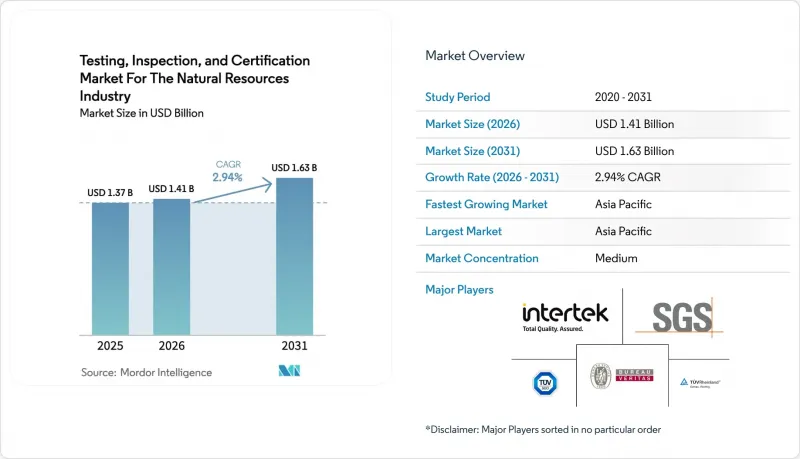
This report is Segmented by Service Type (Testing Services, Inspection Services, and Certification Services), Sourcing Type (In-House and Outsourced), and Geography (North America, South America, Europe, Asia-Pacific, and the Middle East and Africa). The Market Forecasts are Provided in Terms of Value (USD).
Global Testing, Inspection, and Certification for the Natural Resources Industry Trends and Insights
Stringent Environmental Regulations Mandating Third-Party Compliance Testing
Global oversight is pivoting from operator self-reporting to mandatory independent verification that covers emissions, groundwater quality, waste management, and soil impacts. The U.S. Environmental Protection Agency's 2024 PFAS National Primary Drinking Water Regulation added extensive sampling obligations near oil and gas wells, creating new revenue streams for accredited laboratories. Parallel changes to the European Union Industrial Emissions Directive require continuous emissions monitoring calibrated by third parties. U.S. states such as California and Texas demand quarterly methane-leak inspections using optical gas imaging, while nations adopting carbon-pricing regimes stipulate verified greenhouse-gas measurement. The Testing, Inspection, and Certification for the Natural Resources Industry, therefore, benefits from large volumes of laboratory work and on-site audits as regulatory fragmentation generates localized niches that favor seasoned providers.
Rising Global Demand for Energy and Minerals Driving Exploration Activities
A sustained annual 4% growth in energy consumption across Asia-Pacific is spurring fresh LNG, pipeline, and mining projects, each requiring exhaustive geological, environmental, and asset-integrity examinations. Renewable-energy installations themselves depend on lithium, cobalt, and nickel extraction, intensifying demand for environmental impact assessments and specialized assay testing. China's Belt and Road financing funnels capital into Central Asian oil and mining ventures that must demonstrate compliance with multilateral lending standards, thereby importing international verification requirements. Emerging hydrogen economies in Japan, Australia, and India introduce brand-new certification needs for electrolyzers, storage tanks, and transport pipelines. As exploration budgets climb, the Testing, Inspection, and Certification for the Natural Resources Industry expands through the provision of sophisticated laboratory analytics, structural inspections, and certification audits tailored to ever more complex project-design specifications.
Commodity-Price Volatility Causing Cyclical TIC Budget Cuts
Swings in crude oil and base-metal benchmarks lead operators to slash non-core expenditures when cash flows tighten, putting discretionary verification programs in the firing line. World Bank data show post-2020 price variance up 40%, mirrored by average 15-25% spending cuts during downturns. Federal Reserve studies note TIC costs are often treated as overhead, letting them fall disproportionately when budgets shrink. Service providers consequently endure revenue lulls of up to 40%, hindering long-term investment in new laboratories and inspector training. The Testing, Inspection, and Certification for the Natural Resources Industry must therefore diversify across commodities and geographies to smooth revenue cycles, yet smaller regional firms may lack the capital resilience to ride out sharp contractions.
Other drivers and restraints analyzed in the detailed report include:
- Increasing Complexity of Commodity Supply Chains Necessitating Traceability Audits
- Growing Adoption of Digital Oilfields and Smart Mining Requiring Real-Time Inspection Services
- Shortage of Certified Inspectors for Remote Resource Sites
For complete list of drivers and restraints, kindly check the Table Of Contents.
Segment Analysis
Testing services generated 53.25% of revenue in 2025, reflecting indispensable laboratory analysis of hydrocarbon streams, critical mineral ores, and emerging contaminants. That dominance persists because environmental regulators enforce quantitative verification, a task that only accredited laboratories can execute with traceable standards and documented uncertainty. Evolving protocols for PFAS, microplastics, and trace metals are widening the analytical menu and sustaining double-digit sub-segment growth inside the broader Testing, Inspection, and Certification for the Natural Resources Industry.
Certification services, though smaller, register the fastest 3.55% CAGR as institutional investors and lenders demand third-party attestation of ESG metrics. New ISO 14064 standards for greenhouse-gas inventory and carbon-credit quantification are elevating demand for independent certificates, while battery-material supply chains require continuous chain-of-custody validation. Inspection services remain the stalwart for structural integrity checks on pipelines, storage tanks, and heavy equipment, yet their growth lags as more visual routines migrate to drone and sensor platforms. Even so, inspection retains a critical role when catastrophic failure risks preclude relying solely on digital surrogates, ensuring stable demand within the Testing, Inspection, and Certification for the Natural Resources Industry.
Complete Report Scope:
- By Service Type
- Testing Services
- Inspection Services
- Certification Services
- By Sourcing Type
- In-house
- Outsourced
- By Geography
- North America
- United States
- Canada
- Mexico
- South America
- Brazil
- Argentina
- Rest of South America
- Europe
- Germany
- United Kingdom
- France
- Italy
- Spain
- Russia
- Rest of Europe
- Asia-Pacific
- China
- Japan
- India
- South Korea
- South-East Asia
- Rest of Asia-Pacific
- Middle East and Africa
- Middle East
- Saudi Arabia
- United Arab Emirates
- Turkey
- Rest of Middle East
- Africa
- South Africa
- Nigeria
- Rest of Africa
- Middle East
- North America
Geography Analysis
Asia-Pacific's 38.55% share underscores vast energy and infrastructure spending, from LNG import terminals in China to nickel mines in Indonesia. The region's 3.78% CAGR is powered by renewable-energy build-outs that increase demand for materials testing and by tightening local environmental laws that prescribe third-party audits. China's roadmap to 70% renewable electricity by 2050 alone spawns thousands of verification projects annually. Australia, the Philippines, and Vietnam add further momentum with copper, lithium, and rare-earth developments that must prove sustainable sourcing to global buyers. Japan and South Korea's hydrogen-economy ambitions drive certification requests for new electrolyzer and storage technologies, expanding the Testing, Inspection, and Certification for the Natural Resources Industry footprint into emerging clean-energy hubs.
North America contributes substantial volume through mature shale plays that require hydraulic-fracturing-fluid analysis, produced-water treatment validation, and methane-emissions monitoring under Environmental Protection Agency rules. Domestic-content requirements in the Inflation Reduction Act accelerate mining projects for battery metals, translating into assay testing and ESG audits. Canada's oil-sands and Arctic offshore prospects demand cold-weather materials testing and remote inspection, while Mexico's upstream liberalization opens offshore safety-verification opportunities aligned with American Petroleum Institute standards. Although commodity price volatility periodically dents exploration budgets, the region's robust regulatory oversight maintains a baseline need for third-party services, securing stable revenue for the Testing, Inspection, and Certification for the Natural Resources Industry.
Europe's stringent sustainability framework shapes a distinctive service mix centered on renewable-energy-component testing, carbon-capture project validation, and recycling-process certification. The Corporate Sustainability Reporting Directive compels granular third-party data assurance for thousands of companies, expanding certification revenue pools. Norway's offshore wind fields and CO2 storage sites foster demand for marine geotechnical testing and subsea pipeline inspection. Germany's industrial decarbonization funds catalyze hydrogen infrastructure build-outs that require verifying electrolyzer efficiency, storage integrity, and pipeline material compatibility. Meanwhile, Eastern European states adopt EU-aligned regulations, boosting demand for accredited TIC laboratories to support cross-border energy and mineral flows. Collectively, these dynamics anchor Europe as a high-value but technically demanding arena within the Testing, Inspection, and Certification for the Natural Resources Industry.
- SGS SA
- Bureau Veritas SA
- Intertek Group plc
- ALS Limited
- TUV SUD AG
- TUV Rheinland Group
- DEKRA SE
- Applus Services SA
- DNV AS
- Eurofins Scientific SE
- Element Materials Technology Group
- RINA SpA
- Kiwa NV
- UL Solutions Inc.
- Core Laboratories NV
- Petrofac Limited (TIC division)
- Fugro NV
- SGE Lab Asia Pte Ltd
- Inspectorate International Ltd
- Moody International Ltd
- Petrolab Engineering Ltd
- CCIC (China Certification and Inspection Group)
- SGEPL India Private Ltd
- Geosyntec Consultants Inc.
- Control Union Certifications BV
Additional Benefits:
- The market estimate (ME) sheet in Excel format
- 3 months of analyst support
TABLE OF CONTENTS
1 INTRODUCTION
- 1.1 Study Assumptions and Market Definition
- 1.2 Scope of the Study
2 RESEARCH METHODOLOGY
3 EXECUTIVE SUMMARY
4 MARKET LANDSCAPE
- 4.1 Market Overview
- 4.2 Market Drivers
- 4.2.1 Stringent environmental regulations mandating third-party compliance testing
- 4.2.2 Rising global demand for energy and minerals driving exploration activities
- 4.2.3 Increasing complexity of commodity supply chains necessitating traceability audits
- 4.2.4 Growing adoption of digital oilfields and smart mining requiring real-time inspection services
- 4.2.5 Rapid expansion of critical minerals value chain (lithium, nickel, cobalt) spurring specialized assay testing
- 4.2.6 ESG-driven investment pressure for independent sustainability certification
- 4.3 Market Restraints
- 4.3.1 Commodity-price volatility causing cyclical TIC budget cuts
- 4.3.2 Shortage of certified inspectors for remote resource sites
- 4.3.3 In-house sensor and analytics adoption reducing external testing demand
- 4.3.4 Geopolitical sanctions restricting TIC access in resource-rich regions
- 4.4 Industry Value Chain Analysis
- 4.5 Impact of Macroeconomic Factors
- 4.6 Regulatory Landscape
- 4.7 Technological Outlook
- 4.8 Porter's Five Forces Analysis Analysis
- 4.8.1 Threat of New Entrants
- 4.8.2 Bargaining Power of Suppliers
- 4.8.3 Bargaining Power of Buyers
- 4.8.4 Threat of Substitutes
- 4.8.5 Industry Rivalry
5 MARKET SIZE AND GROWTH FORECASTS (VALUE)
- 5.1 By Service Type
- 5.1.1 Testing Services
- 5.1.2 Inspection Services
- 5.1.3 Certification Services
- 5.2 By Sourcing Type
- 5.2.1 In-house
- 5.2.2 Outsourced
- 5.3 By Geography
- 5.3.1 North America
- 5.3.1.1 United States
- 5.3.1.2 Canada
- 5.3.1.3 Mexico
- 5.3.2 South America
- 5.3.2.1 Brazil
- 5.3.2.2 Argentina
- 5.3.2.3 Rest of South America
- 5.3.3 Europe
- 5.3.3.1 Germany
- 5.3.3.2 United Kingdom
- 5.3.3.3 France
- 5.3.3.4 Italy
- 5.3.3.5 Spain
- 5.3.3.6 Russia
- 5.3.3.7 Rest of Europe
- 5.3.4 Asia-Pacific
- 5.3.4.1 China
- 5.3.4.2 Japan
- 5.3.4.3 India
- 5.3.4.4 South Korea
- 5.3.4.5 South-East Asia
- 5.3.4.6 Rest of Asia-Pacific
- 5.3.5 Middle East and Africa
- 5.3.5.1 Middle East
- 5.3.5.1.1 Saudi Arabia
- 5.3.5.1.2 United Arab Emirates
- 5.3.5.1.3 Turkey
- 5.3.5.1.4 Rest of Middle East
- 5.3.5.2 Africa
- 5.3.5.2.1 South Africa
- 5.3.5.2.2 Nigeria
- 5.3.5.2.3 Rest of Africa
- 5.3.5.1 Middle East
- 5.3.1 North America
6 COMPETITIVE LANDSCAPE
- 6.1 Market Concentration
- 6.2 Strategic Moves
- 6.3 Market Share Analysis
- 6.4 Company Profiles {(includes Global level Overview, Market level overview, Core Segments, Financials as available, Strategic Information, Market Rank/Share for key companies, Products and Services, and Recent Developments)}
- 6.4.1 SGS SA
- 6.4.2 Bureau Veritas SA
- 6.4.3 Intertek Group plc
- 6.4.4 ALS Limited
- 6.4.5 TUV SUD AG
- 6.4.6 TUV Rheinland Group
- 6.4.7 DEKRA SE
- 6.4.8 Applus Services SA
- 6.4.9 DNV AS
- 6.4.10 Eurofins Scientific SE
- 6.4.11 Element Materials Technology Group
- 6.4.12 RINA SpA
- 6.4.13 Kiwa NV
- 6.4.14 UL Solutions Inc.
- 6.4.15 Core Laboratories NV
- 6.4.16 Petrofac Limited (TIC division)
- 6.4.17 Fugro NV
- 6.4.18 SGE Lab Asia Pte Ltd
- 6.4.19 Inspectorate International Ltd
- 6.4.20 Moody International Ltd
- 6.4.21 Petrolab Engineering Ltd
- 6.4.22 CCIC (China Certification and Inspection Group)
- 6.4.23 SGEPL India Private Ltd
- 6.4.24 Geosyntec Consultants Inc.
- 6.4.25 Control Union Certifications BV
7 MARKET OPPORTUNITIES AND FUTURE OUTLOOK
- 7.1 White-space and Unmet-need Assessment

