PUBLISHER: Mordor Intelligence | PRODUCT CODE: 2063352

PUBLISHER: Mordor Intelligence | PRODUCT CODE: 2063352
Drippers - Market Share Analysis, Industry Trends & Statistics, Growth Forecasts (2026 - 2031)
According to Mordor Intelligence, the drippers market was valued at USD 3.11 billion in 2025 and is projected to grow from USD 3.35 billion in 2026 to USD 5.54 billion by 2031, growing at a CAGR of 10.7% from 2026 to 2031.
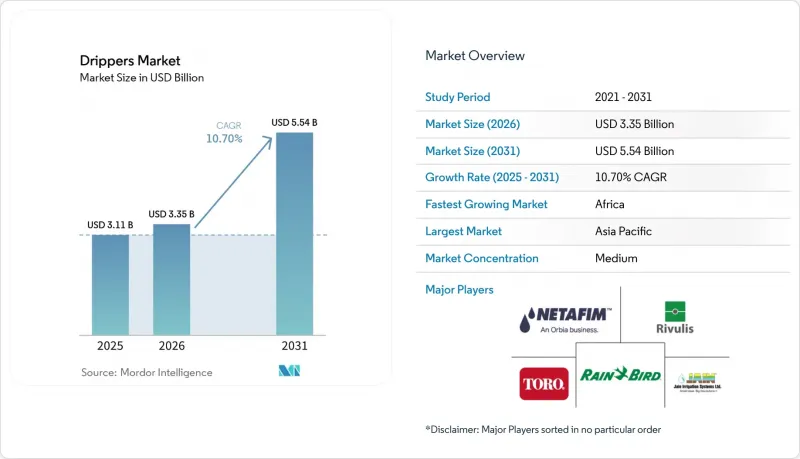
This report is Segmented by Product Type (Inline Drippers and Online Drippers), Flow Rate (Up To 2 L H, 2. 1-4 L H, and More), Crop Type (Field Crops, Fruits and Vegetables, and More), End User (Large Corporate Farms, and More), Distribution Channel (Direct OEM Sales, and More), and Geography (North America, South America, Asia-Pacific, and More). The Market Forecasts are Provided in Terms of Value (USD).
Global Drippers Market Trends and Insights
Drought-Induced Irrigation Mandates
Water scarcity regulations are shifting irrigation from an optional upgrade to a compliance-driven requirement, driving the adoption of drippers in water-stressed regions. Governments are implementing groundwater extraction limits and irrigation efficiency standards to safeguard agricultural productivity and maintain land value. Micro irrigation facilities reduce dependence on rainfall variability and encourage the use of precision irrigation. As compliance becomes mandatory, farmers are increasingly adopting drippers to meet regulatory requirements, ensuring consistent demand irrespective of fluctuations in commodity prices.
Government Micro-Irrigation Subsidies
Public funding programs are playing a crucial role in reducing financial barriers to adopting dripper systems, especially for small and marginal farmers. Subsidy-driven models lower initial capital costs and enhance return on investment, thereby increasing the accessibility of micro-irrigation in developing agricultural economies. For instance, India's Pradhan Mantri Krishi Sinchayee Yojana has facilitated micro-irrigation coverage around 8.3 million hectares through 2024 . These initiatives drive demand for drippers by aligning financial incentives with water conservation objectives. When subsidy frameworks are effectively integrated with local financing mechanisms, they boost installation rates and support stable, policy-driven market growth.
High Up-Front System Cost for Smallholders
The high initial investment required for drip irrigation systems limits adoption among smallholder farmers. This challenge is particularly evident in developing agricultural economies, where farm incomes remain volatile and unpredictable. Despite the proven long-term efficiency benefits, the upfront capital requirements hinder purchasing decisions due to limited access to affordable credit, fragmented landholdings, and the lack of financial incentives or subsidies. This cost barrier continues to slow the adoption of drip irrigation systems in price-sensitive regions, even with policy support in place, as many farmers prioritize immediate cost savings over long-term gains.
Other drivers and restraints analyzed in the detailed report include:
- Commercial Greenhouse Boom in Asia-Pacific
- Smart Fertigation Bundling with IoT Drippers
- Bio-Film and Mineral Clogging Risks
For complete list of drivers and restraints, kindly check the Table Of Contents.
Segment Analysis
Inline drippers led with the largest 48% of the drippers market share in 2025, reflecting strong adoption in plantations with fixed crop layouts and long-term irrigation strategies. Their integrated design reduces leakage points and simplifies installation, enhancing operational efficiency during peak agricultural periods. Inline systems are particularly favored in scenarios where uniform spacing and durability are essential, such as in perennial crops. The market for inline drippers remains stable, as large-scale farms prioritize reliability and low maintenance over flexibility, thereby ensuring consistent demand in structured irrigation setups.
The online drippers market is projected to grow at the fastest CAGR of 10.6% from 2026 to 2031, driven by rising demand for flexible irrigation systems. These emitters enable farmers to adjust outlet positions based on crop spacing and rotation patterns, making them suitable for diversified farming practices. As cropping intensity increases and farm operations become more dynamic, growers are opting for adaptable irrigation solutions. Manufacturers are improving product features, including pressure compensation and anti-siphon mechanisms, enhancing performance comparability with inline systems and driving adoption across varied terrains and mixed cropping systems.
The 2.1 to 4 liters per hour segment held the largest 36% of the drippers market share in 2025, attributed to its adaptability across various soil types and crops. This flow range ensures balanced water distribution, minimizing runoff while achieving effective root-zone penetration. It is commonly utilized in row crops and moderately permeable soils, making it a preferred option for many farmers. The market size for this segment remains robust as growers focus on efficiency and consistency in water application amidst increasing resource limitations.
Flow rates above 8 liters per hour are anticipated to grow at the fastest 9.6% CAGR from 2026 to 2031, driven by their suitability for sandy and arid regions that require deeper water infiltration. These high-flow systems serve crops that require rapid moisture delivery and are increasingly used in large-scale irrigation projects. Investments in infrastructure, including pumps and monitoring systems, further support this segment's growth. As water management becomes more data-driven, growers are increasingly selecting flow rates based on soil properties and evapotranspiration models, driving the adoption of high-flow emitters in specialized agricultural areas.
Geography Analysis
Asia-Pacific is projected to dominate the drippers market with the largest 34% market share in 2025, driven by government-supported micro-irrigation programs and the rapid expansion of greenhouses in major agricultural economies. India remains a key contributor to regional demand, supported by subsidy-driven adoption under irrigation schemes. Meanwhile, China is making significant investments in controlled-environment agriculture to enhance food security. In 2024, India allocated INR 1,600 crore (USD 192 million) to expand micro-irrigation, emphasizing long-term infrastructure development. These policy initiatives and technological advancements position Asia-Pacific as a major growth driver in the drippers market.
The African market is projected to grow at the fastest CAGR of 13.6% from 2026 to 2031, marking a rapid growth rate among regions. This growth is primarily attributed to large-scale irrigation modernization efforts and the increasing need to enhance water-use efficiency in agriculture. Egypt is making good investments in irrigation transformation to expand modern irrigation systems. Additionally, the expansion of commercial farming and policy-driven adoption of efficient irrigation technologies are anticipated to drive increased demand for drippers across the region.
Regional growth trends indicate a global shift toward the adoption of precision irrigation technologies in both developed and emerging economies. Europe and North America are driving adoption due to regulatory constraints on groundwater usage and sustainability objectives. The Middle East has emerged as a center for innovation in irrigation technologies. In the Asia-Pacific region, public investments, such as India's allocation for micro-irrigation programs are promoting widespread adoption. These trends collectively suggest a sustained global demand for efficient irrigation systems.
- Netafim Ltd.
- Rivulis Irrigation Ltd.
- The Toro Company
- Rain Bird Corporation
- Valmont Industries, Inc.
- Lindsay Corporation
- Hunter Industries, Inc.
- Dayu Water-Saving Group Co., Ltd.
- Metzerplas Cooperative Agricultural Organization Ltd.
- Grupo Chamartin, S.A.
- Nelson Irrigation Corporation
- Irritec S.p.A.
- Chinadrip Irrigation Equipment (Xiamen) Co., Ltd.
- Antelco Pty Ltd.
- Jain Irrigation Systems Ltd.
Additional Benefits:
- The market estimate (ME) sheet in Excel format
- 3 months of analyst support
TABLE OF CONTENTS
1 Introduction
- 1.1 Study Assumptions and Market Definition
- 1.2 Scope of the Study
2 Research Methodology
3 Executive Summary
4 Market Landscape
- 4.1 Market Overview
- 4.2 Market Drivers
- 4.2.1 Drought-induced irrigation mandates
- 4.2.2 Government micro-irrigation subsidies
- 4.2.3 Commercial greenhouse boom in Asia-Pacific
- 4.2.4 Smart fertigation bundling with IoT drippers
- 4.2.5 Agro-solar projects needing low-profile irrigation
- 4.2.6 Regenerative agriculture and carbon-credit projects
- 4.3 Market Restraints
- 4.3.1 High up-front system cost for smallholders
- 4.3.2 Bio-film and mineral clogging risks
- 4.3.3 Shortage of skilled installers and technicians
- 4.3.4 Polymer resin price volatility
- 4.4 Regulatory Landscape
- 4.5 Technological Outlook
- 4.6 Porter's Five Forces Analysis
- 4.6.1 Threat of New Entrants
- 4.6.2 Bargaining Power of Suppliers
- 4.6.3 Bargaining Power of Buyers
- 4.6.4 Threat of Substitutes
- 4.6.5 Intensity of Competitive Rivalry
5 Market Size and Growth Forecasts (Value)
- 5.1 By Product Type
- 5.1.1 Inline Drippers
- 5.1.2 Online Drippers
- 5.2 By Flow Rate
- 5.2.1 Up to 2 L h
- 5.2.2 2.1 To 4 L h
- 5.2.3 4.1 To 8 L h
- 5.2.4 Above 8 L h
- 5.3 By Crop Type
- 5.3.1 Field Crops
- 5.3.2 Fruits and Vegetables
- 5.3.3 Orchards and Vineyards
- 5.3.4 Ornamentals and Turf
- 5.4 By End User
- 5.4.1 Large Corporate Farms
- 5.4.2 Small and Medium Farms
- 5.4.3 Greenhouses and Nurseries
- 5.5 By Distribution Channel
- 5.5.1 Direct OEM Sales
- 5.5.2 Dealer/Distributor Network
- 5.5.3 E-Commerce
- 5.6 By Geography
- 5.6.1 North America
- 5.6.1.1 United States
- 5.6.1.2 Canada
- 5.6.1.3 Mexico
- 5.6.1.4 Rest of North America
- 5.6.2 South America
- 5.6.2.1 Brazil
- 5.6.2.2 Argentina
- 5.6.2.3 Rest of South America
- 5.6.3 Europe
- 5.6.3.1 Germany
- 5.6.3.2 France
- 5.6.3.3 Spain
- 5.6.3.4 Italy
- 5.6.3.5 United Kingdom
- 5.6.3.6 Russia
- 5.6.3.7 Rest of Europe
- 5.6.4 Asia-Pacific
- 5.6.4.1 China
- 5.6.4.2 India
- 5.6.4.3 Japan
- 5.6.4.4 South Korea
- 5.6.4.5 Australia
- 5.6.4.6 Rest of Asia-Pacific
- 5.6.5 Middle East
- 5.6.5.1 Israel
- 5.6.5.2 Turkey
- 5.6.5.3 Rest of Middle East
- 5.6.6 Africa
- 5.6.6.1 South Africa
- 5.6.6.2 Egypt
- 5.6.6.3 Rest of Africa
- 5.6.1 North America
6 Competitive Landscape
- 6.1 Market Concentration
- 6.2 Strategic Moves
- 6.3 Market Share Analysis
- 6.4 Company Profiles (Includes Global-level Overview, Market-level Overview, Core Segments, Financials as Available, Strategic Information, Market Rank / Share, Products and Services, and Recent Developments)
- 6.4.1 Netafim Ltd.
- 6.4.2 Rivulis Irrigation Ltd.
- 6.4.3 The Toro Company
- 6.4.4 Rain Bird Corporation
- 6.4.5 Valmont Industries, Inc.
- 6.4.6 Lindsay Corporation
- 6.4.7 Hunter Industries, Inc.
- 6.4.8 Dayu Water-Saving Group Co., Ltd.
- 6.4.9 Metzerplas Cooperative Agricultural Organization Ltd.
- 6.4.10 Grupo Chamartin, S.A.
- 6.4.11 Nelson Irrigation Corporation
- 6.4.12 Irritec S.p.A.
- 6.4.13 Chinadrip Irrigation Equipment (Xiamen) Co., Ltd.
- 6.4.14 Antelco Pty Ltd.
- 6.4.15 Jain Irrigation Systems Ltd.
7 Market Opportunities and Future Outlook

