PUBLISHER: Mordor Intelligence | PRODUCT CODE: 2063375

PUBLISHER: Mordor Intelligence | PRODUCT CODE: 2063375
Africa Data Center Immersion Cooling Fluid - Market Share Analysis, Industry Trends & Statistics, Growth Forecasts (2026 - 2031)
According to Mordor Intelligence, the africa data center immersion cooling fluid market size is projected to expand from USD 50.20 million in 2025 and USD 55.60 million in 2026 to USD 89.10 million by 2031, registering a CAGR of 9.89% between 2026 to 2031.
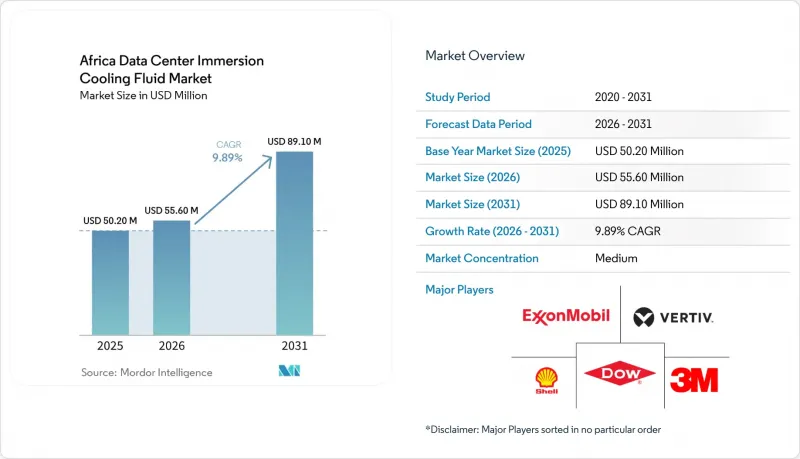
This report is Segmented by Fluid Type (Mineral Oil and Synthetic Hydrocarbon, and More), Phase Type (Single-Phase and Two-Phase), Data Center Type (Cloud Service Providers and Colocation, and More), End-User Industry (IT/ITES and BFSI, and More), and Geography (Brazil and Argentina, and More). The Market Forecasts are Provided in Terms of Value (USD).
Africa Data Center Immersion Cooling Fluid Market Trends and Insights
Hyperscale build-outs in Johannesburg and Nairobi corridors
Africa's two most active data-center corridors are now anchored by Teraco's USD 442 million facility expansion and Equinix's USD 390 million entry plan, both of which specify immersion-ready halls capable of 100 kW-plus racks. High fiber density, carrier hotels, and submarine-cable proximity let operators guarantee sub-40 ms latency to European hubs, a prerequisite for GPU training workloads. Project lenders insist on PUE targets under 1.2, effectively locking in liquid cooling as the baseline architecture. Equipment OEMs follow the investment, placing forward-stock depots in Gauteng and Kiambu counties to shorten lead times for fluid systems. The clustering effect lowers logistics costs for dielectric suppliers, making bulk contracts viable for secondary metro builds.
Rising electricity tariffs driving TCO optimization
Nigeria's Band A tariff leap to NGN 225/kWh (USD 0.14/kWh) in 2024 pushed operating expenditure up by more than 30% for Tier III facilities. Kenya's commercial tariff sits even higher at USD 0.202/kWh, while South Africa's 2025 Eskom hike averages 18.7% on large-power users. Immersion cooling cuts server-fan draw and eliminates chiller loads, shrinking energy needs 40-50% and pushing blended PUE close to 1.05, which in turn shaves two to three years off payback periods. CFOs now build tariff-inflation scenarios into investment memos, often finding liquid cooling the least-cost option beyond year 4 of asset life. The tariff pressure also boosts interest in on-site solar-plus-battery microgrids, whose capex aligns naturally with immersion's reduced HVAC footprint.
Scarce local blending of specialty dielectrics inflating imports
Only two sub-Saharan facilities possess ISO-certified blending lines for dielectric fluids, forcing most buyers to import finished product at freight rates exceeding USD 3,000 per ISO tank. Duties range between 5-10% depending on HS code classification, and forex shortages often delay customs clearance by weeks, leaving racks idle. Smaller operators cannot meet minimum-order quantities, paying spot premiums of 15-20% over contract pricing. Domestic chemical firms have considered toll-blending agreements, yet high feedstock purity requirements deter investment without guaranteed take-or-pay volumes. Until local capacity improves, supply risk and elevated landed cost will cap adoption in price-sensitive metros.
Other drivers and restraints analyzed in the detailed report include:
- Severe water stress in Cape Town and Sahel favoring liquid cooling
- Pan-African AI/ML clusters for fintech and e-commerce
- Higher up-front CAPEX vs. legacy air cooling
For complete list of drivers and restraints, kindly check the Table Of Contents.
Segment Analysis
Mineral oil secured the highest 48.0% share of the Africa data center immersion cooling fluid market in 2025, owing to favorable pricing and broad availability. Bio-esters, though costlier, post the segment's quickest 11.9% CAGR as asset managers scrutinize sustainability disclosures. The Africa data center immersion cooling fluid market size for bio-esters is projected to climb sharply as PFAS-free mandates spread across procurement frameworks. Synthetic hydrocarbons target niche high-heat applications, while fluorocarbon products trend downward following PFAS prohibitions.
Bio-ester suppliers such as TotalEnergies (BioLife) and Cargill (NatureCool) pitch biodegradability advantages to hyperscale bidders, and Chemours' May 2025 alliance with Navin Fluorine adds Opteon production closer to the continent. Local formulators explore palm-derivative feedstocks to cut import bills, though financing hurdles persist.
Single-phase designs represented 73.5% of 2025 revenue, anchoring the Africa data center immersion cooling fluid market share among operators seeking straightforward rollout. Two-phase installations, while only a minority today, are forecast to grow 11.7% annually as they enable GPU rack densities exceeding 100 kW. The Africa data center immersion cooling fluid market size for two-phase fluids could double by 2030 if hyperscale AI clusters adopt the topology at scale.
Johnson Controls' September 2025 modular CDU launch mitigates complexity fears by offering plug-and-play expansion; early pilots in Lagos and Nairobi demonstrate 20% TCO savings versus air-cooled plus CRAH retrofits.
List of Companies Covered in this Report:
- 3M
- The Dow Chemical Company
- Exxon Mobil Corporation
- Shell plc
- The Chemours Company
- Cargill Incorporated
- Castrol Limited (BP)
- FUCHS SE
- The Lubrizol Corporation
- Engineered Fluids Inc.
- Submer Technologies S.L.
- Asperitas
- Iceotope Technologies
- LiquidStack
- Green Revolution Cooling
- Vertiv
- Schneider Electric
- Dell Technologies
- Supermicro
- Asetek
- FluoroCool
- BitCool
- DCX - The Liquid Cooling Co.
- Allied Control Ltd.
- Giga Cooling
Additional Benefits:
- The market estimate (ME) sheet in Excel format
- 3 months of analyst support
TABLE OF CONTENTS
1 INTRODUCTION
- 1.1 Study Assumptions and Market Definition
- 1.2 Scope of the Study
2 RESEARCH METHODOLOGY
3 EXECUTIVE SUMMARY
4 MARKET LANDSCAPE
- 4.1 Market Overview
- 4.2 Market Drivers
- 4.2.1 Hyperscale build-outs in Johannesburg and Nairobi corridors
- 4.2.2 Rising electricity tariffs driving TCO optimisation
- 4.2.3 Severe water-stress in Cape Town and Sahel favouring liquid cooling
- 4.2.4 Pan-African AI/ML clusters for fintech and e-commerce
- 4.2.5 Data-centre tax incentives (e.g., Kenya Investment Promotion Act)
- 4.2.6 Shift to PFAS-free bio-ester fluids for ESG reporting
- 4.3 Market Restraints
- 4.3.1 Scarce local blending of specialty dielectrics inflating imports
- 4.3.2 Higher up-front CAPEX vs. legacy air cooling
- 4.3.3 Absence of African immersion-cooling safety standards
- 4.3.4 Supply-chain risk amid global PFAS phase-out
- 4.4 Value / Supply-Chain Analysis
- 4.5 Regulatory Landscape
- 4.6 Technological Outlook
- 4.7 Porter's Five Forces
- 4.7.1 Threat of New Entrants
- 4.7.2 Bargaining Power of Suppliers
- 4.7.3 Bargaining Power of Buyers
- 4.7.4 Threat of Substitutes
- 4.7.5 Competitive Rivalry
5 MARKET SIZE and GROWTH FORECASTS
- 5.1 By Fluid Type
- 5.1.1 Mineral Oil
- 5.1.2 Synthetic Hydrocarbon
- 5.1.3 Fluorocarbon-based Fluids
- 5.1.4 Bio-based Esters
- 5.2 By Phase Type
- 5.2.1 Single-Phase
- 5.2.2 Two-Phase
- 5.3 By Data Center Type
- 5.3.1 Cloud Service Providers
- 5.3.2 Colocation
- 5.3.3 On-Premise / Enterprise / Edge
- 5.4 By End-User Industry
- 5.4.1 IT / ITES
- 5.4.2 BFSI
- 5.4.3 Healthcare
- 5.4.4 Government and Defense
- 5.4.5 Media and Entertainment
- 5.4.6 Other End-Users
- 5.5 By Country
- 5.5.1 South Africa
- 5.5.2 Nigeria
- 5.5.3 Kenya
- 5.5.4 Egypt
- 5.5.5 Morocco
- 5.5.6 Rest of Africa
6 COMPETITIVE LANDSCAPE
- 6.1 Market Share Analysis
- 6.2 Company Profiles (includes Global level Overview, Market level overview, Core Segments, Financials as available, Strategic Information, Market Rank/Share for key companies, Products and Services, and Recent Developments)
- 6.2.1 3M
- 6.2.2 The Dow Chemical Company
- 6.2.3 Exxon Mobil Corporation
- 6.2.4 Shell plc
- 6.2.5 The Chemours Company
- 6.2.6 Cargill Incorporated
- 6.2.7 Castrol Limited (BP)
- 6.2.8 FUCHS SE
- 6.2.9 The Lubrizol Corporation
- 6.2.10 Engineered Fluids Inc.
- 6.2.11 Submer Technologies S.L.
- 6.2.12 Asperitas
- 6.2.13 Iceotope Technologies
- 6.2.14 LiquidStack
- 6.2.15 Green Revolution Cooling
- 6.2.16 Vertiv
- 6.2.17 Schneider Electric
- 6.2.18 Dell Technologies
- 6.2.19 Supermicro
- 6.2.20 Asetek
- 6.2.21 FluoroCool
- 6.2.22 BitCool
- 6.2.23 DCX - The Liquid Cooling Co.
- 6.2.24 Allied Control Ltd.
- 6.2.25 Giga Cooling
7 MARKET OPPORTUNITIES AND FUTURE OUTLOOK
- 7.1 White-space and Unmet-Need Assessment

