PUBLISHER: Mordor Intelligence | PRODUCT CODE: 2063381

PUBLISHER: Mordor Intelligence | PRODUCT CODE: 2063381
Feed Probiotics - Market Share Analysis, Industry Trends & Statistics, Growth Forecasts (2026 - 2031)
According to Mordor Intelligence, the feed probiotics market size was valued at USD 3.15 billion in 2025 and is projected to grow from USD 3.31 billion in 2026 to USD 4.25 billion by 2031, with a CAGR of 5.06% during 2026 to 2031.
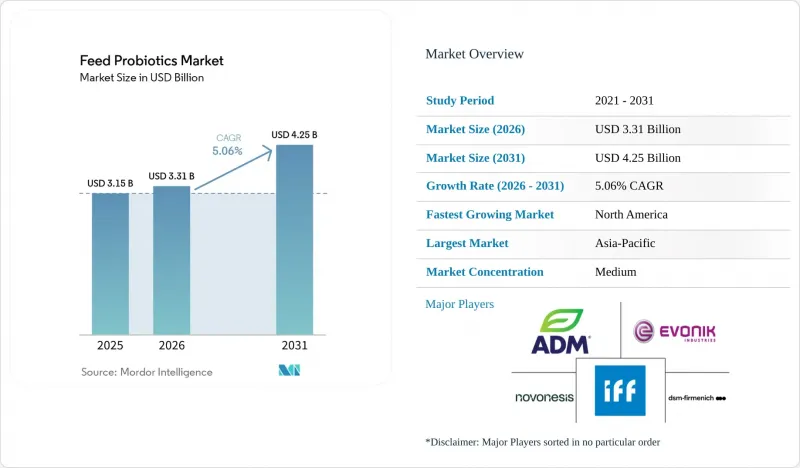
This report is Segmented by Sub Additive (Bifidobacteria, Enterococcus, Lactobacilli, Pediococcus, Streptococcus, and Other Probiotics), by Animal (Aquaculture, Poultry, Ruminants, Swine, and Other Animals), and by Geography (North America, South America, Europe, Asia-Pacific, Middle East, and Africa). The Market Forecasts are Provided in Terms of Value (USD) and Volume (Metric Tons).
Global Feed Probiotics Market Trends and Insights
Antibiotic-Growth-Promoter Restrictions and Antibiotic-Free Production
Restrictions on antibiotic growth promoters are driving increased demand in the feed probiotics market, as livestock producers seek non-antibiotic alternatives to support gut health and production performance. The Food Safety and Standards Authority of India (FSSAI) has announced restrictions, effective April 1, 2025, banning the use of several medically important antibiotics in food-producing animals. This regulatory change is encouraging the adoption of probiotic-based feed additives as replacement solutions. The demand for Bacillus- and Lactobacillus-based probiotics is rising, as these products enhance feed efficiency, digestive stability, and animal health without relying on antibiotic growth promoters.
Poultry Production Scale and Feed Efficiency Focus
The scale of poultry production continues to drive strong demand in the feed probiotics market, as broiler operations rely heavily on feed efficiency and production optimization. According to the United States Department of Agriculture (USDA) Foreign Agricultural Service (FAS), global chicken meat production is projected to reach 110.7 million metric tons by 2026, reflecting a 3% increase from the previous year. This growth is primarily attributed to expansions in China, Brazil, and the United States. The rising poultry output at this level is increasing the demand for probiotic feed additives, which support gut health, enhance nutrient utilization, and ensure production consistency in intensive broiler systems.
Field-Level Strain Performance Variability
Field-level performance variability poses a significant challenge for the feed probiotics market, as the efficacy of probiotics can vary widely across different commercial farming environments. A 2025 meta-analysis published in Frontiers in Animal Science by researchers from Universidad de Chile, Santiago, Chile, found that Bacillus-based probiotics increased broiler body weight gain by an average of 152 g, while Lactobacillus-based probiotics demonstrated an average improvement of 221.6 g under the analyzed trial conditions. These variations in results across probiotic strains and production environments can undermine confidence among livestock producers, limiting repeat usage and impeding the broader commercialization of feed probiotic products.
Other drivers and restraints analyzed in the detailed report include:
- Asia-Pacific Livestock and Aquaculture Intensification
- Better Heat-Stable Bacillus and Dry-Format Formulations
- Multi-Jurisdiction Microbial Registration Burden
For complete list of drivers and restraints, kindly check the Table Of Contents.
Segment Analysis
The feed probiotics market share for bifidobacteria held the largest 34.0% in 2025. This dominance is attributed to their extensive commercial application in poultry, swine, calf, and aquaculture nutrition programs, where digestive stability and early-life gut health are key priorities. Suppliers are increasingly developing multi-strain probiotic formulations that combine bifidobacteria with Lactobacillus and Bacillus species to enhance microbial stability and feed performance across various animal systems. Additionally, the category benefits from established regulatory acceptance in major livestock-producing countries, facilitating adoption by integrated feed manufacturers and large-scale animal protein producers globally.
The feed probiotics market size for bifidobacteria is forecast to grow at the fastest 5.4% CAGR from 2026 to 2031. This growth is driven by an increasing emphasis on microbiome management in young animals, particularly in calf starters, nursery pig diets, hatchery nutrition programs, and aquaculture feeds. Producers are focusing on probiotic solutions that enhance digestive efficiency and support antibiotic-reduced production systems without compromising productivity. Competitive strategies are shifting toward scientifically validated strain combinations and heat-stable formulations that align with commercial feed processing requirements. These developments are promoting broader adoption of bifidobacteria-based products across established livestock industries and emerging aquaculture sectors worldwide.
Geography Analysis
Asia-Pacific accounted for the largest geographic share of the feed probiotics market, holding 32.5% in 2025. This dual leadership is attributed to the region's dominance in both aquaculture and terrestrial livestock categories. According to the United States Department of Agriculture (USDA), China remains the largest single-country demand center for probiotics in the region, driven by its position as the world's second-largest chicken meat producer, forecasted at 17.3 million metric tons in 2026. In Southeast Asia, shrimp-producing nations such as Thailand, Vietnam, Indonesia, and the Philippines represent a concentrated demand for probiotics, with acute hepatopancreatic necrosis disease (AHPND) biosecurity programs driving the use of Bacillus and Lactobacillus solutions in feed and pond-water applications.
North America is projected to grow at the fastest 5.5% CAGR from 2026 to 2031 and ranks as a technically advanced and high-value market, with the United States accounting for the world's largest single-country chicken meat production. This growth is supported by large commercial livestock operations, widespread adoption of precision nutrition programs, and rising demand for antibiotic-reduced animal production systems. According to the United States Department of Agriculture Foreign Agricultural Service, United States chicken meat production is forecast to increase from 21.7 million metric tons in 2025 to 22.2 million metric tons in 2026, creating a significant commercial base for probiotic feed additives in poultry production. Additionally, large integrated feed and livestock companies are investing in direct-fed microbial programs to improve feed efficiency and optimize gut health.
South America continues to contribute meaningful commercial demand through export-oriented poultry and swine production systems, particularly in Brazil and Argentina. Europe remains a mature region supported by long-standing antimicrobial reduction policies, advanced feed manufacturing standards, and strong regulatory oversight for microbial products. Meanwhile, the Middle East and Africa are gradually increasing their adoption of feed probiotics, driven by expanding poultry integration, aquaculture investments, and compound feed production in selected countries. Key demand centers in this region include Saudi Arabia, Turkey, South Africa, and Egypt, where commercial livestock operators are focusing on feed efficiency, digestive stability, and non-antibiotic nutritional solutions to support modern intensive animal production systems.
- Novonesis A/S
- DSM-Firmenich AG
- Evonik Industries AG
- International Flavors & Fragrances Inc.
- Archer Daniels Midland Company
- Cargill, Incorporated
- Lallemand Inc.
- Kemin Industries, Inc.
- Lesaffre International, SAS
- Adisseo France SAS (China National BlueStar (Group) Co., Ltd.)
- Phibro Animal Health Corporation
- Alltech, Inc.
- Huvepharma AD
- Qingdao Vland Biotech Group Co., Ltd.
- Kerry Group plc
Additional Benefits:
- The market estimate (ME) sheet in Excel format
- 3 months of analyst support
TABLE OF CONTENTS
1 INTRODUCTION
- 1.1 Study Assumptions and Market Definition
- 1.2 Scope of the Study
- 1.3 Research Methodology
2 REPORT OFFERS
3 EXECUTIVE SUMMARY AND KEY FINDINGS
4 KEY INDUSTRY TRENDS
- 4.1 Animal Headcount
- 4.1.1 Poultry
- 4.1.2 Ruminants
- 4.1.3 Swine
- 4.2 Feed Production
- 4.2.1 Aquaculture
- 4.2.2 Poultry
- 4.2.3 Ruminants
- 4.2.4 Swine
- 4.3 Regulatory Framework
- 4.3.1 Australia
- 4.3.2 Brazil
- 4.3.3 Canada
- 4.3.4 China
- 4.3.5 France
- 4.3.6 Germany
- 4.3.7 India
- 4.3.8 Indonesia
- 4.3.9 Italy
- 4.3.10 Japan
- 4.3.11 Mexico
- 4.3.12 Netherlands
- 4.3.13 Philippines
- 4.3.14 Russia
- 4.3.15 South Africa
- 4.3.16 South Korea
- 4.3.17 Spain
- 4.3.18 Thailand
- 4.3.19 Turkey
- 4.3.20 United Kingdom
- 4.3.21 United States
- 4.3.22 Vietnam
- 4.4 Value Chain and Distribution Channel Analysis
- 4.5 Market Drivers
- 4.5.1 Antibiotic-growth-promoter restrictions and antibiotic-free production
- 4.5.2 Poultry production scale and feed efficiency focus
- 4.5.3 Asia-Pacific livestock and aquaculture intensification
- 4.5.4 Better heat-stable Bacillus and dry-format formulations
- 4.5.5 Carbon-intensity reduction and Scope 3 pressure in animal protein
- 4.5.6 Shrimp disease management and water-quality programs
- 4.6 Market Restraints
- 4.6.1 Field-level strain performance variability
- 4.6.2 Multi-jurisdiction microbial registration burden
- 4.6.3 Pelleting and storage viability losses for non-spore strains
- 4.6.4 Postbiotic and paraprobiotic substitution risk
- 4.7 Porter's Five Forces Analysis
- 4.7.1 Threat of New Entrants
- 4.7.2 Bargaining Power of Buyers
- 4.7.3 Bargaining Power of Suppliers
- 4.7.4 Threat of Substitute Products
- 4.7.5 Intensity of Competitive Rivalry
5 Market Size and Growth Forecasts (Value and Volume)
- 5.1 By Sub Additive
- 5.1.1 Bifidobacteria
- 5.1.2 Enterococcus
- 5.1.3 Lactobacilli
- 5.1.4 Pediococcus
- 5.1.5 Streptococcus
- 5.1.6 Other Probiotics
- 5.2 By Animal
- 5.2.1 Aquaculture
- 5.2.1.1 Fish
- 5.2.1.2 Shrimp
- 5.2.1.3 Other Aquaculture Species
- 5.2.2 Poultry
- 5.2.2.1 Broiler
- 5.2.2.2 Layer
- 5.2.2.3 Other Poultry Birds
- 5.2.3 Ruminants
- 5.2.3.1 Beef Cattle
- 5.2.3.2 Dairy Cattle
- 5.2.3.3 Other Ruminants
- 5.2.4 Swine
- 5.2.5 Other Animals
- 5.2.1 Aquaculture
- 5.3 By Geography
- 5.3.1 North America
- 5.3.1.1 United States
- 5.3.1.2 Canada
- 5.3.1.3 Mexico
- 5.3.1.4 Rest of North America
- 5.3.2 South America
- 5.3.2.1 Brazil
- 5.3.2.2 Argentina
- 5.3.2.3 Chile
- 5.3.2.4 Rest of South America
- 5.3.3 Europe
- 5.3.3.1 Germany
- 5.3.3.2 France
- 5.3.3.3 Italy
- 5.3.3.4 Netherlands
- 5.3.3.5 Russia
- 5.3.3.6 Spain
- 5.3.3.7 United Kingdom
- 5.3.3.8 Rest of Europe
- 5.3.4 Asia-Pacific
- 5.3.4.1 China
- 5.3.4.2 India
- 5.3.4.3 Japan
- 5.3.4.4 Indonesia
- 5.3.4.5 South Korea
- 5.3.4.6 Thailand
- 5.3.4.7 Vietnam
- 5.3.4.8 Australia
- 5.3.4.9 Philippines
- 5.3.4.10 Rest of Asia-Pacific
- 5.3.5 Middle East
- 5.3.5.1 Iran
- 5.3.5.2 Turkey
- 5.3.5.3 Saudi Arabia
- 5.3.5.4 Rest of Middle East
- 5.3.6 Africa
- 5.3.6.1 Egypt
- 5.3.6.2 Kenya
- 5.3.6.3 South Africa
- 5.3.6.4 Rest of Africa
- 5.3.1 North America
6 COMPETITIVE LANDSCAPE
- 6.1 Key Strategic Moves
- 6.2 Market Share Analysis
- 6.3 Company Landscape
- 6.4 Company Profiles (Includes Global Level Overview, Market Level Overview, Core Business Segments, Financials, Headcount, Key Information, Market Rank, Market Share, Products and Services, and Analysis of Recent Developments)
- 6.4.1 Novonesis A/S
- 6.4.2 DSM-Firmenich AG
- 6.4.3 Evonik Industries AG
- 6.4.4 International Flavors & Fragrances Inc.
- 6.4.5 Archer Daniels Midland Company
- 6.4.6 Cargill, Incorporated
- 6.4.7 Lallemand Inc.
- 6.4.8 Kemin Industries, Inc.
- 6.4.9 Lesaffre International, SAS
- 6.4.10 Adisseo France SAS (China National BlueStar (Group) Co., Ltd.)
- 6.4.11 Phibro Animal Health Corporation
- 6.4.12 Alltech, Inc.
- 6.4.13 Huvepharma AD
- 6.4.14 Qingdao Vland Biotech Group Co., Ltd.
- 6.4.15 Kerry Group plc
7 KEY STRATEGIC QUESTIONS FOR FEED ADDITIVE CEOS

