
PUBLISHER: Mordor Intelligence | PRODUCT CODE: 2063450

PUBLISHER: Mordor Intelligence | PRODUCT CODE: 2063450
Veterinary Sutures - Market Share Analysis, Industry Trends & Statistics, Growth Forecasts (2026 - 2031)
According to Mordor Intelligence, the veterinary sutures market size was valued at USD 527.60 million in 2025 and is estimated to grow from USD 567.10 million in 2026 to reach USD 818.40 million by 2031, at a CAGR of 7.66% during the forecast period (2026-2031).
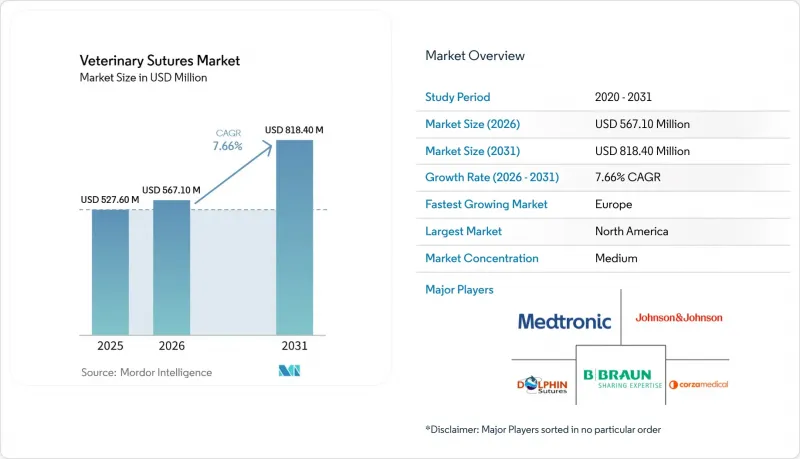
This report is Segmented by Suture Type (Absorbable, Non-Absorbable), Structure (Monofilament, Multifilament), Animal Type (Companion Animals, Livestock), End User (Veterinary Hospitals, Clinics, Ambulatory Centers, and More), Application (Soft Tissue, Orthopedic, and More), and Geography (North America, Europe, Asia-Pacific, MEA, South America). Market Forecasts are Provided in Terms of Value (USD).
Global Veterinary Sutures Market Trends and Insights
High Surgical Volumes in Companion Animals Drive Baseline Demand
Shelters admitted 2.8 million animals in the United States during the first half of 2025, and adoption rates climbed to 76%, seeding future elective surgeries that consume large suture quantities . High-quality high-volume spay-neuter (HQHVSN) clinics now complete 25-60 procedures daily, standardizing barbed absorbable sutures to maximize throughput. Lower procedure costs from these efficiencies broaden access for cost-sensitive pet owners and municipalities, stabilizing demand even in downturns. Rising diagnostic-imaging use is pushing tumor resections higher, layering additional volume. Together, shelter sterilization and owner-funded elective work form a resilient dual-engine that underpins the veterinary sutures market.
Pet Insurance Expansion Unlocks Advanced Procedures
North American pet-insurance premiums grew 20.8% in 2024 to USD 5.15 billion, lifting insured pets to 6.4 million and reducing out-of-pocket hurdles for advanced surgeries . Policies now routinely cover orthopedic repairs and complex oncologic work, driving uptake of absorbable and barbed lines that reduce anesthesia episodes. European penetration already exceeds 25% in the United Kingdom and Scandinavia, and pilot products in urban China and India are replicating this model. As insurance spreads, case-mix shifts to higher-acuity interventions that need more and more sophisticated closure materials, lifting both volume and average selling price. Insurers' reimbursement guidelines also validate premium products, reinforcing their position in the veterinary sutures market.
Tissue Adhesives and Staples Erode Share in Select Applications
Cyanoacrylate glues and skin staples close low-tension wounds in seconds, saving surgeon time and allowing technicians to handle routine closures under supervision. HQHVSN clinics adopt them aggressively because minutes shaved per case multiply across dozens of daily procedures. Nonetheless, adhesives cost more per use when waste from partially used tubes is factored in, and staples require a removal visit unless absorbable variants are chosen, narrowing their appeal. The substitution risk is therefore confined to roughly 10-15% of the veterinary sutures market, mainly within commodity non-absorbable lines.
Other drivers and restraints analyzed in the detailed report include:
- Absorbable Sutures Reduce Follow-Up Visits and Anesthesia Risk
- Asia-Pacific Veterinary Infrastructure Expansion Creates Long-Term Growth
- Private-Label and Regional Manufacturers Intensify Price Pressure
For complete list of drivers and restraints, kindly check the Table Of Contents.
Segment Analysis
Absorbable products captured 56.30% of the veterinary sutures market share in 2025 and are forecast to grow with 8.12% CAGR. Hospitals prefer polyglycolic-acid and polydioxanone lines for soft-tissue closures because they negate removal visits, reduce anesthesia risk, and satisfy owner convenience. The veterinary sutures market size tied to absorbables is therefore rising faster than overall revenue growth, even in price-sensitive regions where follow-up logistics are difficult.
Barbed absorbable variants compound the speed advantage by eliminating knots, and early adoption in HQHVSN programs signals mainstream diffusion. Non-absorbables keep niche roles in tendon repairs and large-animal external skin closures where lasting tensile support is vital, yet their share is eroding as polymer science boosts absorbable strength. Regulatory scrutiny from FDA-CVM on hydrolysis profiles sets a quality baseline that discourages low-grade imports, maintaining brand loyalty where surgical risk is highest.
Monofilament lines held 61.67% of market revenue in 2025, and are expected to grow at 8.21% CAGR by 2031. Reduced tissue drag shortens operating time, and lower bacterial adherence aligns with antimicrobial-stewardship goals. Consequently, the value slice of the veterinary sutures market size earned by monofilament is growing faster than braided alternatives.
Barbed monofilament adds another layer of utility, merging infection control with time savings. Braided sutures still dominate cardiovascular and ophthalmic procedures where pliability overrides infection concerns. Manufacturers counter monofilament gains by adding antibacterial coatings to braided lines, but structural disadvantages remain. As clinics measure post-operative complication rates more rigorously, surgeons default to monofilament for contaminated fields, reinforcing the shift.
Geography Analysis
North America accounted for 35.78% of the veterinary sutures market in 2025, underpinned by more than 30,000 U.S. practices and 6.4 million insured pets that authorize elective interventions. Workforce shortages temper growth, yet HQHVSN programs performing up to 60 sterilizations daily keep baseline volumes healthy. FDA-CVM regulations on biocompatibility maintain a quality floor that favors established suppliers.
Europe is projected to post an 8.03% CAGR through 2031, the fastest among all regions. AniCura's 400-clinic network centralizes purchasing and accelerates adoption of triclosan-coated lines under uniform protocols. EMA device-approval harmonization lowers launch hurdles, and pet-insurance penetration above 25% in the United Kingdom sustains demand for premium absorbables. Eastern Europe emerges as a price-competitive manufacturing base for private-label sutures, while Scandinavian countries pilot next-gen antimicrobial coatings.
Asia-Pacific trails in market share but leads in incremental volume, driven by China's USD 39.8 billion pet economy and rapid hospital build-outs. Japan provides a mature template for specialty practice, and Indian chains open flagship hospitals in metros, widening access. Regional makers like Genia Group and Orion Sutures win on price, yet rising quality expectations open lanes for branded coated and barbed imports. Middle East & Africa and South America remain small but rising as disposable incomes widen surgical access, with Brazil's large dog population anchoring Latin American demand.
- Arthrex Vet Systems
- Assut Europe / AIP Medical
- B. Braun
- Corza Medical, Inc.
- Covetrus Brand Sutures
- DemeTECH
- Dolphin Sutures
- Genia Group
- Johnson & Johnson
- KATSAN
- KRUUSE
- Lotus Surgicals
- Medtronic
- Orion Sutures
- Peters Surgical
- Pivetal
- ProNorth Medical
- Riverpoint Medical
- Securos Surgical
- SMI (Sutures.be)
- VeterSut
- Vitrex Medical A/S
Additional Benefits:
- The market estimate (ME) sheet in Excel format
- 3 months of analyst support
TABLE OF CONTENTS
1 Introduction
- 1.1 Study Assumptions & Market Definition
- 1.2 Scope of the Study
2 Research Methodology
3 Executive Summary
4 Market Landscape
- 4.1 Market Overview
- 4.2 Market Drivers
- 4.2.1 High Surgical Volumes in Companion Animals From 2026 Onward
- 4.2.2 Pet Insurance Expansion Raises Affordability of Advanced Procedures
- 4.2.3 Absorbable Sutures Preferred for Soft Tissue Surgery, Reducing Follow-Up Visits
- 4.2.4 APAC Veterinary Infrastructure and Pet Ownership Expansion
- 4.2.5 Adoption of Barbed/Knotless and Antibacterial Sutures That Improve OR Efficiency and SSI Outcomes
- 4.2.6 HQHVSN And Mobile Clinics Expand Access, Lifting Baseline Surgical Volumes
- 4.3 Market Restraints
- 4.3.1 Tissue Adhesives and Staples Substitute Sutures in Select Low-Tension Skin Closures
- 4.3.2 Private-Label and Low-Cost Regional Manufacturers Intensify Price Pressure
- 4.3.3 Veterinary Surgeon/Staff Shortages Constrain Procedure Capacity
- 4.3.4 Antimicrobial Stewardship Curbs Prophylactic Antibiotics, Raising Performance Expectations for Closure Materials
- 4.4 Supply-Chain Analysis
- 4.5 Regulatory Landscape
- 4.6 Technological Outlook
- 4.7 Porter's Five Forces
- 4.7.1 Threat of New Entrants
- 4.7.2 Bargaining Power of Suppliers
- 4.7.3 Bargaining Power of Buyers
- 4.7.4 Threat of Substitutes
- 4.7.5 Competitive Rivalry
5 Market Size & Growth Forecasts (Value, USD)
- 5.1 By Suture Type
- 5.1.1 Absorbable
- 5.1.2 Non-absorbable
- 5.2 By Structure
- 5.2.1 Monofilament
- 5.2.2 Multifilament (Braided)
- 5.3 By Animal Type
- 5.3.1 Companion Animals
- 5.3.2 Livestock
- 5.4 By End User
- 5.4.1 Veterinary Hospitals
- 5.4.2 Veterinary Clinics
- 5.4.3 Ambulatory & Specialty Centers
- 5.4.4 Academic & Research Institutes
- 5.5 By Application
- 5.5.1 Soft Tissue / General Surgery
- 5.5.2 Orthopedic Surgery
- 5.5.3 Ophthalmic Surgery
- 5.5.4 Dental / Oral Surgery
- 5.5.5 Gastrointestinal & Urologic Surgery
- 5.5.6 Dermatologic & Plastic Procedures
- 5.6 By Geography
- 5.6.1 North America
- 5.6.1.1 United States
- 5.6.1.2 Canada
- 5.6.1.3 Mexico
- 5.6.2 Europe
- 5.6.2.1 Germany
- 5.6.2.2 United Kingdom
- 5.6.2.3 France
- 5.6.2.4 Italy
- 5.6.2.5 Spain
- 5.6.2.6 Rest of Europe
- 5.6.3 Asia-Pacific
- 5.6.3.1 China
- 5.6.3.2 India
- 5.6.3.3 Japan
- 5.6.3.4 South Korea
- 5.6.3.5 Australia
- 5.6.3.6 Rest of Asia-Pacific
- 5.6.4 Middle East and Africa
- 5.6.4.1 GCC
- 5.6.4.2 South Africa
- 5.6.4.3 Rest of Middle East and Africa
- 5.6.5 South America
- 5.6.5.1 Brazil
- 5.6.5.2 Argentina
- 5.6.5.3 Rest of South America
- 5.6.1 North America
6 Competitive Landscape
- 6.1 Market Concentration
- 6.2 Market Share Analysis
- 6.3 Company Profiles {(includes Global level Overview, Market level overview, Core Segments, Financials as available, Strategic Information, Market Rank/Share for key companies, Products & Services, and Recent Developments)}
- 6.3.1 Arthrex Vet Systems
- 6.3.2 Assut Europe / AIP Medical
- 6.3.3 B. Braun Melsungen AG
- 6.3.4 Corza Medical, Inc.
- 6.3.5 Covetrus Brand Sutures
- 6.3.6 DemeTECH Corporation
- 6.3.7 Dolphin Sutures
- 6.3.8 Genia Group
- 6.3.9 Johnson & Johnson
- 6.3.10 KATSAN
- 6.3.11 KRUUSE
- 6.3.12 Lotus Surgicals
- 6.3.13 Medtronic Plc
- 6.3.14 Orion Sutures
- 6.3.15 Peters Surgical
- 6.3.16 Pivetal
- 6.3.17 ProNorth Medical
- 6.3.18 Riverpoint Medical
- 6.3.19 Securos Surgical
- 6.3.20 SMI (Sutures.be)
- 6.3.21 VeterSut
- 6.3.22 Vitrex Medical A/S
7 Market Opportunities & Future Outlook
- 7.1 White-space & Unmet-Need Assessment

