PUBLISHER: Mordor Intelligence | PRODUCT CODE: 2063543

PUBLISHER: Mordor Intelligence | PRODUCT CODE: 2063543
Microplate Washers - Market Share Analysis, Industry Trends & Statistics, Growth Forecasts (2026 - 2031)
According to Mordor Intelligence, the microplate washers market size is expected to grow from USD 626.07 million in 2025 to USD 657.49 million in 2026 and is forecast to reach USD 870.04 million by 2031 at 5.76% CAGR over 2026-2031.
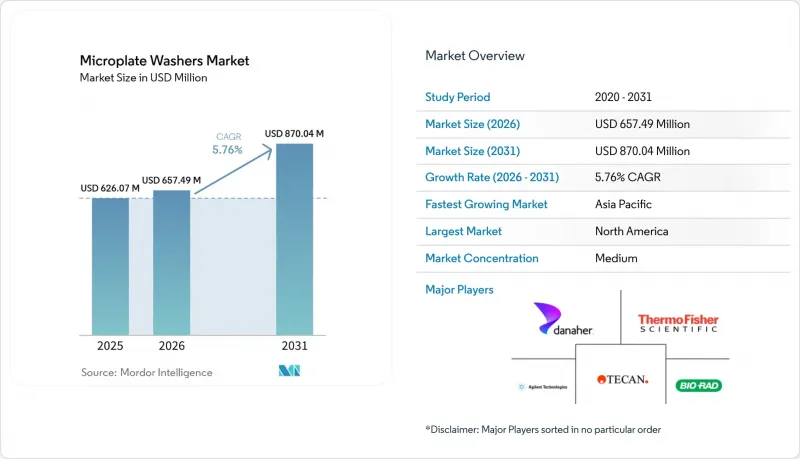
This report is Segmented by Automation Level (Automated, Semi-Automated, Manual), Application (ELISA/Immunoassays, and More), End User (Hospital & Diagnostic Laboratories, Reference Laboratories, Pharmaceutical & Biotechnology Companies, and More), and Geography (North America, Europe, Asia-Pacific, Middle East & Africa, South America). The Market Forecasts are Provided in Terms of Value (USD).
Global Microplate Washers Market Trends and Insights
Growth in ELISA/Immunoassay Testing Volumes in Clinical and Research Labs
Chronic-disease surveillance and infectious-disease monitoring are expanding ELISA plate throughput across hospital and translational laboratories. Multiplex kits measuring up to 40 analytes per well heighten the need for wash consistency; automated systems reduce inter-assay variability from 12% to below 5%. Middleware-controlled plate washers are now integrated into laboratory information systems, eliminating manual data entry errors that historically drove rework costs above USD 70,000 per lab each year.
Rising Lab Automation and High-Throughput Screening Adoption in Pharma/Biotech
Top pharmaceutical groups embed washers inside robotic screening cells to compress discovery cycles and save reagents. Tecan recorded CHF 311.9 million in revenue in the third quarter of 2024, citing strong liquid-handling demand. Bio-Rad's clinical-diagnostics arm grew 6.5% to USD 393.1 million in the same period, confirming that assay volume directly translates into washer utilization. Payback periods for automated washers range from 6-12 months in pharmaceutical QC, driven by reagent savings when 96-well assays migrate to 1536-well plates.
High Acquisition and Maintenance Costs for Advanced Automated Washers
A fully automated 384-channel washer costs USD 25,000-60,000, with annual service contracts adding another 10-15%. Funding pressure is visible in academia, where NIH obligations fell 34% versus 2024, shrinking equipment-grant pools. Leasing mitigates upfront cash but raises five-year ownership cost by 15-20%. Chinese suppliers such as Autobio and Kehua now ship sub-USD 15,000 units with local service centers, loosening the price barrier in resource-sensitive regions.
Other drivers and restraints analyzed in the detailed report include:
- Shift Toward Higher-Density Plates Requiring Precision Washing
- Expansion of Life-Sciences R&D Funding and Installed-Base Refresh Cycles
- Skills/Training Gaps to Optimize Wash Protocols and Reduce Assay Variability
For complete list of drivers and restraints, kindly check the Table Of Contents.
Segment Analysis
Automated platforms captured 41.12% of 2025 revenue and will advance at 7.13% CAGR over 2026-2031. Robotic loaders paired with 384-channel manifolds complete a wash cycle on a 1536-well plate in 90 seconds, enabling screening centers to log over 100,000 data points daily. The microplate washers market share for semi-automated units is sliding as their higher operator-touch time clashes with quality-control protocols in GMP-regulated environments. Manual devices remain entrenched where capital budgets are thin and maintenance infrastructure is sparse, especially in rural Latin America and MEA, but their variability above 15% in proficiency tests is driving gradual replacement by entry-level automation.
Cost dynamics are shifting as Chinese vendors introduce automated models just above USD 10,000, undercutting Western incumbents by up to 40%. Hospitals processing 200-500 plates weekly find that semi-automated washers earn payback within 18 months through reagent savings and lower rework rates. However, reference and pharma labs value end-to-end automation that integrates with laboratory information systems; middleware connectivity now ranks second only to residual volume specification in many tenders.
Geography Analysis
North America generated 47.13% of 2025 revenue, reflecting dense installed bases and early IVDR-aligned upgrades even before European deadlines. U.S. academic spending is softening due to reduced NIH appropriations, yet private labs offset the gap through large automation budgets. Middleware integration that satisfies emerging ISO 15189 criteria is guiding specification sheets in Canadian and U.S. hospital systems alike.
Europe holds the second-largest slice, driven by the mandatory shift to CE-IVD washers under EU IVDR. Laboratories in Germany, France, and the United Kingdom began accelerated replacement during 2024 to avoid accreditation risk. Horizon Europe grants continue to fund translational projects that require validated immunoassay platforms, supporting steady washer demand in public research.
Asia-Pacific is the expansion hotspot at 7.19% CAGR. Developed economies such as Taiwan and Japan boast hospital-automation penetration. Government incentive schemes in China and India now subsidize laboratory robotics, propelling local makers such as Mindray and Autobio. Sub-USD 15,000 automated models shorten payback to two fiscal years, tipping procurement decisions in favor of automation even in mid-tier provincial hospitals.
South America and Middle East & Africa account for modest shares but present latent upside once service-network hurdles recede. Parts delays exceeding 90 days in sub-Saharan Africa push owners toward manual systems, but cloud-monitored washers are starting to reduce on-site technical visits significantly. Local distributors that stock spare parts and provide multi-brand training enjoy a competitive edge in both regions.
- Accuris Instruments
- Agilent Technologies
- Autobio Diagnostics
- Awareness Technology
- Berthold Technologies
- BIOBASE
- Bio-Rad Laboratories
- Biosan
- CAPP / AHN Biotechnologie
- Caretium Medical Instruments
- Danaher
- Erba Mannheim
- Hudson Robotics
- HUMAN Diagnostics
- Mindray
- Perlong Medical
- Shanghai Kehua Bio-Engineering (KHB)
- Tecan Group
- Thermo Fisher Scientific
Additional Benefits:
- The market estimate (ME) sheet in Excel format
- 3 months of analyst support
TABLE OF CONTENTS
1 Introduction
- 1.1 Study Assumptions & Market Definition
- 1.2 Scope of the Study
2 Research Methodology
3 Executive Summary
4 Market Landscape
- 4.1 Market Overview
- 4.2 Market Drivers
- 4.2.1 Growth In ELISA/Immunoassay Testing Volumes in Clinical and Research Labs
- 4.2.2 Rising Lab Automation and High-Throughput Screening Adoption in Pharma/Biotech
- 4.2.3 Shift Toward Higher-Density Plates (E.G., 384-Well) Requiring Precision Washing
- 4.2.4 Expansion Of Life Sciences R&D Funding and Installed Base Refresh Cycles
- 4.2.5 Magnetic Bead-Based Workflows Expanding Washer Use Cases (Bead Washing)
- 4.2.6 EU IVDR/Quality Compliance Pushing CE-IVD-Capable Washers In Diagnostics
- 4.3 Market Restraints
- 4.3.1 High Acquisition and Maintenance Costs for Advanced Automated Washers
- 4.3.2 Skills/Training Gaps to Optimize Wash Protocols and Reduce Assay Variability
- 4.3.3 Lack Of Protocol Standardization Increases Reproducibility Risks
- 4.3.4 Fragmented After-Sales/Service Networks in Developing Regions
- 4.4 Supply-Chain Analysis
- 4.5 Regulatory Landscape
- 4.6 Technological Outlook
- 4.7 Porter's Five Forces Analysis
- 4.7.1 Threat of New Entrants
- 4.7.2 Bargaining Power of Suppliers
- 4.7.3 Bargaining Power of Buyers
- 4.7.4 Threat of Substitutes
- 4.7.5 Competitive Rivalry
5 Market Size & Growth Forecasts (Value, USD)
- 5.1 By Automation Level
- 5.1.1 Automated
- 5.1.2 Semi-automated
- 5.1.3 Manual
- 5.2 By Application
- 5.2.1 ELISA / Immunoassays
- 5.2.2 Cell-based assays
- 5.2.3 Bead-based assays
- 5.2.4 Filter-plate assays
- 5.3 By End User
- 5.3.1 Hospital & diagnostic laboratories
- 5.3.2 Reference laboratories
- 5.3.3 Pharmaceutical & biotechnology companies
- 5.3.4 Academic & research institutes
- 5.4 By Geography
- 5.4.1 North America
- 5.4.1.1 United States
- 5.4.1.2 Canada
- 5.4.1.3 Mexico
- 5.4.2 Europe
- 5.4.2.1 Germany
- 5.4.2.2 United Kingdom
- 5.4.2.3 France
- 5.4.2.4 Italy
- 5.4.2.5 Spain
- 5.4.2.6 Rest of Europe
- 5.4.3 Asia-Pacific
- 5.4.3.1 China
- 5.4.3.2 India
- 5.4.3.3 Japan
- 5.4.3.4 South Korea
- 5.4.3.5 Australia
- 5.4.3.6 Rest of Asia-Pacific
- 5.4.4 Middle East and Africa
- 5.4.4.1 GCC
- 5.4.4.2 South Africa
- 5.4.4.3 Rest of Middle East and Africa
- 5.4.5 South America
- 5.4.5.1 Brazil
- 5.4.5.2 Argentina
- 5.4.5.3 Rest of South America
- 5.4.1 North America
6 Competitive Landscape
- 6.1 Market Concentration
- 6.2 Market Share Analysis
- 6.3 Company Profiles {(includes Global level Overview, Market level overview, Core Segments, Financials as available, Strategic Information, Market Rank/Share for key companies, Products & Services, and Recent Developments)}
- 6.3.1 Accuris Instruments
- 6.3.2 Agilent Technologies
- 6.3.3 Autobio Diagnostics
- 6.3.4 Awareness Technology
- 6.3.5 Berthold Technologies
- 6.3.6 BIOBASE
- 6.3.7 Bio-Rad Laboratories
- 6.3.8 Biosan
- 6.3.9 CAPP / AHN Biotechnologie
- 6.3.10 Caretium Medical Instruments
- 6.3.11 Danaher Corporation
- 6.3.12 Erba Mannheim
- 6.3.13 Hudson Robotics
- 6.3.14 HUMAN Diagnostics
- 6.3.15 Mindray
- 6.3.16 Perlong Medical
- 6.3.17 Shanghai Kehua Bio-Engineering (KHB)
- 6.3.18 Tecan Group
- 6.3.19 Thermo Fisher Scientific
7 Market Opportunities & Future Outlook
- 7.1 White-space & unmet-need assessment

