PUBLISHER: Mordor Intelligence | PRODUCT CODE: 2114459

PUBLISHER: Mordor Intelligence | PRODUCT CODE: 2114459
Microplate Systems - Market Share Analysis, Industry Trends & Statistics, Growth Forecasts (2026 - 2031)
According to Mordor Intelligence, the microplate systems market size is projected to expand from USD 1.21 billion in 2025 and USD 1.26 billion in 2026 to USD 1.59 billion by 2031, registering a CAGR of 4.73% between 2026 to 2031.
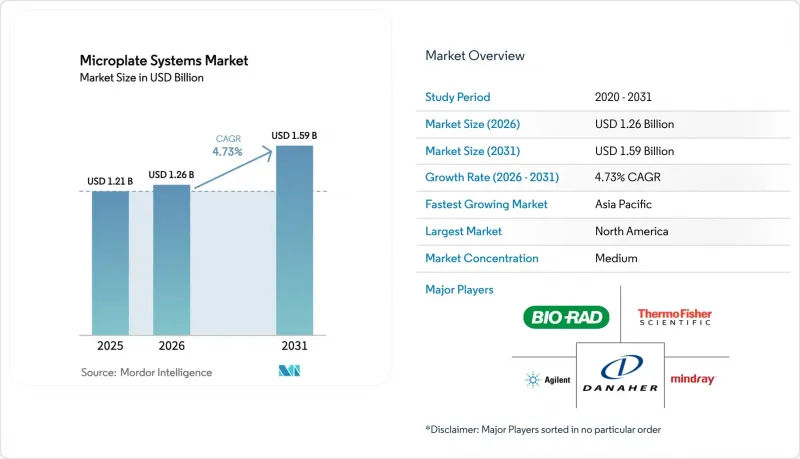
This report is Segmented by Product Type (Single-Mode Readers, Multi-Mode Readers, Microplate Washers, Pipetting & Dispensing Systems, and More), Application (Drug Discovery & HTS, and More), End User (Pharmaceutical & Biotechnology Companies, and More), and Geography (North America, Europe, Asia-Pacific, Middle East & Africa, South America). The Market Forecasts are Provided in Terms of Value (USD).
Global Microplate Systems Market Trends and Insights
Rising Adoption of High-Throughput Screening in Drug Discovery
Pharmaceutical pipelines continue to migrate toward complex modalities such as antibody-drug conjugates and cell therapies that demand phenotypic assays screening tens of thousands of compounds per campaign. Modern high-throughput platforms now process more than 100,000 data points per day by integrating robotic plate handlers, tight environmental control, and hybrid optics that switch between fluorescence polarization and time-resolved luminescence without manual changeover. This consolidation lets a single reader displace multiple single-mode devices, freeing bench space and reducing validation overhead. Biopharma R&D spending rose above USD 145 billion in 2025, intensifying pressure to improve productivity. Automation answers that call by allowing chemists to interrogate larger libraries with fewer full-time employees. Oncology and immunology programs show the greatest uptake because they rely on multiplexed cytokine profiling and live-cell imaging across 384- and 1536-well formats.
Growing Demand for Automation & Multi-Mode Detection in Diagnostics
Clinical laboratories now link sample reception, centrifugation, aliquoting, and microplate immunoassays into a single conveyor workflow, cutting manual touchpoints by more than 70% and reducing turnaround time for routine panels from 4 hours to under 90 minutes. Multi-mode readers fit seamlessly because they switch among ELISA, chemiluminescence, and fluorescence assays without operator intervention. Molecular Devices embedded AI-driven quality-control algorithms in its SpectraMax iD5e and iD3s models, released in July 2025, lowering repeat runs by an estimated 15%. Hospitals that reach 98% instrument availability can defer capital replacement by up to two years, a vital cash-flow advantage for regional networks. Demand is strongest in Asia-Pacific, where universal health coverage programs and electronic health record mandates require machine-readable assay data. Compliance frameworks such as ISO 15189 now stress audit trails, prompting vendors to add HL7 and FHIR connectivity.
High Capital & Maintenance Costs of Advanced Systems
Multi-mode readers with integrated incubators, robotic stackers, and AI modules range from USD 80,000 to USD 200,000, stretching budgets for academic cores and early-stage biotech firms. Annual service contracts add an additional 8-12% to the purchase price, covering photomultiplier replacement and software updates. Import duties in several middle-income nations inflate landed costs by up to 35%, delaying adoption. Leasing and reagent-rental models from PerkinElmer and Tecan convert capital outlay into operating expense, but multi-year minimums expose laboratories to penalty clauses if projects stall. Cost pressure sometimes steers buyers toward lower-spec single-mode devices that can become obsolete once research shifts to multiplexed assays.
Other drivers and restraints analyzed in the detailed report include:
- Expansion of Life-Sciences Research Funding
- Technological Advances in Sensitivity & Throughput
- Shortage of Skilled Technicians
For complete list of drivers and restraints, kindly check the Table Of Contents.
Segment Analysis
Multi-mode readers accounted for 36.12% of 2025 revenue and are projected to grow at 6.06% through 2031, the fastest rate among product categories, as laboratories replace single-mode absorbance units with hybrid platforms that integrate filter wheels and monochromators in a single chassis. This segment's expansion lifts the microplate systems market size because each unit commands premium pricing and pulls through ancillary software and service contracts. Single-mode readers survive in high-volume ELISA labs where cost per test rules, yet their share erodes as automated conveyor architectures need instruments that run chemiluminescence and fluorescence without downtime. Pipetting and dispensing systems gain relevance as 1536-well and 3456-well formats spread, but their uptake depends on precision at sub-microliter volumes.
Tecan's Spark and Agilent's Cytation illustrate the trend toward convergence, folding detection, environment control, and imaging into footprints under 3 m2. BMG LABTECH's VANTAstar and Molecular Devices' iD5e embed AI quality control, cutting repeat runs by 15%. Pipettor vendors focus on acoustic or piezoelectric dispensing to achieve <=1 nL precision, a must for ultra-high-density plates. Microplate washers remain essential for ELISA workflows but often sell bundled with readers, reflecting buyer preference for single-vendor support contracts. Handlers and incubators round out the ecosystem; open-source designs such as G-Bot lower entry costs but challenge incumbent profit pools.
Complete Report Scope:
- By Product Type
- Single-Mode Readers
- Multi-Mode Readers
- Microplate Washers
- Pipetting & Dispensing Systems
- Handlers & Incubators
- By Application
- Drug Discovery & HTS
- Genomics & Proteomics Research
- Clinical Diagnostics
- Cell-based Assays & Toxicity Testing
- Environmental & Food Safety Testing
- By End User
- Pharmaceutical & Biotechnology Companies
- CROs & CMOs
- Hospitals & Diagnostic Laboratories
- Academic & Research Institutes
- By Geography
- North America
- United States
- Canada
- Mexico
- Europe
- Germany
- United Kingdom
- France
- Italy
- Spain
- Rest of Europe
- Asia-Pacific
- China
- Japan
- India
- Australia
- South Korea
- Rest of Asia-Pacific
- Middle East & Africa
- GCC
- South Africa
- Rest of Middle East & Africa
- South America
- Brazil
- Argentina
- Rest of South America
- North America
Geography Analysis
North America retained a 38.29% share in 2025, fueled by biotech clusters in Boston and San Francisco, which together raised more than USD 30 billion in venture funding in 2024. Large CROs such as Charles River and IQVIA operate fleets of more than 500 readers each, ensuring consistent replacement cycles. FDA's predictable 510(k) and Computer Software Assurance frameworks lower regulatory risk, speeding adoption of AI-enabled models. Canada contributes via Genome Canada grants that direct funds to precision-medicine cores, while Mexico's demand is nascent but growing as private labs in Mexico City shift from manual ELISA to semi-automatic platforms.
Asia-Pacific is the fastest-growing region, with a 10.13% CAGR to 2031, double the global pace. China's state funding of above USD 20 billion in 2024 and India's roadmap to a USD 300 billion biotechnology value by 2030 supply robust capital for laboratory infrastructure. NMPA's accelerated approvals enable domestic firms like Mindray to capture hospital share through localized service. Japan's aging demographics drive laboratory automation, though lengthy consensus procurement slows cycles. Australia and South Korea maintain steady demand tied to genomics and biosecurity projects at leading universities.
Europe's market reflects the revised in vitro diagnostic regulation, which increases data and environmental reporting requirements. Germany, the United Kingdom, and France dominate demand, blending pharmaceutical giants with academic heavyweights such as Max Planck Institutes and the Francis Crick Institute. Sustainability rules push buyers toward ACT-labeled instruments and recyclable consumables. The Middle East and Africa, though smaller, grow as Gulf states build biotech hubs; King Abdullah University and Dubai's Mohammed bin Rashid University both installed multi-mode readers in 2025. South America sees Brazil leading, but high tariffs and currency swings temper growth. Collectively, these dynamics shape a geographically diversified microplate systems market with region-specific catalysts.
- Agilent Technologies
- Alpha Laboratories Ltd
- Berthold Technologies
- Bio-Rad Laboratories
- BMG LABTECH
- Corning
- Danaher
- Dynex Technologies
- Eppendorf
- Greiner Bio-One
- Hudson Robotics
- Lonza Group
- PerkinElmer
- Promega
- Rayto Life & Analytical Sciences
- Mindray
- Shimadzu
- Tecan Group
- Thermo Fisher Scientific
Additional Benefits:
- The market estimate (ME) sheet in Excel format
- 3 months of analyst support
TABLE OF CONTENTS
1 Introduction
- 1.1 Study Assumptions & Market Definition
- 1.2 Scope of the Study
2 Research Methodology
3 Executive Summary
4 Market Landscape
- 4.1 Market Overview
- 4.2 Market Drivers
- 4.2.1 Rising Adoption of High-Throughput Screening in Drug Discovery
- 4.2.2 Growing Demand for Automation & Multi-Mode Detection in Diagnostics
- 4.2.3 Expansion of Life-Sciences Research Funding
- 4.2.4 Technological Advances in Sensitivity & Throughput
- 4.2.5 Emergence of AI-Integrated Real-Time Analytics
- 4.2.6 Sustainability Push for Energy-Efficient Instruments & Recyclable Plates
- 4.3 Market Restraints
- 4.3.1 High Capital & Maintenance Costs of Advanced Systems
- 4.3.2 Shortage of Skilled Technicians
- 4.3.3 Semiconductor & Optical Component Supply-Chain Volatility
- 4.3.4 Competition From Lab-On-Chip Microfluidics
- 4.4 Regulatory Landscape
- 4.5 Technological Outlook
- 4.6 Porter's Five Forces Analysis
- 4.6.1 Threat of New Entrants
- 4.6.2 Bargaining Power of Buyers
- 4.6.3 Bargaining Power of Suppliers
- 4.6.4 Threat of Substitute Products
- 4.6.5 Intensity of Competitive Rivalry
5 Market Size & Growth Forecasts
- 5.1 By Product Type
- 5.1.1 Single-Mode Readers
- 5.1.2 Multi-Mode Readers
- 5.1.3 Microplate Washers
- 5.1.4 Pipetting & Dispensing Systems
- 5.1.5 Handlers & Incubators
- 5.2 By Application
- 5.2.1 Drug Discovery & HTS
- 5.2.2 Genomics & Proteomics Research
- 5.2.3 Clinical Diagnostics
- 5.2.4 Cell-based Assays & Toxicity Testing
- 5.2.5 Environmental & Food Safety Testing
- 5.3 By End User
- 5.3.1 Pharmaceutical & Biotechnology Companies
- 5.3.2 CROs & CMOs
- 5.3.3 Hospitals & Diagnostic Laboratories
- 5.3.4 Academic & Research Institutes
- 5.4 By Geography
- 5.4.1 North America
- 5.4.1.1 United States
- 5.4.1.2 Canada
- 5.4.1.3 Mexico
- 5.4.2 Europe
- 5.4.2.1 Germany
- 5.4.2.2 United Kingdom
- 5.4.2.3 France
- 5.4.2.4 Italy
- 5.4.2.5 Spain
- 5.4.2.6 Rest of Europe
- 5.4.3 Asia-Pacific
- 5.4.3.1 China
- 5.4.3.2 Japan
- 5.4.3.3 India
- 5.4.3.4 Australia
- 5.4.3.5 South Korea
- 5.4.3.6 Rest of Asia-Pacific
- 5.4.4 Middle East & Africa
- 5.4.4.1 GCC
- 5.4.4.2 South Africa
- 5.4.4.3 Rest of Middle East & Africa
- 5.4.5 South America
- 5.4.5.1 Brazil
- 5.4.5.2 Argentina
- 5.4.5.3 Rest of South America
- 5.4.1 North America
6 Competitive Landscape
- 6.1 Market Concentration
- 6.2 Market Share Analysis
- 6.3 Company Profiles (includes Global Level Overview, Market Level Overview, Core Segments, Financials as Available, Strategic Information, Market Rank/Share for Key Companies, Products & Services, and Recent Developments)
- 6.3.1 Agilent Technologies, Inc.
- 6.3.2 Alpha Laboratories Ltd
- 6.3.3 Berthold Technologies
- 6.3.4 Bio-Rad Laboratories
- 6.3.5 BMG LABTECH
- 6.3.6 Corning Incorporated
- 6.3.7 Danaher Corporation
- 6.3.8 Dynex Technologies
- 6.3.9 Eppendorf AG
- 6.3.10 Greiner Bio-One
- 6.3.11 Hudson Robotics
- 6.3.12 Lonza Group AG
- 6.3.13 PerkinElmer
- 6.3.14 Promega Corporation
- 6.3.15 Rayto Life & Analytical Sciences
- 6.3.16 Shenzhen Mindray Bio-Medical Electronics Co., Ltd
- 6.3.17 Shimadzu Corporation
- 6.3.18 Tecan Group Ltd.
- 6.3.19 Thermo Fisher Scientific Inc.
7 Market Opportunities & Future Outlook
- 7.1 White-space & Unmet-Need Assessment

