PUBLISHER: Mordor Intelligence | PRODUCT CODE: 2063574

PUBLISHER: Mordor Intelligence | PRODUCT CODE: 2063574
Zinc Polycarboxylate Cement - Market Share Analysis, Industry Trends & Statistics, Growth Forecasts (2026 - 2031)
According to Mordor Intelligence, the zinc polycarboxylate cement market size is projected to expand from USD 175.97 million in 2025 and USD 186.30 million in 2026 to USD 247.78 million by 2031, registering a CAGR of 5.87% between 2026 to 2031.
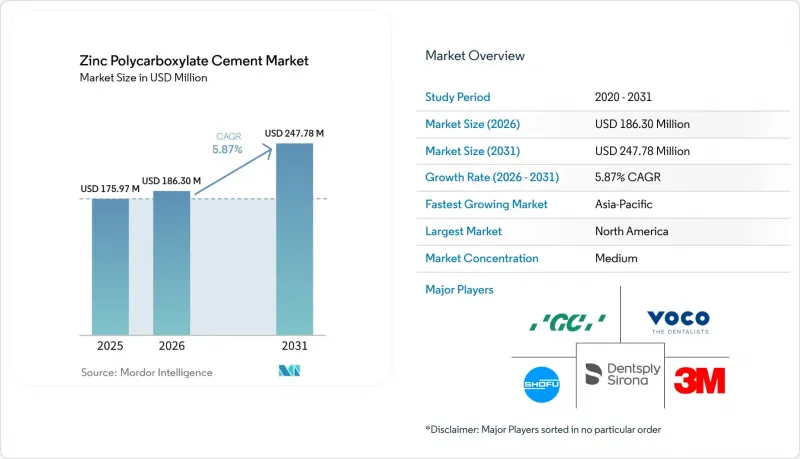
This report is Segmented by Form (Powder, Liquid), Application (Crown & Bridge Cementation, Orthodontic Band/Bracket Luting, Cavity Base/Liner, and More), End User (Hospitals, Dental Clinics, Academic & Research Institutes, Others), and Geography (North America, Europe, Asia-Pacific, Middle East and Africa, South America). The Market Forecasts are Provided in Terms of Value (USD).
Global Zinc Polycarboxylate Cement Market Trends and Insights
Rising Volume of Single-Unit Metal and Zirconia Restorations
The increasing chairside production of zirconia and metal crowns is driving growth in the zinc polycarboxylate cement market. This cement chemically bonds without requiring separate primers, offering significant time savings in high-throughput environments. Zirconia's low translucency effectively conceals the slightly opaque cement line, and clinicians can seat units under moderate moisture, providing a practical advantage over hydrophobic resin cements. Dental tourism hubs such as Thailand and Mexico prefer ISO 9917-compliant products, which eliminate the need for light-curing lamps in remote outreach clinics. In the United States, group purchasing organizations bundle zinc polycarboxylate cements with stainless-steel crown kits for Medicaid children's programs, demonstrating the niche's resilience. As CAD/CAM workflows expand, the cement's low film thickness continues to meet marginal gap requirements, ensuring its relevance in the digital era.
Accelerating Adoption in Pediatric & Geriatric Dentistry (Hypersensitivity to Resin Cements)
Clinical protocols for pediatric and geriatric patients increasingly favor biocompatible cementation methods that avoid bisphenol A and other sensitizing monomers, contributing to the steady growth of the zinc polycarboxylate cement market. Stainless-steel crowns on primary molars exhibit a five-year survival rate of 93-97% when seated with conventional acid-base cements, significantly outperforming composite alternatives. Among U.S. adults aged 65 and older, root caries prevalence reaches 60%, making the cement's fluoride release and moisture tolerance particularly suitable for these cases.Additionally, xerostomia caused by polypharmacy further limits the effectiveness of resin-based cements, reinforcing the preference for traditional chemistries. The European Union's pediatric BPA ban has further accelerated this trend, with suppliers emphasizing BPA-free labeling to attract family clinics.
Substitution by Resin-Modified Glass Ionomers & Resin Cements
Resin-hybrid cements now deliver a shear bond strength of 1.39 MPa to zirconia, outperforming the 0.85 MPa bond strength of conventional glass ionomers. These cements also exhibit strong resistance to washout under occlusal stress. Digital milling centers have standardized the use of these resins to ensure retention on CAD/CAM onlays, capturing higher-value cases that were previously dominated by the zinc polycarboxylate cement market. In a notable development, GC America's collaboration with SprintRay in March 2026 has streamlined production by linking CAD files directly to a press capable of producing ten units optimized for resin bonding in just ten minutes. With insurers now reimbursing digital crowns at parity, clinicians are increasingly transitioning to these solutions, reducing the volume of legacy cements.
Other drivers and restraints analyzed in the detailed report include:
- Cost Advantage Over Resin-Based Cements in Emerging Markets
- Demand for Self-Adhesive, Faster-Setting ZPC Formulations
- Higher Water Solubility & Marginal Leakage Concerns
For complete list of drivers and restraints, kindly check the Table Of Contents.
Segment Analysis
In 2025, the powder segment held a dominant 58.40% share of the zinc polycarboxylate cement market, driven by hospitals and teaching institutions that mix chairside for varied viscosities. These organizations procure kilogram drums through long-term contracts, effectively managing budgets and reducing losses due to product expiration. Additionally, powder-liquid kits help avoid plastic capsule waste, aligning with sustainability objectives in healthcare facilities.
Liquid capsules, however, are growing at a steady 5.98% CAGR as clinics increasingly prefer single-dose consistency and faster cleanup, particularly under stringent infection-control protocols introduced after the COVID-19 pandemic. The capsulated delivery system minimizes operator mixing errors and is particularly appealing to mobile dental units that lack glass slabs. In India, emerging brands are introducing foil-pouch powders that dissolve directly in proprietary liquids, further narrowing the distinction between segments and enhancing market penetration.
Geography Analysis
In 2025, North America captured 39.67% of the zinc polycarboxylate cement market share, supported by Medicaid and Veterans Affairs contracts that require ISO-compliant, BPA-free cements. Integrated delivery networks secure multiyear tenders, ensuring consistent supply and reducing risks associated with off-label resin use in pediatric applications. The United States dominates the region, contributing approximately 85% of sales, while Canada and Mexico account for the remainder through public benefit plans and cross-border clinics.
Asia-Pacific is projected to experience the fastest growth, with a 6.15% CAGR from 2026 to 2031. This growth is driven by localization initiatives in China and India, which lower import tariffs and accelerate product registration. Increasing disposable incomes in Indonesia and Vietnam are boosting out-of-pocket spending on restorative treatments. Additionally, government dental programs in rural India prefer powder kits due to their ability to withstand tropical storage conditions. Japan's aging population is driving consistent demand for atraumatic restorative treatments, leveraging the cement's fluoride release properties.
Europe, South America, and the Middle East & Africa collectively account for the remaining market demand. Europe is witnessing moderate growth as clinicians adapt to BPA bans and prefer traditional chemistries for pediatric applications. Brazil's public SUS network procures domestically blended powders to meet ISO 9917 radiopacity standards while managing costs. In Dubai, private clinics alternate between premium resins and conventional powders based on patient payment methods. South Africa's mobile outreach programs rely on foil-pack powder kits for their portability, maintaining steady demand across provinces in the zinc polycarboxylate cement market.
- 3M
- Dentsply Sirona
- DMP Dental
- GC Corporation
- Harvard Dental International
- Hoffmann Dental Manufaktur
- Imicryl Dental
- Kerr (Envista)
- Medental International
- Pentron (Coltene)
- Perfection Plus
- Prevest DenPro
- Prime Dental Products
- Septodont
- Shanghai Medical Instrument Co.
- Shanghai Qing Pu Dental Materials
- Shanghai Rongxiang Dental Material
- Shanghai Yuwei Dental Materials
- Shofu
- VOCO
Additional Benefits:
- The market estimate (ME) sheet in Excel format
- 3 months of analyst support
TABLE OF CONTENTS
1 Introduction
- 1.1 Study Assumptions & Market Definition
- 1.2 Scope of the Study
2 Research Methodology
3 Executive Summary
4 Market Landscape
- 4.1 Market Overview
- 4.2 Market Drivers
- 4.2.1 Rising Volume of Single-Unit Metal and Zirconia Restorations
- 4.2.2 Accelerating Adoption in Pediatric & Geriatric Dentistry (Hypersensitivity to Resin Cements)
- 4.2.3 Cost Advantage Over Resin-Based Cements in Emerging Markets
- 4.2.4 Demand For Self-Adhesive, Faster-Setting ZPC Formulations
- 4.2.5 OEM Outsourcing by Global Brands to Asian Toll Manufacturers
- 4.2.6 Regulatory Shift Toward BPA-Free Materials Pushing Legacy Chemistries
- 4.3 Market Restraints
- 4.3.1 Substitution By Resin-Modified Glass Ionomers & Resin Cements
- 4.3.2 Higher Water Solubility & Marginal Leakage Concerns
- 4.3.3 Stringent Radiopacity & Biocompatibility Testing Raising Costs
- 4.3.4 Supply Volatility of High-Purity Zinc Oxide Feedstock
- 4.4 Value / Supply-Chain Analysis
- 4.5 Regulatory Landscape
- 4.6 Technological Outlook
- 4.7 Porter's Five Forces Analysis
- 4.7.1 Threat of New Entrants
- 4.7.2 Bargaining Power of Suppliers
- 4.7.3 Bargaining Power of Buyers
- 4.7.4 Threat of Substitutes
- 4.7.5 Competitive Rivalry
5 Market Size & Growth Forecasts (Value, USD)
- 5.1 By Form
- 5.1.1 Powder
- 5.1.2 Liquid
- 5.2 By Application
- 5.2.1 Crown & Bridge Cementation
- 5.2.2 Orthodontic Band/Bracket Luting
- 5.2.3 Cavity Base / Liner
- 5.2.4 Temporary / Pediatric Restorations
- 5.3 By End User
- 5.3.1 Hospitals
- 5.3.2 Dental Clinics
- 5.3.3 Academic & Research Institutes
- 5.3.4 Others
- 5.4 By Geography
- 5.4.1 North America
- 5.4.1.1 United States
- 5.4.1.2 Canada
- 5.4.1.3 Mexico
- 5.4.2 Europe
- 5.4.2.1 Germany
- 5.4.2.2 United Kingdom
- 5.4.2.3 France
- 5.4.2.4 Italy
- 5.4.2.5 Spain
- 5.4.2.6 Rest of Europe
- 5.4.3 Asia-Pacific
- 5.4.3.1 China
- 5.4.3.2 India
- 5.4.3.3 Japan
- 5.4.3.4 South Korea
- 5.4.3.5 Australia
- 5.4.3.6 Rest of Asia-Pacific
- 5.4.4 Middle East and Africa
- 5.4.4.1 GCC
- 5.4.4.2 South Africa
- 5.4.4.3 Rest of Middle East and Africa
- 5.4.5 South America
- 5.4.5.1 Brazil
- 5.4.5.2 Argentina
- 5.4.5.3 Rest of South America
- 5.4.1 North America
6 Competitive Landscape
- 6.1 Market Concentration
- 6.2 Market Share Analysis
- 6.3 Company Profiles (includes Global level Overview, Market-level Overview, Core Segments, Financials, Strategic Information, Market Rank/Share, Products & Services, Recent Developments)
- 6.3.1 3M Company
- 6.3.2 Dentsply Sirona
- 6.3.3 DMP Dental
- 6.3.4 GC Corporation
- 6.3.5 Harvard Dental International
- 6.3.6 Hoffmann Dental Manufaktur
- 6.3.7 Imicryl Dental
- 6.3.8 Kerr (Envista)
- 6.3.9 Medental International
- 6.3.10 Pentron (Coltene)
- 6.3.11 Perfection Plus
- 6.3.12 Prevest DenPro
- 6.3.13 Prime Dental Products
- 6.3.14 Septodont
- 6.3.15 Shanghai Medical Instrument Co.
- 6.3.16 Shanghai Qing Pu Dental Materials
- 6.3.17 Shanghai Rongxiang Dental Material
- 6.3.18 Shanghai Yuwei Dental Materials
- 6.3.19 Shofu
- 6.3.20 VOCO GmbH
7 Market Opportunities & Future Outlook
- 7.1 White-space & Unmet-Need Assessment

