
PUBLISHER: Mordor Intelligence | PRODUCT CODE: 2063600

PUBLISHER: Mordor Intelligence | PRODUCT CODE: 2063600
HER2 Testing - Market Share Analysis, Industry Trends & Statistics, Growth Forecasts (2026 - 2031)
According to Mordor Intelligence, the hER2 testing market size was valued at USD 217.46 million in 2025 and is estimated to grow from USD 234.82 million in 2026 to reach USD 346.86 million by 2031, at a CAGR of 8.09% during the forecast period (2026-2031).
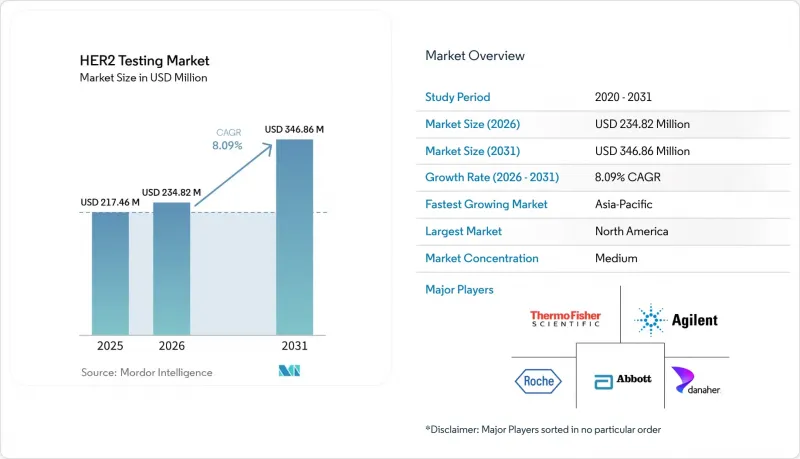
This report is Segmented by Test Modality (IHC, ISH, PCR/DPCR, NGS/CGP), Sample Type (Tissue/FFPE, Liquid Biopsy), Cancer Type (Breast, Gastric/GEJ, NSCLC, Colorectal, Biliary/Pancreatic), End User (Hospital/Academic Labs, Reference Labs, Research/CROs), and Geography (North America, South America, Europe, APAC, MEA). Market Forecasts are Provided in Value (USD).
Global HER2 Testing Market Trends and Insights
HER2-Low Eligibility Expands Tested Population
In January 2025, the FDA approved Roche's PATHWAY HER2 (4B5) rabbit monoclonal antibody, enabling the identification of HER2-ultralow expression. This significant development expanded the eligibility for trastuzumab deruxtecan to patients previously classified as HER2-negative. Laboratories are now required to differentiate between IHC 0 and 1+, a process that increases slide volumes and drives demand for external proficiency programs. Studies in 2024 revealed only 60-75% agreement among pathologists in HER2-low scoring, prompting the adoption of whole-slide imaging and AI to standardize readings. The rise in retest rates has led to higher reagent consumption and more frequent quality-control runs, contributing to the steady growth of the HER2 testing market.
Tumor-Agnostic HER2-Positive Approvals Widen Testing Across Tumor Types
In March 2026, Japan granted a tumor-agnostic authorization for trastuzumab deruxtecan, requiring pathologists to evaluate HER2 levels across nearly all solid tumors. This decision mirrored an FDA tissue-agnostic approval in April 2024, which prompted U.S. oncology centers to incorporate HER2 immunostaining into protocols for colorectal, lung, biliary, and pancreatic cancers. A July 2025 analysis of 65,000 tumors identified actionable HER2 positivity in nearly 10% of bladder and endometrial cancers, highlighting untapped sample volumes. This expanded testing requirement has driven significant revenue growth for independent reference laboratories, particularly those bundling HER2 with KRAS, BRAF, and MSI markers in comprehensive panels, further strengthening the HER2 testing market.
Low-End (0 vs 1+) IHC Reproducibility Challenges
Subtle membrane-staining differences between IHC 0 and 1+ result in variable readings, potentially withholding therapy from eligible patients. A 2024 survey in Sweden indicated that only half of laboratories met proficiency benchmarks on low-expression samples. Variation arises from factors such as cold ischemia, under-fixation, and antibody selection, driving the demand for external quality assessment programs and digital image analysis. These ongoing inconsistencies reduce physician confidence and limit the growth of the HER2 testing market, particularly in resource-constrained regions.
Other drivers and restraints analyzed in the detailed report include:
- Guideline-Mandated Testing in Breast and Gastric/GEJ Cancers
- Hospital and Lab Infrastructure Upgrades, Automation
- IHC-ISH Discordance and Pre-Analytical Variability
For complete list of drivers and restraints, kindly check the Table Of Contents.
Segment Analysis
Guidelines favoring protein visualization on tissue helped immunohistochemistry secure 48.19% of the HER2 testing market's 2025 revenue. Next-generation sequencing, projected to grow at an annual rate of 9.56% through 2031, is being integrated into laboratories' comprehensive panels for ERBB2 copy-number and mutation analysis. The market for NGS-based HER2 testing is set to rise alongside companion-diagnostic labels for zanidatamab and zongertinib. While in situ hybridization is the go-to confirmatory method for ambiguous IHC 2+ cases, its share is declining as AI-enhanced IHC improves first-pass accuracy.
FFPE tissue accounted for a dominant 85.19% of the HER2 testing market's 2025 volume, thanks to its longstanding role in histopathology. Tissue, being the gold standard for protein and gene assessment, enjoys robust reimbursement support. While the market size for liquid biopsy in HER2 testing is smaller, it is on a rapid ascent, projected to grow at a 10.56% CAGR through 2031. Plasma-based assays are proving invaluable for inaccessible metastatic lesions and enable serial monitoring without the need for new biopsies.
Geography Analysis
In 2025, North America accounted for 43.12% of the HER2 testing market revenue, driven by extensive insurance coverage and rapid adoption of digital pathology. The U.S. benefits from a consistent pipeline of FDA companion-diagnostic approvals, integrating HER2 assessments into treatment pathways. Meanwhile, Canada's adherence to U.S. guidelines, supported by its publicly funded healthcare system, ensures stable testing volumes.
Asia-Pacific is projected to achieve a 10.43% CAGR through 2031, as regulators in China and Japan expand indications for trastuzumab deruxtecan. China's approval in March 2026 for neoadjuvant breast cancer advances HER2 testing to earlier disease stages, increasing the number of slides required per patient. In 2024, Tata Memorial Centre in India implemented a hub-and-spoke digital pathology model, enabling regional hospitals to access centralized expert readings. South Korea's K-MASTER platform incorporates HER2 testing into a national precision medicine initiative, ensuring reimbursement and promoting standardization.
Europe, guided by consistent ESMO guidelines and ISO quality standards, faces price variability due to differing reimbursement policies, which slows the adoption of premium NGS panels. Germany, France, and the U.K. lead in volume, supported by Roche's CE-marked navify image analysis, which accelerates turnaround times. While Latin America and the Middle East encounter infrastructure challenges, strategic investments in Turkey, Saudi Arabia, and Brazil are establishing new laboratories and expanding the HER2 testing market's reach.
- Abbott Laboratories
- Agilent Technologies
- ARUP Laboratories
- Bio SB, Inc.
- Biocare Medical
- Caris Life Sciences, Inc.
- Danaher
- Roche
- Guardant Health
- Ibex Medical Analytics Ltd.
- Illumina
- LabCorp
- NeoGenomics Laboratories
- PathAI, Inc.
- Quest Diagnostics
- Sysmex
- Tempus Labs Inc.
- Thermo Fisher Scientific
- Visiopharm
- ZytoVision GmbH
Additional Benefits:
- The market estimate (ME) sheet in Excel format
- 3 months of analyst support
TABLE OF CONTENTS
1 Introduction
- 1.1 Study Assumptions & Market Definition
- 1.2 Scope of the Study
2 Research Methodology
3 Executive Summary
4 Market Landscape
- 4.1 Market Overview
- 4.2 Market Drivers
- 4.2.1 HER2-Low Eligibility Expands Tested Population
- 4.2.2 Tumor-Agnostic HER2-Positive Approvals Widen Testing Across Tumor Types
- 4.2.3 Guideline-Mandated Testing in Breast and Gastric/GEJ Cancers
- 4.2.4 Hospital and Lab Infrastructure Upgrades, Automation
- 4.2.5 Digital Pathology and AI Adoption Improves HER2 Scoring Throughput
- 4.2.6 Liquid Biopsy and CGP Panels Broaden Access to ERBB2 Assessment
- 4.3 Market Restraints
- 4.3.1 Low-End (0 Vs 1+) IHC Reproducibility Challenges
- 4.3.2 IHC-ISH Discordance and Pre-Analytical Variability
- 4.3.3 Skilled Personnel and QC Burden for Consistent HER2 Reads
- 4.3.4 Limited Validation of Ctdna for HER2-Low/Ultralow
- 4.4 Value Chain Analysis
- 4.5 Regulatory Landscape
- 4.6 Technological Outlook
- 4.7 Porter's Five Forces Analysis
5 Market Size & Growth Forecasts (Value, USD)
- 5.1 By Test Modality
- 5.1.1 Immunohistochemistry (IHC)
- 5.1.2 In Situ Hybridization (FISH, CISH, SISH)
- 5.1.3 PCR/dPCR
- 5.1.4 Next-Generation Sequencing (NGS/CGP)
- 5.2 By Sample Type
- 5.2.1 Tissue/FFPE Biopsy
- 5.2.2 Liquid Biopsy (Plasma ctDNA)
- 5.3 By Cancer Type / Application
- 5.3.1 Breast Cancer (incl. HER2-low)
- 5.3.2 Gastric & Gastroesophageal Junction Adenocarcinoma
- 5.3.3 Non-Small Cell Lung Cancer (HER2-altered)
- 5.3.4 Colorectal Cancer (HER2-amplified subset)
- 5.3.5 Biliary Tract & Pancreatic Cancers (HER2-positive subset)
- 5.4 By End User
- 5.4.1 Hospital & Academic Pathology Laboratories
- 5.4.2 Independent Reference/Central Laboratories
- 5.4.3 Research Institutes & CROs (clinical trials, translational)
- 5.5 By Geography
- 5.5.1 North America
- 5.5.1.1 United States
- 5.5.1.2 Canada
- 5.5.1.3 Mexico
- 5.5.2 Europe
- 5.5.2.1 Germany
- 5.5.2.2 United Kingdom
- 5.5.2.3 France
- 5.5.2.4 Italy
- 5.5.2.5 Spain
- 5.5.2.6 Rest of Europe
- 5.5.3 Asia-Pacific
- 5.5.3.1 China
- 5.5.3.2 India
- 5.5.3.3 Japan
- 5.5.3.4 South Korea
- 5.5.3.5 Australia
- 5.5.3.6 Rest of Asia-Pacific
- 5.5.4 Middle East and Africa
- 5.5.4.1 GCC
- 5.5.4.2 South Africa
- 5.5.4.3 Rest of Middle East and Africa
- 5.5.5 South America
- 5.5.5.1 Brazil
- 5.5.5.2 Argentina
- 5.5.5.3 Rest of South America
- 5.5.1 North America
6 Competitive Landscape
- 6.1 Market Concentration
- 6.2 Market Share Analysis
- 6.3 Company Profiles (includes Global level Overview, Market-level Overview, Core Segments, Financials, Strategic Information, Market Rank/Share, Products & Services, Recent Developments)
- 6.3.1 Abbott Laboratories
- 6.3.2 Agilent Technologies Inc.
- 6.3.3 ARUP Laboratories
- 6.3.4 Bio SB, Inc.
- 6.3.5 Biocare Medical, LLC
- 6.3.6 Caris Life Sciences, Inc.
- 6.3.7 Danaher Corporation
- 6.3.8 F. Hoffmann-La Roche AG
- 6.3.9 Guardant Health Inc.
- 6.3.10 Ibex Medical Analytics Ltd.
- 6.3.11 Illumina Inc.
- 6.3.12 Laboratory Corporation of America Holdings
- 6.3.13 NeoGenomics Laboratories, Inc.
- 6.3.14 PathAI, Inc.
- 6.3.15 Quest Diagnostics Incorporated
- 6.3.16 Sysmex Corporation
- 6.3.17 Tempus Labs Inc.
- 6.3.18 Thermo Fisher Scientific Inc.
- 6.3.19 Visiopharm A/S
- 6.3.20 ZytoVision GmbH
7 Market Opportunities & Future Outlook
- 7.1 White-space & unmet-need assessment

