PUBLISHER: Mordor Intelligence | PRODUCT CODE: 2063623

PUBLISHER: Mordor Intelligence | PRODUCT CODE: 2063623
Kazakhstan-China Freight Forwarding - Market Share Analysis, Industry Trends & Statistics, Growth Forecasts (2026 - 2031)
According to Mordor Intelligence, the kazakhstan-China freight forwarding market size is projected to expand from USD 370.15 million in 2025 and USD 402.74 million in 2026 to USD 583.93 million by 2031, registering a CAGR of 7.71% between 2026 to 2031.
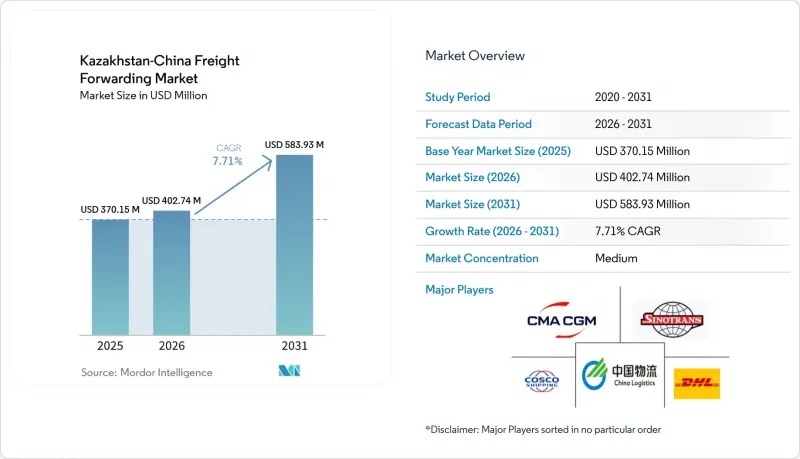
A sustained pivot away from the northern Russian corridor, record bilateral trade, and Belt and Road Initiative (BRI) rail and road upgrades are enlarging freight volumes on every mode. This report is Segmented by Mode of Transport (Air Freight Forwarding, Sea Freight Forwarding, and Ground Freight Forwarding), by End-User Industry (Manufacturing & Automotive, Construction, and Others), and by Flow Direction(Kazakhstan To China (Exported From Kazakhstan), and China To Kazakhstan (Imported To Kazakhstan)). The Market Forecasts are Provided in Terms of Value (USD).
Kazakhstan-China Freight Forwarding Market Trends and Insights
BRI-Led Infrastructure Investment and Multi-Corridor Expansion Generating Structural Freight Forwarding Demand
In 2025, the Khorgos Gateway dry port significantly accelerated operational throughput by adding 10 new broad-gauge railway tracks and upgrading its intelligent infrastructure, slashing container transshipment times from 5 hours to 1 hour and driving annual handling volume past 372,000 TEUs. KTZ Express opened a 140,000 TEU container hub at Aktau in December 2025, adding cranes and yard space to shorten vessel turnaround times. Joint working groups now aim to reach 1,000 container trains on the Trans-Caspian route by 2027, doubling to 2,000 by 2029. Capacity upgrades trigger a self-reinforcing cycle: higher volume justifies fresh capital, locking the corridor into long-term growth. The strategy cements Kazakhstan as the principal land bridge between Chinese factories and European buyers.
Record-Breaking Kazakhstan-China Bilateral Trade Volumes Creating Cross-Sector Freight Forwarding Demand
Goods trade climbed to USD 48.7 billion in 2025, up 11% year on year. Chinese investment of USD 23 billion in the first half of 2025 alone financed large aluminum and copper smelters that import machinery and export metals. Agricultural freight is growing rapidly; in 2025, rail-bound grain exports to China surpassed 4.2 million tons, driven by a massive structural shift toward specialized, containerized feed shipments, which reached a record 3.1 million tons. Vehicle exports to China exceeded USD 160 million in the first half of 2025 as joint-venture assembly plants scaled output. Diversifying flows beyond hydrocarbons improves container back-haul utilization and shields forwarders from oil price swings.
Physical Infrastructure Bottlenecks and Rail Gauge Incompatibility at Border Crossings Limiting Throughput Capacity
Standard-gauge Chinese wagons must transship to broad-gauge Kazakh wagons, adding 6-12 hours per train and saturating siding capacity during peak seasons. Although Khorgos expanded to 800,000 TEU a year, overflow already strains adjacent yards. Planned second-track projects will not deliver relief until after 2027, so forwarders must budget longer dwell times and higher demurrage in the medium term.
Other drivers and restraints analyzed in the detailed report include:
- Geopolitical Re-Routing Post Russia-Ukraine War: Elevating Kazakhstan as an Indispensable Transit Hub
- Digital Customs Modernization and Smart Logistics Technology: Reducing Freight Transit Lead Times
- Declining Caspian Sea Water Levels Constraining Maritime Freight Capacity on the Trans-Caspian Route
For complete list of drivers and restraints, kindly check the Table Of Contents.
Segment Analysis
Ground services captured 94.59% of the Kazakhstan-China freight forwarding market share in 2025. Rail accounts for most tonnage, moving bulk copper, grain, and coal at low unit cost, while road accelerates time-critical shipments such as live plants and e-commerce returns. The TIR haul from Guangzhou to Almaty, completed in five days, shows the road's speed advantage over the rail's 15-day average on the same corridor. Multimodal offerings now integrate road legs with rail block trains and ferry links via the Caspian, enhancing schedule flexibility.
Air freight is the fastest-growing mode, forecast to post a 9.96% CAGR through 2031. Explosive, unprecedented year-over-year growth in cross-border parcel volumes is the primary catalyst driving this surge. Government plans for full-scale cargo hubs and removal of Kazakhstan's 25-year aircraft age limit encourage operators like YTO Express and QazPost to invest in 60,000 m2 of new warehousing. With domestic jet-fuel supply expansion and tariff revisions underway, the air component is set to transition from a niche to a mainstream option for high-value electronics and fashion.
List of Companies Covered in this Report:
- COSCO SHIPPING Holdings Co., Ltd.
- KTZ Express
- Sinotrans Ltd.
- DHL Group
- CMA CGM Group (including CEVA Logistics)
- China Logistics Group Co., Ltd.
- Kerry Logistics
- DSV A/S (including DB Schenker)
- UTLC ERA
- UPS
- FedEx
- Nur Trans Service
- TransContainer
- Yuxinou (Chongqing) Logistics
- China Railway Container Transport (CRCT)
- Kuehne+Nagel
- Globalink Logistics
- Hellmann Worldwide Logistics
- Nippon Express
- Eurotrans Group LLC
Additional Benefits:
- The market estimate (ME) sheet in Excel format
- 3 months of analyst support
TABLE OF CONTENTS
1 Introduction
- 1.1 Study Assumptions and Market Definition
- 1.2 Scope of the Study
2 Research Methodology
3 Executive Summary
4 Market Landscape
- 4.1 Market Overview
- 4.2 Market Drivers
- 4.2.1 BRI-Led Infrastructure Investment and Multi-Corridor Expansion Generating Structural Freight Forwarding Demand
- 4.2.2 Record-Breaking Kazakhstan-China Bilateral Trade Volumes Creating Cross-Sector Freight Forwarding Demand
- 4.2.3 Geopolitical Re-Routing Post Russia-Ukraine War: Elevating Kazakhstan as an Indispensable Transit Hub
- 4.2.4 Digital Customs Modernization and Smart Logistics Technology: Reducing Freight Transit Lead Times
- 4.2.5 Diversified Industrial End-User Demand Across Mining, Oil & Gas, Agriculture, Manufacturing & Automotive
- 4.2.6 Growth of Temperature-Controlled Rail Containers
- 4.3 Market Restraints
- 4.3.1 Physical Infrastructure Bottlenecks and Rail Gauge Incompatibility at Border Crossings Limiting Throughput Capacity
- 4.3.2 Declining Caspian Sea Water Levels Constraining Maritime Freight Capacity on the Trans-Caspian Route
- 4.3.3 Heightened Western Sanctions Compliance Obligations and Dual-Use Cargo Scrutiny Causing Systemic Freight Delays
- 4.3.4 Fragmented Multi-Jurisdictional Regulatory Frameworks, Non-Harmonized Tariffs, and Multi-Modal Procedural Complexity
- 4.4 Value / Supply-Chain Analysis
- 4.5 Regulatory Landscape
- 4.6 Technological Outlook
- 4.7 Porter's Five Forces
- 4.7.1 Threat of New Entrants
- 4.7.2 Bargaining Power of Suppliers
- 4.7.3 Bargaining Power of Buyers
- 4.7.4 Threat of Substitutes
- 4.7.5 Competitive Rivalry
- 4.8 Impact of Geo-Political Events
5 Market Size and Growth Forecasts (Value, 2021-2031)
- 5.1 By Mode of Transport
- 5.1.1 Air Freight Forwarding
- 5.1.2 Sea Freight Forwarding
- 5.1.3 Ground (Road and Rail) Freight Forwarding
- 5.2 By End-User Industry
- 5.2.1 Manufacturing and Automotive
- 5.2.2 Oil and Gas, Mining and Quarrying
- 5.2.3 Agriculture, Fishing and Forestry
- 5.2.4 Construction
- 5.2.5 Distributive Trade (Wholesale/Retail, FMCG)
- 5.2.6 Other End Users (Telecom, Pharmaceutical, etc.)
- 5.3 By Flow Direction
- 5.3.1 Kazakhstan to China (Exported from Kazakhstan)
- 5.3.2 China to Kazakhstan (Imported to Kazakhstan)
6 Competitive Landscape
- 6.1 Market Concentration
- 6.2 Strategic Moves
- 6.3 Market Share Analysis
- 6.4 Company Profiles (includes Global level Overview, Market level overview, Core Segments, Financials as available, Strategic Information, Market Rank/Share for Key Companies, Products & Services, and Recent Developments)
- 6.4.1 COSCO SHIPPING Holdings Co., Ltd.
- 6.4.2 KTZ Express
- 6.4.3 Sinotrans Ltd.
- 6.4.4 DHL Group
- 6.4.5 CMA CGM Group (including CEVA Logistics)
- 6.4.6 China Logistics Group Co., Ltd.
- 6.4.7 Kerry Logistics
- 6.4.8 DSV A/S (including DB Schenker)
- 6.4.9 UTLC ERA
- 6.4.10 UPS
- 6.4.11 FedEx
- 6.4.12 Nur Trans Service
- 6.4.13 TransContainer
- 6.4.14 Yuxinou (Chongqing) Logistics
- 6.4.15 China Railway Container Transport (CRCT)
- 6.4.16 Kuehne+Nagel
- 6.4.17 Globalink Logistics
- 6.4.18 Hellmann Worldwide Logistics
- 6.4.19 Nippon Express
- 6.4.20 Eurotrans Group LLC
7 Market Opportunities and Future Outlook
- 7.1 White-space and Unmet-Need Assessment

