PUBLISHER: Mordor Intelligence | PRODUCT CODE: 2063640

PUBLISHER: Mordor Intelligence | PRODUCT CODE: 2063640
Asia-Pacific Machining Centers - Market Share Analysis, Industry Trends & Statistics, Growth Forecasts (2026 - 2031)
According to Mordor Intelligence, the asia-Pacific machining centers market size was valued at USD 12.25 billion in 2025 and is estimated to grow from USD 12.79 billion in 2026 to reach USD 15.70 billion by 2031, at a CAGR of 4.19% during the forecast period (2026-2031).
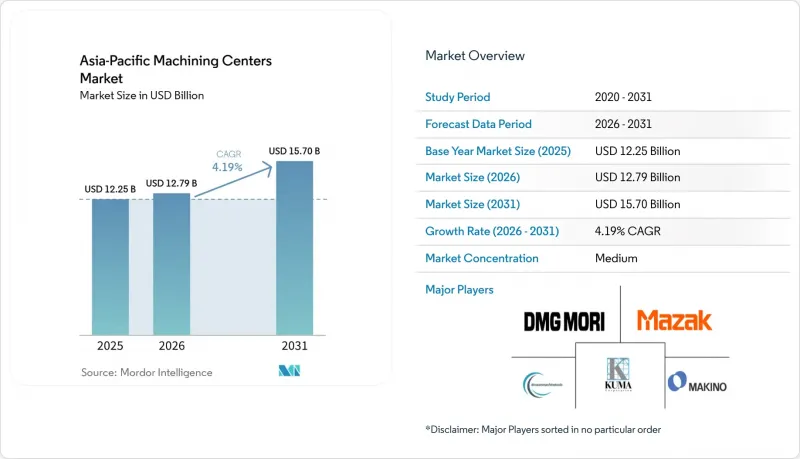
This report is Segmented by Machine Type (Horizontal Machining Centers, and More), by Axis Configuration (3-Axis, 4-Axis, 5-Axis & Above), by Spindle Orientation (Horizontal, and More), by Structure Type (Column-Type, Gantry-Type, and Moving-Table), by End-User Industry (Automotive, and More), and by Country (China, and More). The Market Forecasts are Provided in Terms of Value (USD).
Asia-Pacific Machining Centers Market Trends and Insights
Electronics Manufacturing Reshoring in Asia-Pacific Accelerates Precision Machining Demand
As electronics assemblers and printed circuit board manufacturers diversify their geographic footprints, the establishment of new production lines is driving the need for precision milling and turning equipment to produce essential molds, jigs, and dies. In Vietnam, Samsung's six major manufacturing complexes and the robust Apple supplier corridors in the northern provinces have established a dominant electronics manufacturing hub, collectively boosting current and forward-looking orders for compact vertical machining centers. Meanwhile, India's expanding tech supply chain saw the addition of a USD 30 million aluminum-housing facility in Chennai, designed to produce 1.2 million units per month, underscoring the growing need for flexible machining cells. Further south, Thailand's Board of Investment approved a total of USD 8.91 billion in electronics and electrical appliance investments for 2025. This surge will heavily depend on high-speed spindle platforms for advanced connector tooling. Overall, procurement trends are shifting away from traditional mass production toward high-mix, small-batch capabilities, further accelerating the regional machining centers market. Because mandatory ISO 9001 quality audits are required to enter these lucrative tech supply chains, even mid-tier machine shops are being compelled to upgrade their legacy equipment.
Internal Combustion Engine (ICE)-to-Electric Vehicle (EV) Powertrain Shift Drives Multi-Axis Machining Adoption Across Automotive Sector
Shifting from internal-combustion engines to battery power removes many legacy parts yet introduces new precision needs for motor housings, battery trays, and reduction gears that call for simultaneous five-axis cutting. Uno Minda invested USD 51 million in its Pune plant to install 5-axis cells dedicated to aluminum battery trays, with production slated for 2026. Japan's trade ministry's export controls on advanced five-axis controllers underscore the technology's strategic value. As EV volumes rise, the Asia-Pacific machining centers market benefits as suppliers either upgrade three-axis lines with rotary tables or buy full multi-axis platforms. Furthermore, the automotive push to offset the massive weight of batteries with large-scale aluminum structural castings is accelerating demand for large-envelope, high-torque multi-axis centers. This structural shift ensures sustained capital expenditure from Tier 1 suppliers eager to secure lucrative, long-term EV platform contracts.
High Upfront Capital Expenditure (CAPEX) and Long Payback Periods Limit New Equipment Investments
A mid-range five-axis machining center can cost up to USD 800,000, while total ownership over five years often exceeds USD 1.2 million, including installation and tooling. Small firms in Vietnam and Thailand run on net margins below 8% and struggle to secure bank financing without state co-investment. Machine builders now push modular designs so buyers can start with a three-axis frame and bolt on rotary tables later, spreading cash outlay across several years. Leasing and pay-per-spindle-hour models are emerging in India and Indonesia, lowering barriers yet creating dependence on vendor uptime guarantees. Until financing terms ease, this restraint will weigh on the Asia-Pacific machining centers market, especially among tier-2 suppliers.
Other drivers and restraints analyzed in the detailed report include:
- Smart Factory Incentives in China Japan and South Korea Boost Computer Numerical Control (CNC) Automation Investments
- Dark Factory Expansion in China and Singapore Drives Automated Machining Center Deployment
- Skilled Labor Shortages Across ASEAN Hinder Machining Center Utilization
For complete list of drivers and restraints, kindly check the Table Of Contents.
Segment Analysis
Vertical machining centers accounted for 38% of the Asia-Pacific machining centers market share in 2025 because they cut common prismatic parts such as engine blocks and mold bases at the lowest cost per spindle hour. Widespread dealer support across China, India, and Thailand keeps maintenance costs low and lets job shops add capacity quickly. Orders from consumer-electronics suppliers in Vietnam and Malaysia also favor vertical formats that fit tight floor plans and evacuate chips by gravity, preserving surface finish on aluminum housings. The Asia-Pacific machining centers market gains additional pull from Thailand's 47 electronics projects, many of which specify high-speed VMC cells for connector tooling.
The Asia-Pacific machining centers market size for multi-tasking machining centers is projected to expand at a 6.20% CAGR between 2026 and 2031 as buyers consolidate milling and turning to save floor space. DMG Mori's NTX series, ACCUWAY turn-mill lines, and Tongtai's three-turret platform enable aerospace and medical shops to finish complex parts in a single setup, reducing work-in-process by up to 40%. These machines demand operators fluent in both G-code families, which is scarce across ASEAN, so builders bundle simulation software and remote support to speed adoption. As automotive suppliers retool for electric-vehicle battery trays, they increasingly specify multi-tasking capability to combine roughing, finishing, and probing on the same platform, reinforcing the growth trajectory.
Three-axis systems held 46% of the Asia-Pacific machining centers market share in 2025 because they achieve tolerances acceptable for most steel and aluminum parts while keeping programming simple. Tier-2 automotive and appliance vendors rely on these machines to meet short delivery windows with minimal operator training. Chinese and Indian refurbishers also supply used three-axis units at 60% of new-machine prices, further extending their footprint.
Five-axis platforms are advancing at a 6.80% CAGR through 2031, reflecting demand for turbine blades, aerospace brackets, and electric-vehicle motor housings that require simultaneous contouring. Yumoto Denki's 32-pallet automated cell now runs five-axis machines 18 hours unattended, proving the productivity boost achievable with advanced setups. Export controls on sub-3-micron accuracy units from Japan reinforce regional sourcing, concentrating technical support and training in Japan, South Korea, and Taiwan.
List of Companies Covered in this Report:
- Yamazaki Mazak Corporation
- DMG Mori Co., Ltd.
- Okuma Corporation
- Makino Milling Machine Co., Ltd.
- Doosan Machine Tools Co., Ltd.
- Hyundai WIA Corporation
- Haas Automation, Inc.
- JTEKT Corporation
- Fanuc Corporation
- Fair Friend Group
- Hurco Companies, Inc.
- MHI Machine Tool Co., Ltd.
- Chongqing Machine Tool Co., Ltd.
- Guangdong Taikan NC Machine Co., Ltd.
- Dalian Machine Tool Group
- Brother Industries, Ltd.
- Kiwa Japan Co., Ltd.
- Hwacheon Machine Tools Co., Ltd.
- Ace Micromatic Group
- Shanghai THREEGUN Machine Tool Co., Ltd.
- Shenyang Machine Tool Co., Ltd.
- Nidec Machine Tool Corporation
- Sodick Co., Ltd.
Additional Benefits:
- The market estimate (ME) sheet in Excel format
- 3 months of analyst support
TABLE OF CONTENTS
1 Introduction
- 1.1 Study Assumptions & Market Definition
- 1.2 Scope of the Study
2 Research Methodology
3 Executive Summary
4 Market Landscape
- 4.1 Market Overview
- 4.2 Market Drivers
- 4.2.1 Electronics manufacturing reshoring in Asia-Pacific accelerates precision machining demand
- 4.2.2 ICE-to-EV powertrain shift drives multi-axis machining adoption across automotive sector
- 4.2.3 Smart factory incentives in China, Japan, and South Korea boost CNC automation investments
- 4.2.4 Asia-Pacific space start-ups increase demand for advanced precision machining capabilities
- 4.2.5 Dark factory expansion in China and Singapore drives automated machining center deployment
- 4.2.6 Titanium implant manufacturing growth in India raises need for high-precision machining
- 4.3 Market Restraints
- 4.3.1 High upfront CAPEX and long payback periods limit new equipment investments
- 4.3.2 Skilled labor shortages across ASEAN hinder machining center utilization
- 4.3.3 Semiconductor capex volatility disrupts machining equipment demand cycles
- 4.3.4 Retrofit preference over new machine purchases in Japan slows market growth
- 4.4 Value/Supply-Chain Analysis
- 4.5 Regulatory Landscape
- 4.6 Technological Outlook
- 4.7 Industry Attractiveness - Porter's Five Forces
- 4.7.1 Threat of New Entrants
- 4.7.2 Bargaining Power of Suppliers
- 4.7.3 Bargaining Power of Buyers
- 4.7.4 Threat of Substitutes
- 4.7.5 Competitive Rivalry
5 Market Size and Growth Forecasts (Value, USD)
- 5.1 By Machine Type
- 5.1.1 Horizontal Machining Centers (HMC)
- 5.1.2 Vertical Machining Centers (VMC)
- 5.1.3 Universal/5-Axis Machining Centers
- 5.1.4 Multi-Tasking Machining Centers (MTM)
- 5.1.5 Others (Gantry/Bridge-Type Centers, Turn-Mill Centers)
- 5.2 By Axis Configuration
- 5.2.1 3-Axis
- 5.2.2 4-Axis
- 5.2.3 5-Axis & Above
- 5.3 By Spindle Orientation
- 5.3.1 Horizontal
- 5.3.2 Vertical
- 5.3.3 Multi-spindle
- 5.4 By Structure Type
- 5.4.1 Column-Type
- 5.4.2 Gantry-Type
- 5.4.3 Moving-Table
- 5.5 By End-User Industry
- 5.5.1 Automotive
- 5.5.2 Aerospace & Defense
- 5.5.3 Energy (Oil-Gas, Renewables)
- 5.5.4 Medical Devices
- 5.5.5 Mold and Die Manufacturing
- 5.5.6 Others (General Manufacturing, Job Shops, Electronics, etc.)
- 5.6 By Country
- 5.6.1 China
- 5.6.2 Japan
- 5.6.3 India
- 5.6.4 Australia
- 5.6.5 South Korea
- 5.6.6 Rest of Asia-Pacific
6 Competitive Landscape
- 6.1 Market Concentration
- 6.2 Strategic Moves
- 6.3 Market Share Analysis
- 6.4 Company Profiles (includes Global level Overview, Market level overview, Core Segments, Financials as available, Strategic Information, Products & Services, and Recent Developments)
- 6.4.1 Yamazaki Mazak Corporation
- 6.4.2 DMG Mori Co., Ltd.
- 6.4.3 Okuma Corporation
- 6.4.4 Makino Milling Machine Co., Ltd.
- 6.4.5 Doosan Machine Tools Co., Ltd.
- 6.4.6 Hyundai WIA Corporation
- 6.4.7 Haas Automation, Inc.
- 6.4.8 JTEKT Corporation
- 6.4.9 Fanuc Corporation
- 6.4.10 Fair Friend Group
- 6.4.11 Hurco Companies, Inc.
- 6.4.12 MHI Machine Tool Co., Ltd.
- 6.4.13 Chongqing Machine Tool Co., Ltd.
- 6.4.14 Guangdong Taikan NC Machine Co., Ltd.
- 6.4.15 Dalian Machine Tool Group
- 6.4.16 Brother Industries, Ltd.
- 6.4.17 Kiwa Japan Co., Ltd.
- 6.4.18 Hwacheon Machine Tools Co., Ltd.
- 6.4.19 Ace Micromatic Group
- 6.4.20 Shanghai THREEGUN Machine Tool Co., Ltd.
- 6.4.21 Shenyang Machine Tool Co., Ltd.
- 6.4.22 Nidec Machine Tool Corporation
- 6.4.23 Sodick Co., Ltd.
7 Market Opportunities and Future Outlook
- 7.1 White-space and Unmet-Need Assessment

