PUBLISHER: Mordor Intelligence | PRODUCT CODE: 2063646

PUBLISHER: Mordor Intelligence | PRODUCT CODE: 2063646
OTC Pet Medication - Market Share Analysis, Industry Trends & Statistics, Growth Forecasts (2026 - 2031)
According to Mordor Intelligence, the oTC pet medication market size is expected to grow from USD 9.70 billion in 2025 to USD 10.20 billion in 2026 and is forecast to reach USD 13.5 billion by 2031 at 5.69% CAGR over 2026-2031.
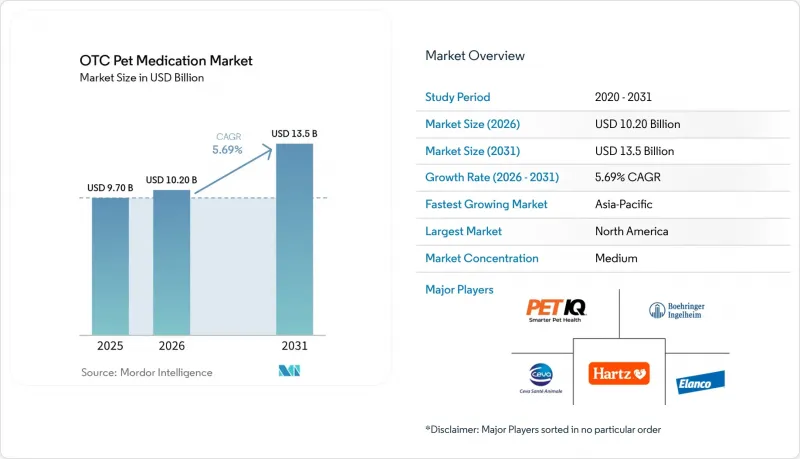
This report is Segmented by Product Type (Flea & Tick Control, Dewormers, Skin & Coat Treatments, Dental & Oral Care, and More), Animal Type (Dogs, Cats, Small Mammals, Birds, Others), Distribution Channel (Online, Pet Specialty, and More), Form (Topical, Oral, Collars, Shampoos, Sprays), and Geography (North America, South America, Europe, APAC, MEA). Market Forecasts are Provided in Value (USD).
Global OTC Pet Medication Market Trends and Insights
Climate-Driven Expansion of Tick and Flea Prevalence Elevates Year-Round Prevention Demand
Warmer winters and higher humidity have extended the active seasons of key vectors such as Ixodes and Amblyomma ticks, prompting veterinarians to recommend twelve-month prevention protocols even in regions that once paused treatment in winter . The geographic creep of the Asian longhorned tick into 21 U.S. states by 2025 underscores how climate forces are rewiring baseline demand. Long-duration injectables like Bravecto Quantum now offer 12-month coverage and remove monthly owner intervention. Continuous parasite pressure is therefore nudging the OTC pet medication market toward subscription models that lock in compliance and stabilize revenue flows.
E-Commerce and Subscription Autoship Normalize OTC Replenishment and Raise Adherence
Autoship's behavioral lock-in reduced lapse rates across Chewy's 21.3 million customers, with 83% enrolled as of fiscal 2025. Monthly dosing aligns naturally with subscription cadence, allowing online platforms to undercut brick-and-mortar pricing while still expanding total volume. Integrations with tele-veterinary services and price-comparison widgets further entrench these ecosystems, shifting channel power toward marketplaces that define reference pricing across the OTC pet medication market.
Heightened Safety Scrutiny of Flea/Tick Collars and Spot-Ons Dampens Some Categories
Seresto adverse-event reports and FDA alerts on isoxazoline class products have prompted risk-averse owners to abandon collars in favor of oral or injectable options . Sales data show collars sliding as much as 10% year on year within the OTC pet medication market, reinforcing the pivot to formats viewed as safer and easier to dose
Other drivers and restraints analyzed in the detailed report include:
- High Pet Ownership and Humanization Sustain Spend on Convenient OTC Care
- Product Innovation in Longer-Acting, Easier-to-Administer OTC Formats
- Counterfeit and Illegal Online OTC Sales Erode Trust and Require Channel Gating
For complete list of drivers and restraints, kindly check the Table Of Contents.
Segment Analysis
Nutraceuticals and supplements are advancing at a 7.63% CAGR and are expected to command an outsize slice of incremental OTC pet medication market size to 2031. Owners increasingly layer microbiome modulators, calming botanicals, and joint-health compounds onto routine parasite control, and brands that can cite peer-reviewed efficacy data are achieving premium price points. Although flea and tick control still generated 43.18% of 2025 revenue, growth is moderating as resistance to fipronil and imidacloprid emerges in field populations.
Manufacturers are broadening nutraceutical portfolios through science-backed ingredients such as postbiotic yeast fermentates, while food companies like Purina have crossed the aisle with probiotic-fortified kibbles that blur category lines. The diverse SKU mix cushions brands against regulatory shocks that periodically buffet chemical parasiticides, underscoring why nutraceuticals are central to long-run value creation in the OTC pet medication market.
Dogs continued to dominate revenue with a 58.15% slice of the OTC pet medication market share in 2025. However, cat-specific innovation, particularly in palatable oral flea-and-tick treatments, has unlocked a 7.43% CAGR through 2031. Credelio Cat's 99.5% owner-reported dosing success reflects how flavor-engineering can neutralize historical compliance barriers. Liquid solutions for feline hypertension and hyperthyroidism further illustrate the formulation shift toward precision dosing for smaller body weights. As the global cat population ages, demand for renal-support and mobility supplements is likely to accelerate, tightening the race for share capture inside the OTC pet medication market.
Geography Analysis
North America supplied 42.88% of 2025 value, benefiting from high per-pet spend and mature distribution infrastructure. North America's high baseline spend provides fertile ground for premium upsell, and injectables delivering year-long coverage are rapidly adopting subscription billing models, reinforcing customer stickiness. Counterfeit mitigation initiatives spearheaded by the FDA and major brands are also raising online trust levels, sustaining digital channel momentum inside the region's OTC pet medication market.
Asia-Pacific posts the sharpest trajectory at 7.55% CAGR through 2031. Asia-Pacific's double-digit expansion in pet populations is intersecting with cross-border e-commerce, allowing owners in Tier-2 cities to access international brands previously confined to capital hubs. Yet the diversity of regulatory classifications from prescription-only rules in South Korea to loosely policed online sales in parts of Southeast Asia requires agile compliance strategy and localized education to secure durable footholds.
Europe benefits from coordinated customs enforcement initiatives such as Operation SHIELD VI, which removed thousands of counterfeit listings and reinforced consumer confidence. The region's ongoing shift from collars to chewables is being shepherded by strict pharmacovigilance that favors companies with robust safety dossiers, effectively concentrating growth within the compliant subset of the OTC pet medication market.
- Beaphar
- Bob Martin
- Boehringer Ingelheim
- Central Garden & Pet
- Ceva Sante Animale
- Durvet
- Elanco
- Hartz Mountain
- HomeoPet
- Nutramax Laboratories
- Pet King Brands
- PetIQ
- Petlab Co.
- Tomlyn (Vetoquinol)
- TropiClean
- Vetoquinol
- VetriScience
- Virbac
- Wondercide
- Zesty Paws
Additional Benefits:
- The market estimate (ME) sheet in Excel format
- 3 months of analyst support
TABLE OF CONTENTS
1 Introduction
- 1.1 Study Assumptions & Market Definition
- 1.2 Scope of the Study
2 Research Methodology
3 Executive Summary
4 Market Landscape
- 4.1 Market Overview
- 4.2 Market Drivers
- 4.2.1 Climate-Driven Expansion of Tick and Flea Prevalence Elevates Year-Round Prevention Demand
- 4.2.2 E-Commerce and Subscription Auto-Ship Normalize OTC Replenishment and Raise Adherence
- 4.2.3 High Pet Ownership and Humanization Sustain Spend on Convenient OTC Care
- 4.2.4 Product Innovation in Longer-Acting, Easier-To-Administer OTC Formats
- 4.2.5 Regulatory Harmonization and Potential EPA-To-FDA Oversight Shift Improve Safety Confidence
- 4.2.6 Retail Private Label Scaling Widens Price-Access for OTC Parasiticides and Care
- 4.3 Market Restraints
- 4.3.1 Heightened Safety Scrutiny of Flea/Tick Collars and Spot-On Dampens Some Categories
- 4.3.2 Counterfeit and Illegal Online OTC Sales Erode Trust and Require Channel Gating
- 4.3.3 Localized Resistance to Legacy Actives Reduces Efficacy Perceptions
- 4.3.4 Price Sensitivity in Downturns Shifts Buyers to Generics and Delays Preventive Cycles
- 4.4 Supply-Chain Analysis
- 4.5 Regulatory Landscape
- 4.6 Technological Outlook
- 4.7 Porter's Five Forces Analysis
- 4.7.1 Threat of New Entrants
- 4.7.2 Bargaining Power of Suppliers
- 4.7.3 Bargaining Power of Buyers
- 4.7.4 Threat of Substitutes
- 4.7.5 Competitive Rivalry
5 Market Size & Growth Forecasts (Value, USD)
- 5.1 By Product Type
- 5.1.1 Flea & Tick Control
- 5.1.2 Dewormers and Anthelmintics
- 5.1.3 Skin & Coat Treatments
- 5.1.4 Dental & Oral Care OTC
- 5.1.5 Calming & Behavioral OTC
- 5.1.6 Nutraceuticals & Supplements
- 5.2 By Animal Type
- 5.2.1 Dogs
- 5.2.2 Cats
- 5.2.3 Small Companion Mammals (rabbits, ferrets)
- 5.2.4 Birds
- 5.2.5 Others (Fish and Reptiles, among others)
- 5.3 By Distribution Channel
- 5.3.1 Online Retailers & Marketplaces
- 5.3.2 Pet Specialty Stores
- 5.3.3 Mass Merchandisers, Grocery & Club
- 5.3.4 Veterinary Clinics
- 5.3.5 Drug & Pharmacy Stores
- 5.4 By Form
- 5.4.1 Topical (spot-ons, sprays)
- 5.4.2 Oral (chews, tablets)
- 5.4.3 Collars
- 5.4.4 Shampoos & Dips
- 5.4.5 Sprays & Powders
- 5.5 By Geography
- 5.5.1 North America
- 5.5.1.1 United States
- 5.5.1.2 Canada
- 5.5.1.3 Mexico
- 5.5.2 Europe
- 5.5.2.1 Germany
- 5.5.2.2 United Kingdom
- 5.5.2.3 France
- 5.5.2.4 Italy
- 5.5.2.5 Spain
- 5.5.2.6 Rest of Europe
- 5.5.3 Asia-Pacific
- 5.5.3.1 China
- 5.5.3.2 India
- 5.5.3.3 Japan
- 5.5.3.4 South Korea
- 5.5.3.5 Australia
- 5.5.3.6 Rest of Asia-Pacific
- 5.5.4 Middle East and Africa
- 5.5.4.1 GCC
- 5.5.4.2 South Africa
- 5.5.4.3 Rest of Middle East and Africa
- 5.5.5 South America
- 5.5.5.1 Brazil
- 5.5.5.2 Argentina
- 5.5.5.3 Rest of South America
- 5.5.1 North America
6 Competitive Landscape
- 6.1 Market Concentration
- 6.2 Market Share Analysis
- 6.3 Company Profiles (includes Global level Overview, Market Level Overview, Core Segments, Financials as Available, Strategic Information, Market Rank/Share for Key Companies, Products & Services, and Recent Developments)
- 6.3.1 Beaphar
- 6.3.2 Bob Martin
- 6.3.3 Boehringer Ingelheim Animal Health
- 6.3.4 Central Garden & Pet
- 6.3.5 Ceva Sante Animale
- 6.3.6 Durvet
- 6.3.7 Elanco Animal Health
- 6.3.8 Hartz Mountain
- 6.3.9 HomeoPet
- 6.3.10 Nutramax Laboratories
- 6.3.11 Pet King Brands
- 6.3.12 PetIQ
- 6.3.13 Petlab Co.
- 6.3.14 Tomlyn (Vetoquinol)
- 6.3.15 TropiClean
- 6.3.16 Vetoquinol
- 6.3.17 VetriScience
- 6.3.18 Virbac
- 6.3.19 Wondercide
- 6.3.20 Zesty Paws
7 Market Opportunities & Future Outlook
- 7.1 White-space & unmet-need assessment

