PUBLISHER: Mordor Intelligence | PRODUCT CODE: 2063664

PUBLISHER: Mordor Intelligence | PRODUCT CODE: 2063664
AI Code Generation And Developer Assistant - Market Share Analysis, Industry Trends & Statistics, Growth Forecasts (2026 - 2031)
According to Mordor Intelligence, the aI code generation market size is expected to grow from USD 11.8 billion in 2025 to USD 16.13 billion in 2026 and is forecast to reach USD 78.97 billion by 2031 at 37.39% CAGR over 2026-2031.
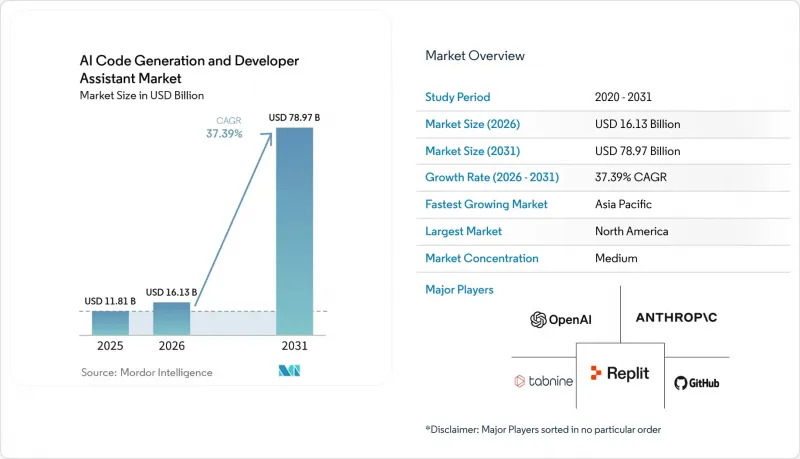
This report is Segmented by Deployment Mode (Cloud, On-Premise, and Hybrid), Function (Code Generation and Autocompletion, and More), End-User Industry (Individual Developers and Freelancers, and More), Application (Software Development, Devops and CI/CD, Data Science and Analytics, and More), and Geography. The Market Forecasts are Provided in Terms of Value (USD).
Global AI Code Generation And Developer Assistant Market Trends and Insights
Accelerating Enterprise Adoption Of AI-Assisted Development Tools
Enterprise procurement surged in 2025 and 2026 as businesses sought faster release cycles to counter limited headcount. Microsoft disclosed 15 million Microsoft 365 Copilot seats and 4.7 million GitHub Copilot paid subscribers by the second quarter of 2026, demonstrating board-level endorsement of automated coding platforms. Replit reported that 85% of Fortune 500 firms now use its workspace, proving that adoption has moved beyond pilot programs. Companies that embed assistants into day-to-day workflows record 55% faster code completion on average, but legal and compliance reviews are lengthening procurement cycles. Vendors responding with explicit IP indemnities and usage analytics are gaining favor, especially in regulated sectors. The net effect is a short-term surge in revenue concentration among players offering enterprise-grade governance features.
Rapid Advances In Large Language Models Enabling Context-Aware Code Generation
The release of GPT-5.4 in early 2026 lifted reasoning accuracy and expanded context windows, allowing assistants to span entire repositories in a single prompt. GitHub integrated the upgrade within hours, which immediately translated into higher solution rates for multi-file edits and automatic test generation. Anthropic's Claude 3.5 Sonnet, already woven into Replit's Agent, triggered a tenfold revenue jump for the platform in the months after launch. Frontier-model vendors are pivoting from pure inference services toward differentiated reasoning APIs, opening a premium tier that cost-sensitive firms may find prohibitive. Smaller open-source models lag, leaving the market divided between elite paid offerings and value-oriented alternatives.
Intellectual-Property And Licensing Uncertainty Around AI-Generated Code
The class-action suit alleging Copilot training infringed copyrighted repositories remains unresolved, producing board-level hesitancy in sectors with strict IP stewardship. Tabnine counters by training solely on permissive licenses and offering broad indemnity clauses. Legal clarity is unlikely before 2027, so many companies insist on human review of every AI contribution and audit trails linking code snippets to prompts. Vendors with transparent dataset provenance and contractual indemnity are capturing finance and healthcare accounts, while opaque models face elongated sales cycles.
Other drivers and restraints analyzed in the detailed report include:
- Growing Shortage Of Skilled Software Developers Worldwide
- Integration Of AI Assistants Into Popular IDEs And DevOps Pipelines
- Data-Privacy And Security Concerns In Regulated Industries
For complete list of drivers and restraints, kindly check the Table Of Contents.
Segment Analysis
The cloud slice accounted for 63.71% of the 2025 value, reflecting the ease with which frontier models can be integrated into existing pipelines. This integration has become a cornerstone of the AI code-generation market-share narrative, as businesses increasingly prioritize the seamless adoption of advanced technologies. Hybrid configurations are advancing at a 37.99% CAGR, driven by enterprises seeking to balance data sovereignty with the benefits of continuous model upgrades. This trend is adding a significant wedge to the AI code generation market size calculation, as organizations aim to optimize their operational frameworks.
Cloud-first vendors are gaining traction by offering weekly model refreshes, pay-per-token billing, and instantaneous onboarding, making them the preferred choice for green-field projects. However, industries such as financial services, defense, and healthcare are increasingly opting for solutions like Tabnine or Rosetic, which provide single-tenant or air-gapped installations. These options are particularly appealing due to their compliance with stringent regulations such as GDPR and HIPAA. Multi-vendor strategies are also emerging, where low-risk internal tools remain in the cloud, while production code for critical workloads is compiled on-premises. Providers capable of unifying telemetry, policy, and billing across both cloud and on-premises environments are well positioned to gain market share in the broader AI code generation market by effectively addressing their clients' diverse needs.
Code generation and autocompletion accounted for 46.33% of 2025 spending, establishing themselves as the foundational components of the AI code generation market size for functional segments. These features remain critical for developers, offering significant efficiency gains and reducing manual coding efforts. However, agentic orchestration, while representing a smaller share of the market, is growing at an impressive 38.59% CAGR. This growth trajectory highlights its potential to redefine how teams derive value from AI-driven coding tools. Traditional functionalities, such as debugging, test generation, and documentation, are increasingly integrated into broader platforms rather than being offered as stand-alone solutions. This shift is diminishing the competitive edge of single-function tools, pushing vendors to innovate and expand their offerings to remain relevant in the evolving market landscape.
Advanced tools like Reflection AI and GitHub's coding agents are transforming workflows by automating processes across the entire development lifecycle, from planning and coding to testing and pull-request stages. These capabilities enable enterprises to achieve significant headcount savings, which were previously considered unattainable. Organizations are now prioritizing platforms that combine orchestration capabilities with robust governance features, ensuring compliance and operational efficiency. This trend is creating pressure on single-function vendors to diversify their capabilities or risk being commoditized. As a result, the AI code generation industry is increasingly consolidating around comprehensive suites that integrate basic code-completion capabilities with advanced autonomous workflows, catering to the growing demand for end-to-end solutions.
Geography Analysis
North America accounted for 39.37% of projected demand in 2025, establishing itself as the commercial anchor of the AI code-generation market. The region benefits from several structural advantages, including a high density of venture capital investments, the presence of hyperscalers, and an enterprise culture that prioritizes innovation. In the United States, federal programs actively promote AI adoption across both defense and civilian agencies, driving significant growth. Meanwhile, Canada and Mexico are experiencing a more gradual uptake of AI code generation technologies, primarily due to smaller talent pools and limited resources compared to the United States.
Asia-Pacific is emerging as the fastest-growing region, with a remarkable compound annual growth rate (CAGR) of 37.94%. This growth is fueled by India's extensive developer workforce, which numbers approximately 5 million, and China's robust sovereign AI programs. Companies like DeepSeek are introducing cost-efficient AI models that align with Chinese data-localization policies, ensuring compliance with local regulations. In India, major outsourcing firms are integrating AI-powered coding assistants to significantly reduce turnaround times for their Western clients, enhancing operational efficiency. Additionally, Japan and South Korea, both facing challenges related to shrinking workforces, are increasingly adopting AI coding tools as a means to boost productivity and address labor shortages.
Europe demonstrates a balance between moderate growth and regulatory leadership in the AI code generation market. The General Data Protection Regulation (GDPR) and the forthcoming EU AI Act are setting global benchmarks for compliance, creating opportunities for vendors that achieve early certification. These regulations not only shape the market but also encourage innovation among compliant vendors. In the Middle East and Africa, the market is still nascent but is showing signs of growth as governments invest in initiatives such as digital skills academies to build a future-ready workforce. Collectively, these regional dynamics contribute to a multi-polar growth trajectory, diversifying revenue streams and creating opportunities for vendors operating in the AI code generation market.
- OpenAI L.L.C.
- Anthropic P.B.C.
- GitHub, Inc.
- GitLab Inc.
- Replit, Inc.
- JetBrains s.r.o.
- Tabnine Ltd.
- Sourcegraph, Inc.
- Codeium AI, Inc.
- CodiumAI Ltd.
- Cursor AI, Inc.
- DeepCode AG
- Hugging Face, Inc.
- Mistral AI SAS
- DeepSeek AI Technology Co., Ltd.
- Blackbox AI, Inc.
- CodeRabbit Inc.
- Cogram GmbH
- Sourcegraph, Inc.
- TabbyML, Inc.
Additional Benefits:
- The market estimate (ME) sheet in Excel format
- 3 months of analyst support
TABLE OF CONTENTS
1 INTRODUCTION
- 1.1 Study Assumptions and Market Definition
- 1.2 Scope of the Study
2 RESEARCH METHODOLOGY
3 EXECUTIVE SUMMARY
4 MARKET LANDSCAPE
- 4.1 Market Overview
- 4.2 Market Drivers
- 4.2.1 Accelerating Enterprise Adoption of AI-Assisted Development Tools
- 4.2.2 Rapid Advances in Large Language Models Enabling Context-Aware Code Generation
- 4.2.3 Growing Shortage of Skilled Software Developers Worldwide
- 4.2.4 Integration of AI Assistants into Popular IDEs and DevOps Pipelines
- 4.2.5 Emergence of Agentic Workflows Automating Multi-Step Coding Tasks
- 4.2.6 On-Device/Edge Code-Gen Models Reducing Data-Sovereignty Barriers
- 4.3 Market Restraints
- 4.3.1 Intellectual-Property and Licensing Uncertainty Around AI-Generated Code
- 4.3.2 Data-Privacy and Security Concerns in Regulated Industries
- 4.3.3 Integration Complexity with Legacy Build Systems and Toolchains
- 4.3.4 Model Hallucination Leading to Hidden Security Vulnerabilities
- 4.4 Impact of Macroeconomic Factors on the Market
- 4.5 Industry Value Chain Analysis
- 4.6 Regulatory Landscape
- 4.7 Technological Outlook
- 4.8 Porter's Five Forces Analysis
- 4.8.1 Bargaining Power of Suppliers
- 4.8.2 Bargaining Power of Buyers
- 4.8.3 Threat of New Entrants
- 4.8.4 Threat of Substitutes
- 4.8.5 Intensity of Competitive Rivalry
5 MARKET SIZE AND GROWTH FORECASTS (VALUE)
- 5.1 By Deployment Mode
- 5.1.1 Cloud
- 5.1.2 On-Premise
- 5.1.3 Hybrid
- 5.2 By Function
- 5.2.1 Code Generation and Autocompletion
- 5.2.2 Debugging and Error Detection
- 5.2.3 Code Review and Optimization
- 5.2.4 Test Generation
- 5.2.5 Documentation Generation
- 5.2.6 Agentic Workflow Orchestration
- 5.3 By End-User Industry
- 5.3.1 Individual Developers and Freelancers
- 5.3.2 Start-ups and SMEs
- 5.3.3 Large Enterprises
- 5.3.4 Educational Institutions
- 5.3.5 Government and Non-Profit Organizations
- 5.4 By Application
- 5.4.1 Software Development
- 5.4.2 DevOps and CI/CD
- 5.4.3 Data Science and Analytics
- 5.4.4 Embedded and IoT Development
- 5.4.5 Low-Code / No-Code Development
- 5.5 By Geography
- 5.5.1 North America
- 5.5.1.1 United States
- 5.5.1.2 Canada
- 5.5.1.3 Mexico
- 5.5.2 South America
- 5.5.2.1 Brazil
- 5.5.2.2 Argentina
- 5.5.2.3 Rest of South America
- 5.5.3 Europe
- 5.5.3.1 United Kingdom
- 5.5.3.2 Germany
- 5.5.3.3 France
- 5.5.3.4 Italy
- 5.5.3.5 Spain
- 5.5.3.6 Rest of Europe
- 5.5.4 Asia-Pacific
- 5.5.4.1 China
- 5.5.4.2 Japan
- 5.5.4.3 India
- 5.5.4.4 South Korea
- 5.5.4.5 Rest of Asia-Pacific
- 5.5.5 Middle East and Africa
- 5.5.5.1 Middle East
- 5.5.5.1.1 United Arab Emirates
- 5.5.5.1.2 Saudi Arabia
- 5.5.5.1.3 Rest of Middle East
- 5.5.5.2 Africa
- 5.5.5.2.1 South Africa
- 5.5.5.2.2 Egypt
- 5.5.5.2.3 Rest of Africa
- 5.5.5.1 Middle East
- 5.5.1 North America
6 COMPETITIVE LANDSCAPE
- 6.1 Market Concentration
- 6.2 Strategic Moves
- 6.3 Market Share Analysis
- 6.4 Company Profiles (includes Global Level Overview, Market Level Overview, Core Segments, Financials as available, Strategic Information, Market Rank/Share, Products and Services, Recent Developments)
- 6.4.1 OpenAI L.L.C.
- 6.4.2 Anthropic P.B.C.
- 6.4.3 GitHub, Inc.
- 6.4.4 GitLab Inc.
- 6.4.5 Replit, Inc.
- 6.4.6 JetBrains s.r.o.
- 6.4.7 Tabnine Ltd.
- 6.4.8 Sourcegraph, Inc.
- 6.4.9 Codeium AI, Inc.
- 6.4.10 CodiumAI Ltd.
- 6.4.11 Cursor AI, Inc.
- 6.4.12 DeepCode AG
- 6.4.13 Hugging Face, Inc.
- 6.4.14 Mistral AI SAS
- 6.4.15 DeepSeek AI Technology Co., Ltd.
- 6.4.16 Blackbox AI, Inc.
- 6.4.17 CodeRabbit Inc.
- 6.4.18 Cogram GmbH
- 6.4.19 Sourcegraph, Inc.
- 6.4.20 TabbyML, Inc.
7 MARKET OPPORTUNITIES AND FUTURE OUTLOOK
- 7.1 White-Space and Unmet-Need Assessment

